

Mass–energy equivalence is one of the most transformative concepts in modern physics: mass and energy are not separate, independent quantities, but are interconvertible different forms of the same physical quantity, governed by Albert Einstein's equation E = mc². At nuclear and subatomic scales, tiny changes in mass yield massive quantities of energy, explaining how nuclear transformations release power and how high-energy accelerators produce new matter from kinetic energy. In 1932, John Cockcroft and Irish physicist Ernest Walton verified this relationship experimentally by splitting lithium nuclei with artificially accelerated protons. The same principle is what allows high-energy collisions to create brand-new particles, and it was experiments like these that built up the Standard Model — the current model that sorts all matter into fundamental fermions (quarks and leptons) and explains forces as the exchange of bosons.
Einstein's Principle of Mass–Energy Equivalence
In classical Newtonian mechanics, mass and energy were considered completely separate, independently conserved physical quantities. In 1905, Albert Einstein published his Special Theory of Relativity, demonstrating that mass and energy are not separate, independent quantities, but are interconvertible different forms of the same physical quantity, governed by .
When a change in mass occurs, the corresponding change in energy is given by:
Where:
- is the energy change in joules (J)
- is the change in rest mass in kilograms (kg)
- is the speed of light in a vacuum ()
Because , a minute mass loss releases a colossal amount of energy. If () of matter were converted entirely into energy:
Checking units and order of magnitude: , so the units are correct. A nuclear reaction releasing something of order per event (tens of MeV) is the expected order of magnitude; a chemical reaction releases only a few eV per molecule, roughly a million times less.
Even in everyday chemical reactions, such as burning petrol, energy release corresponds to an infinitesimal loss of mass. When of petrol burn, roughly of chemical potential energy is released, accompanied by a mass decrease of:
Such small mass losses are undetectable on laboratory balances. In nuclear reactions, however, the energy changes per particle are millions of times greater, resulting in mass changes that can be measured directly.
Units in Nuclear Physics
Because particle masses in kilograms are unwieldy, physicists use the unified atomic mass unit (), defined as one-twelfth the mass of an unbound carbon-12 atom at rest:
Using the more precise :
Converting to electronvolts ():
(Rounding to gives about , which is why the standard conversion factor is quoted using the precise speed of light.) So a mass of is equivalent to an energy of . Written as a mass, this is — which is the form used in the tables.
The Quick Route to MeV
If masses are given in and the answer is required in , you do not need to convert to kilograms at all:
Use the kilogram route only when the question explicitly gives masses in kg, asks for the mass lost in kg, or asks for the energy in joules.
Balancing Equations, Mass Defect, and Binding Energy
Balancing a Nuclear Equation
Every nuclide is written as , where is the mass number (total number of protons and neutrons) and is the atomic number (number of protons, which gives the nuclear charge in units of ). In any nuclear reaction:
- the sum of the mass numbers (, the top numbers) is the same on both sides;
- the sum of the atomic numbers (, the bottom numbers) is the same on both sides.
Useful particle symbols:
- Proton: or
- Neutron:
- Alpha particle:
- Beta-minus electron:
- Positron:
- Gamma photon:
Finding an unknown number of particles: A uranium-235 nucleus absorbs a neutron and splits into barium-139, krypton-94, and neutrons:
Mass numbers: . Atomic numbers: . Everything balances, showing that three neutrons are released.
Mass Defect and Binding Energy
Two different quantities are found by subtracting masses — keep them distinct:
- Mass defect of a nucleus: the difference between the total mass of the separate, individual protons and neutrons and the actual measured mass of the complete nucleus. A nucleus always has less mass than its separated parts.
- Binding energy: the energy equivalent of the mass defect, . It is the energy required to completely separate an atomic nucleus into its constituent nucleons (and equally, the energy released when nucleons assemble into a nucleus).
- Loss in mass in a reaction: (total rest mass of reactants) − (total rest mass of products). This represents the mass converted into released energy during fission, fusion, or nuclear transmutations.
Calculation — Binding energy of helium-4: Mass of 2 separate protons Mass of 2 separate neutrons Total mass of separated nucleons Actual mass of helium-4 nucleus Mass defect Binding energy
The Cockcroft and Walton Experiment (1932)
In 1932, at the Cavendish Laboratory in Cambridge, English physicist John Cockcroft and Irish physicist Ernest Walton (born in Dungarvan, Co. Waterford, and later Professor of Natural and Experimental Philosophy at Trinity College Dublin) carried out an experiment that verified Einstein's equation. This is an experiment students analyse rather than carry out in school practicals, so examination marks centre on what was done, what was measured, and why it mattered.
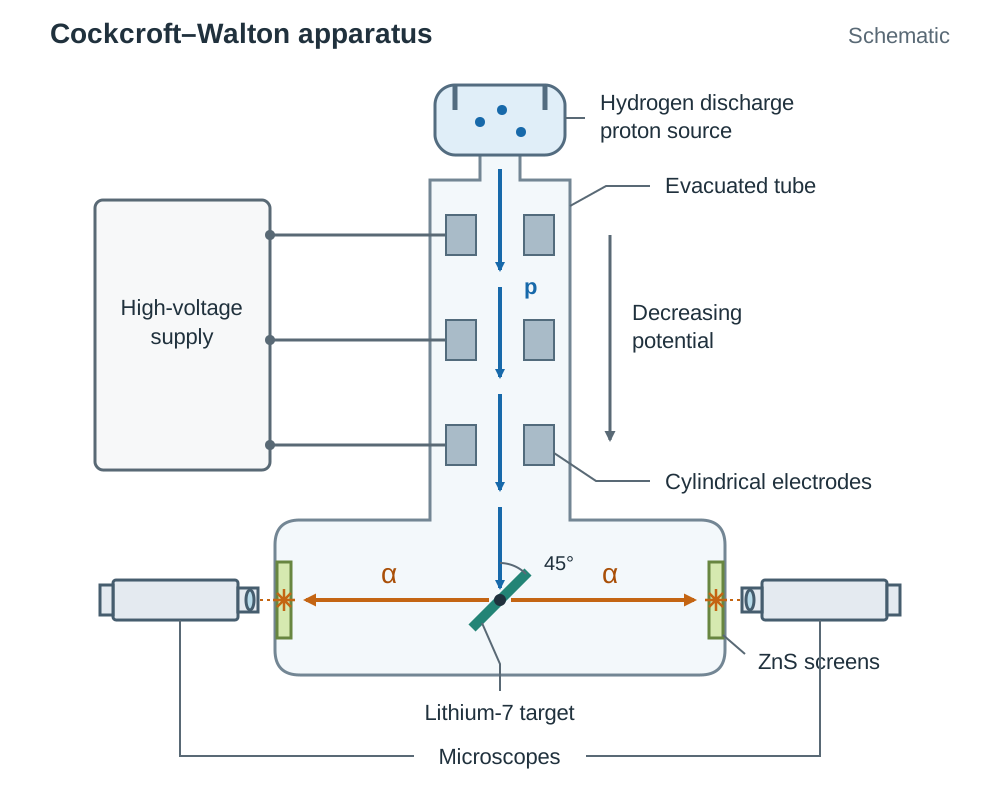
Why the Protons Had to be Accelerated
Both the proton and the lithium nucleus are positively charged, so they repel each other electrostatically. A slow proton is turned away by Coulomb repulsion before it gets close enough for the short-range strong nuclear force to act. Accelerating the proton through a large potential difference gives it kinetic energy , enough to overcome this repulsion and penetrate the nucleus.
Apparatus and the Job of Each Part
- Proton source (hydrogen discharge tube): Located at the top of the tube, where low-pressure hydrogen gas is ionised to supply protons.
- Evacuated accelerating tube: A tall glass column maintained under a high vacuum to prevent accelerated protons from colliding with or scattering off air molecules.
- High-voltage supply (voltage multiplier): Connected across internal cylindrical electrodes to accelerate protons downwards through hundreds of kilovolts ().
- Lithium target: A sample of lithium-7 metal set at an angle of directly in the path of the proton beam.
- Scintillation screens and microscopes: Zinc sulfide (ZnS) screens placed on opposite sides of the target chamber, viewed through low-power microscopes to detect alpha particles as tiny flashes of light (scintillations).
Reaction and Measurements
Cockcroft and Walton accelerated protons through a potential difference of a few hundred kilovolts; scintillations were first detected at about . In an exam question the accelerating voltage is always given to you — use the value in the question, not a remembered one, in .
For a voltage of , incoming kinetic energy is:
The two alpha particles together carried about of kinetic energy — roughly each. This was over 100 times greater than the energy supplied by the accelerator. When the loss in mass was calculated:
The kinetic energy of the products matched the mass lost, confirming that mass had converted directly into kinetic energy.
How the Released Energy is Shared
The two alpha particles have equal mass and fly off in opposite directions to conserve momentum (the incoming proton's momentum is negligibly small compared to that of the high-speed fragments). Equal masses with equal and opposite momenta must have equal kinetic energies. Each alpha particle therefore takes half the total kinetic energy (), giving each a speed of .
Historical Significance
Two distinct achievements are examined at Leaving Certificate level:
- It was the first artificial transmutation of a nucleus using artificially accelerated particles.
- It was the first experimental verification of .
Nuclear transmutation is the changing of one element into another by altering the number of protons in its nucleus. Rutherford had achieved transmutation in 1919 using natural alpha particles from radioactive decay; what was new in 1932 was using a machine to accelerate particles with controllable, measurable energy. For this work, Cockcroft and Walton were jointly awarded the 1951 Nobel Prize in Physics.
Accelerating Particles and Creating Matter
Mass–energy equivalence operates symmetrically: just as rest mass can be converted into kinetic energy, kinetic energy can be converted into rest mass ().
A charged particle accelerated across a potential difference gains kinetic energy:
At low speeds (), this kinetic energy is written as . Once a particle's speed approaches , however, no longer gives the kinetic energy. At collider energies, physicists work directly in energy units (such as ) rather than calculating non-relativistic speeds.
In modern colliders like the Large Hadron Collider (LHC) at CERN, electric fields accelerate protons to relativistic speeds, while powerful magnetic fields steer and focus them into head-on collisions. When two relativistic protons collide, their kinetic energy becomes available to create brand-new particles that did not exist beforehand:
Here, a neutral pion () is formed entirely from colliding kinetic energy.
In fixed-target accelerators, conservation of momentum requires that much of the projectile's kinetic energy remains as kinetic energy of the forward-moving debris. By colliding two identical beams head-on with equal and opposite momenta, the net momentum before collision is zero. This allows the maximum possible kinetic energy to be converted into the rest masses of new, heavy particles.
The Standard Model: Fundamental Fermions and Antimatter
The Standard Model sorts all fundamental matter into fermions (matter particles) and force-carrying gauge bosons.
Fermions: Quarks and Leptons
Fundamental matter particles are divided into two distinct classes:
- Quarks: Six flavours arranged in three generations. Quarks carry fractional electric charge and experience the strong nuclear force. They are never found in isolation; they bind together to form composite particles called hadrons:
- Baryons: Composed of three quarks (). A proton is (charge: ). A neutron is (charge: ).
- Mesons: Composed of one quark and one antiquark (), such as pions.
| Generation 1 | Generation 2 | Generation 3 | Electric Charge |
|---|---|---|---|
| Up () | Charm () | Top () | |
| Down () | Strange () | Bottom () |
- Leptons: Fundamental particles that do not experience the strong nuclear force:
| Charged Lepton | Charge | Associated Neutral Lepton (Neutrino) | Charge |
|---|---|---|---|
| Electron () | Electron neutrino () | ||
| Muon () | Muon neutrino () | ||
| Tau () | Tau neutrino () |
Antimatter, Pair Annihilation, and Pair Production
Every fundamental particle has an antiparticle with identical rest mass, but opposite electric charge:
- The antiparticle of the electron is the positron ( or ).
- An antiproton () has quark composition (charge ).
- An antineutron () has quark composition (charge , but made of antiquarks).
When a particle meets its antiparticle, pair annihilation occurs. Their entire combined rest mass is converted into high-energy gamma-ray photons:
Two photons are emitted in opposite directions to conserve linear momentum. In Positron Emission Tomography (PET scanners), a patient receives a positron-emitting radiotracer. Because the two gamma photons leave in opposite directions, detectors arranged in a ring can work back along the line joining two simultaneous detections to locate where the annihilation happened.
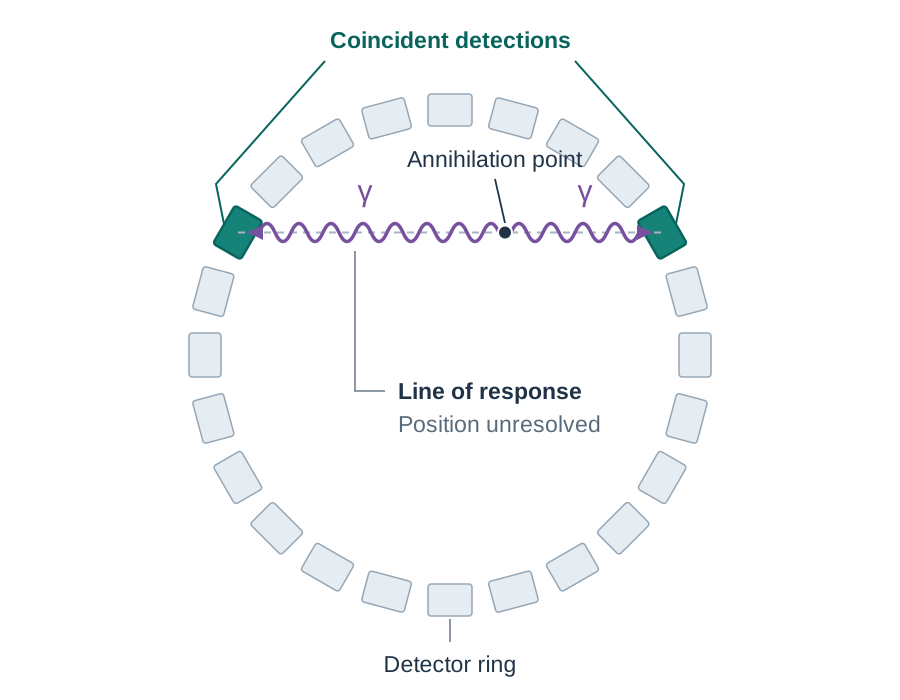
Annihilation can run in reverse: in pair production, a single high-energy photon passing near an atomic nucleus vanishes to create a particle–antiparticle pair. Energy must be conserved, so the photon needs at least enough energy to supply both rest masses:
Any extra photon energy above appears as kinetic energy of the electron and positron.
Is a Particle Reaction Allowed?
In every particle interaction, charge, energy, and momentum are conserved. Charge is straightforward to verify on paper:
- : Left is ; right is . Charge is conserved.
- Beta decay (): Left is ; right is . Charge is conserved.
Fundamental Interactions and Force Carriers
In modern physics, forces are not treated as action-at-a-distance. Instead, interactions are mediated by the exchange of force-carrier particles called gauge bosons.
Exchanging a particle explains attraction, not just repulsion: in both cases the exchanged boson carries momentum from one particle to the other. The 'throwing a ball' picture is only a rough analogy.
| Fundamental Interaction | Relative Strength | Range | Mediating Boson | Particles Affected |
|---|---|---|---|---|
| Strong Nuclear | Short () | Gluon () | Quarks and hadrons | |
| Electromagnetic | Infinite | Photon () | Charged particles | |
| Weak Nuclear | Extremely short () | , , | Quarks and leptons | |
| Gravitational | Infinite | Graviton (hypothesised, unobserved) | All mass-energy |
In beta-minus decay, a down quark transforms into an up quark by emitting a virtual boson, which rapidly decays into an electron and an electron antineutrino ().
Evolving Models and Limitations (Nature of Science)
The Standard Model has produced remarkably precise predictions, including the discovery of the and bosons (1983), the top quark (1995), and the Higgs boson (2012). However, it remains an evolving and incomplete model:
- It does not incorporate gravity, and the graviton has never been detected.
- It does not account for dark matter or dark energy.
- It does not explain why there is far more matter than antimatter in the universe.
Key terms
- Mass–energy equivalence
- The principle established by Albert Einstein stating that mass and energy are interconvertible forms of the same physical quantity, related by E = mc².
- Loss in mass (mass defect) in a reaction
- The difference between the total rest mass of the reactants and the total rest mass of the products in a nuclear reaction (Δm = m_reactants - m_products).
- Mass defect
- The difference between the total mass of the separate nucleons and the actual mass of the assembled nucleus.
- Binding energy
- The energy equivalent of the mass defect (E_b = Δmc²), representing the energy needed to separate a nucleus into its constituent individual nucleons.
- Unified atomic mass unit (u)
- A unit of mass defined as one-twelfth the mass of an unbound carbon-12 atom at rest, equal to 1.66054 × 10⁻²⁷ kg.
- Nuclear transmutation
- The conversion of one chemical element into another by altering the number of protons in the atomic nucleus.
- Cockcroft and Walton experiment
- The 1932 experiment that achieved the first artificial nuclear transmutation using artificially accelerated protons to split lithium-7, providing the first experimental verification of E = mc².
- Scintillation
- A tiny flash of visible light produced on a fluorescent screen (such as zinc sulfide) when struck by an ionising particle such as an alpha particle.
- Fermion
- A fundamental matter particle, classified into quarks and leptons.
- Quark
- A fundamental fermion that experiences the strong nuclear force and carries fractional electric charge (+⅔e or -⅓e).
- Lepton
- A fundamental fermion that does not experience the strong nuclear force, such as the electron, muon, tau, and their neutrinos.
- Hadron
- A composite subatomic particle made of quarks held together by the strong force, subdivided into baryons (three quarks) and mesons (one quark and one antiquark).
- Baryon
- A hadron composed of three quarks, such as a proton (uud) or neutron (udd).
- Meson
- A hadron composed of one quark and one antiquark, such as a pion.
- Antiparticle
- A particle having the same rest mass as its corresponding matter particle, but opposite electric charge.
- Pair annihilation
- The process where a particle and its corresponding antiparticle collide and convert their total combined rest mass into photons.
- Pair production
- The creation of an elementary particle and its antiparticle from a single photon of sufficient energy passing near an atomic nucleus.
- Gauge boson
- A force-carrying particle that mediates one of the fundamental interactions of nature.
Check yourself
What two historical achievements are associated with Cockcroft and Walton's 1932 experiment?
It was the first artificial transmutation of a nucleus using artificially accelerated particles, and the first experimental verification of Einstein's mass–energy equivalence equation (E = mc²).
Complete and balance the nuclear equation: ¹⁴₇N + ⁴₂He → ¹⁷₈O + ?
¹₁H (a proton). Top: 14 + 4 = 18 = 17 + 1. Bottom: 7 + 2 = 9 = 8 + 1.
A reaction has a loss in mass of 0.0032 u. Calculate the energy released in MeV.
E = 0.0032 u × 931.5 MeV u⁻¹ = 2.98 MeV.
Why was the accelerating tube in Cockcroft and Walton's apparatus evacuated?
To prevent the accelerated protons from colliding with or being scattered by air molecules before striking the lithium target.
State the quark composition of a proton and a neutron, and show how the charges sum to the net charge of each.
A proton is uud: +⅔e + ⅔e - ⅓e = +1e. A neutron is udd: +⅔e - ⅓e - ⅓e = 0.
Which of the four fundamental interactions is not included in the Standard Model?
Gravity is not included in the Standard Model, and its hypothesised exchange particle (the graviton) has never been observed.