

The electron is the fundamental carrier of negative charge in matter. This topic covers the experimental evidence establishing the electron as an indivisible packet of charge, how electrons are released from metals by thermionic emission, and how their paths are controlled by uniform electric and magnetic fields. At Higher Level, you must be able to analyse secondary data from experiments, predict beam deflection qualitatively and quantitatively, and apply conservation of energy to determine electron speeds.
The Electron and Quantisation of Charge
Electric charge is not a continuous fluid. It exists in discrete quantities that are whole-number multiples of an indivisible elementary charge:
Every electron carries a charge and has a rest mass (about the mass of a proton). Because electric charge is subject to charge quantisation, any observable charge on an object obeys:
where is an integer (). An object can neither gain nor lose half an electron. If an insulated body gains electrons, its net charge is . If it loses electrons, its charge is .
In 1909, Robert Millikan demonstrated this quantisation directly in his oil drop experiment. By balancing the downward gravitational weight of microscopic charged oil droplets against an upward electrostatic force (), he found that the charge on every droplet was always a whole-number multiple of .
Evidence for the Nature of Cathode Rays
When a potential difference of several kilovolts was applied across electrodes in an evacuated glass tube, something streamed from the negative electrode (the cathode) across to the positive electrode (the anode). Whatever it was, it made the glass at the far end glow, and it was given the name cathode rays.
In an 'analyse the evidence' question, each mark comes from pairing one observation with the one thing it proves. Never offer an observation on its own.
| Experimental Observation | Physical Deduction Supported |
|---|---|
| A metal obstacle (such as a Maltese cross) in the beam path casts a sharp shadow on a fluorescent screen. | Cathode rays travel in straight lines perpendicular to the cathode surface when no external field acts. |
| A light paddle wheel on low-friction rails rolls towards the anode when struck by the rays. | The rays possess momentum and kinetic energy, showing they consist of particles rather than massless electromagnetic waves. |
| The beam deflects towards a positively charged plate and away from a negatively charged plate. | The particles carry negative electric charge. |
| The beam curves into a circular arc when passing across a magnetic field. | The rays consist of moving electric charges (magnetic fields exert forces on moving charges, not on light). |
| An insulated metal target struck by the beam accumulates negative charge and gets hot. | The beam deposits negative charge and converts its kinetic energy into internal energy upon absorption. |
| Identical deflection and specific charge are measured regardless of the cathode metal or residual gas. | Electrons are universal, fundamental subatomic constituents present in all chemical elements. |
In 1897, J.J. Thomson measured the charge-to-mass ratio of cathode rays and obtained a value of the order of (the accepted modern value is ). Assuming the charge was of the same order as that on a hydrogen ion, this meant the particles were over a thousand times lighter than the lightest atom, proving that atoms are divisible and contain electrons.
Thermionic Emission and Experimental Diagrams
Thermionic emission is the emission of electrons from the surface of a heated metal.
Inside a metal, free conduction electrons move between positive ion cores. At room temperature, they lack the energy needed to escape the attractive electrostatic forces pulling them towards the lattice. Heating the metal transfers thermal energy to these electrons. When an electron receives enough energy to overcome the surface barrier, it escapes. The minimum energy required for an electron to escape from the metal surface is called the work function of the metal.
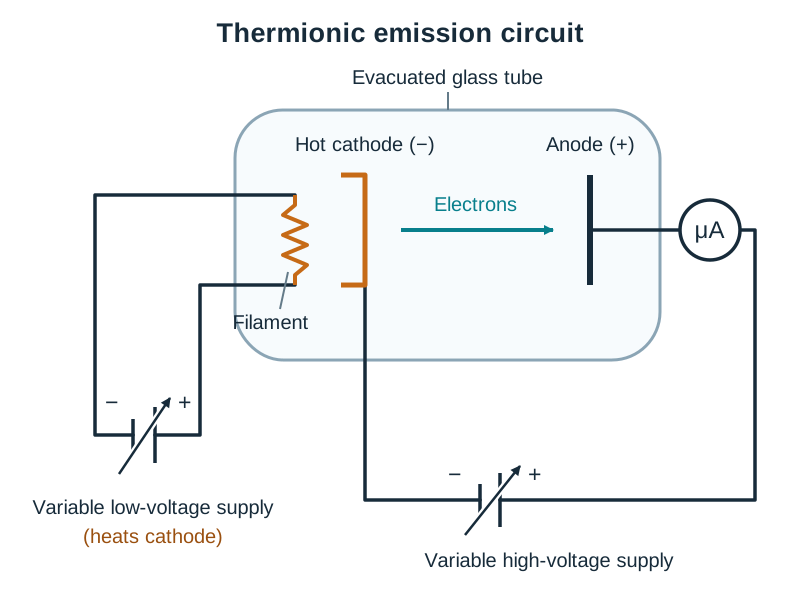
Diagram 1: Thermionic Emission Circuit (Draw and Label)
To draw the circuit used to verify thermionic emission, sketch an evacuated glass tube with a filament, cathode, and anode. Show a low-voltage variable supply across the filament, labelled filament supply (heats cathode). Connect the anode through a microammeter (μA) to the positive terminal of a variable high-voltage supply, whose negative terminal connects to the cathode. Add an arrow between the electrodes labelled electrons from hot cathode to positive anode. Beside the sketch, state the core deductions: the microammeter reads zero when the filament is unheated, and it reads zero if the anode is made negative relative to the cathode.
Verifying Principles from Secondary Data
You are expected to use secondary data — data collected by somebody else — to check that a principle really holds. Consider three key tests:
- Effect of cathode temperature: When the filament is cold (), the collected anode current is zero, even if a large positive voltage is applied to the anode. As filament current increases, the anode current rises once a threshold temperature is reached. This confirms that thermal energy is needed to liberate electrons from the metal surface.
- Saturation of anode current at fixed temperature: If you keep the filament temperature fixed and gradually increase the positive anode voltage, the current initially rises, but then levels off at a constant value called the saturation current. At low anode voltages, electrons accumulate outside the cathode into a space charge that repels further emission. Once the anode voltage is high enough, every electron emitted per second is collected, so current cannot increase further. Increasing the filament current shifts the whole curve upwards, proving that the cathode, not the anode voltage, governs the supply of electrons.
- Effect of anode polarity: If the polarity is reversed so that the anode is negative relative to the cathode, the measured current drops immediately to zero at all filament temperatures. This verifies that the emitted particles carry negative charge, because they are repelled by a negative potential.
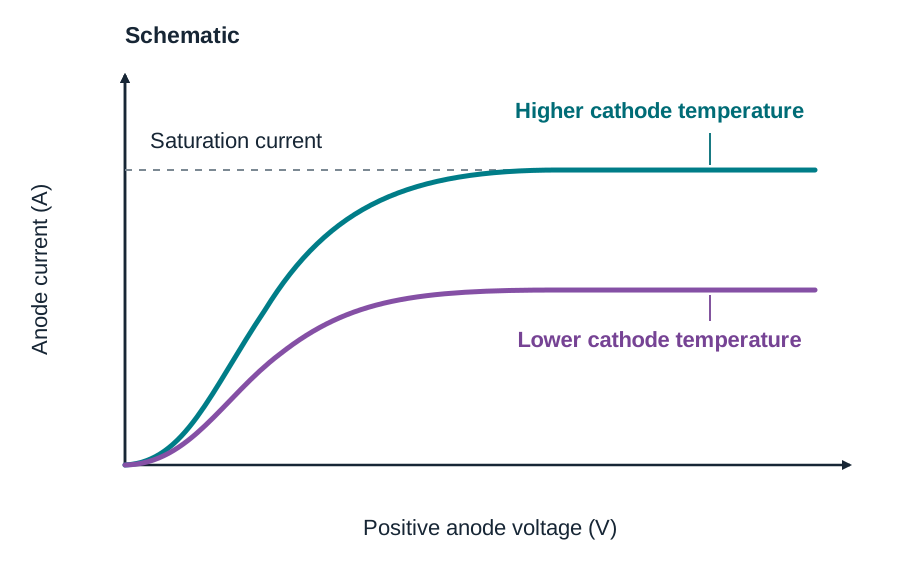
When evaluating such data, note two common limitations: filament current is only an indirect measure of cathode temperature, and single runs without repeat trials prevent evaluating random error and repeatability.
Cathode Ray Tubes, Energy, and Applications
A cathode ray tube (CRT) produces, accelerates, and directs an electron beam inside an evacuated glass tube:
- Filament: Heated by a low-voltage supply (around ) to heat the adjacent cathode.
- Cathode: Negative electrode that emits electrons via thermionic emission.
- Anode: Maintained at a high positive potential (typically ) to accelerate electrons.
- Anode aperture: A small central hole that lets a narrow, collimated pencil beam pass through.
- High vacuum: Air is removed to prevent electrons from colliding with and ionising gas molecules, which would scatter the beam.
- Fluorescent screen: Coated with a phosphor such as zinc sulphide that glows when struck by electrons.
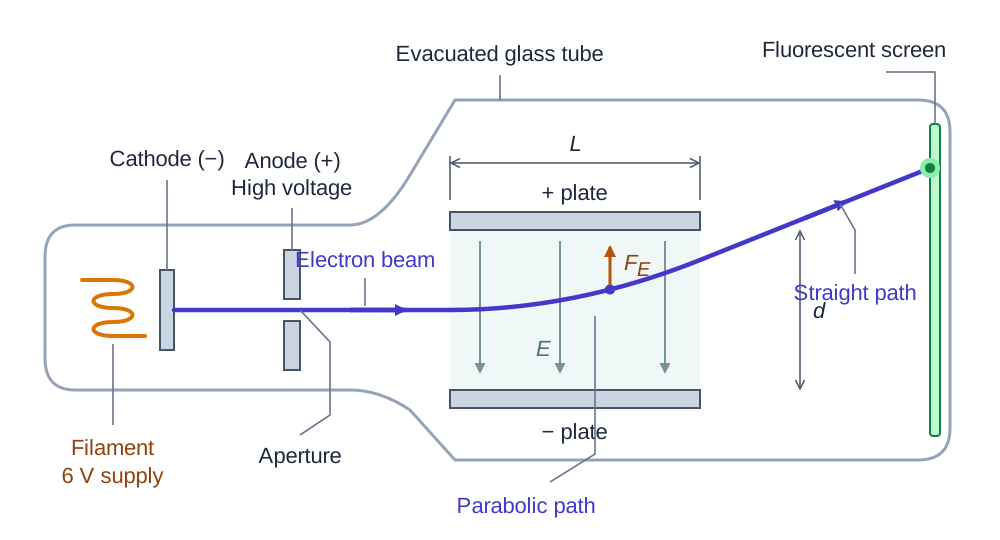
Diagram 2: Electron Deflection Tube (Draw and Label)
Draw a horizontal evacuated glass tube. At the left end, sketch a small coil labelled filament (6 V supply) touching a plate labelled cathode (–). Just to the right, draw a vertical plate with a central hole labelled anode (+, high voltage). From the hole, draw a straight line labelled electron beam. Between the anode and the screen, draw two parallel plates labelled + plate and – plate, marking plate separation and plate length . Draw the beam curving towards the positive plate along a parabolic path inside the plates, and continuing in a straight line to the right-hand end, labelled fluorescent screen.
Energy Conversions and the Electronvolt
When an electron accelerates from rest through an anode potential difference , electrical potential energy is converted into kinetic energy:
Solving for the exit velocity gives:
In Leaving Certificate calculations we always use , even when speeds exceed . Newtonian mechanics begins to break down at these speeds, but the classical equation is what is examined.
The electronvolt (eV) is the kinetic energy gained by an electron when it accelerates through an electrostatic potential difference of one volt:
Electron Absorption and Technology Applications
When fast electrons strike a metal target, they are absorbed and transfer their kinetic energy to the metal lattice. Almost all of this energy becomes internal energy, so the target gets hot and must be cooled.
When electrons are stopped suddenly by a metal target, a small fraction of their kinetic energy is converted into high-energy photons called X-rays. If all the kinetic energy of an electron is converted into a single photon, .
Other technological and health applications of electron beams include:
- Medical X-ray tubes: Rapidly stopping electron beams produces diagnostic radiation for healthcare.
- Electron microscopes: Beams of high-speed electrons have extremely short wavelengths, resolving structural details far smaller than visible light can detect.
- Cathode ray oscilloscopes: Deflected electron beams trace electrical waveforms on a screen.
- Particle accelerators: Electric fields accelerate charged particles while magnetic fields steer them in circular tracks.
- Industrial electron beam welding: Concentrated kinetic energy melts metals rapidly in a vacuum.
Deflection in Electric Fields and Trajectory Prediction
Electric field strength at a point is defined as the electrostatic force per unit charge experienced by a small positive test charge placed at that point:
It is measured in newtons per coulomb () or volts per metre (). Between parallel plates separated by distance across a potential difference , the field is uniform: .
Because electrons are negatively charged, the electric force acts in the direction opposite to the electric field lines, pulling the electrons towards the positive plate with magnitude:
By Newton's second law, this produces a constant vertical acceleration .
Predicting the Motion
Like a projectile in gravity, the motion breaks into two independent parts:
- Horizontal motion (-axis): No horizontal force acts, so horizontal speed remains constant. For plates of length , the transit time is .
- Vertical motion (-axis): Under constant acceleration , the vertical deflection upon leaving the plates is:
Because , substituting reveals:
Inside the plates, the path is a parabola. The electric field does work along the transverse displacement, so the speed and kinetic energy of the electron increase. After clearing the plates, the electron moves in a straight line tangent to its exit velocity.
Qualitative Prediction Rules for Electric Deflection
- Double the deflecting plate voltage : deflection doubles ().
- Double the accelerating voltage : deflection halves (, because faster electrons spend less time in the field).
- Double the plate length : deflection quadruples ().
- Increase plate separation : deflection decreases ().
- Charge and mass cancel completely: under identical voltages and geometry, any non-relativistic particle with charge-to-mass ratio equal to follows the exact same path.
Deflection in Magnetic Fields and Crossed Fields
A stationary electron in a magnetic field experiences no force. When an electron moves with velocity at right angles to a uniform magnetic field of flux density , it experiences a deflecting force:
Direction and Fleming's Left-Hand Rule
Use Fleming's left-hand rule with thumb, first finger, and second finger held mutually at right angles:
- First finger: Magnetic Field (, North to South).
- Second finger: Conventional Current ().
- Thumb: Direction of Force ().
Remember that conventional current is the flow of positive charge, so for an electron your second finger points opposite to the direction the electron is travelling. If an electron travels to the right, point your second finger to the left.
Circular Path and Zero Work
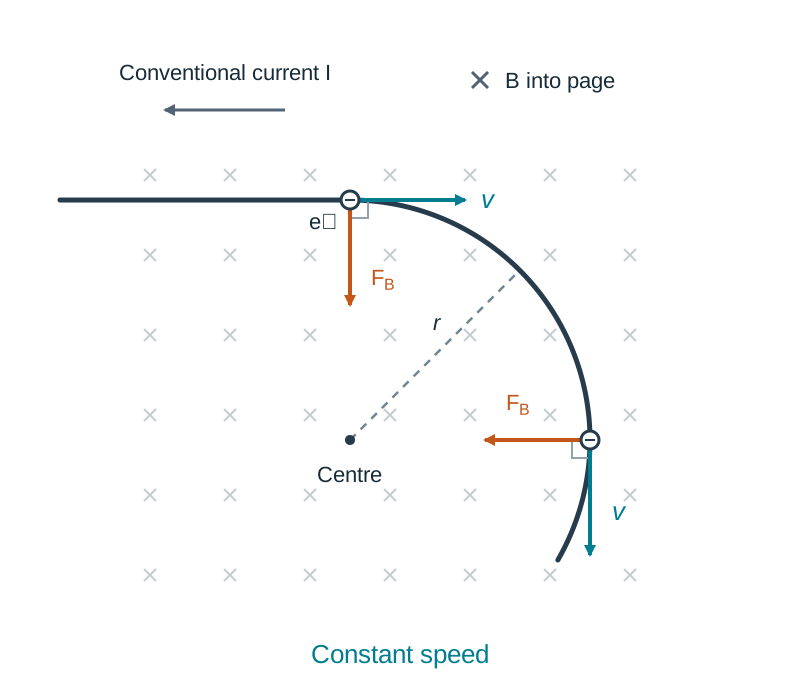
Because the magnetic force acts at right angles to the instantaneous velocity at every point ():
- The magnetic force does zero work on the electron ().
- The speed and kinetic energy of the electron remain strictly constant.
- The magnetic force acts as a centripetal force, curving the beam into a circular arc of radius :
Qualitative Prediction Rules for Magnetic Deflection
- Stronger magnetic field : smaller radius , so tighter curve and larger deflection.
- Faster electrons (larger ): larger radius , so straighter path and smaller deflection.
- Reversing the magnetic field or the beam direction reverses the deflection direction.
Crossed Fields (Velocity Selector)
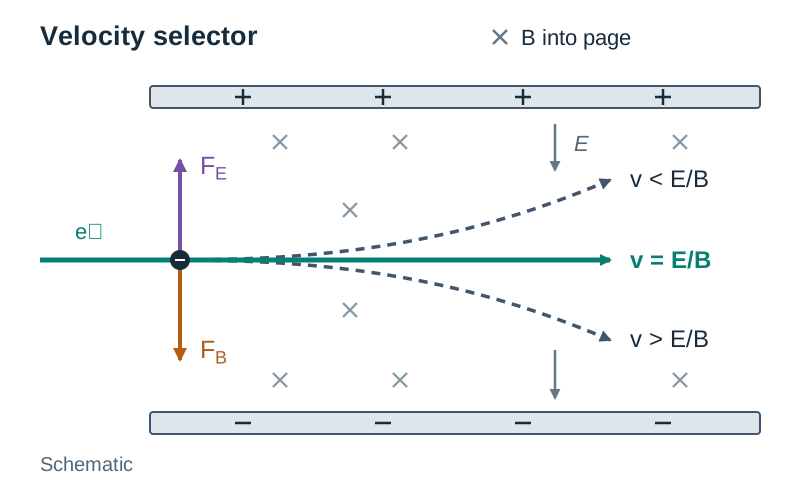
When electric and magnetic fields are applied simultaneously in the same region at right angles to each other and to the beam, the arrangement is called crossed fields.
Suppose electrons travel horizontally to the right. Parallel plates create a downward electric field, so the electrons feel an upward electric force . A magnetic field into the page gives, by Fleming's left-hand rule (second finger pointing left, opposite to electron travel), a downward magnetic force .
If both fields are on and the beam goes straight through, the two opposing forces must be equal, and that single fact gives you the speed:
This setup acts as a velocity selector: only particles with speed emerge undeflected. Faster particles deflect downwards (magnetic force dominates); slower particles deflect upwards (electric force dominates).
Key terms
- Electron
- A fundamental subatomic particle carrying an indivisible negative charge of 1.602 × 10⁻¹⁹ C and having a rest mass of 9.109 × 10⁻³¹ kg.
- Elementary Charge (e)
- The magnitude of electric charge carried by a single proton or electron, equal to 1.602 × 10⁻¹⁹ C.
- Charge Quantisation
- The physical principle that all observable electric charge exists only in integer multiples of the elementary charge (Q = ±Ne).
- Thermionic Emission
- The emission of electrons from the surface of a heated metal.
- Work Function
- The minimum energy needed to remove an electron from the surface of a metal.
- Cathode Rays
- Streams of high-speed electrons emitted from the negative electrode (cathode) in an evacuated discharge tube.
- Electronvolt (eV)
- The kinetic energy gained by an electron when accelerated through an electrostatic potential difference of one volt (1 eV = 1.602 × 10⁻¹⁹ J).
- Electric Field Strength
- The force per unit charge experienced by a small positive test charge placed at a point in an electric field (E = F/q).
- Fleming's Left-Hand Rule
- A mnemonic rule for finding the direction of the magnetic force on a current: thumb gives force, first finger gives magnetic field, and second finger gives conventional current.
- Velocity Selector
- A device using crossed electric and magnetic fields that allows only charged particles of a specific speed (v = E/B) to pass through undeflected.
Check yourself
State the precise syllabus definition of thermionic emission.
Thermionic emission is the emission of electrons from the surface of a heated metal.
An electron beam is deflected vertically by 1.2 mm between parallel plates. If the accelerating potential difference is doubled while all other plate dimensions and voltages remain unchanged, what is the new vertical deflection?
The new deflection is 0.6 mm. Deflection is inversely proportional to accelerating voltage (y ∝ 1/V_a) because faster electrons have greater horizontal speed, spend less time between the plates, and have less time to be deflected sideways.
An electron travels horizontally from left to right into a uniform magnetic field directed vertically upwards. In which direction is the initial magnetic force?
Using Fleming's left-hand rule: first finger points upwards (field), second finger points to the left (conventional current, opposite to electron travel). The thumb points into the page, away from the reader. The electron is deflected into the page.
Why must the glass envelope of a cathode ray tube be evacuated to a high vacuum?
To prevent electrons from colliding with and ionising gas molecules, which would scatter the beam, drain electron kinetic energy, and blur the beam spot.
A beam of electrons strikes an insulated metal target, producing a current of 1.60 μA for 10.0 s. Calculate the total number of electrons absorbed.
Total charge Q = It = (1.60 × 10⁻⁶ A)(10.0 s) = 1.60 × 10⁻⁵ C. Number of electrons N = Q/e = (1.60 × 10⁻⁵ C) / (1.602 × 10⁻¹⁹ C) = 9.99 × 10¹³ electrons.