

Leaving Certificate German Higher Level tests your writing across two distinct formats: the short reaction piece (Äußerung zum Thema, approximately 100 words, 25 marks) and the longer written production task (Schriftliche Produktion, approximately 160 words, 50 marks). Both tasks require you to engage directly with stimulus prompts—such as news snippets, photos, or letters from pen friends—by expressing personal viewpoints, narrating experiences, reacting to statements, and offering concrete suggestions. Success depends on addressing every prompt point and demonstrating accurate grammar, particularly verb placement, tenses, and sentence connectors.
Understanding the Two Exam Tasks and Mark Schemes
Before writing a single word, check which task you are doing and notice its length and weighting:
- Äußerung zum Thema (ÄZT): A short reaction piece of about 100 words, worth 25 marks. The marking allocates approximately 13 marks to content (Inhalt), which includes discretionary marks for elaboration, and 12 marks to expression (Ausdruck). Because word count is tight, you must answer every bullet point in a sentence or two without wasting time on a lengthy introduction.
- Schriftliche Produktion: An extended piece of about 160 words, worth 50 marks. This is divided equally into Inhalt (25 marks) and Ausdruck (25 marks). It usually takes the form of an opinion essay, a photo response, or a reply to an informal letter from a German-speaking friend.
In both tasks, content marks are tied directly to each individual prompt bullet point. Examiners also award discretionary marks for elaboration, so always support each point with a reason or a concrete example rather than giving a bare one-sentence answer. Leaving out a bullet point forfeits its marks entirely, no matter how good your German is.
Take thirty seconds to plan before you write: number each prompt bullet point on your exam paper and jot down one German keyword or verb structure beside each before starting.
Structure and Informal Letter Layout
Most tasks require either a standard short article or an informal letter reply.
The Standard Essay Framework
- Einleitung (Introduction): Refer briefly to the topic in your own words. Im Text geht es um das Thema... (The text deals with the topic of...) or Dieses Thema wird heutzutage viel diskutiert. (This topic is widely discussed nowadays).
- Hauptteil (Main Body): Work through each prompt bullet in turn. Answer only what is asked. If the question asks for advantages and disadvantages or a comparison between Ireland and Germany, provide both sides using connectors like einerseits ... andererseits (on the one hand ... on the other hand) and Im Vergleich zu Irland... (In comparison to Ireland...). If the prompt does not ask for a comparison, spend your words developing each point with examples instead.
- Schluss (Conclusion): Finish with one or two sentences that sum up your personal stance: Abschließend bin ich der Ansicht, dass... (In conclusion, I am of the view that...).
Informal Letter Frame
When the prompt is a letter from a friend (such as Julia or Alex), use correct letter conventions. In past papers, a suitable opening and closing has been rewarded (for example, 4 marks in 2016), so always include them:
- Opening: Liebe Julia, (to a female friend) or Lieber Julian, (to a male friend).
- First sentence: The line immediately after the comma starts with a small letter: vielen Dank für deinen Brief. (Many thanks for your letter.)
- Closing: Schreib bald wieder! (Write back soon!), followed on the next line by Liebe Grüße or Viele Grüße (Best wishes), and your name: Deine Aoife or Dein Conor.
- Pronouns: Address your friend consistently using informal pronouns: du, dich, dir, and dein.
Describing Photos, Reacting, and Suggesting
Exam prompts regularly require three specific functional skills:
1. Describing a Photo (Bildbeschreibung)
When a prompt asks you to describe an image, describe what you see and add a brief interpretation using verb second (V2) word order:
- Auf dem Foto sieht man eine Familie, die zusammen auf dem Sofa sitzt. (In the photo you can see a family sitting together on the sofa.)
- Im Vordergrund hält der Vater einen Laptop. (In the foreground the father is holding a laptop.)
- Es scheint, dass sie einen Film anschauen. (It seems that they are watching a film.)
- Useful location markers that trigger inversion: Im Hintergrund (in the background), Links / Rechts (on the left / on the right), In der Mitte (in the middle).
2. Reacting to Statements and Facts
When responding to a scenario (such as food waste or smartphone rules), state your emotional reaction clearly. Most of these phrases introduce a Nebensatz (subordinate clause) with dass, which sends the conjugated verb to the very end:
- Ich finde es erschreckend / schade, dass so viele Lebensmittel im Müll landen. (I find it shocking / a pity that so much food ends up in the bin.)
- Es freut mich, dass junge Leute sich für die Umwelt engagieren. (I am pleased that young people are getting involved in protecting the environment.)
- Ich bin darüber erstaunt, dass viele Jugendliche so wenig lesen. (I am astonished that many young people read so little.)
- Das wundert mich nicht. (That does not surprise me.)
3. Making Suggestions and Expressing Wishes
Use modal verbs and Konjunktiv II to offer solutions:
- Man sollte einen Essensplan machen. (One should make a meal plan.)
- Ich schlage vor, dass die Schule mehr Laptops kauft. (I suggest that the school buys more laptops.)
- Es wäre sinnvoll, mehr Geld in den Nahverkehr zu investieren. (It would make sense to invest more money in local transport.)
- Ich würde gern nach Österreich reisen, weil mich die Berge interessieren. (I would like to travel to Austria because the mountains interest me.)
- Für mich wäre es schwierig, eine Woche ohne Handy zu leben. (For me it would be difficult to live for a week without a mobile phone.)
Talking About Personal Experience in the Past
Prompts frequently ask you to recount a past event, primary school experience, or how you learned a language.
The Perfekt Tense
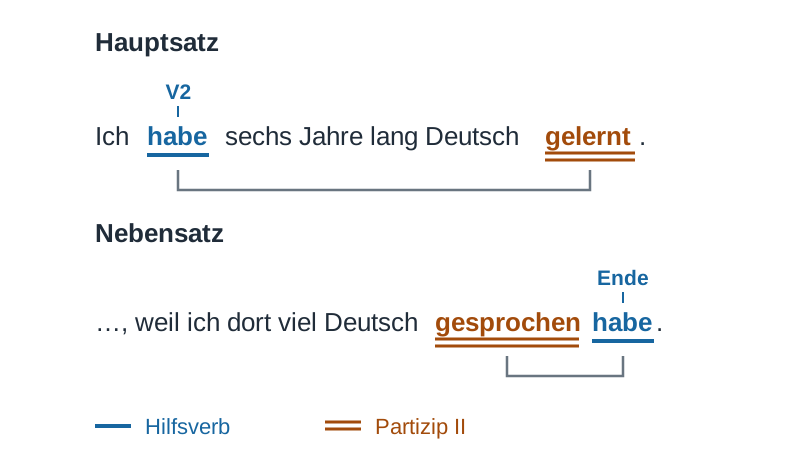
Use the Perfekt for talking about your past experiences. Place the auxiliary verb (haben or sein) in Position 2 and the past participle at the end of the main clause:
- Most verbs take haben: Ich habe sechs Jahre lang Deutsch gelernt. (I learned German for six years.)
- Verbs of movement or change of state take sein: Ich bin letztes Jahr nach Berlin gefahren. (I went to Berlin last year.)
- In a subordinate clause, the auxiliary goes to the very end: ..., weil ich dort viel Deutsch gesprochen habe. (...because I spoke a lot of German there.)
The Präteritum of Common Verbs
For sein, haben, and modal verbs, the simple past (Präteritum) is standard:
- In der Grundschule waren fast alle Lehrkräfte Frauen. (In primary school almost all the teachers were women.)
- Ich musste jeden Tag Hausaufgaben machen. (I had to do homework every day.)
- Wir hatten immer viel Spaß. (We always had lots of fun.)
Essential Word Order Rules and Connectors
Accurate sentence mechanics earn high marks in Ausdruck.
Verb-Second (V2) in Main Clauses
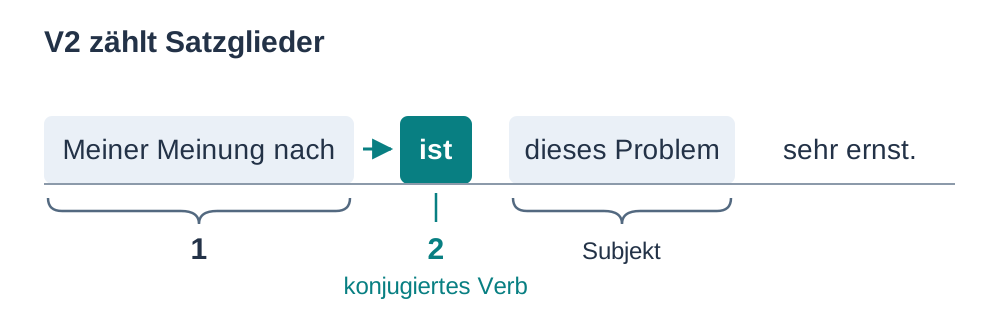
If you begin a sentence with a time phrase, an adverb, or an opinion starter like Meiner Meinung nach, that phrase takes Position 1. The conjugated verb must take Position 2, followed immediately by the subject:
- Correct: Meiner Meinung nach ist dieses Problem sehr ernst. (In my opinion this problem is very serious.)
- Incorrect: Meiner Meinung nach dieses Problem ist...
Verb-End in Subordinate Clauses (Nebensätze)
Subordinating conjunctions such as weil (because), dass (that), obwohl (although), and wenn (if/when) send the conjugated verb to the end of the clause:
- Viele Teenager stehen unter Druck, weil sie gute Noten erzielen wollen. (Many teenagers are under pressure because they want to achieve good grades.)
Note: Older exam papers and syllabus extracts print daß. Current standard German spelling is dass, which you should write consistently.
Expressing Purpose: 'um ... zu' vs 'damit'
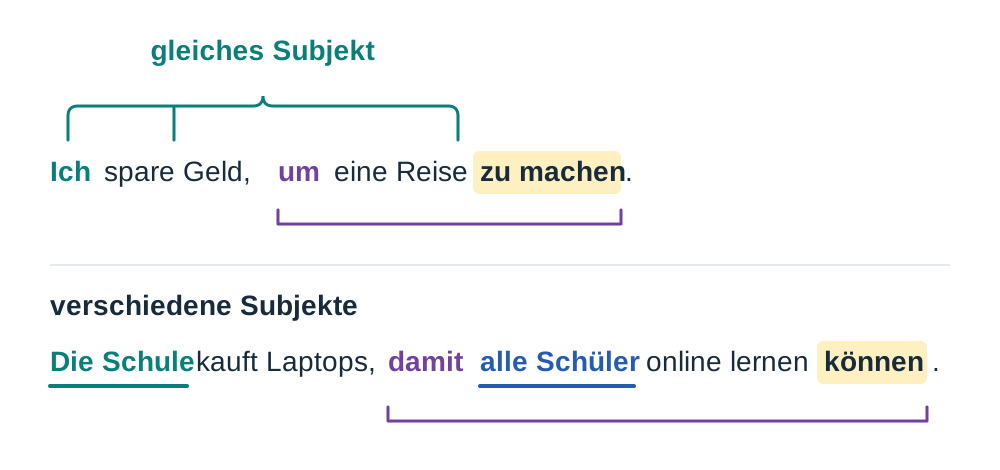
- Use um ... zu + Infinitiv when the subject of both actions is identical: Ich spare Geld, um eine Reise zu machen. (I am saving money in order to take a trip.)
- Use damit (with verb at the end) when the subjects are different: Die Schule kauft Laptops, damit alle Schüler online lernen können. (The school buys laptops so that all pupils can learn online.)
Da-Compounds
A compound of da(r)- + preposition (davon, darüber, dazu) represents a thing, an action, or a broader idea. It can point forward to an upcoming clause or back to an earlier statement:
- Ich bin davon überzeugt, dass wir handeln müssen. (I am convinced that we must act.)
- Ich habe mit Interesse darüber gelesen. (I read about that with interest.)
Thematic Vocabulary for Written Tasks
Senior cycle written prompts draw from recurring themes. Memorise the article, noun, and plural together:
| Theme | German Term (with Gender & Plural) | English Meaning |
|---|---|---|
| Umwelt & Konsum | die Lebensmittelverschwendung (no pl.)<br>wegwerfen (wirft weg, warf weg, hat weggeworfen)<br>der Klimawandel (no pl.)<br>die Umwelt schonen (verb) | food waste<br>to throw away<br>climate change<br>to protect the environment |
| Schule & Arbeit | der Leistungsdruck (no pl.)<br>das Punktesystem, -e<br>einen Studienplatz bekommen (verb)<br>Berufserfahrung sammeln (verb) | pressure to perform / do well<br>the points system<br>to get a university place<br>to gain work experience |
| Sprachen & Kultur | die Fremdsprache, -n<br>zweisprachig (adj.)<br>eine Kultur kennenlernen (verb)<br>das Ausland (no pl.) | foreign language<br>bilingual<br>to get to know a culture<br>abroad |
| Technologie | das Smartphone, -s<br>die sozialen Medien (pl.)<br>der Bildschirm, -e<br>im Netz surfen (verb) | smartphone<br>social media<br>screen<br>to surf the internet |
Key terms
- Äußerung zum Thema
- A short written reaction piece of approximately 100 words worth 25 marks, requiring direct answers to stimulus points.
- Schriftliche Produktion
- The extended written production section of approximately 160 words worth 50 marks, split equally between Content (25) and Expression (25).
- Inhalt
- The content mark awarded for addressing every bullet point in the prompt with supporting detail and elaboration.
- Ausdruck
- The expression mark assessing grammatical accuracy, vocabulary range, idiomatic phrasing, and word order.
- Verb-Zweit-Stellung (V2)
- The German main-clause rule where the conjugated verb must stand in second position, directly after an introductory element.
- Nebensatz
- A subordinate clause introduced by a conjunction like 'weil', 'dass', or 'obwohl', placing the conjugated verb at the very end.
- um ... zu + Infinitiv
- A purpose structure ('in order to') used when the subject of both clauses is identical, placing 'zu' directly before the final infinitive.
- Konjunktiv II
- The subjunctive mood used to express wishes, polite suggestions, and unreal conditions (e.g. 'wäre', 'könnte', 'würde').
- Da-Verbindung
- A compound of da(r)- + preposition (e.g. 'darüber', 'davon') that points forward to a dass/infinitive clause or refers back to an idea.
Check yourself
Rewrite this sentence with correct German word order: 'Meiner Meinung nach viele Schüler haben zu viel Stress.'
'Meiner Meinung nach haben viele Schüler zu viel Stress.' The phrase 'Meiner Meinung nach' takes Position 1, so the conjugated verb 'haben' must take Position 2.
Complete the reaction clause using the correct word order: 'Ich finde es schade, dass viele Jugendliche ... (wenig lesen)'.
'..., dass viele Jugendliche wenig lesen.' In a subordinate clause introduced by 'dass', the conjugated verb 'lesen' must stand at the very end.
Fill in the blanks with the correct past tense (Perfekt) forms of 'fahren': 'Ich _ letztes Jahr nach Berlin _.'
'Ich bin letztes Jahr nach Berlin gefahren.' 'Fahren' denotes motion, requiring the auxiliary 'sein' (bin) in Position 2 and the past participle (gefahren) at the end.
Why does 'Die Schule kauft Tablets, damit die Schüler besser lernen können' use 'damit' rather than 'um ... zu'?
'damit' must be used because the subjects of the two clauses are different ('Die Schule' buys, but 'die Schüler' learn). 'um ... zu' can only be used when both clauses share the same subject.
What are the word counts and mark totals for the two Leaving Certificate German writing tasks (ÄZT vs Schriftliche Produktion)?
The Äußerung zum Thema (ÄZT) is approximately 100 words worth 25 marks. The Schriftliche Produktion is approximately 160 words worth 50 marks (split 25 for Content / 25 for Expression).