

Digital technology and communication features across all four components of Leaving Certificate Higher Level German: the Oral (25%), Listening Comprehension (20%), Reading Comprehension (30%), and Written Production (25%). The syllabus requires you to handle practical telecommunications—such as making calls, clarifying line issues, leaving voicemail messages, and relaying information using reported speech (indirekte Rede with Konjunktiv I)—alongside contemporary debates on screen time, cyberbullying, gaming, and online privacy. Mastering these structures, and answering every prompted point, will help you earn content and language marks in both the 100-word Äußerung zum Thema and the 160-word letter or opinion task.
Telefonieren und Simsen (Calling and Texting)
Everyday communication begins with placing a call or sending a text message. German requires specific verbs, cases, and set phrases that differ from English.
Core Calling and Texting Vocabulary
| German | English |
|---|---|
| der Anruf, die Anrufe | phone call |
| anrufen (ruft an, rief an, hat angerufen) | to ring / phone |
| zurückrufen | to ring back |
| die Handynummer, die Handynummern | mobile number |
| die Vorwahl, die Vorwahlen | area code / dialling code |
| besetzt | engaged (line busy) |
| der Empfang / kein Netz | mobile reception / no signal |
| das WLAN | Wi-Fi |
| die Nachricht, die Nachrichten | message |
| die SMS, die SMS | text message |
| eine Nachricht schicken / schreiben | to send / write a message |
| der Klingelton, die Klingeltöne | ringtone |
| erreichbar | reachable / contactable |
| ständig erreichbar sein | to be constantly reachable |
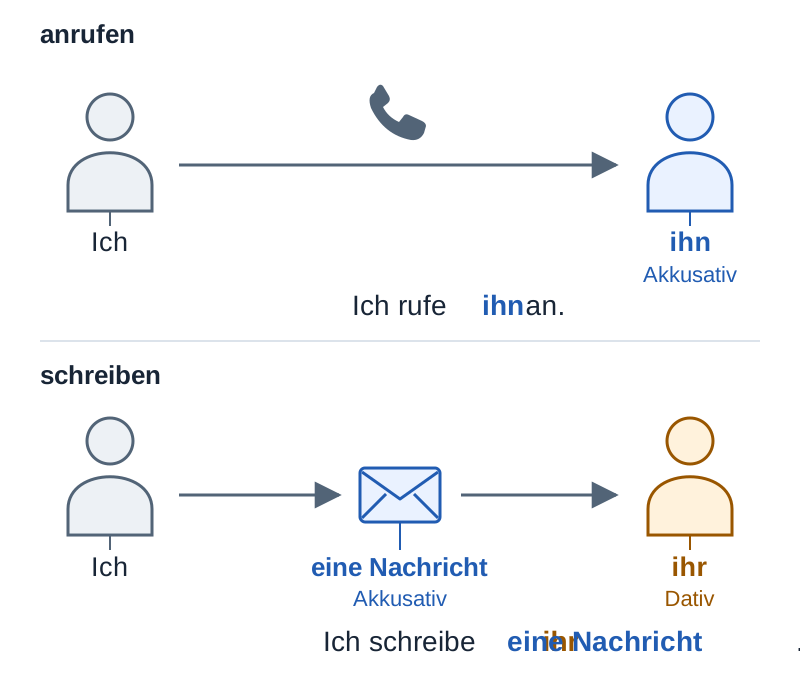
Essential Grammar Rule: anrufen takes the Accusative
The verb anrufen governs a direct object in the accusative case, not the dative:
- Ich rufe ihn morgen an. (I will ring him tomorrow. NOT: ihm)
- Hast du deine Mutter angerufen? (Did you call your mother?)
In contrast, verbs for sending messages take a dative person and an accusative thing:
- Ich schreibe ihr eine Nachricht. (I am writing her a message.)
- Er hat mir ein Bildschirmfoto geschickt. (He sent me a screenshot.)
Gesprächsführung am Telefon (Managing a Phone Conversation)
Section 1.9 of the syllabus tests your ability to start a conversation, confirm details, deal with line breakdowns, and end the call politely.
Identifying Yourself and Picking Register
On the phone, state who you are using Hier spricht ... or Hier ist .... In professional or domestic settings, native speakers often state their surname directly (Kelly, guten Tag). Using Mein Name ist ... is also grammatically correct. Among friends, Hallo, ich bin's, Conor! is completely natural.
Maintain one register throughout the call:
- Formal (Sie): For an adult stranger, hotel, doctor's surgery, or school office.
- Könnten Sie das bitte wiederholen? (Could you please repeat that?)
- Wie ist Ihre Handynummer? (What is your mobile number?)
- Rufen Sie mich bitte zurück. (Please ring me back.)
- Informal (du): For a pen pal, friend, or host sibling.
- Könntest du das bitte wiederholen? (Could you please repeat that?)
- Wie ist deine Handynummer? (What is your mobile number?)
- Ruf mich bitte zurück. (Please ring me back.)
- Tschüss! / Bis später! (Bye! / See you later!)
Stating Purpose with Infinitive Clauses (um ... zu)
- Ich rufe an, um einen Termin zu vereinbaren. (I am ringing to arrange an appointment.)
- Ich rufe an, um mich nach dem Kurs zu erkundigen. (I am ringing to enquire about the course.)
Confirming and Checking Comprehension
- Alles klar, ich habe verstanden. (All clear, I have understood.)
- Habe ich Sie richtig verstanden, dass der Termin um zehn Uhr ist? (Have I understood you correctly that the appointment is at 10 o'clock?)
- Also, ich soll Sie morgen zurückrufen, oder? (So I am to ring you back tomorrow, right?)
Dealing with Breakdown and Line Problems
- Wie bitte? (Pardon? / Sorry?)
- Ich habe Sie nicht ganz verstanden. (I didn't quite understand you.)
- Das habe ich leider gar nicht verstanden. (Unfortunately I didn't catch that at all.)
- Könnten Sie bitte langsamer sprechen? (Could you please speak more slowly?)
- Könnten Sie das bitte buchstabieren? (Could you please spell that, please?)
- Die Verbindung ist sehr schlecht; ich kann Sie kaum hören. (The connection is very bad; I can barely hear you.)
- Die Verbindung ist abgebrochen. / Wir wurden getrennt. (The call dropped. / We got cut off.)
- Es tut mir leid, Sie haben sich verwählt. (I am sorry, you have dialled the wrong number.)
Closing the Call
On a formal call, end with Auf Wiederhören! rather than Auf Wiedersehen (which implies seeing someone face to face). With friends, Tschüss!, Bis später!, or Bis zum nächsten Mal! is normal.
Nachrichten aufnehmen und weiterleiten (Taking, Leaving, and Relaying Messages)
Syllabus Section 1.11 covers handling recorded messages, taking notes for others, and expressing urgency.
Taking a Message
- Er ist gerade nicht da / nicht erreichbar. (He is not here / not available at the moment.)
- Kann ich etwas ausrichten? (Can I take a message?)
- Möchten Sie eine Nachricht hinterlassen? (Would you like to leave a message?)
- Soll sie Sie zurückrufen? (Should she ring you back?)
- Unter welcher Nummer sind Sie erreichbar? (On what number can you be reached?)
- Ich richte es ihm aus. (I will pass it on to him.)
Leaving a Message on an Answering Machine (der Anrufbeantworter / die Mailbox)
- Bitte hinterlassen Sie eine Nachricht nach dem Signalton. (Please leave a message after the tone.)
- Hallo Frau Braun, hier ist Aoife Murphy. Ich rufe wegen des Praktikums an. Könnten Sie mich bitte so bald wie möglich zurückrufen? Sie erreichen mich unter 087 1234567. Vielen Dank und auf Wiederhören! (Hello Ms Braun, this is Aoife Murphy. I'm ringing about the work experience. Could you please ring me back as soon as possible? You can reach me on 087 1234567. Many thanks and goodbye!)
Urgency Adverbs and Short Notes
- dringend: urgently (Du sollst sie dringend zurückrufen.)
- umgehend: immediately / without delay (Bitte melden Sie sich umgehend.)
- wichtig: important (Es ist sehr wichtig.)
- Es eilt. (It is urgent.)
Model Written Note (Notiz)
Hallo Mama, Herr Braun hat um 15 Uhr angerufen. Er sagt, das Treffen sei auf Freitag verschoben. Bitte ruf ihn umgehend zurück! Bis später, Ciara (Hi Mam, Mr Braun rang at 3 o'clock. He says the meeting has been moved to Friday. Please ring him back straight away! See you later, Ciara)
This short note shows the key elements examiners look for: who called and when, what was said using reported speech (sei), an urgency adverb (umgehend), and an informal imperative (ruf ... zurück).
Indirekte Rede: Konjunktiv I und Konjunktiv II (Reported Speech)
When reporting what someone else said or wrote, German uses reported speech (indirekte Rede). In news reports and formal written German, this requires Konjunktiv I.
In everyday speech, and when passing on a message, Germans usually keep the normal present tense: Sie sagt, dass der Zug spät ankommt. / Sie sagt, der Zug kommt spät an. (She says the train is arriving late.) Konjunktiv I (…, der Zug komme spät an) is the formal written version.
Forming Konjunktiv I
Take the infinitive stem (the infinitive minus -en) and add the endings: -e, -est, -e, -en, -et, -en.
- aufladen er lade auf (NOT läde)
- kommen er komme
- haben er habe
- sein is irregular: ich sei, du seist, er sei, wir seien, ihr seiet, sie seien.
The Ambiguity Rule: Replacing with Konjunktiv II
If the Konjunktiv I form looks identical to the normal present tense indicative (which is almost always true for ich, wir, and sie/Sie), replace it with Konjunktiv II (hätten, wären, or würden + infinitive):
- Indicative: Wir haben keine Zeit. Reported: Sie sagen, sie hätten keine Zeit. (not haben, which would sound like direct speech).
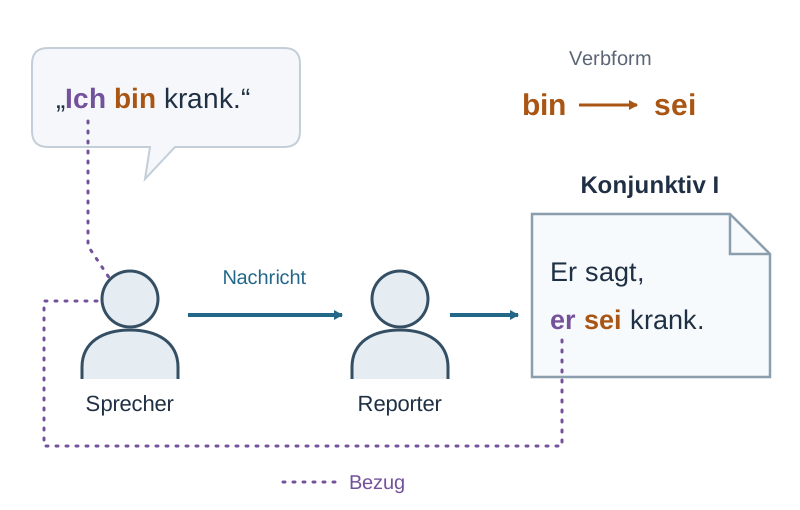
| Direct Speech | Reported Speech (with or without dass) | Meaning |
|---|---|---|
| „Ich bin krank.“ | Er sagt, er sei krank. | He says he is sick. |
| „Ich habe kein Netz.“ | Sie behauptet, dass sie kein Netz habe. | She claims she has no signal. |
| „Das ist eine Lüge.“ | Er behauptet, das sei eine Lüge. | He claims that is a lie. |
| „Wir wollen helfen.“ | Sie sagen, sie wollten helfen. | They say they want to help. |
Past, Future, Questions, and Requests in Reported Speech
- Past (Perfekt / Präteritum): Use habe / sei + past participle.
- „Ich habe das Foto hochgeladen.“ Er sagt, er habe das Foto hochgeladen. (He says he uploaded the photo.)
- „Sie ist nach Berlin geflogen.“ Er berichtet, sie sei nach Berlin geflogen. (He reports she flew to Berlin.)
- Infinitive structure: Er behauptet, den Brief schon geschickt zu haben. (He claims to have sent the letter already.)
- Future: Use werde + infinitive.
- Er sagt, er werde morgen anrufen. (He says he will ring tomorrow.)
- Reported Questions: Use ob for yes/no questions; retain the question word for open questions.
- Sie fragt, ob du Zeit habest. (She asks whether you have time.)
- Er fragt, wann der Zug ankomme. (He asks when the train arrives.)
- Reported Requests: Use the modal verb sollen.
- „Ruf mich an!“ Sie sagt, du sollst / sollest sie anrufen. (She says you are to ring her.)
Geräte, Software und trennbare Verben (Hardware, Software, and Verbs)
Discussing digital equipment requires control of noun genders and separable verbs.
Hardware and Digital Concepts
| German Noun | Plural | English Meaning |
|---|---|---|
| das Handy | die Handys | mobile phone |
| das Smartphone | die Smartphones | smartphone |
| der Computer | die Computer | computer |
| der Laptop | die Laptops | laptop |
| das Tablet | die Tablets | tablet |
| der Bildschirm | die Bildschirme | screen / monitor |
| der Akku | die Akkus | rechargeable battery |
| das Passwort | die Passwörter | password |
| die Datei | die Dateien | electronic file |
| die App | die Apps | app |
Note on das Handy: Remember that das Handy is exclusively a German noun for a mobile phone. Never use it as an adjective to mean convenient; use praktisch or nützlich instead.
Key Verbs and Their Principal Parts
Pay attention to the principal parts (Stammformen):
- aufladen (lädt auf, lud auf, hat aufgeladen) – to charge (separable)
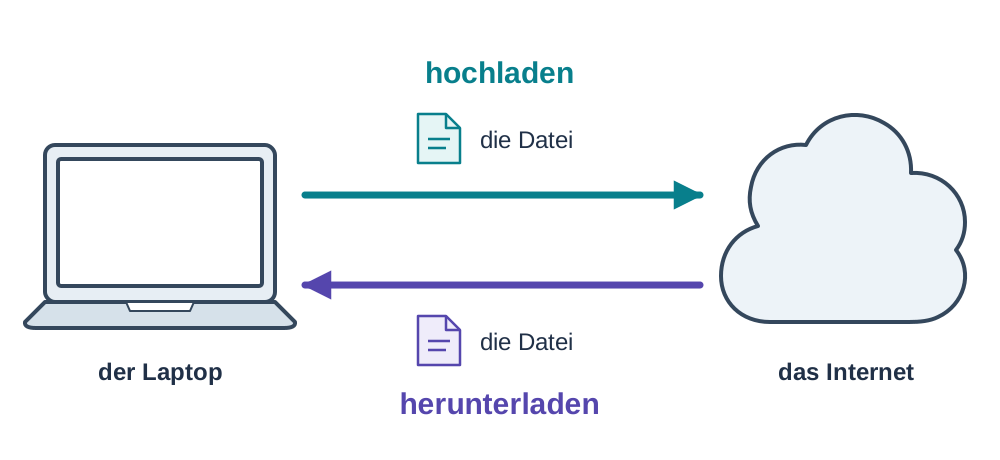
- herunterladen (lädt herunter, lud herunter, hat heruntergeladen) – to download (separable)
- hochladen (lädt hoch, lud hoch, hat hochgeladen) – to upload (separable)
- speichern (speichert, speicherte, hat gespeichert) – to save (not separable): Vergiss nicht, deine Hausaufgaben auf dem Laptop zu speichern! (Don't forget to save your homework on the laptop!)
- löschen (löscht, löschte, hat gelöscht) – to delete (not separable): Sie hat die Nachricht versehentlich gelöscht. (She deleted the message by mistake.)
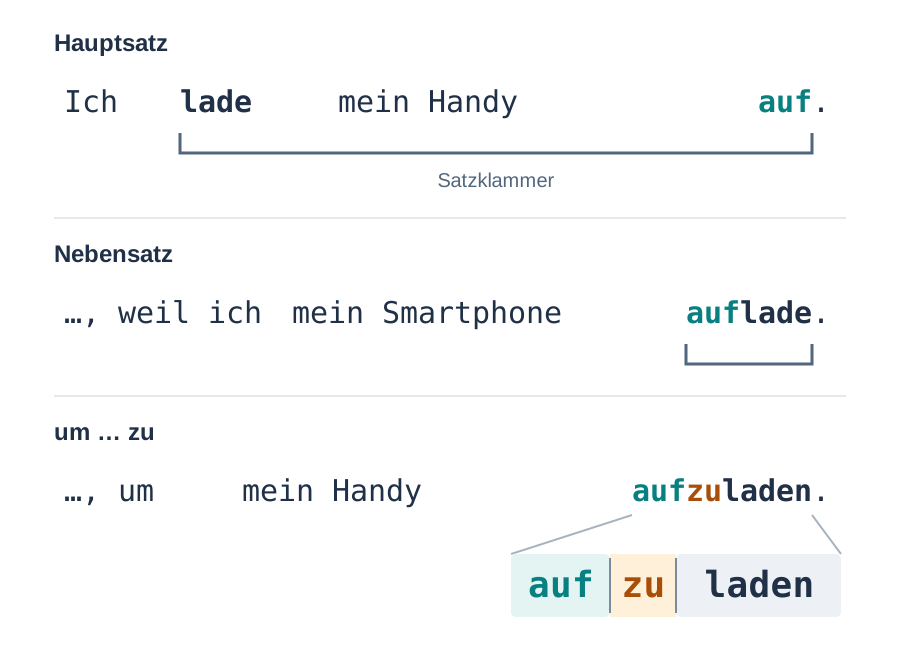
Prefix movement rules:
- In a main clause, the separable prefix separates and goes to the very end in the present tense, simple past, and imperative:
- Ich lade mein Handy auf. (I am charging my phone.)
- Er lud die App herunter. (He downloaded the app.)
- Lad dein Handy auf!* (Charge your phone!)
- In a subordinate clause (weil, dass, obwohl), the prefix remains attached to the verb at the very end:
- ..., weil ich mein Smartphone auflade.
- In an infinitive clause with zu, the zu slots between the prefix and the stem:
- Ich brauche ein Ladekabel, um mein Handy aufzuladen. (I need a charging cable to charge my phone.)
Soziale Medien, Hörverstehen und Online-Hilfe (Social Media and Helplines)
Social media topics appear frequently in listening comprehensions and reading texts, particularly around online youth services such as Nummer gegen Kummer.
Listening Vocabulary: Helpline Features and Youth Problems
| German | English |
|---|---|
| kostenlos | free of charge |
| bundesweit | nationwide |
| anonym | anonymous |
| vertraulich | confidential |
| die Nummer wird nicht angezeigt | the phone number is not displayed |
| die Daten werden nicht weitergegeben | data is not passed on to third parties |
| ein Benutzerkonto anlegen | to create a user account |
| der Live-Chat | live chat |
| per E-Mail | by email |
| der Kummer / die Sorgen | worries / grief |
| der Liebeskummer | lovesickness |
| der Streit mit Freunden | arguments with friends |
| der Leistungsdruck | pressure to perform / academic stress |
| die Zukunftsangst | fear of the future |
| das Mobbing / das Cybermobbing | bullying / cyberbullying |
Social Media Actions and Collocations
- in Kontakt bleiben: Soziale Netzwerke helfen mir, mit Freunden weltweit in Kontakt zu bleiben. (Social networks help me stay in contact with friends worldwide.)
- jemandem folgen (+ dative): Ich folge vielen deutschsprachigen Kanälen. (I follow many German channels.)
- die Privatsphäre schützen: Man muss seine Privatsphäre vor Missbrauch schützen. (You must protect your privacy from misuse.)
- süchtig machen: Kurze Videoclips können schnell süchtig machen. (Short video clips can quickly become addictive.)
- Zeit verschwenden: Viele Teenager verschwenden täglich Stunden am Bildschirm. (Many teenagers waste hours daily in front of the screen.)
- blockieren / melden: Wenn man beleidigt wird, sollte man den Absender sofort blockieren oder melden. (If someone insults you online, you should block or report them straight away.)
Gaming und Jugendkultur (Gaming and Leisure)
Syllabus Section III focuses on cultural awareness and everyday leisure (Freizeitgestaltung). When discussing gaming hobbies in the oral exam or an opinion piece, move beyond basic nouns into balanced viewpoints.
Gaming Terms
| German | English |
|---|---|
| das Videospiel, die Videospiele | video game |
| das Computerspiel, die Computerspiele | computer game |
| das Rollenspiel, die Rollenspiele | role-playing game (RPG) |
| der Mehrspielermodus, die Mehrspielermodi | multiplayer mode |
| der Einzelspielermodus | single-player mode |
| die Konsole, die Konsolen | console |
| die Steuerung, die Steuerungen | controls |
| das Level, die Levels / Level | level (game stage) |
Expressing Opinions on Gaming
- Am Wochenende spiele ich gern mit Freunden online Videospiele, um mich nach der Schule zu entspannen. (At the weekend I like playing video games online with friends to relax after school. Note: Keep the slang verb zocken for speaking only).
- Online-Spiele fördern den Teamgeist. (Online games promote team spirit.)
- Manche Spiele können leider süchtig machen. (Unfortunately, some games can be addictive.)
- Man verliert leicht das Zeitgefühl vor dem Bildschirm. (You easily lose track of time in front of the screen.)
- Brutale Spiele sind für jüngere Kinder absolut nicht geeignet. (Violent games are completely unsuitable for younger children.)
Diskussion und Konjunktiv II (Discussion Language and Hypotheses)
Higher Level writing tasks (the 25-mark Äußerung zum Thema and the 50-mark letter/opinion task) require structured argumentation. You need clear transitions, conditional forms, and comparisons between Ireland and German-speaking countries.
Reacting and Giving Conviction with dass-Clauses
- Ich finde es bedenklich, dass viele Jugendliche nachts am Handy sind. (I find it worrying that many teenagers are on their phones at night.)
- Es freut mich, dass Apps das Sprachenlernen erleichtern. (I am pleased that apps make language learning easier.)
- Ich bin davon überzeugt, dass Handyverbote Leben retten. (I am convinced that mobile phone bans save lives.)
Conceding and Contrasting (V2 Inversion)
- Es stimmt zwar, dass das Internet praktisch ist, aber ... (It is indeed true that the internet is handy, but ...)
- Das ist wohl möglich, aber ... (That may well be, but ...)
- Ich will nicht damit sagen, dass soziale Medien schlecht sind. (I don't mean to say that social media are bad.)
- Einerseits ... andererseits ... (triggers verb second (V2) word order immediately after each word):
- Einerseits bieten Smartphones viele Vorteile, andererseits führen sie oft zu Ablenkung. (On the one hand smartphones offer many advantages; on the other hand they often lead to distraction.)
- Meiner Meinung nach (occupies position 1; verb must come second):
- Meiner Meinung nach ist ein Smartphoneverbot sinnvoll. (In my opinion a smartphone ban makes sense. NOT: Meiner Meinung nach, ein Smartphoneverbot ist ...)
Comparing Ireland and Germany
- In Irland ist die Situation ähnlich wie in Deutschland. (In Ireland the situation is similar to Germany.)
- Wie in Deutschland gilt auch an vielen irischen Schulen ein Handyverbot. (As in Germany, a mobile phone ban also applies in many Irish schools.)
- Auch bei uns in Irland nutzen fast alle Jugendlichen Instagram und TikTok. (Here in Ireland too, almost all young people use Instagram and TikTok.)
Concluding
- Alles in allem ist Technologie ein nützliches Werkzeug. (All in all, technology is a useful tool. Note V2: ist follows Alles in allem.)
- Zusammenfassend lässt sich sagen, dass ein Gleichgewicht nötig ist. (In summary, it can be said that balance is necessary.)
Konjunktiv II: Hypotheses and Suggestions
When an exam task asks what you would do or what would be difficult, use Konjunktiv II.
- For most verbs: use würde + infinitive at the end: Ich würde eine Woche ohne Handy vorschlagen. (I would suggest a week without a phone.)
- For core auxiliary and modal verbs, memorise the one-word forms:
- sein wäre (would be): Ohne Handy wäre es für mich sehr schwierig. (Without a phone it would be very difficult for me.)
- haben hätte (would have): Wenn ich kein Handy hätte, würde ich mehr lesen. (If I didn't have a phone, I would read more.)
- können könnte (could): Man könnte ein Projekt starten. (You could start a project.)
- sollen sollte (should): Schulen sollten mehr Online-Projekte anbieten. (Schools should offer more online projects.)
- müssen müsste (would have to): Ich müsste früher aufstehen. (I would have to get up earlier.)
Key terms
- anrufen + accusative
- The verb meaning to call by phone; it takes a direct object in the accusative case (e.g. 'Ich rufe ihn an', not 'ihm').
- Hier spricht ...
- Standard polite telephone formula meaning 'This is [Name] speaking', used to identify yourself when making a call.
- Auf Wiederhören
- Formal closing formula used exclusively at the end of telephone conversations ('hören' = to hear).
- die Mailbox
- Feminine noun for mobile phone voicemail or answering service; not used to refer to an email inbox.
- indirekte Rede
- Reported speech in German, used to relay statements objectively using indicative 'dass'-clauses or formal Konjunktiv I forms.
- Konjunktiv I
- The mood used for formal reported speech, formed from the infinitive stem plus the endings -e, -est, -e, -en, -et, -en (e.g. 'er habe', 'er sei').
- Konjunktiv II
- The subjunctive mood expressing hypothetical conditions, wishes, and polite suggestions (e.g. 'wäre', 'hätte', 'könnte', 'sollte', 'würde + infinitive').
- separable verb
- A verb whose prefix detaches to the end of a main clause in the present, simple past, and imperative, but remains attached in subordinate clauses.
- verb second (V2)
- The fundamental word-order rule in German main clauses requiring the conjugated verb to sit immediately after the first sentence unit (e.g. after 'Meiner Meinung nach' or 'Einerseits').
- einerseits / andererseits
- Paired contrastive adverbs meaning 'on the one hand / on the other hand', each occupying position 1 and requiring immediate verb-second inversion.
- Meiner Meinung nach
- Common opinion phrase meaning 'in my opinion'; acts as position 1 in the clause and must be followed directly by the conjugated verb without a comma.
- Äußerung zum Thema
- A short written task (approx. 100 words) linked to a reading text, in which you answer the specific instructions given (e.g. give two reasons, describe the situation in Ireland).
Check yourself
What is the Konjunktiv I form of 'er lädt das Foto hoch'?
er lade das Foto hoch (formed from the infinitive stem 'lad-', not the present tense stem 'lädt').
Correct this sentence: 'Ich rufe ihm morgen um acht Uhr an.'
'Ich rufe ihn morgen um acht Uhr an.' ('anrufen' requires the accusative pronoun 'ihn', not dative 'ihm').
How do you offer to take a phone message politely in German?
'Kann ich etwas ausrichten?' (or 'Möchten Sie eine Nachricht hinterlassen?').
What word order is required immediately after 'Einerseits' or 'Andererseits' in a main clause?
Verb-second (V2) inversion: the conjugated verb must immediately follow, before the subject (e.g. 'Einerseits bieten Smartphones viele Vorteile...').
How do you say 'Without my smartphone it would be very difficult for me' using Konjunktiv II?
'Ohne mein Smartphone wäre es für mich sehr schwierig.'
What does 'die Mailbox' mean in German telephone terminology?
Voicemail or answering machine service on a phone (not an email inbox).