

In German, cases, prepositions, and adjective endings work together as an interconnected grammatical system. The four cases (Nominativ, Akkusativ, Dativ, and Genitiv) signal the exact function each noun, pronoun, and article performs in a sentence. Prepositions govern specific cases regardless of word order, while attributive adjectives take precise endings depending on the preceding determiner, gender, number, and case. These rules come up directly in the Angewandte Grammatik questions, such as naming case, gender, and number, or filling in missing prepositions. Getting them right is also one of the most effective ways to raise your language mark across written production tasks.
The Four Cases, Article Declensions, and Weak Masculine Nouns
German uses four grammatical cases to indicate who is doing what to whom. Unlike English, where word order largely determines meaning, German relies on case inflections on articles, pronouns, and adjectives.
- Nominativ: Marks the subject performing the action. It also follows linking verbs such as sein (to be), werden (to become), and bleiben (to remain). It answers the question Wer? (Who?) or Was? (What?).
- Akkusativ: Marks the direct object receiving the action of the verb. Among the articles, only the masculine singular changes (der → den, ein → einen). Personal pronouns change far more (ich → mich, du → dich, er → ihn, wir → uns). It also marks definite time expressions without a preposition (jeden Tag, nächsten Monat, letzte Woche, den ganzen Tag). When a two-way preposition expresses time (an, in, vor, zwischen), it always takes the Dativ (am Wochenende, im Juli, vor drei Jahren). It answers Wen? (Whom?) or Was? (What?).
- Dativ: Marks the indirect object, which is the person or entity benefiting from or receiving something (answering Wem? / To whom?). It is required by fixed dative prepositions and specific dative verbs. Useful dative verbs and syllabus expressions include:
- helfen: Ich helfe dir gern. (I gladly help you.)
- danken: Wir danken Ihnen herzlich. (We thank you cordially.)
- gefallen: Es gefällt ihr gut. (She likes it.)
- gehören: Das Buch gehört mir. (The book belongs to me.)
- gratulieren: Ich gratuliere dir zum Geburtstag. (I congratulate you on your birthday.)
- passen: Die Hose passt mir nicht. (The trousers do not fit me.)
- schmecken: Das Essen schmeckt den Gästen. (The guests enjoy the food.)
- fehlen: Du fehlst mir. (I miss you.)
- antworten: Er antwortet dem Lehrer. (He answers the teacher.)
- Fixed dative idioms: Es tut mir leid (I am sorry), Es geht mir gut (I am doing well), and Mir ist kalt / langweilig (I am cold / bored).
- Genitiv: Expresses possession, relationship, or part of a whole, answering Wessen? (Whose?). Regular masculine and neuter singular nouns add an -s or -es suffix.
Bestimmter Artikel (Definite Articles: der, die, das)
| Kasus | Maskulin | Feminin | Neutral | Plural |
|---|---|---|---|---|
| Nominativ | der Mann | die Frau | das Kind | die Kinder |
| Akkusativ | den Mann | die Frau | das Kind | die Kinder |
| Dativ | dem Mann | der Frau | dem Kind | den Kindern (+n) |
| Genitiv | des Mannes | der Frau | des Kindes | der Kinder |
In the dative plural, the noun itself adds an -n ending (den Kindern, den Freunden), unless its plural form already ends in -n or -s (den Familien, den Autos).
Unbestimmter Artikel (Indefinite Articles: ein, eine, ein)
| Kasus | Maskulin | Feminin | Neutral | Plural (Possessiv / kein) |
|---|---|---|---|---|
| Nominativ | ein Mann | eine Frau | ein Kind | meine Kinder |
| Akkusativ | einen Mann | eine Frau | ein Kind | meine Kinder |
| Dativ | einem Mann | einer Frau | einem Kind | meinen Kindern (+n) |
| Genitiv | eines Mannes | einer Frau | eines Kindes | meiner Kinder |
Weak Masculine Nouns (N-Deklination)
A small group of masculine nouns add -(e)n in every case except the nominative singular. Most refer to living persons or animals, and many end in -e.
| Kasus | Singular | Plural |
|---|---|---|
| Nominativ | der Junge | die Jungen |
| Akkusativ | den Jungen | die Jungen |
| Dativ | dem Jungen | den Jungen |
| Genitiv | des Jungen | der Jungen |
Common n-nouns include der Junge (boy), der Mensch (person), der Student (student), der Kollege (colleague), der Nachbar (neighbour), der Kunde (customer), der Tourist (tourist), der Präsident (president), and der Herr (gentleman; forms: den Herrn, dem Herrn).
- Die Polizei hält den Jungen fest. (The police hold the boy.)
- Ich spreche mit dem Nachbarn. (I am speaking with the neighbour.)
Personal and Reflexive Pronouns
Personal pronouns replace nouns and decline according to case. Reflexive pronouns refer back to the subject of the sentence.
Personal Pronouns
| Person | Nominativ | Akkusativ | Dativ | Possessive (my, your, his …) |
|---|---|---|---|---|
| 1. Sing. (ich) | ich | mich | mir | mein- |
| 2. Sing. inf. (du) | du | dich | dir | dein- |
| 3. Sing. mask. (er) | er | ihn | ihm | sein- |
| 3. Sing. fem. (sie) | sie | sie | ihr | ihr- |
| 3. Sing. neutr. (es) | es | es | ihm | sein- |
| 1. Plural (wir) | wir | uns | uns | unser- |
| 2. Plural inf. (ihr) | ihr | euch | euch | euer- |
| 3. Plural (sie) | sie | sie | ihnen | ihr- |
| Höflichkeitsform (Sie) | Sie | Sie | Ihnen | Ihr- |
Possessives take the same case endings as ein and kein (mit meinem Bruder, für unsere Familie).
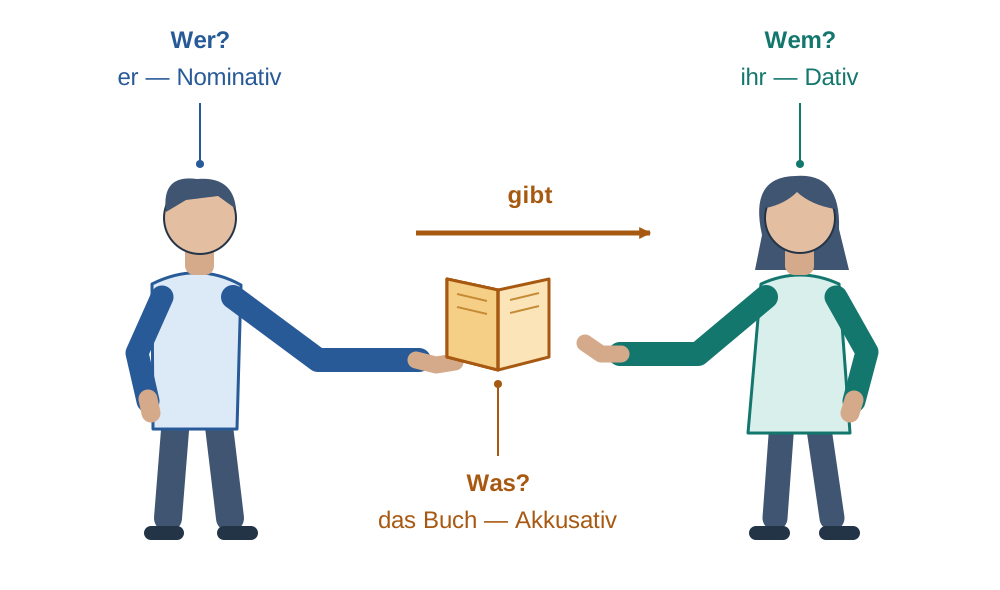
Notice the contrast between accusative and dative pronouns: Ich sehe dich (I see you; direct object) versus Ich helfe dir (I help you; dative verb). Similarly, Er gibt ihr das Buch shows ihr as the dative recipient, while Er besucht sie shows sie as the direct accusative object.
Reflexive Pronouns
Reflexive pronouns match the subject. All third-person and formal forms use sich.
| Kasus | ich | du | er/sie/es | wir | ihr | sie/Sie |
|---|---|---|---|---|---|---|
| Akkusativ | mich | dich | sich | uns | euch | sich |
| Dativ | mir | dir | sich | uns | euch | sich |
- Use the Akkusativ when there is no other direct object: Ich freue mich auf die Reise. (I am looking forward to the trip.)
- Use the Dativ when the sentence already contains a separate direct object: Ich putze mir die Zähne. (I brush my teeth.) / Ich kann mir das nicht vorstellen. (I cannot imagine that.)
Prepositions: Accusative, Dative, Genitive, and Two-Way
Prepositions govern the case of the following noun phrase regardless of the verb in the clause.
1. Accusative Prepositions
Memorise this core set: durch, für, gegen, ohne, um, bis.
- Ich kaufe ein Geschenk für meinen Vater. (meinen Vater = maskulin Akkusativ).
- Wir gehen durch den Wald. (den Wald = maskulin Akkusativ).
2. Dative Prepositions
The core set is aus, bei, mit, nach, seit, von, zu, along with außer and gegenüber.
- Nach der Schule fahre ich mit dem Bus nach Hause. (der Schule = feminin Dativ; dem Bus = maskulin Dativ).
- Sie wohnt bei ihrer Tante. (ihrer Tante = feminin Dativ).
3. Genitive Prepositions
These prepositions appear frequently in formal writing: anstatt / statt (instead of), außerhalb (outside of), innerhalb (inside of, within), trotz (in spite of), während (during), and wegen (because of).
- Trotz des schlechten Wetters gingen wir spazieren. (des schlechten Wetters = neutral Genitiv).
- Während der Ferien habe ich gearbeitet. (der Ferien = Plural Genitiv).
4. Two-Way Prepositions (Wechselpräpositionen)
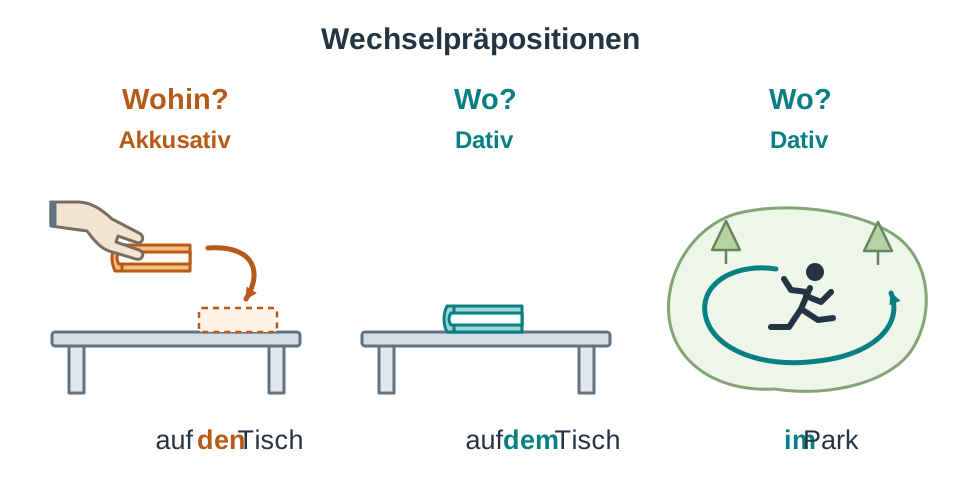
Nine prepositions govern either the accusative or the dative: an, auf, hinter, in, neben, über, unter, vor, zwischen.
Wohin? → Akkusativ (movement to a new place)
- Ich lege das Buch auf den Tisch. (Movement onto the surface of the table.)
- Wir gehen in die Stadt. (Movement into town.)
Wo? → Dativ (position, or movement inside one place)
- Das Buch liegt auf dem Tisch. (Stationary position on the table.)
- Er joggt im (in dem) Park. (Running inside the park; no boundary crossed).
Common Contractions
- an + dem = am | an + das = ans
- in + dem = im | in + das = ins
- bei + dem = beim | von + dem = vom | zu + dem = zum | zu + der = zur
Adjective Declension, Summary Grid, and Adjectival Nouns
German adjectives behave differently depending on whether they sit after the verb or directly in front of a noun.
1. Predicate Adjectives (No Endings)
When an adjective stands after linking verbs such as sein, werden, or bleiben, it takes no ending at all:
- Das Haus ist alt. (The house is old.)
- Die Aufgabe war schwer. (The task was difficult.)
2. Attributive Adjectives (Endings Required)
When an adjective stands directly before the noun it describes, its ending depends on the preceding article as well as the case, gender, and number of the noun.
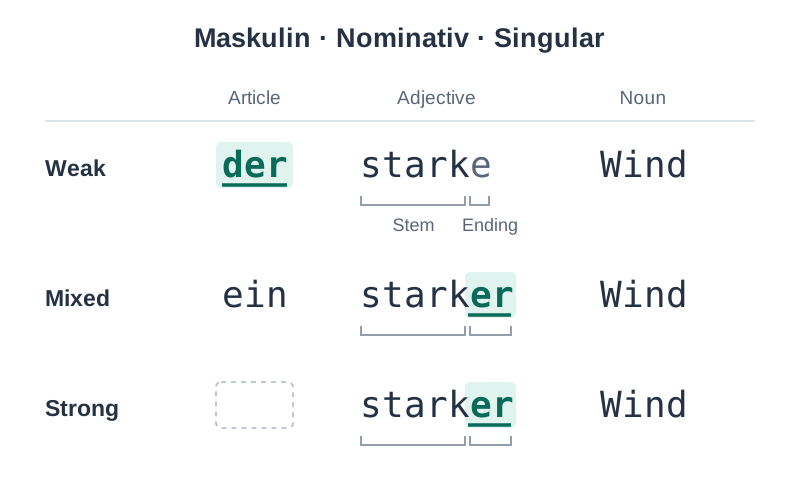
- Weak endings (after der, die, das, dieser, jeder): The definite article already signals the gender and case clearly. The adjective adds only -e in the nominative singular for all genders and the accusative feminine and neuter singular. All other positions take -en*.
- Mixed endings (after ein, eine, ein, kein, and possessives): Where ein carries no grammatical suffix (masculine nominative, neuter nominative and accusative), the adjective steps in to mark the gender with strong endings (-er for masculine, -es for neuter). Feminine takes -e. All plural forms, datives, genitives, and masculine accusatives take -en*.
- Strong endings (no preceding article): When there is no article before the noun, the adjective takes the ending of the definite article: der → -er, die → -e, das → -es, dem → -em, den → -en. The one exception is the masculine and neuter genitive, which take -en (wegen starken Windes).
Master Summary Grid of Adjective Endings
| Type | Kasus | Maskulin | Feminin | Neutral | Plural |
|---|---|---|---|---|---|
| Weak (der/die/das) | Nom. | -e | -e | -e | -en |
| Akk. | -en | -e | -e | -en | |
| Dat. | -en | -en | -en | -en | |
| Gen. | -en | -en | -en | -en | |
| Mixed (ein/mein/kein) | Nom. | -er | -e | -es | -en |
| Akk. | -en | -e | -es | -en | |
| Dat. | -en | -en | -en | -en | |
| Gen. | -en | -en | -en | -en | |
| Strong (no article) | Nom. | -er | -e | -es | -e |
| Akk. | -en | -e | -es | -e | |
| Dat. | -em | -er | -em | -en | |
| Gen. | -en | -er | -en | -er |
Adjectival Nouns
Some nouns are formed from adjectives. They are capitalised but keep standard adjective endings.
- der Jugendliche (the young person) → ein Jugendlicher (a young person) → Jugendliche (young people; no article, strong -e).
- Viele Jugendliche haben einen Nebenjob. (Many young people have a part-time job.)
- Die Jugendlichen von heute lernen fleißig. (Young people today learn hard.)
- Sein Vater ist Deutscher. (His father is German.)
After etwas, nichts, viel, and wenig, the adjective becomes a neuter noun ending in -es:
- etwas Neues** (something new)
- nichts Besonderes** (nothing special)
- Ich finde nichts Schlimmes dabei. (I see nothing wrong with it.)
Comparatives, Superlatives, and Descriptive Adjectives
Adjectives change form to express comparisons across people, objects, and ideas.
1. Comparative Forms
Add -er to the base adjective. Many one-syllable adjectives with a, o, or u add an umlaut:
- alt → älter (older)
- groß → größer (bigger / taller)
- jung → jünger (younger)
- warm → wärmer (warmer)
Common irregular and shifting comparative stems include:
- gut → besser (better)
- viel → mehr (more)
- gern → lieber (prefer to / rather)
- hoch → höher (higher)
- nah → näher (nearer / closer)
To compare elements in a sentence:
- Use als (than) with the comparative form: Mein Bruder ist fleißiger als ich. (My brother is more hardworking than me.)
- Use so ... wie (as ... as) with the base form: Er ist genauso alt wie seine Schwester. (He is just as old as his sister.)
If a comparative adjective stands before a noun, add the normal adjective ending after the -er comparative suffix: ein größerer Tisch (a bigger table).
2. Superlative Forms
- Predicative Superlative (am ...-sten): Used after sein or to describe how something is done: Dieser Zug fährt am schnellsten. (This train runs fastest.) Adjectives ending in -t, -d, -s, -ß, or -z add an extra -e- before -sten (but groß → am größten): alt → am ältesten, heiß → am heißesten, kurz → am kürzesten*.
- Attributive Superlative (der/die/das ...-ste): Sits directly before a noun and takes regular weak endings: Das ist das schönste Kleid im Geschäft.* (That is the most beautiful dress in the shop.)
High-Frequency Descriptive Adjectives
- Personality: freundlich (friendly), höflich (polite), klug (smart), ehrlich (honest), hilfsbereit (helpful), ernst (serious).
- Physical: groß (tall/big), klein (small), breit (wide), dünn (thin), sauber (clean), schmutzig (dirty).
- States: glücklich (happy), traurig (sad), wütend (angry), nervös (nervous), ruhig (calm), müde (tired).
- Evaluation: günstig (affordable), teuer (expensive), wichtig (important), nützlich (useful), schwierig (difficult).
Verb-Preposition Pairs, Da-Compounds, and Word Order
Many German verbs pair with specific prepositions that govern a fixed case. Learn them as set units.
- warten auf + Akkusativ: to wait for (Ich warte auf den Bus).
- hoffen auf + Akkusativ: to hope for (Sie hofft auf eine gute Note).
- denken an + Akkusativ: to think of/about (Sie denkt oft an ihre Ferien).
- sich erinnern an + Akkusativ: to remember (Er erinnert sich an den Tag).
- teilnehmen an + Dativ: to take part in (Wir nehmen an dem Wettbewerb teil).
- sich freuen auf + Akkusativ: to look forward to (Wir freuen uns auf die Reise).
- sich freuen über + Akkusativ: to be pleased about (Ich freue mich über das Geschenk).
- sich interessieren für + Akkusativ: to be interested in (Er interessiert sich für Geschichte).
- überzeugt sein von + Dativ: to be convinced of (Ich bin von der Idee überzeugt).
- sprechen über + Akkusativ: to talk about (Sie sprechen über das Thema).
- Angst haben vor + Dativ: to be afraid of (Das Kind hat Angst vor Hunden).
Da-Compounds (Pointing to Clauses or Things)
When a verb + preposition pair is followed by a whole dass- or zu-clause, or when you replace a thing already mentioned (instead of saying 'it'), the preposition becomes da(r) + preposition. With a noun you keep the normal preposition: Ich warte auf den Bus → Ich warte darauf. Add -r- before a vowel.
- Ich freue mich auf die Ferien. → Ich freue mich darauf, dass die Ferien beginnen. (I look forward to the holidays beginning.)
- Sie hofft auf eine gute Note. → Sie hofft darauf, eine gute Note zu bekommen. (She hopes to get a good grade.)
- Ich bin davon überzeugt, dass Sport wichtig ist. (I am convinced that sport is important.)
- Ich bin darüber erstaunt, dass er nicht mitkommt. (I am astonished that he is not coming along.)
- Wartest du auf den Bus? Ja, ich warte darauf. (Are you waiting for the bus? Yes, I am waiting for it.)
Essential Word Order Rules
- Inversion after introductory prepositional phrases: When a sentence opens with a prepositional phrase, that entire phrase occupies position one. The finite verb must follow immediately in second position:
- Meiner Meinung nach ist das ein großes Problem. (Not: Meiner Meinung nach das ist...)
- Trotz des Regens gingen wir in die Schule.
- Time, Cause, Manner, Place (TeKaMoLo: temporal, kausal, modal, lokal): When several adverbials appear together, keep this order:
- Ich fahre morgen (Time) mit dem Zug (Manner) nach Berlin (Place).
Negation and Question Formation
Negation and question forming are tested regularly in both grammar sections and written production.
Negation: nicht or kein?
- Use kein to negate nouns that would otherwise take ein/eine or no article. It declines with the exact same endings as ein (and meine in the plural):
- Ich habe einen Hund. → Ich habe keinen Hund. (I do not have a dog.)
- Wir haben Zeit. → Wir haben keine Zeit. (We have no time.)
- Use nicht to negate verbs, adjectives, adverbs, and nouns preceded by der/die/das or possessives:
- Das Buch ist nicht interessant. (The book is not interesting.)
- Ich kenne den Lehrer nicht. (I do not know the teacher.)
Where nicht sits:
- At the end of a simple sentence: Er kommt heute nicht.
- Directly before an adjective, a prepositional phrase, or a second verb part: Er fährt nicht nach Berlin. / Ich habe ihn nicht gesehen.
Additional useful negative terms:
- nie (never) | nichts (nothing) | niemand (nobody) | noch nicht (not yet)
- kein ... mehr (no more / not any longer): Ich habe keine Lust mehr.
- weder ... noch (neither ... nor): Er trinkt weder Kaffee noch Tee.
Forming Questions About an Underlined Phrase
When asked to form a question about a specific sentence element, use these four steps:
- Step 1: Identify the case of the underlined phrase.
- Step 2: Choose the matching interrogative pronoun:
- Wer? (Nominativ, person/subject): *Der Junge hatte ihr Fahrrad gestohlen. → Wer hatte ihr Fahrrad gestohlen?*
- Wen? (Akkusativ, person/direct object): Sie hat ihren Bruder gesehen. → *Wen hat sie gesehen?*
- Wem? (Dativ, person/indirect object): Er hilft seiner Mutter. → *Wem hilft er?*
- Wessen? (Genitiv, possession): Das ist Annas Handy. → *Wessen Handy ist das?*
- Was? (thing, nominative or accusative): Er kauft ein Auto. → *Was kauft er?*
- Step 3: Keep prepositions with the question word:
- For a person, combine preposition + wen/wem: Sie fährt mit ihrem Vater. → *Mit wem fährt sie?*
- For an inanimate object or concept, form a wo(r)-compound: Er wartet auf den Bus. → *Worauf wartet er? (Other examples: wovon, womit. Insert an -r- only when the preposition begins with a vowel: woran, worüber*.)
- Step 4: Place the conjugated verb second, straight after the question word: Worauf wartet er?
Key terms
- Nominativ
- The grammatical case marking the subject that performs the action or following linking verbs like sein, werden, and bleiben.
- Akkusativ
- The grammatical case indicating the direct object, expressions of definite time without a preposition, and objects of accusative prepositions.
- Dativ
- The case marking the indirect recipient or beneficiary, governed by dative verbs and dative prepositions; plural nouns add an -n ending unless already ending in -n or -s.
- Genitiv
- The case signalling possession or relationship between nouns, governed by genitive prepositions like während, wegen, and trotz.
- Wechselpräpositionen
- The nine dual-case prepositions (an, auf, hinter, in, neben, über, unter, vor, zwischen) taking accusative for destination (Wohin?) and dative for stationary location (Wo?).
- N-Deklination
- A group of weak masculine nouns (such as der Junge, der Mensch, der Herr) that add -(e)n in all cases except the nominative singular.
- Attributive Adjective
- An adjective placed directly before a noun that must take an inflectional ending reflecting gender, number, case, and preceding determiner.
- Predicate Adjective
- An adjective standing after a linking verb (sein, werden, bleiben); it remains in its base dictionary form and takes no inflectional ending.
- Adjectival Noun
- A noun derived from an adjective (such as die Jugendlichen or etwas Neues) that is capitalised but keeps standard adjective declension endings.
- Da-Compound
- A combination of da(r)- plus a preposition (such as darauf or davon) used to refer back to an inanimate object or forward to a subordinate clause.
Check yourself
Which case is governed by the prepositions 'aus', 'bei', 'mit', and 'seit'?
The dative case (Dativ).
Identify the number, gender, and case of the article 'der' in the following sentence: 'Er hilft der alten Frau über die Straße.'
Singular, feminin, Dativ ('helfen' takes the dative case, and 'Frau' is feminine).
Form a question asking about the underlined phrase: 'Er fährt mit seinem Bruder nach Berlin.'
'Mit wem fährt er nach Berlin?' ('mit' takes the dative, and the phrase refers to a person).
Supply the missing adjective ending: 'Wir trinken gern heiß___ Tee.' (masculine accusative, no preceding article).
'heißen Tee'. Unpreceded adjectives take strong endings that reflect the definite article (masculine accusative 'den' gives '-en').
Turn this statement into a sentence using a da-compound: 'Ich freue mich auf die Sommerferien.' → 'Ich freue mich ______, dass die Ferien beginnen.'
'darauf' (da- + -r- + auf, because 'auf' begins with a vowel and introduces a subordinate clause).