

The present tense (das Präsens) and modal verbs (Modalverben) form the backbone of grammatical accuracy in Leaving Certificate Higher Level German. You need them across every component of the examination: reading and listening comprehensions, the applied grammar section (Angewandte Grammatik), written production tasks like the opinion piece, letter, or diary, and your oral exam. Unlike English, German has no continuous tense, so 'ich lerne' translates both 'I learn' and 'I am learning'. Getting stem-vowel changes and modal word order right improves the accuracy and range of language that examiners reward in your writing and in the oral.
Regular Verbs and Essential Spelling Rules
To conjugate a regular (weak) verb in the present tense, strip the infinitive ending -en to find the stem (Wortstamm), then add the personal endings.
| Pronoun | Ending | lernen (to learn) | arbeiten (to work) |
|---|---|---|---|
| ich | -e | lerne | arbeite |
| du | -st | lernst | arbeitest |
| er / sie / es | -t | lernt | arbeitet |
| wir | -en | lernen | arbeiten |
| ihr | -t | lernt | arbeitet |
| sie / Sie | -en | lernen | arbeiten |
Spelling adjustments
- Stems ending in -d or -t (e.g. arbeiten, warten, finden) or consonant clusters like -chn or -tm (zeichnen, atmen): add an extra -e- before endings starting with -st or -t so the word rolls off the tongue: du arbeitest, er wartet, ihr findet.
- Stems ending in an s-sound (-s, -ss, -ß, -z) (e.g. heißen, reisen, tanzen): the du form drops the -s from the ending because the s-sound is already there: du heißt (never du heißst), du tanzt.
- Stems ending in -eln (e.g. sammeln, lächeln): the ich form drops the interior -e- (ich sammle, ich lächle), while the plural wir and sie/Sie forms add only -n (wir sammeln, sie lächeln).
Irregular Verbs: Stem-Vowel Changes and Key Patterns
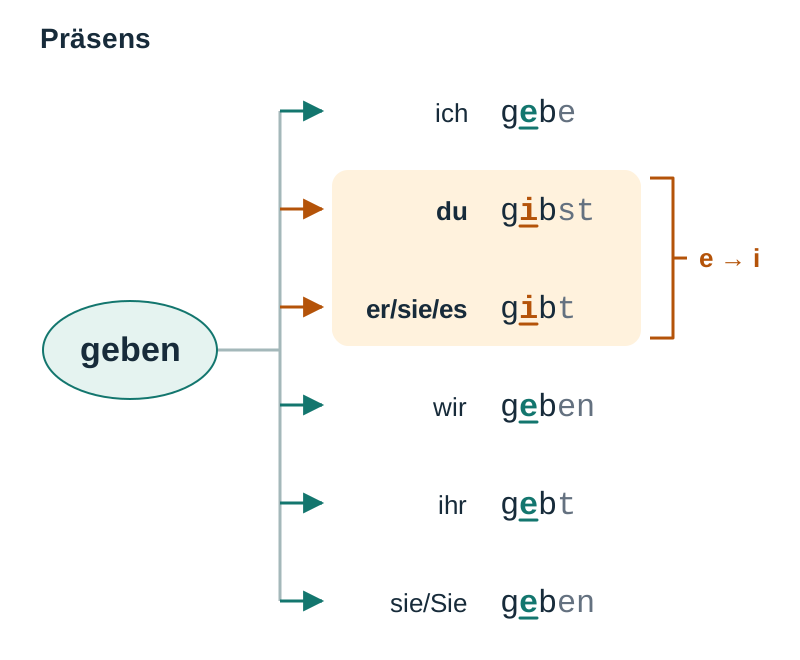
Many high-frequency German verbs undergo a stem-vowel change in the present tense. This vowel change happens only in the second person singular (du) and third person singular (er/sie/es). The ich form and all plural forms (wir, ihr, sie/Sie) keep the original infinitive vowel.
There are four main vowel change patterns:
- e → i
- geben (to give): ich gebe, du gibst, er gibt, wir geben, ihr gebt, sie geben
- helfen (to help): du hilfst, er hilft
- sprechen (to speak): du sprichst, er spricht
- treffen (to meet): du triffst, er trifft
- e → ie
- sehen (to see): ich sehe, du siehst, er sieht, wir sehen, ihr seht, sie sehen
- lesen (to read): du liest, er liest
- empfehlen (to recommend): du empfiehlst, er empfiehlt
- stehlen (to steal): du stiehlst, er stiehlt
- a → ä
- fahren (to travel / drive): ich fahre, du fährst, er fährt, wir fahren, ihr fahrt, sie fahren
- schlafen (to sleep): du schläfst, er schläft
- tragen (to carry / wear): du trägst, er trägt
- au → äu
- laufen (to run): ich laufe, du läufst, er läuft, wir laufen, ihr lauft, sie laufen
Verbs ending in -t with vowel changes
When a verb with an a → ä shift has a stem ending in -t, such as halten or raten, it does not add an extra -et in the third person singular. The ending contracts directly onto the stem: er hält (not er hältet) and er rät.
High-frequency verbs to learn by heart
- nehmen (to take): du nimmst, er nimmt (the h drops and the m doubles)
- essen (to eat): du isst, er isst
- vergessen (to forget): du vergisst, er vergisst
- werfen (to throw): du wirfst, er wirft
- gefallen (to please / to like): es gefällt mir (I like it); Wie gefällt Ihnen Irland? (How do you like Ireland?)
- waschen (to wash): du wäschst, er wäscht
Separable verbs in the present
In a simple main clause, the verb takes position 2 and the separable prefix goes right to the end. The vowel change still occurs: Der Film fängt um acht Uhr an. (The film starts at eight.) Ich lade dich ein. (I am inviting you.) In a subordinate clause, the verb joins back together at the very end: ..., weil der Film um acht Uhr anfängt.
Essential auxiliaries and wissen
The three helping verbs are irregular and must be memorised:
- sein (to be): ich bin, du bist, er ist, wir sind, ihr seid, sie/Sie sind
- haben (to have): ich habe, du hast, er hat, wir haben, ihr habt, sie/Sie haben
- werden (to become / will): ich werde, du wirst, er wird, wir werden, ihr werdet, sie/Sie werden
Watch out for two common traps with these forms: ihr seid (you are) is often confused with the preposition seit (since), and plural forms like ihr fahrt or ihr lauft never take an umlaut.
The verb wissen (to know a fact) behaves like a modal in the present: its vowel changes to -ei- in the singular, and the ich and er/sie/es forms take no ending: ich weiß, du weißt, er/sie/es weiß, wir wissen, ihr wisst, sie/Sie wissen.
The Six Modal Verbs and möchten
German has six modal verbs. There is also möchte(n) ('would like'), the polite form of mögen, which you use like a seventh modal.
| Infinitive | Meaning | ich | du | er/sie/es | wir | ihr | sie/Sie |
|---|---|---|---|---|---|---|---|
| können | can / able to | kann | kannst | kann | können | könnt | können |
| dürfen | may / allowed to | darf | darfst | darf | dürfen | dürft | dürfen |
| müssen | must / have to | muss | musst | muss | müssen | müsst | müssen |
| sollen | should / supposed to | soll | sollst | soll | sollen | sollt | sollen |
| wollen | to want to | will | willst | will | wollen | wollt | wollen |
| mögen | to like | mag | magst | mag | mögen | mögt | mögen |
| möchten | would like | möchte | möchtest | möchte | möchten | möchtet | möchten |
Here is how each modal works in everyday sentences:
- Ich kann gut schwimmen. (I can swim well.)
- Darf ich das Fenster öffnen? (May I open the window?)
- Wir müssen um acht Uhr in der Schule sein. (We have to be in school at eight.)
- Du sollst mehr Wasser trinken. (You are supposed to drink more water.)
- Er will Ingenieur werden. (He wants to become an engineer.)
- Ich mag Hunde. (I like dogs.)
- Ich möchte ein Eis kaufen. (I would like to buy an ice cream.)
Rules for modal conjugation
- In the singular forms (ich, du, er/sie/es), the stem vowel changes for every modal except sollen (können → a, dürfen → a, müssen → u, wollen → i, mögen → a).
- For the six core modals, the ich and er/sie/es forms are identical and have a zero ending: never add -e or -t to these forms (ich kann, er kann; ich darf, sie darf).
- Exception for möchte(n): it keeps its -e in the singular: ich möchte, du möchtest, er/sie/es möchte. The ich and er forms are still identical, but they end in -e, never -t.
Watch out: wollen is not 'will'
ich will means I want (to), never 'I will'. For example, Ich will Ärztin werden means 'I want to become a doctor'. Translating 'will' as future tense here is a serious error. To express the future, use werden + infinitive (Ich werde Ärztin werden) or the present tense with a time expression (Nächstes Jahr lerne ich fleißig).
Crucial distinction: nicht dürfen versus nicht müssen
- nicht dürfen expresses strict prohibition (must not / are not allowed to): Man darf hier nicht parken. (You are not allowed to park here.)
- nicht müssen expresses the absence of obligation (do not have to / need not): Du musst die Hausaufgaben heute nicht machen. (You do not have to do the homework today.)
Modals in the Past, Polite Forms, and Register
Leaving Certificate tasks frequently require modal verbs beyond the present tense, especially in diary entries, formal letters, and oral role-plays.
Modals in the simple past (Präteritum)
To form the simple past of a modal, drop the umlaut from the infinitive and add regular past endings (-te, -test, -te, -ten, -tet, -ten). Watch mögen: the g changes to ch as well (ich mochte).
| Infinitive | Präteritum (ich / er) | Meaning |
|---|---|---|
| können | konnte | could / was able to |
| dürfen | durfte | was allowed to |
| müssen | musste | had to |
| sollen | sollte | was supposed to |
| wollen | wollte | wanted to |
| mögen | mochte | liked |
In diaries and informal letters, always use these simple past forms instead of the perfect tense: Gestern musste ich um sechs Uhr aufstehen (Yesterday I had to get up at six); Leider konnte ich nicht kommen (Unfortunately I couldn't come).
Polite and conditional modal forms (Konjunktiv II)
When making requests or giving advice, the umlaut returns for modals whose infinitive has one:
- könnte (could, would be able to): Könnten Sie das bitte wiederholen? (Could you please repeat that?)
- dürfte (might / may I): Dürfte ich eine Frage stellen? (Might I ask a question?)
- müsste (would have to): Man müsste eigentlich mehr für den Umweltschutz tun. (One would really have to do more for environmental protection.)
- sollte (should, ought to): Man sollte weniger Plastik benutzen. (One should use less plastic.)
- Alongside modals, use Wäre es möglich, ...? (Would it be possible...?) and Ich würde gern ... (I would like to...).
Choosing du, ihr, or Sie (register)
- du: one friend, classmate, family member, or young person (Kannst du mir helfen?).
- ihr: two or more friends, family members, or young people (Könnt ihr morgen kommen?).
- Sie: one or more adults you do not know well, or anyone in an official role such as an examiner, hotel receptionist, shop assistant, or employer. It is always written with a capital S and takes the same verb form as wir and sie: Können Sie mir helfen?
Always maintain consistency: use du / dich / dir / dein in informal letters, and use Sie / Ihnen / Ihr in formal letters and official role-plays. Never mix them in the same piece of writing.
Sentence Structure: The Modal Sentence Bracket (Satzklammer)
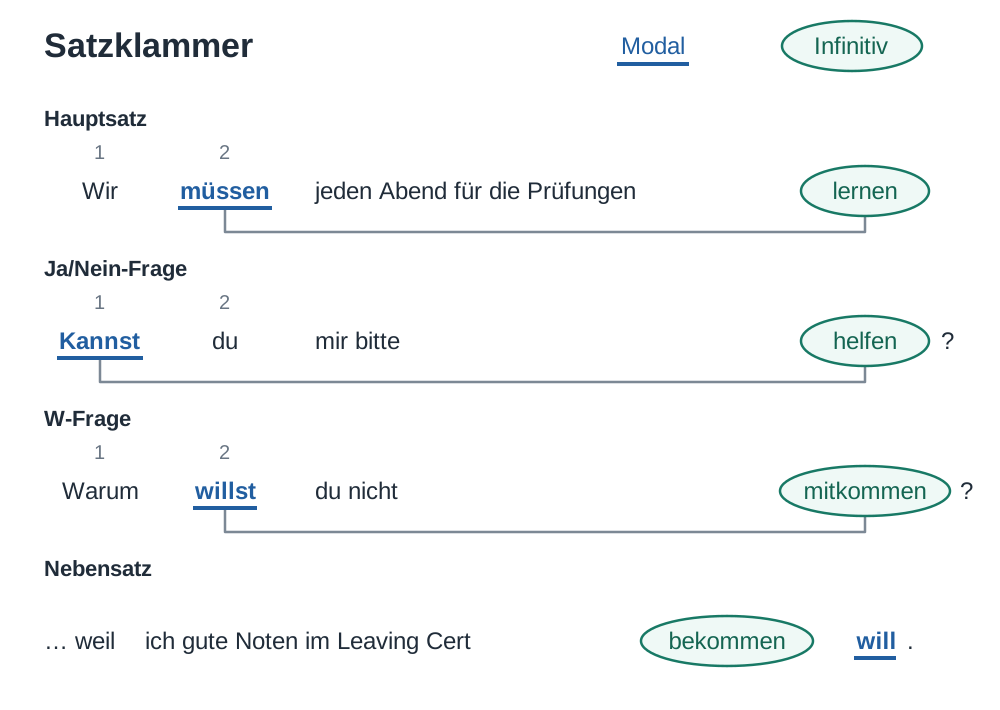
When a modal verb pairs with another verb in a sentence, it sets up a grammatical frame called the sentence bracket (Satzklammer).
1. Main clauses
The conjugated modal verb sits in position 2. The main action verb stays in the infinitive at the end of the clause:
- Wir müssen jeden Abend für die Prüfungen lernen. (We have to study for the exams every evening.)
2. Questions
- Yes/No questions: The modal takes position 1, and the infinitive finishes the clause: Kannst du mir bitte helfen? (Can you please help me?)
- W-questions: The question word sits in position 1, the modal in position 2, and the infinitive at the end: Warum willst du nicht mitkommen? (Why don't you want to come along?)
3. Separable verbs with modals
Normally, a separable verb splits in a present-tense main clause (Er steht früh auf). When governed by a modal, the prefix stays attached, and the whole verb sits as an infinitive at the end:
- Er muss morgen früh aufstehen. (He has to get up early tomorrow.)
4. Subordinate clauses (Nebensätze)
In clauses started by subordinating conjunctions like weil, dass, obwohl, or wenn, verbs move to the end. The infinitive comes second-to-last, and the conjugated modal verb finishes the clause:
- Ich lerne fleißig, weil ich gute Noten im Leaving Cert bekommen will. (I study hard because I want to get good grades in the Leaving Cert.)
5. Working backwards to the infinitive
Angewandte Grammatik questions have asked you to identify the infinitive, tense, and number of a verb from a reading passage. Follow this process:
- Check the subject to determine if the form is singular or plural.
- Strip the ending (-e, -st, -t, -en).
- Reverse any stem-vowel change: i or ie reverts to e, and ä reverts to a (e.g. er hilft → helfen; sie liest → lesen; du fährst → fahren). For modal verbs, return to the plural infinitive vowel (darf → dürfen; will → wollen).
- State the tense in German: das Präsens (present), das Präteritum (simple past), or das Perfekt (perfect).
For example: Stella spricht mit Jason. → Infinitiv: sprechen; Zeit: Präsens; Form: Singular.
Key terms
- das Präsens
- The German present tense, used for current actions, habitual events, ongoing states, and scheduled future actions when paired with a time expression.
- der Wortstamm
- The verb stem, found by removing the -en or -n ending from the infinitive form of the verb.
- stem-vowel change
- A vowel change (such as e to i, e to ie, a to ä, or au to äu) that occurs only in the du and er/sie/es forms of strong verbs in the present tense.
- Modalverben
- The six German verbs (dürfen, können, mögen, müssen, sollen, wollen) used with an infinitive to express permission, ability, preference, obligation, advice, or intention.
- zero ending
- The absence of any grammatical suffix on the ich and er/sie/es forms of the six core modal verbs and the verb wissen in the present tense (e.g. ich muss, er darf).
- Satzklammer
- The sentence bracket structure where the finite conjugated verb takes position 2 and the infinitive or separable prefix goes to the absolute end of the clause.
- Inversion
- Putting the verb before the subject. This happens in yes/no questions (Kannst du...?) and whenever anything other than the subject comes first in a main clause.
- Sie (formal)
- The polite pronoun used when addressing one or more adults you do not know well or anyone in an official setting. Always capitalised, and takes the same verb form as wir and sie (they), e.g. Sie lernen, Sie können, Sie sind.
Check yourself
What are the du and er forms of the strong verb 'nehmen' in the present tense?
du nimmst, er nimmt (the vowel shifts from e to i, the h drops, and the m doubles).
Give the du form of 'heißen' and the er form of 'arbeiten'.
du heißt (drops the s from -st because the stem ends in ß) and er arbeitet (inserts an extra -e- before -t because the stem ends in -t).
For the verb form 'sie hilft', state the infinitive, tense, and number.
Infinitiv: helfen; Zeit: Präsens; Form: Singular.
Translate into German: 'We do not have to go to school tomorrow.'
Wir müssen morgen nicht zur Schule gehen (using 'nicht müssen', not 'nicht dürfen').
Rewrite this sentence with the modal 'können': 'Kommst du morgen mit?'
Kannst du morgen mitkommen? (The modal takes position 1 in the question, and the separable verb 'mitkommen' stays whole at the end).
How do you conjugate 'dürfen' for 'ich' and 'ihr' in the present tense?
ich darf (vowel changes to a, zero ending) and ihr dürft (keeps the infinitive stem vowel ü, adds regular -t ending).