

You will use this language to give advice in letters, argue in opinion pieces and role-plays, and spot viewpoints and tone in reading and listening comprehensions. In Leaving Certificate Higher Level German, expressing viewpoints and giving advice spans all four components: Oral (25%), Written Production (25%), Reading Comprehension (30%), and Listening Comprehension (20%). Scoring top marks requires moving beyond repetitive openers by mastering verb-second word order, subordinate clauses with verbs at the end, polite suggestions in the subjunctive mood, and precise connectors to weigh arguments.
Expressing Opinions and the Verb-Second (V2) Rule
Sharing your viewpoint effectively requires varied openers and accurate word order. In a German main clause (Hauptsatz), the conjugated verb must be the second element.
The most frequent introductory phrase in Leaving Certificate essays is Meiner Meinung nach (in my opinion) or Meiner Ansicht nach (in my view). Because this introductory phrase occupies the entire first position, the conjugated verb must come immediately next in position two, followed by the subject:
- Meiner Meinung nach ist dieses Thema besonders wichtig. (In my opinion, this topic is particularly important.)
- Meiner Ansicht nach sollten die Politiker sofort handeln. (In my view, politicians should act immediately.)
Avoid writing Meiner Meinung nach ich denke... or placing the subject before the verb. This English word order is one of the most common errors examiners see, and it costs Expression marks. If you prefer not to invert, start with the subject and put the phrase after the verb (Viele Schüler schlafen meiner Meinung nach zu wenig.), or use Ich bin der Meinung, dass… (I am of the opinion that…).
(Note on spelling: The syllabus and older exam papers print the spelling daß, but you should always write the modern spelling dass.)
Subordinate Clauses, Justifying Views, and Da-Compounds
When you introduce an opinion using a subordinating conjunction like dass (that) or weil (because), you create a subordinate clause (Nebensatz). In a subordinate clause, the conjugated verb is sent to the very end of the clause.
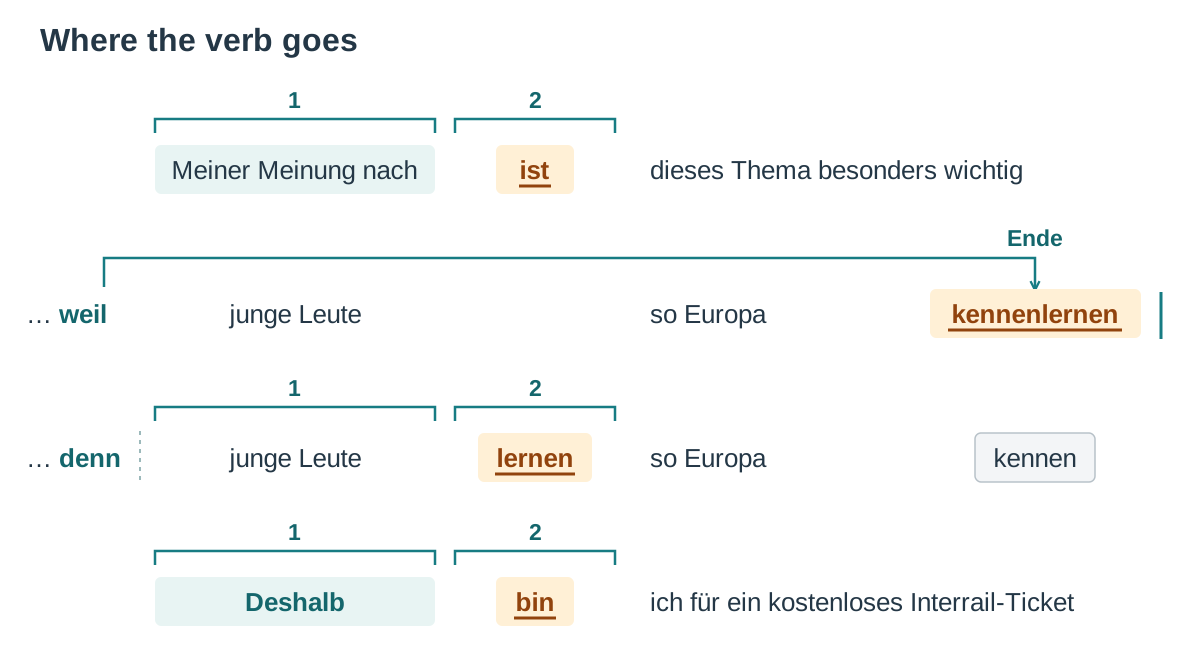
Giving reasons: weil vs denn vs deshalb
Justifying your opinion earns substantial Content marks in written tasks:
- weil (because) sends the verb to the end: Ich finde die Idee gut, weil junge Leute so Europa kennenlernen.* (I think the idea is good because young people get to know Europe that way.)
- denn (because / for) keeps normal word order, with the verb in position two: Ich finde die Idee gut, denn junge Leute lernen so Europa kennen.*
- deshalb / deswegen (that is why / therefore) takes position one, so the verb comes straight after it: Deshalb bin ich für ein kostenloses Interrail-Ticket.* (That is why I am in favour of a free Interrail ticket.)
Da-compounds before a dass-clause
Some adjectives and verbs take specific prepositions, such as überzeugt von (convinced of) or erstaunt über (amazed at). When followed by a whole clause, put da- + the preposition before the comma (or dar- if the preposition begins with a vowel):
- Ich bin davon überzeugt, dass Sport gesund ist. (I am convinced that sport is healthy.)
- Ich bin darüber erstaunt, dass so viele Lebensmittel weggeworfen werden. (I am amazed that so much food is thrown away.)
- Ich bin dafür / dagegen, dass Handys in der Schule verboten werden. (I am in favour of / against phones being banned in school.)
Reporting verbs and recognising Konjunktiv I
In reading texts, you will often meet reporting verbs (Verben des Mitteilens) such as behaupten (to claim), zugeben (to admit), and betonen (to emphasise). It is dass that sends the verb to the end:
- Der Autor behauptet, dass viele Jugendliche im Internet gemobbt werden. (The author claims that many teenagers are bullied online.)
In quality newspapers, journalists report utterances using the indirect speech subjunctive (Konjunktiv I), especially in the third person: sei (is), habe (has), werde (will), könne (can), müsse (must):
- Er behauptet, dass das eine Lüge sei. (He claims that it is a lie.)
- Die Ministerin sagte, die Regierung werde mehr investieren. (The minister said the government would invest more.)
In reading comprehension answers written in English, treat these forms as reported claims and attribute them to the speaker rather than stating them as confirmed facts. In your own writing, dass with standard indicative verbs is completely acceptable: Sie sagt, dass der Zug spät ankommt.
Giving Advice, Suggestions, and Role-Play Dialogue
Offering advice requires adapting your register to the task: an informal letter to a friend (du), a role-play with an adult host or official (Sie), or an opinion piece (man).
Subjunctive advice (Konjunktiv II)
- To a friend (du): An deiner Stelle würde ich sofort mit der Lehrerin sprechen.* (If I were you, I would speak to the teacher immediately.)
- Gentle advice: Du solltest dich besser vorbereiten. (You should prepare better.)
- Collaborative ideas: Wir könnten am Wochenende eine Radtour machen. (We could go on a bike tour at the weekend.)
- Verbs of advice: raten and empfehlen take a dative person and a zu-infinitive: Ich rate dir, mehr zu schlafen. (I advise you to sleep more.) / Ich empfehle dir, eine Sprach-App zu benutzen. (I recommend that you use a language app.)
Polite requests and suggestions
- Wäre es möglich, das Zimmer zu wechseln? (Would it be possible to change rooms?)
- Hätten Sie etwas dagegen, wenn ich das Fenster öffne? (Would you mind if I opened the window?)
- Könntest du nicht früher kommen? (Could you not come earlier?)
- Wie wäre es mit einem Ausflug nach Galway? (How about an excursion to Galway? Note: mit + dative)
- Lass uns ins Kino gehen! (Let us go to the cinema!)
- Warum machen wir nicht eine Radtour? (Why don't we do a bike tour?)
- Suggesting in the past: Er schlug eine Reise vor. (He suggested a trip.)
Forming commands: the imperative (Befehlsform)
- du form:* Take the du present tense, drop du and the -st. Retain vowel changes (), drop umlauts (): Komm!, Nimm!, Fahr!, Arbeite!, Sei vorsichtig!, Ruf mich an!*
- ihr form:* Verb matches regular ihr without the pronoun: Kommt!, Seid leise!*
- Sie form:* Invert verb and pronoun: Kommen Sie herein!, Seien Sie bitte vorsichtig!*
Sample role-play dialogue (Host parent & student)
- Gastmutter: Möchtest du heute Abend mit uns in die Stadt fahren? (Would you like to drive into town with us this evening?)
- Schüler(in): Das geht heute leider nicht, weil ich für die Deutschprüfung lernen muss. Aber wie wäre es mit morgen Abend? (Unfortunately that is not possible today because I have to study for the German exam. But how about tomorrow evening?)
- Gastmutter: Gute Idee! Wir könnten morgen ins Theater gehen. (Good idea! We could go to the theatre tomorrow.)
- Schüler(in): Wunderbar! Dürfte ich vielleicht einen Freund mitbringen? (Wonderful! Might I perhaps bring a friend along?)
- Gastmutter: Natürlich, kein Problem! (Of course, no problem!)
Obligation, Bans, and Past Modals: Müssen, Dürfen, and Trotz
Rules, permissions, and prohibitions are central to role-plays, opinion topics, and letters.
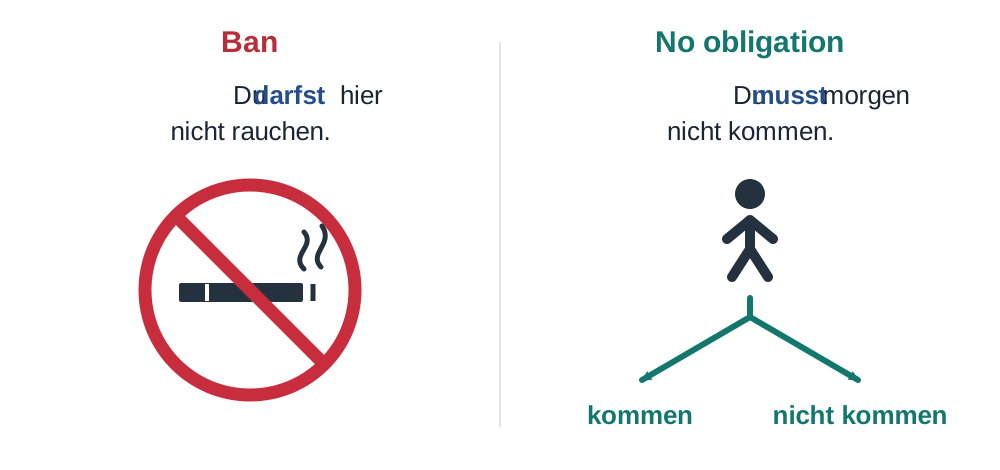
Don't have to vs must not
In English, 'must not' signifies a ban. In German, nicht müssen means there is no obligation. For a prohibition, you must use nicht dürfen:
- Du darfst hier nicht rauchen. = You must not / are not allowed to smoke here. (a ban)
- Du musst morgen nicht kommen. = You do not have to come tomorrow. (no obligation)
- Du brauchst morgen nicht zu kommen. = You do not need to come tomorrow. (alternative to nicht müssen)
Forbidding and permitting: verbieten and erlauben
Both verbs govern the dative of the person, followed by a zu-infinitive:
- Meine Eltern haben mir verboten, Musik illegal herunterzuladen. (My parents forbade me to download music illegally.)
- Die Schule erlaubt den Schülern, Handys in den Pausen zu benutzen. (The school allows students to use phones during breaks.)
- Nouns: das Verbot (the ban), die Erlaubnis (the permission).
Modal verbs in the past (Präteritum) vs Konjunktiv II
In the simple past tense, modal verbs lose their umlauts. Adding an umlaut changes the meaning to hypothetical or polite subjunctive (Konjunktiv II):
| Verb | Past / Präteritum | Konjunktiv II |
|---|---|---|
| dürfen | durfte (was allowed to) | dürfte (might / would be allowed) |
| können | konnte (was able to / could) | könnte (could / would be able to) |
| müssen | musste (had to) | müsste (would have to) |
| sollen | sollte (was supposed to) | sollte (should) |
| wollen | wollte (wanted to) | wollte (would want to) – same form as the past |
| mögen | mochte (liked) | möchte (would like) |
- Als ich fünfzehn war, durfte ich nicht allein in die Stadt fahren. (When I was fifteen, I was not allowed to go into town alone.)
- Letztes Jahr musste mein Bruder eine Geldstrafe zahlen. (Last year my brother had to pay a fine.)
The preposition trotz
Theme 1.7 highlights trotz (despite). In standard written German, trotz governs the genitive case (Genitiv):
- Trotz meines Verbotes hat er die Party besucht. (Despite my ban, he went to the party.)
- Trotz des schlechten Wetters machten wir eine Wanderung. (Despite the bad weather, we went for a hike.)
Essential Comprehension and Discussion Vocabulary
Leaving Certificate reading and listening passages frequently use specific vocabulary to express advice, demands, and arguments:
Advice and suggestions
- der Rat / die Ratschläge = advice / pieces of advice
- raten (+ Dativ) = to advise
- die Empfehlung (-en) = recommendation; empfehlen = to recommend
- der Vorschlag (die Vorschläge) = suggestion; vorschlagen = to suggest
Permission and bans
- die Erlaubnis = permission; erlauben (+ Dativ) = to permit
- das Verbot (-e) = ban / prohibition; verbieten (+ Dativ) = to forbid
Demands and conflict
- die Forderung (-en) = demand; fordern / verlangen = to demand
- nachgeben = to give in / yield (e.g. to trade union demands)
- auffordern zu = to call on / urge someone to do something
Pros, cons, and public announcements
- der Vorteil (-e) = advantage; der Nachteil (-e) = disadvantage
- dafür sein = to be in favour; dagegen sein = to be against
- ablehnen = to reject; kritisieren = to criticise
- Man sollte... = One should...
- Es wird empfohlen, ... zu... = It is recommended to...
- Sie sollten auf keinen Fall... = You should on no account...
Key terms
- Meiner Meinung nach
- Introductory phrase meaning 'in my opinion'. It fills position one in the clause and must be followed immediately by the conjugated verb in position two.
- dass
- Subordinating conjunction meaning 'that'. It sends the conjugated verb to the very end of the clause. (Modern standard spelling of 'daß').
- an deiner Stelle würde ich
- Formula for giving informal advice meaning 'if I were you / in your place, I would', followed by an infinitive at the end of the clause.
- dürfen
- Modal verb meaning 'to be allowed to / may'. Used for asking or granting permission. Combined with 'nicht', it signifies a strict ban ('must not').
- müssen nicht
- Phrase expressing absence of obligation ('do not have to'), in sharp contrast to 'dürfen nicht' ('must not / forbidden').
- weil vs denn
- Two ways to say 'because'. 'Weil' is subordinating and sends the verb to the end; 'denn' is coordinating and keeps normal subject-verb order.
- trotz (+ Genitiv)
- Preposition meaning 'despite'. In standard written German, it governs the genitive case (for example, 'trotz des Verbotes').
- zustimmen (+ Dativ)
- Separable verb meaning 'to agree with'. The person or idea agreed with must be in the dative case (for example, 'Dem stimme ich zu').
- widersprechen (+ Dativ)
- Inseparable verb meaning 'to contradict / disagree with'. It requires the dative case (for example, 'Da muss ich dir widersprechen').
- einerseits ... andererseits
- Paired linking adverbs meaning 'on the one hand ... on the other hand', used to weigh contrasting points. Each takes position one and forces verb-second order.
- behaupten
- Reporting verb meaning 'to claim / assert', frequently found in reading texts to introduce claims that may require critical evaluation.
- der Konjunktiv I
- Subjunctive forms (sei, habe, werde, könne) used in news and reports to indicate reported speech without confirming the statement as fact.
Check yourself
Which word order error is present here: 'Meiner Meinung nach viele Schüler schlafen zu wenig'?
'Meiner Meinung nach' occupies position one, so the conjugated verb must come second: 'Meiner Meinung nach schlafen viele Schüler zu wenig.'
Correct the syntax error in this subordinate clause: 'Ich bin dafür, weil es ist billig.'
'Weil' sends the conjugated verb to the end of the clause: 'Ich bin dafür, weil es billig ist.' (Alternatively with 'denn': 'Ich bin dafür, denn es ist billig.')
Translate into German: 'You must not do that' and 'You don't have to do that'.
'Das darfst du nicht machen' (ban) and 'Das musst du nicht machen' (no obligation).
How do you advise a friend politely in a letter: 'If I were you, I would speak to your parents'?
'An deiner Stelle würde ich mit deinen Eltern sprechen.' (Uses 'an deiner Stelle' followed by the Konjunktiv II verb 'würde', with the infinitive 'sprechen' at the end).
Combine these two opposing statements using 'Einerseits ... andererseits': 'Der Tourismus bringt viel Geld.' / 'Er schadet der Umwelt.'
'Einerseits bringt der Tourismus viel Geld, andererseits schadet er der Umwelt.' (Both linking adverbs occupy position one and require the verb in position two).