

The Leaving Certificate Higher Level French opinion piece tests your ability to take a firm stance on a topical issue and defend it with coherent arguments. Written production carries 100 marks (25% of your total mark in Higher Level French) in Section II of the written paper. Every response is assessed on an equal split between Communication and Language. Scoring high marks requires answering the exact question asked, exploiting the prompt or stimulus text, deploying varied logical connectors, handling the subjunctive and conditional moods and the future tense accurately, and maintaining consistent grammatical control.
Section II Architecture and Assessment Principles
Section II (Written Production) carries 100 marks, representing 25% of your total mark in Higher Level French. On recent papers, Section II has usually followed this pattern:
- Question 1 (Compulsory, 40 marks): You choose between option (a), typically an opinion piece based on a stimulus phrase or linked to the Section I reading text, or option (b), which is often a narrative or an informal letter. The prompt asks for approximately 90 words (environ 90 mots).
- Questions 2, 3, and 4 (Choose two, 30 marks each): These offer choices between shorter opinion pieces, formal letters, diary entries, or notes. Each prompt asks for approximately 75 words (environ 75 mots).
Check the instructions on your own examination paper carefully, as layout and optional formats can vary.
Every written production task is marked using two equal criteria:
- Communication (50% of marks): Assesses how directly and completely you answer the prompt, whether you exploit the stimulus material, the clarity of your stance (prise de position), and the logical flow of your ideas. If you write off-topic or produce a pre-memorised essay that ignores the question, you lose heavily on Communication, and even excellent French cannot make up for not answering the question that was asked.
- Language (50% of marks): Assesses grammatical accuracy (verb endings, noun-adjective agreements, prepositions), lexical range, and appropriate register.
The examination prompt specifies environ 90 mots for Question 1 and environ 75 mots for Questions 2 to 4. Aim roughly for 90 to 110 words for Question 1 and 75 to 95 words for the shorter tasks. That provides enough room for a clear opinion, two developed points, and a concession. Writing 150 to 200 words earns no extra credit; it simply wastes time and multiplies your risk of basic agreement errors.
Note: Do not confuse written production opinion pieces with the final question of Section I Reading Comprehension (such as Q1.6). Those reading questions ask for your opinion on a character or topic based on the passage, but they are answered in English or Irish using specific textual evidence.
Exploiting the Stimulus and Matching the Question Type
Examiners specifically credit candidates who show that the stimulus material is well exploited. Many prompts open with a quotation, a statistical finding, or a reference back to a reading passage in Section I. Pick up the stimulus directly in your opening sentence, rephrasing it in your own words rather than copying long phrases word for word.
Opening Techniques for Stimulus Prompts
- Comme le montre le texte, la vie en France rurale devient de plus en plus difficile. C'est aussi le cas en Irlande. (As the text shows, life in rural France is becoming more and more difficult. The same is true in Ireland.)
- Selon l'article, 80 % du temps consacré au sport à la télévision ne montre que des hommes. Je trouve ce chiffre choquant. (According to the article, 80% of sports airtime on television shows only men. I find this figure shocking.)
- Contrairement à la France, l'Irlande attire de plus en plus de touristes. (Unlike France, Ireland is attracting more and more tourists.)
Matching Your Opening to the Question Type
Leaving Certificate prompts recur in several distinct forms. Match your opening stance to the operative phrase:
- Êtes-vous d'accord ? (Do you agree?)
- Je suis tout à fait d'accord avec cette affirmation. (I completely agree with this statement.)
- Je ne partage pas du tout cet avis. (I do not share this view at all.)
- Je suis d'accord jusqu'à un certain point. (I agree up to a point.)
- Donnez votre réaction (Give your reaction): React emotionally or critically first, then supply your reasons.
- Quel scandale ! Je trouve inacceptable que les sportives soient si peu visibles. (What a scandal! I find it unacceptable that sportswomen are so rarely seen.) Note that trouver inacceptable que triggers the subjonctif.
- Cela ne m'étonne pas du tout. (That does not surprise me at all.)
- Faut-il... ? (Must we / Should we...?)
- Oui, il faut absolument agir afin de régler ce problème. (Yes, we absolutely must act in order to resolve this problem.)
- Non, il ne faut pas interdire cela car ce serait contre-productif. (No, we must not ban this because it would be counter-productive.)
- Quelles en sont les raisons ? (What are the reasons for this?)
- Il y a plusieurs raisons à cela. La raison principale, c'est que... (There are several reasons for this. The main reason is that...)
Argumentative Blueprint and Planning Routine
Examiners reward visible, deliberate structure. Avoid handing in an unbroken block of prose. Always leave a blank line between your paragraphs so your argumentative roadmap is immediately obvious.
The Two-Minute Planning Routine
Before writing a single sentence of your piece, spend two minutes working through these four steps:
- Identify the question type (agree/disagree, emotional reaction, causes, or future consequences).
- Decide your stance (prise de position).
- Jot down two main points and one concession or counter-argument.
- Select your targeted structures: one subjunctive clause and one conditional or future construction.
The Three-Part Structure
1. Introduction (1–2 sentences)
Acknowledge the topic, exploit the stimulus, and state your personal stance:
- À l'heure actuelle, la question du réchauffement climatique fait beaucoup débat. En ce qui me concerne, je suis convaincu(e) qu'il faut agir d'urgence. (At present, the question of global warming is much debated. As far as I am concerned, I am convinced that urgent action is needed.)
2. Body: Flexible Development
For a 90-word response, develop your argument systematically. You can use the sequence Point → Reason → Example → Concession:
- Point: State the main argument clearly (Tout d'abord, les écrans nuisent à la concentration.).
- Reason: Explain the cause using an explanatory connector (En effet, les notifications empêchent les jeunes de travailler.).
- Example: Give a concrete application (Par exemple, beaucoup d'élèves regardent leur téléphone au lieu de réviser.).
- Concession: Acknowledge an opposing view before re-establishing your stance (Il est vrai que le numérique est utile, mais l'abus est dangereux.).
For a shorter 75-word piece, or a prompt asking quelles en sont les raisons ?, listing two developed reasons using sequencing markers (d'abord, ensuite, enfin) is often more natural and effective than forcing a rigid four-step sequence.
3. Conclusion (1–2 sentences)
Sum up your view in one sentence and suggest what should happen next, without introducing any major new argument:
- Pour toutes ces raisons, je pense qu'il est grand temps de sensibiliser les jeunes afin d'assurer leur bien-être. (For all these reasons, I think it is high time to raise young people's awareness in order to ensure their well-being.)
Connectors and Argumentative Signposting
Varied connectors are directly credited under Language because they demonstrate range and make your argument easy to follow. However, connectors alone cannot salvage an answer with flawed basic grammar; they must work hand in hand with accurate verbs and agreements.
| Argumentative Function | French Phrases | English Translation |
|---|---|---|
| Introducing Opinions | À mon avis / Selon moi<br>Je suis persuadé(e) que<br>Il me semble que | In my opinion / In my view<br>I am convinced that<br>It seems to me that |
| Sequencing Ideas | Tout d'abord / En premier lieu<br>De plus / En outre<br>Enfin | First of all / In the first place<br>Moreover / Furthermore<br>Finally / Lastly (in a list) |
| Cause | car / parce que<br>puisque<br>grâce à / à cause de + noun | because<br>since<br>thanks to (positive) / because of (negative) |
| Consequence | donc<br>par conséquent<br>c'est pourquoi<br>ce qui entraîne + noun | so / therefore<br>consequently<br>that is why<br>which leads to / causes |
| Conceding | il est vrai que... mais...<br>bien que + subjunctive<br>malgré + noun | it is true that... but...<br>although<br>despite |
| Contrast | cependant / néanmoins<br>en revanche / par contre<br>d'un côté... de l'autre... | however / nevertheless<br>on the other hand<br>on the one hand... on the other... |
| Concluding | en somme / tout bien considéré<br>pour toutes ces raisons | in short / all things considered<br>for all these reasons |
Take care with sequencing vocabulary: use enfin to present the final point in a series. Do not use finalement for this purpose; finalement means 'in the end' or 'eventually', indicating the delayed outcome of events (e.g. Finalement, le projet a été abandonné).
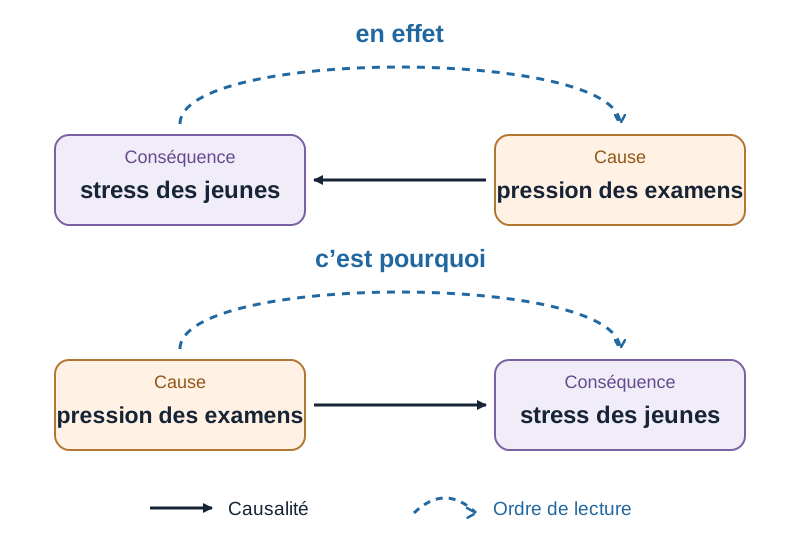
The connector en effet is exceptionally useful for securing Communication marks. Whenever you make a broad statement, follow it immediately with en effet and the supporting reason: Les jeunes subissent un stress immense. En effet, la pression des examens ne cesse d'augmenter. (Young people suffer immense stress. Indeed, exam pressure keeps on increasing.)
Grammar Exponents: Subjunctive, Conditional, and Future
The Leaving Certificate syllabus links verb moods to communicative functions: giving advice and suggestions (syllabus 1.7), expressing feelings, belief, and doubt (syllabus 1.8), and arguing, doubting, and conceding (syllabus 1.10). Using these structures accurately provides concrete evidence of the 'range of structures' rewarded under Language. One accurate complex clause is worth far more than three shaky attempts.
The Subjunctive Mood (Le Subjonctif)
The subjunctive is triggered by conjunctions of concession, verbs of necessity, and expressions of emotion or judgement:
- Concession with bien que: Always requires the subjunctive.
- Bien que ce soit difficile, nous devons agir. (Although it is difficult, we must act.)
- Impersonal necessity with il faut que:
- Il faut que le gouvernement prenne des mesures fermes. (The government must take firm measures.)
- Emotion and judgement with que:
- Il est dommage que les jeunes ne lisent plus. (It is a pity that young people no longer read.)
- Je regrette que les autorités ne fassent rien. (I regret that the authorities are doing nothing.)
- Il est important que chacun puisse exprimer son avis. (It is important that everyone can express their opinion.)
Key Irregular Subjunctive Forms
| Verb | Subjunctive (il / elle / on) | Subjunctive (ils / elles) |
|---|---|---|
| être | soit | soient |
| avoir | ait | aient |
| faire | fasse | fassent |
| pouvoir | puisse | puissent |
| aller | aille | aillent |
| savoir | sache | sachent |
| prendre | prenne | prennent |
Indicative vs. Subjunctive with Opinion Verbs
- Affirmative certainty takes the Indicative: Je pense qu'il a raison. (I think he is right.) / Je crois que le projet est utile. (I believe the project is useful.)
- Negative doubt takes the Subjunctive: Je ne pense pas qu'il ait raison. (I do not think he is right.) / Je doute que cela soit efficace. (I doubt that this is effective.)
The Conditional Mood (Le Conditionnel) for Diplomatic Recommendations
Syllabus 1.7 highlights the conditional for offering advice and diplomatic solutions:
- Il serait préférable / plus utile de + infinitive: Il serait préférable de sensibiliser le public au lieu de punir. (It would be preferable to raise public awareness instead of punishing.)
- On pourrait / Le gouvernement devrait + infinitive: On pourrait encourager l'usage du vélo en ville. (We could encourage bicycle use in towns.)
The Future Tense (Le Futur Simple) for Consequences Prompts
When a prompt asks quelles seront les conséquences ?, using the future tense correctly is essential.
- Rule: Take the infinitive (dropping final -e for -re verbs) and add the endings: -ai, -as, -a, -ons, -ez, -ont.
- Common irregular stems:
- être → ser- (il sera)
- avoir → aur- (il y aura)
- faire → fer- (cela fera)
- aller → ir- (on ira)
- pouvoir → pourr- (on pourra)
- devoir → devr- (l'État devra)
- voir → verr- (nous verrons)
- Framing consequences: À mon avis, il y aura de graves conséquences pour notre économie. Il est probable que les prix augmenteront. (In my opinion, there will be serious consequences for our economy. It is likely that prices will rise.) Note that il est probable que takes the indicative mood.
Topical Thematic Vocabulary and Syntax Rules
To write convincingly, combine your argumentative framework with precise topic vocabulary drawn from recurring syllabus themes:
Media and Technology
- les réseaux sociaux: social media
- les fausses nouvelles / l'infox (f.): fake news
- vérifier les sources: to check sources
- le cyberharcèlement: cyberbullying
- la dépendance aux écrans: screen addiction
Society and Equality
- l'égalité (f.) des sexes: gender equality
- la discrimination: discrimination
- le racisme: racism
- l'exode rural (m.): rural depopulation
- le chômage: unemployment
- la santé mentale: mental health
Environment
- le réchauffement climatique: global warming
- les énergies renouvelables (f. pl.): renewable energy
- les transports en commun (m. pl.): public transport
- recycler: to recycle
- menacer la planète: to threaten the planet
Ireland, Europe, and Tourism
- l'Union européenne (f.): the European Union
- la frontière: the border
- les échanges commerciaux (m. pl.): trade
- le patrimoine culturel: cultural heritage
- les paysages magnifiques: beautiful scenery
- accueillant(e): welcoming
- l'internet à haut débit (m.): high-speed internet
Essential Syntax Traps
- The verb nuire à: Nuire is an indirect transitive verb requiring the preposition à. Write La pollution nuit gravement à l'environnement (Pollution seriously harms the environment), never la pollution nuit l'environnement.
- Expressions of quantity: Expressions like beaucoup de, trop de, peu de, de plus en plus de, and de moins en moins de take de or d' alone without a definite article. Write de plus en plus de jeunes, never de plus en plus des jeunes.
- Exception to the quantity rule: The expressions la plupart des (most) and bien des (many) retain the contracted article des. Write la plupart des élèves, not la plupart d'élèves.
Key terms
- Production écrite
- Section II (Written Production) of the written paper: 100 marks, 25% of the Higher Level French examination.
- Prise de position
- The clear declaration of your personal stance or viewpoint on the prompt, stated in the opening lines and sustained throughout.
- Communication
- The assessment criterion (50% of marks) evaluating how directly you answer the prompt, exploit the stimulus, and structure your arguments.
- Language
- The assessment criterion (50% of marks) evaluating grammatical accuracy, verb forms, agreements, vocabulary range, and syntax.
- Connecteur logique
- A linking word or phrase (such as 'cependant', 'en effet', or 'c'est pourquoi') that establishes clear relationships between ideas.
- Le mode subjonctif
- A verb mood used after conjunctions such as 'bien que' and expressions of emotion, necessity, or doubt ('il faut que', 'je doute que').
- Le mode conditionnel
- A verb mood used to express recommendations, advice, or hypothetical outcomes ('il serait préférable de', 'on devrait').
- Nuire à
- An indirect transitive verb meaning to harm or damage, which strictly requires the preposition 'à' before its object.
Check yourself
What is the assessment weighting between Communication and Language in Leaving Certificate French written production?
Marks are divided equally: 50% for Communication (fulfilling the prompt, structure, reasoning) and 50% for Language (grammar, verb accuracy, vocabulary range).
Which verb mood must be used after the conjunction 'bien que'?
The subjunctive mood (e.g. 'bien que ce soit', 'bien qu'il fasse').
Explain the difference in mood between 'Je pense qu'il réussira' and 'Je ne pense pas qu'il réussisse'.
Affirmative expressions of belief take the indicative mood ('réussira'), whereas negative expressions of belief express doubt and require the subjunctive mood ('réussisse').
Why is 'de plus en plus des voitures' grammatically incorrect?
Expressions of quantity take 'de' or 'd'' on its own without a definite article. The correct phrase is 'de plus en plus de voitures'.
Translate into French using an appropriate conditional structure: 'It would be preferable to raise public awareness.'
'Il serait préférable de sensibiliser le public.'
What future tense form of 'avoir' is used in the phrase 'there will be serious consequences'?
'Il y aura de graves conséquences' (using the irregular stem 'aur-').