

Mastering French past tenses is essential for Leaving Certificate Higher Level. In written tasks such as the diary entry (le journal intime), letters, and emails where you recount an event, and in the oral examination when discussing past experiences, using a range of past tenses alongside precise sequencing structures displays high linguistic control. In reading comprehension, you must recognise both compound past tenses and the formal literary passé simple for grammar identification tasks. This guide covers the formation and usage of the passé composé, imparfait, plus-que-parfait, and passé simple, alongside syllabus-prescribed sequencing structures for recounting past events.
Le Passé Composé: Formation, Auxiliaries, and Agreement Rules
The passé composé is the primary tense for recounting completed actions and specific past events. It tells the reader what happened at a defined point in time, translating into English as 'I did', 'I have done', or 'I did do'.
Structure
It is a compound tense built from two parts: the present tense of an auxiliary verb (avoir or être) followed by the past participle (participe passé).
- Regular participles:
- -er verbs drop -er and add -é (parler → parlé)
- -ir verbs drop -ir and add -i (finir → fini)
- -re verbs drop -re and add -u (vendre → vendu)
- Common irregular participles: avoir (eu), être (été), faire (fait), prendre (pris), mettre (mis), voir (vu), boire (bu), écrire (écrit), dire (dit), pouvoir (pu), devoir (dû).
Choosing Avoir or Être
Most French verbs use avoir (j'ai mangé, nous avons fini). Only two groups of verbs use être as their auxiliary in the passé composé (and in the plus-que-parfait):
- Verbs of movement and change of state, often remembered by the mnemonic MRS VANDERTRAMP: monter, rester, sortir, venir, aller, naître, descendre, entrer, rentrer, tomber, retourner, arriver, mourir, partir (plus compounds like revenir, devenir).
- All reflexive verbs (se lever, se blesser).
When Être Verbs Take Avoir
Six movement verbs—sortir, monter, descendre, rentrer, retourner, and passer—switch their auxiliary to avoir when they take a direct object:
- Je suis sorti(e). (I went out.) vs J'ai sorti la poubelle. (I took out the bin.)
- Elle est montée. (She went up.) vs Elle a monté les valises. (She carried the cases up.)
- Nous sommes descendus. (We went down.) vs Nous avons descendu l'escalier. (We went down the stairs.)
- J'ai passé une semaine à Nice. (I spent a week in Nice.)
Participle Agreement Rules
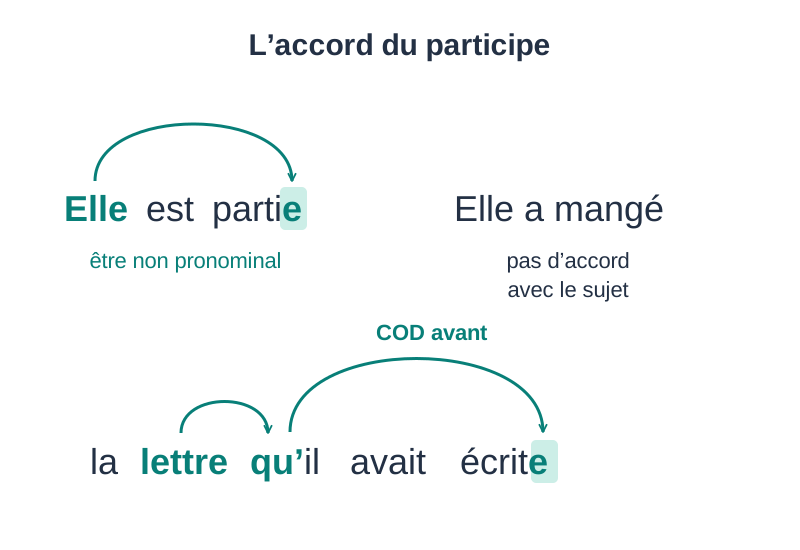
- With être (movement verbs): The participle agrees with the grammatical subject in gender and number. Add -e for feminine singular (Elle est partie), -s for masculine plural (Ils sont arrivés), and -es for feminine plural (Elles sont venues).
- With reflexive verbs: The participle agrees with the reflexive pronoun only when that pronoun functions as the direct object (Elle s'est blessée). When a direct object noun follows the verb, the participle does not agree (Elle s'est lavé les mains).
- Agreement with avoir (preceding direct object): With avoir, the participle never agrees with the subject (Elle a mangé). However, it must agree with a direct object that comes before the verb. This happens in three standard patterns:
- Direct object pronouns (le, la, l', les, me, te, nous, vous): La voiture ? Je l'ai vue. (The car? I saw it.) Les clés ? Je les ai perdues. (The keys? I lost them.)
- Relative pronoun que: une vieille porte cochère qu'il n'avait jamais remarquée (remarquée ends in -e because que refers back to porte, which is feminine singular).
- Questions with quel(le)(s) or combien de: Quelles photos as-tu prises ? (Which photos did you take?)
Pronoun Position and Negation
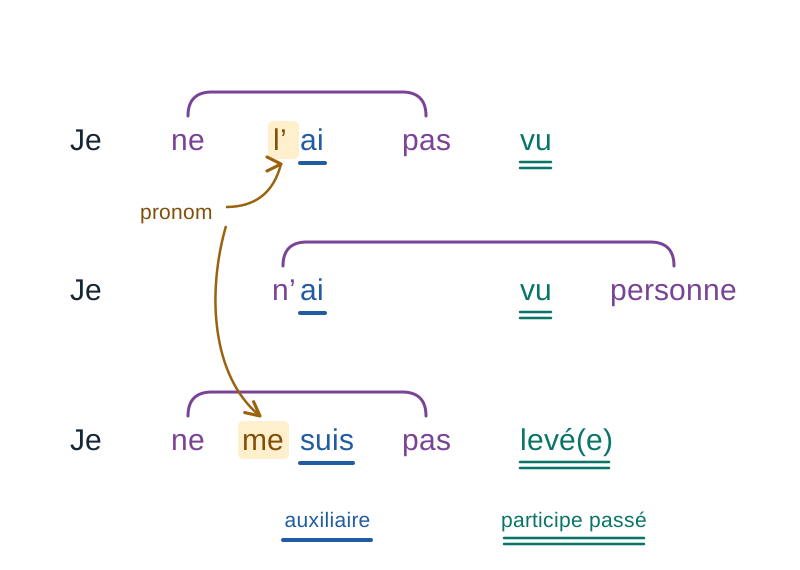
In compound tenses, object pronouns always sit before the auxiliary verb, not before the participle:
- Je l'ai appelé. (I called him.)
- Il m'a aidé. (He helped me.)
Negative words follow two distinct placement patterns:
- ne … pas, ne … jamais, ne … rien, ne … plus wrap around the auxiliary verb:
- Je n'ai rien vu. (I saw nothing.)
- Je ne l'ai pas vu. (I didn't see him.)
- ne … personne, ne … que, ne … aucun(e), ne … nulle part place their second element after the past participle:
- Je n'ai vu personne. (I saw nobody.)
- Il n'a pris que mon sac. (He only took my bag.)
- Je n'ai trouvé aucune trace. (I found no trace.)
- Negating reflexive verbs: ne precedes the reflexive pronoun, while pas follows the auxiliary verb:
- Je ne me suis pas levé(e) à temps. (I did not get up in time.)
L'Imparfait: Formation, Spelling Tweaks, and Scene-Setting
While the passé composé drives the action forward, the imparfait sets the scene. It describes what conditions were like, ongoing background actions, past habits, and physical or emotional states.
Formation
Take the nous form of the verb in the present tense, drop the -ons ending to find the stem, and add the imparfait endings:
| Subject | Ending | Parler (nous parl-ons) | Finir (nous finiss-ons) |
|---|---|---|---|
| je | -ais | je parlais | je finissais |
| tu | -ais | tu parlais | tu finissais |
| il / elle / on | -ait | il parlait | il finissait |
| nous | -ions | nous parlions | nous finissions |
| vous | -iez | vous parliez | vous finissiez |
| ils / elles | -aient | ils parlaient | ils finissaient |
Because the stem comes from the present nous form, irregular present stems carry straight into the imparfait: faire (nous faisons → je faisais), prendre (nous prenons → je prenais).
The Sole Formation Exception
The verb être does not derive its stem from nous sommes. Its stem is ét- (j'étais, tu étais, il était, nous étions, vous étiez, ils étaient).
Spelling Changes in -cer and -ger Verbs
To preserve pronunciation, keep the soft sound before a, but drop the extra letter or accent before i:
- -cer verbs: je commençais, il commençait, ils commençaient, but nous commencions, vous commenciez.
- -ger verbs: je mangeais, elle nageait, ils voyageaient, but nous mangions, vous nagiez.
The Double 'i' Trap
Verbs with stems ending in -i (such as étudier, crier) keep a double 'i' in the nous and vous forms of the imparfait: nous étudiions (we were studying) versus the present nous étudions (we study).
When to Use the Imparfait
- Background description and weather: Il faisait nuit et le vent soufflait. (It was night and the wind was blowing.)
- Habitual or repeated past actions: Tous les étés, nous allions en France. (Every summer, we used to go to France.)
- Mental and physical states: J'avais tellement peur que je tremblais. (I was so afraid that I was trembling.)
- Ongoing action interrupted by an event: Je dormais quand le réveil a sonné. (I was sleeping when the alarm rang.)
Narrative Balance: Passé Composé vs Imparfait in Action
Balancing the passé composé and the imparfait is one of the most reliable markers of grammatical control at Leaving Certificate Higher Level.
The Film Metaphor
Think of your narrative as a film scene:
- L'Imparfait is the camera pan showing the setting, lighting, atmosphere, and what was already taking place.
- Le Passé Composé is the action cut: a car skids, a glass breaks, a shout rings out.
The Interruption Pattern
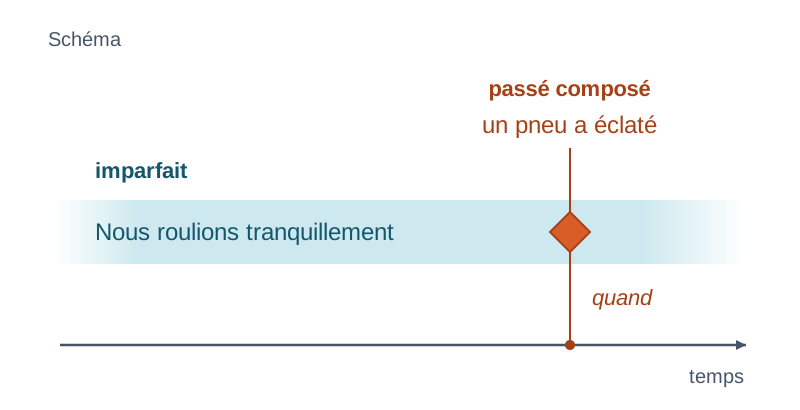
A continuous background action in the imparfait is broken by a sudden completed action in the passé composé:
- Nous roulions tranquillement quand un pneu a éclaté. (We were driving quietly when a tyre blew out.)
Signal Words (Time Markers)
- Imparfait indicators: d'habitude (usually), souvent (often), tous les jours (every day), à cette époque (at that time), toujours (always).
- Passé composé indicators: soudain (suddenly), tout à coup (all of a sudden), un jour (one day), hier (yesterday), à ce moment-là (at that moment).
Meaning Shifts Between Tenses
Several common verbs take on distinct English nuances depending on the tense used:
- Savoir:
- Je savais: I knew (ongoing state of knowledge).
- J'ai su: I found out / learned (sudden discovery).
- Vouloir:
- Elle voulait partir: She wanted to leave (ongoing wish).
- Elle a voulu partir: She tried to leave / decided to leave. (Elle n'a pas voulu partir = She refused to leave.)
Le Plus-que-parfait and Venir de in the Imparfait
To step behind the immediate past and explain what had happened earlier, French uses two structures.
Le Plus-que-parfait (Pluperfect)
The plus-que-parfait matches English 'had done'. It combines the imparfait of the auxiliary with the past participle:
- With avoir: j'avais fini (I had finished), il avait vu (he had seen), nous avions mangé (we had eaten).
- With être: j'étais parti(e) (I had left), elle était arrivée (she had arrived), ils s'étaient réveillés (they had woken up).
Participle agreement rules are identical to the passé composé: with non-reflexive être verbs the participle agrees with the subject, reflexive verbs follow the reflexive rule, and with avoir it agrees with a preceding direct object (la lettre qu'il avait écrite).
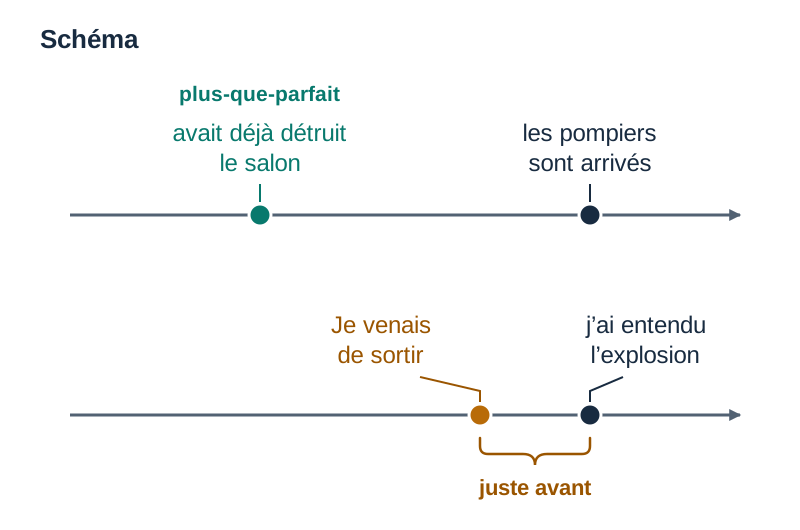
Use it to explain causes or give background depth to an incident:
- Quand les pompiers sont arrivés, le feu avait déjà détruit le salon. (When the firefighters arrived, the fire had already destroyed the living room.)
- J'ai raté mon vol parce que je m'étais réveillé trop tard. (I missed my flight because I had woken up too late.)
Venir de + Infinitive in the Imparfait ('Had Just Done')
To express that an action had just taken place immediately before another past event, conjugate venir in the imparfait followed by de and the infinitive:
- Je venais de sortir quand j'ai entendu l'explosion. (I had just gone out when I heard the explosion.)
- Le bus venait de partir. (The bus had just left.)
Never use the passé composé for this construction in a past-tense narrative; always keep venir in the imparfait.
Connecting Events: Syllabus Sequencing Structures and Time Markers
When you describe an accident, breakdown, theft, or assault, you need to connect events clearly. The syllabus highlights five specific structures for sequencing past actions:
- Après avoir / être + past participle (After having done):
- Après avoir appelé les secours, je suis resté auprès du blessé. (After calling the emergency services, I stayed beside the injured person.)
- Après être rentré(e) chez moi, j'ai tout raconté à mes parents. (After getting home, I told my parents everything.)
- Rule: The participle following être agrees with the subject of the main verb (je). A female candidate writes rentrée; plural subjects take -s (Après être rentrés, nous avons…).
- Avant de + infinitive (Before doing):
- Avant de téléphoner à la police, j'ai cherché mes clés. (Before phoning the police, I looked for my keys.)
- Avant que + subjunctive (Before something happens):
- Nous sommes partis avant qu'il fasse nuit. (We left before it got dark.)
- Fixed phrases to learn: avant qu'il (ne) soit trop tard (before it was too late); avant que les secours (n')arrivent (before emergency services arrived). The optional ne is non-negative (ne explétif).
- En + present participle (Le Gérondif: While / By doing):
- Take the present-tense nous form, drop -ons, and add -ant (nous voyons → voyant; nous finissons → finissant; nous faisons → faisant). Three exceptions: être → étant, avoir → ayant, savoir → sachant.
- En voyant la fumée, j'ai tout de suite composé le 112. (On seeing the smoke, I immediately dialled 112.)
- Rule: Both the gérondif and the main verb must share the same subject.
- Pendant que + imparfait (While something was happening):
- L'accident s'est produit pendant que nous attendions le bus. (The accident happened while we were waiting for the bus.)
Chronological Connectors for Narrative Flow
- d'abord (first)
- ensuite / puis (then / next)
- au moment où (just as / at the moment when)
- dès que (as soon as)
- à ce moment-là (at that moment)
- quelques instants plus tard (a few moments later)
- au bout de dix minutes (after ten minutes)
- la veille (the day before) / le lendemain (the next day)
- enfin / finalement (finally)
Le Passé Simple: Literary Recognition for Reading Comprehension
The passé simple reports completed past actions in formal written narratives, novels, and journalistic prose. You do not need to produce it in your essays or diary entries, but you must be able to recognise it instantly in literary reading comprehensions.
While third-person forms (il/elle/ils/elles) appear most frequently, literary extracts are often told in the first person, making je and nous forms equally examinable for recognition.
Regular Endings
| Group | je | il / elle | nous | ils / elles |
|---|---|---|---|---|
| -er verbs | -ai (je parlai) | -a (il parla) | -âmes (nous parlâmes) | -èrent (ils parlèrent) |
| -ir / -re verbs | -is (je finis) | -it (il finit) | -îmes (nous finîmes) | -irent (ils finirent) |
| u-type verbs | -us (je crus) | -ut (il crut) | -ûmes (nous crûmes) | -urent (ils crurent) |
High-Yield Irregular Forms
| Infinitive | je | il / elle | ils / elles | Meaning |
|---|---|---|---|---|
| être | fus | fut | furent | was / were |
| avoir | eus | eut | eurent | had |
| faire | fis | fit | firent | did / made |
| dire | dis | dit | dirent | said |
| prendre | pris | prit | prirent | took |
| voir | vis | vit | virent | saw |
| venir | vins | vint | vinrent | came |
| mettre | mis | mit | mirent | put |
| pouvoir | pus | put | purent | could / was able to |
| mourir | mourus | mourut | moururent | died |
Confused Pairs and Present-Tense Traps
- Voir (to see) → il vit / ils virent vs Vivre (to live) → il vécut / ils vécurent.
- Note that il vit is also the present tense of vivre (he lives).
- Forms like je finis, il finit, and il dit look identical in the present and the passé simple. Determine the tense from the surrounding verbs: in a past narrative, these are passé simple.
Recounting Events in the Oral and Topic Vocabulary
The oral examination accounts for 25% of Higher Level marks. Examiners regularly ask about past activities and holidays (Qu'est-ce que tu as fait l'été dernier ?). Use a fluent combination of passé composé for events, imparfait for conditions, and at least one sequencing structure.
Oral Response Model
L'été dernier, j'ai passé deux semaines en France avec ma famille. Il faisait un temps magnifique et nous allions à la plage tous les jours. Un après-midi, après avoir loué des vélos, nous avons visité un petit village médiéval où j'ai acheté des souvenirs. C'était une expérience inoubliable. (Last summer, I spent two weeks in France with my family. The weather was wonderful and we used to go to the beach every day. One afternoon, after renting bikes, we visited a small medieval village where I bought souvenirs. It was an unforgettable experience.)
Incident and Emergency Vocabulary
Recognising these terms aids listening and reading comprehension, while using them elevates written accounts of incidents:
- un témoin (a witness)
- un voleur (a thief)
- un vol (a theft / a flight)
- heurter / percuter (to hit / crash into)
- déraper (to skid)
- freiner (to brake)
- la chaussée glissante (the slippery road)
- porter plainte (to lodge a complaint / report a crime)
- une panne (a breakdown)
- les secours (the emergency services)
- blessé(e) (injured)
Key terms
- Passé composé
- A compound past tense made of a present-tense auxiliary (avoir or être) and a past participle, used to narrate completed events and specific actions.
- Imparfait
- A past tense formed from the present nous stem plus -ais, -ais, -ait, -ions, -iez, -aient, used for descriptions, ongoing background, habits, and states.
- Plus-que-parfait
- A compound past tense formed with an imparfait auxiliary (avoir or être) and a past participle, expressing an action completed before another past event ('had done').
- Passé simple
- A formal literary past tense equivalent in meaning to the passé composé, encountered receptively in novels, historical extracts, and reading comprehension passages.
- Accord du participe
- The rule by which a past participle changes its ending (-e, -s, -es) to match gender and number. With être (non-reflexive verbs) it agrees with the subject; with reflexive verbs it agrees with the reflexive pronoun only when that pronoun is the direct object; with avoir it agrees only with a direct object placed before the verb.
- Gérondif
- The structure en + present participle (-ant), used to express simultaneous actions or means ('while doing' / 'by doing') sharing the same grammatical subject.
- Auxiliaire
- A helping verb (avoir or être) conjugated in a simple tense and combined with a past participle to create compound tenses.
Check yourself
How do you form the stem of an imparfait verb, and what is the single irregular exception?
Take the present-tense 'nous' form of the verb and drop the '-ons' ending. The only exception is être, which uses the stem 'ét-'.
Translate into French: 'I saw nobody, but I found the keys and I picked them up.'
'Je n'ai vu personne, mais j'ai trouvé les clés et je les ai ramassées.' (Notice 'personne' follows the participle, and 'ramassées' agrees with the preceding direct object pronoun 'les').
Why is it 'Elle est sortie' but 'Elle a sorti son passeport'?
Sortir uses être when expressing movement without an object, but switches to avoir when it is transitive and takes a direct object ('son passeport').
Translate into French: 'He had just left when the phone rang.'
'Il venait de partir quand le téléphone a sonné.' (Use venir de in the imparfait for 'had just done').
In a literary comprehension passage, what do the passé simple forms 'il vit', 'il vécut', and 'je pris' mean in English?
'Il vit' means 'he saw' (from voir), 'il vécut' means 'he lived' (from vivre), and 'je pris' means 'I took' (from prendre).
How do you form the gérondif of 'faire' and what rule governs its subject?
Take the present nous form (faisons), remove -ons, and add -ant: 'en faisant'. Both the gérondif and the main verb must share the same grammatical subject.