

Adjectives describe people and things, adverbs describe how, when or how much something happens, and comparatives let you say that one thing is better, worse or the same as another. You need all three to write a good letter, diary entry or opinion piece at Higher Level. Written production marks take account of both communication and accuracy, so mastering adjectival agreements, natural word order, and adverb placement provides immediate marks protection across the paper. In reading comprehensions, recognizing irregular adjectival forms and parts of speech allows you to answer grammar-hunt questions accurately. Comparatives and superlatives give you the tools to weigh options, trace societal trends, and distinguish clearly between 'meilleur' and 'mieux'.
Adjective Agreement and Formation Patterns
In French, every adjective must agree in gender (masculine or feminine) and number (singular or plural) with the noun or pronoun it qualifies. Written answers are marked on how well you get your message across and on the accuracy and range of your French. Wrong agreements are among the most frequent accuracy errors, so checking them is one of the easiest ways to protect your language marks.
Regular Formation
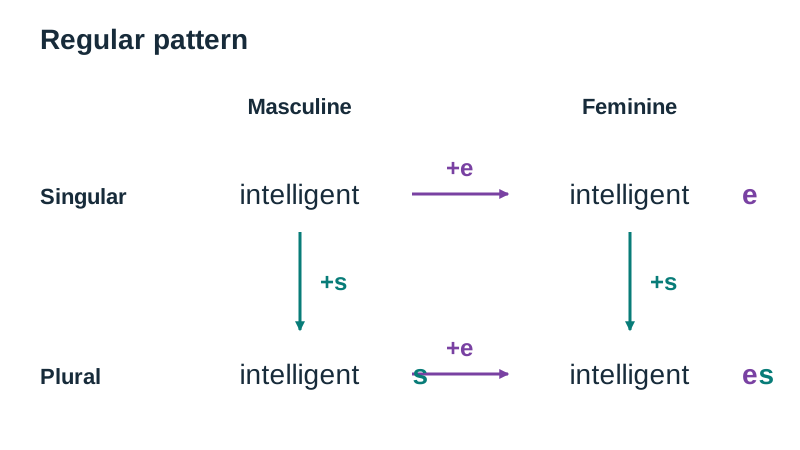
The masculine singular form serves as the base. Add -e for feminine singular and -s for plural:
- un étudiant intelligent → une étudiante intelligente
- un projet intéressant → des projets intéressants
- une idée intéressante → des idées intéressantes
If the masculine singular already ends in an unaccented -e, it remains identical in the feminine singular: un livre utile / une ressource utile. If it ends in -s or -x, the masculine plural remains unchanged: un choix dangereux / des choix dangereux.
Adding -e in the feminine causes a silent final consonant to be pronounced: in vert, the 't' is silent, but in verte, the 't' is clearly sounded. Similarly, in grand the 'd' is silent, while in grande you pronounce it.
Common Irregular Feminines
Many common adjectives alter their stems before taking feminine endings:
| Pattern | Masculine → Feminine | Meaning |
|---|---|---|
| Double the consonant | bon → bonne, gentil → gentille, gros → grosse, bas → basse | good, kind, big/fat, low |
| -eux → -euse | heureux → heureuse, dangereux → dangereuse | happy, dangerous |
| -eur → -euse | travailleur → travailleuse, menteur → menteuse | hard-working, lying |
| -if → -ive | sportif → sportive, actif → active | sporty, active |
| -er → -ère | premier → première, dernier → dernière | first, last |
| -et → -ète | complet → complète, inquiet → inquiète | complete, worried |
| -el / -en doubling | naturel → naturelle, quotidien → quotidienne | natural, daily |
| One-offs | blanc → blanche, long → longue, doux → douce, fou → folle, sec → sèche | white, long, gentle/soft, mad, dry |
Irregular root adjectives include: beau → belle, nouveau → nouvelle, vieux → vieille, faux → fausse, and frais → fraîche.
Plurals in -al and -eau
- Adjectives ending in -al change to -aux in the masculine plural: un problème environnemental → des problèmes environnementaux; un enjeu mondial → des enjeux mondiaux. The feminine plural remains regular: des crises environnementales.
- Adjectives ending in -eau take -x in the masculine plural: un beau paysage → de beaux paysages.
Two Important Agreement Rules
- Mixed nouns take the masculine plural: if an adjective describes a masculine and a feminine noun together, use the masculine plural (Mon frère et ma sœur sont contents).
- des becomes de before a plural adjective placed in front of the noun: des paysages → de beaux paysages; des perspectives → de meilleures perspectives.
Adjective Position and Grammar Hunting
English places descriptive words almost exclusively in front of nouns, but French uses two distinct positions depending on the category of the adjective.
Default Position: After the Noun
The vast majority of French adjectives sit directly after the noun they qualify. This rule covers:
- Colours: une chemise blanche, des feux verts
- Nationalities and origins: le peuple irlandais, la cuisine française
- Shapes and physical states: une table ronde, de l'eau froide
- Analytical, technical, and longer adjectives: une situation intolérable, un système économique
The BAGS Exceptions: Before the Noun
A small group of short, everyday adjectives precedes the noun. Memorise them using the acronym BAGS:
- Beauty: beau, joli (un beau discours, une jolie maison)
- Age: jeune, vieux, nouveau (un jeune travailleur, un vieux quartier)
- Goodness: bon, mauvais, meilleur (un bon exemple, une mauvaise habitude)
- Size: grand, petit, gros, long (une grande ville, un petit village)
Note that BAGS is a memory aid rather than an exhaustive rule. A few other short adjectives (court, propre, ancien) can also precede the noun.
Euphonic Forms Before Vowels
Before a masculine singular noun starting with a vowel or silent h, three BAGS adjectives use special formes euphoniques to prevent an awkward vowel clash:
- beau becomes bel: un bel appartement, un bel hommage
- nouveau becomes nouvel: un nouvel hôtel, un nouvel ami
- vieux becomes vieil: un vieil homme, un vieil arbre
The feminine forms remain unaffected (une belle opportunité, une nouvelle école, une vieille dame).
Meaning Changes Depending on Position
A select group of adjectives changes meaning depending on whether you place them before or after the noun:
- un grand homme (a great man) vs un homme grand (a tall man)
- un ancien professeur (a former teacher) vs un monument ancien (an ancient monument)
- ma propre chambre (my own bedroom) vs une chambre propre (a clean bedroom)
- la semaine dernière (last week, the week before this one) vs la dernière semaine (the final week of a series)
Finding Adjectives in Comprehension Texts
When a reading comprehension asks you to find 'un adjectif au féminin singulier' or similar, remember that possessive adjectives (ma, ta, sa) and demonstrative adjectives (cette) count alongside descriptive adjectives.
- Watch the vowel trap: son amie uses son purely for sound even though amie is feminine. Choose an unambiguous word like seule, petite, folle, or sa.
- Write only the exact word asked for. Adding extra words such as an article or noun results in zero marks.
Adverb Formation, Classification, and Nuance
Adverbs modify verbs, adjectives, or other adverbs. Unlike adjectives, adverbs are invariable; they never agree with nouns and take neither feminine nor plural endings.
Regular Formation from Adjectives
To build an adverb of manner (adverbe de manière):
- Take the feminine singular form of the adjective.
- Add the suffix -ment (equivalent to English -ly).
- lent (masc.) → lente (fem.) → lentement (slowly)
- attentif (masc.) → attentive (fem.) → attentivement (attentively)
- heureux (masc.) → heureuse (fem.) → heureusement (fortunately / happily)
- doux (masc.) → douce (fem.) → doucement (gently)
Spelling Exceptions
- Adjectives ending in a vowel (other than mute -e): Add -ment directly to the masculine base: vrai → vraiment (truly), poli → poliment (politely), absolu → absolument (absolutely). Adjectives ending in mute -e such as facile are regular because their feminine form is identical: facile → facilement.
- Adjectives of more than one syllable ending in -ant or -ent: Drop the ending and replace with -amment or -emment. Both endings sound the same: -emment is said as if it were spelt -amment (évidemment sounds like 'ay-vee-da-mon'). Examples include constant → constamment, évident → évidemment, récent → récemment, and patient → patiemment. The short adjective lent is regular: lente + -ment → lentement.
- Adverbs with an acute accent (-ément): énorme → énormément (enormously), précis → précisément (precisely), profond → profondément (deeply).
- Irregular one-off: gentil → gentiment (kindly).
Adverbs for Ordering and Shading Meaning
- Sequencing adverbs order a narrative, a diary entry, or an argument: d'abord (first), ensuite / puis (then), après (afterwards), enfin / finalement (finally), l'année prochaine (next year).
- Qualifying adverbs adjust tone and intensity: très (very), assez (quite), plutôt (rather), vraiment (really), tellement / si (so), tout à fait (completely).
- High-frequency irregular adverbs: bien (well — use bien, never bon, to qualify an action: Il joue bien), mal (badly), vite (quickly), beaucoup (a lot), trop (too much), peu (little).
Placement of Adverbs in Sentences
Adverb placement in French is strictly governed by verb tense and structure rather than English word order patterns.
Simple Tenses (Present, Imperfect, Future Simple)
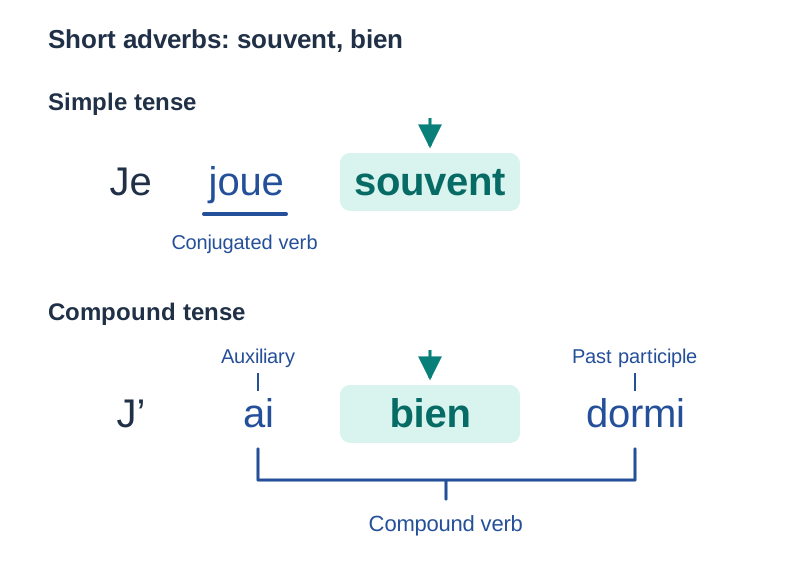
In simple tenses, short adverbs sit immediately after the conjugated verb. They never split the subject pronoun and the verb:
- Je joue souvent au foot le samedi. (I often play football on Saturdays — never Je souvent joue).
- Elle comprend parfaitement la situation. (She perfectly understands the situation).
Compound Tenses (Passé Composé, Plus-que-parfait)
In compound tenses, short, common adverbs of manner, quantity, and time (bien, mal, déjà, beaucoup, trop, souvent, toujours, vite) sit between the auxiliary verb (avoir or être) and the past participle:
- J'ai bien dormi hier soir. (I slept well last night — never J'ai dormi bien).
- Nous avons déjà abordé ce sujet. (We have already tackled this topic).
- Ils ont trop dépensé. (They spent too much).
Longer descriptive adverbs ending in -ment can either slot between the auxiliary and participle or follow the past participle directly (Il a prudemment agi or Il a agi prudemment).
Time and Place Adverbs
- hier, aujourd'hui, and demain go at the start or end of the clause: Hier, nous sommes sortis or Nous sommes sortis hier.
- tôt, tard, ici, and là go after the past participle: Il est rentré tard; Je suis arrivé ici à midi.
Comparatives: Qualities, Quantities, and Actions
Comparatives allow you to weigh alternatives, evaluate social issues, and balance viewpoints in Leaving Certificate debates.
Comparing Qualities (Adjectives and Adverbs)
Use plus... que (more... than), moins... que (less... than), or aussi... que (as... as). The adjective still agrees with the noun it describes:
- Le vélo est plus écologique que la voiture, mais il est moins rapide. (Cycling is greener than the car, but it is less fast).
- Le train est aussi confortable que l'avion. (The train is as comfortable as the plane).
- Cette solution est moins coûteuse que la précédente. (coûteuse is feminine because solution is feminine).
To strengthen a comparative, place bien or beaucoup before it: bien plus stimulant (much more stimulating), beaucoup moins cher (much less expensive).
Comparing Quantities with Nouns
When comparing quantities of nouns, you must insert de (or d' before a vowel), and 'as much/many' changes from aussi to autant de:
- More of: plus de + noun + que (J'ai plus de travail cette année.)
- Less/Fewer of: moins de + noun + que (Il consomme moins d'énergie qu'avant.)
- As much/many of: autant de + noun + que (Elle a autant de devoirs que ses camarades.)
Comparing Actions (Verbs)
After a verb, use plus que, moins que, or autant que. When comparing with a person, use stressed pronouns (moi, toi, lui, elle, nous, vous, eux, elles):
- Elle lit plus que moi. (She reads more than me).
- Je travaille autant que lui. (I work as much as him).
Trend Expressions for Opinion Writing
Two useful phrases for describing trends in opinion writing:
- de plus en plus (de) = more and more (De plus en plus de jeunes souffrent du stress.)
- de moins en moins (de) = fewer and fewer / less and less (On achète de moins en moins de journaux.)
Superlatives, Irregular Comparisons, and Impersonal Patterns
The superlative expresses the extreme degree ('the most' or 'the least') of a quality, quantity, or action.
Superlative Word Order
Form the superlative by placing the definite article (le, la, les) before plus or moins:
- If the adjective precedes the noun (BAGS), the superlative precedes the noun: la plus grande ville.
- If the adjective follows the noun, repeat the definite article after the noun: le problème le plus grave, les méthodes les moins efficaces.
- With adverbs, always use le: C'est elle qui court le plus vite.
- A possessive adjective can replace the article: mon meilleur ami, sa plus grande peur.
'In' After a Superlative
To translate 'in' after a superlative, French always requires de (contracting to du, de la, des), never dans:
- C'est le plus grand bâtiment du monde. (It is the biggest building in the world).
- Elle est la meilleure élève de la classe. (She is the best student in the class).
Discriminating Between Meilleur and Mieux
Mixing up meilleur and mieux is a very common accuracy error, so check each one before you hand up:
| Word | Part of Speech | Base Form | Comparative | Superlative | Function |
|---|---|---|---|---|---|
| Bon | Adjective | bon(ne)(s) | meilleur(e)(s) (better) | le/la/les meilleur(e)(s) (the best) | Modifies a noun (agrees) |
| Bien | Adverb | bien | mieux (better) | le mieux (the best) | Modifies a verb/action (invariable) |
| Mauvais | Adjective | mauvais(e)(s) | pire(s) / plus mauvais (worse) | le/la/les pire(s) (the worst) | Modifies a noun (agrees) |
| Mal | Adverb | mal | plus mal (worse) | le plus mal (the worst) | Modifies a verb/action (invariable) |
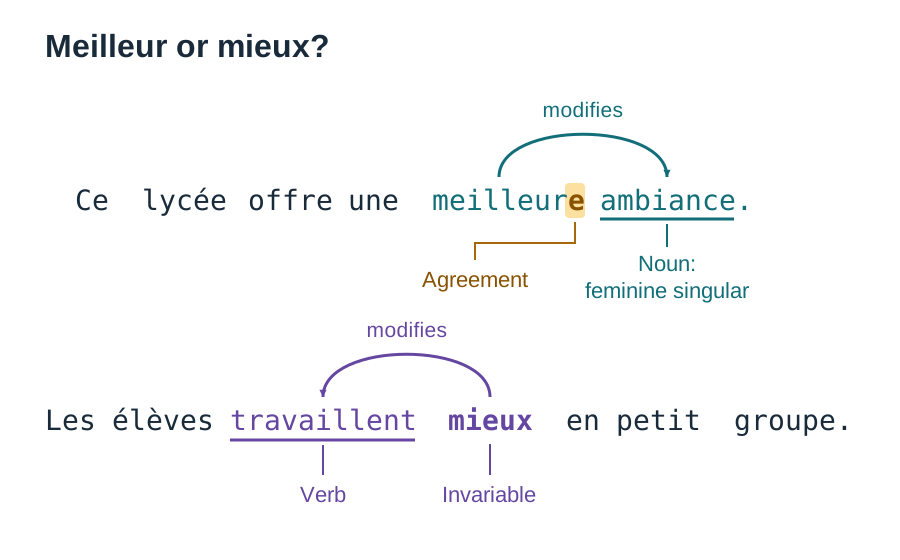
- Ce lycée offre une meilleure ambiance. (meilleure modifies the feminine noun ambiance).
- Les élèves travaillent mieux en petit groupe. (mieux modifies the verb travaillent).
Impersonal Comparatives and Urgency Patterns
- Pattern: Il est / Il serait + plus / moins + adjective + de + infinitive: Il serait moins cher de prendre le bus (It would be cheaper to take the bus); Il serait plus utile d'investir dans les transports en commun.
- Il vaut mieux + infinitive: Il vaut mieux prendre le train (It is better to take the train).
- Degrees of urgency: use le plus + adverb + possible: Réponds-moi le plus vite possible (Reply as quickly as possible); Rappelez-moi le plus tôt possible (Call me back as soon as possible).
Set Phrases for Leaving Certificate Written Formats
- Wishing someone well / letter opening: J'espère que tu vas mieux. / Meilleurs vœux pour tes examens ! / Je te souhaite bonne chance.
- Opinion piece: Il vaut mieux agir maintenant avant qu'il ne soit trop tard. / De plus en plus de jeunes estiment que...
- Closing an informal letter: Écris-moi le plus vite possible.
Key terms
- Accord
- The grammatical agreement requiring adjectives to match the gender (masculine/feminine) and number (singular/plural) of the noun they describe.
- BAGS
- A memory aid acronym (Beauty, Age, Goodness, Size) designating the small group of frequent French adjectives placed before the noun.
- Forme euphonique
- A modified masculine singular adjective form (bel, nouvel, vieil) used before a vowel or mute 'h' to maintain smooth pronunciation.
- Adverbe de manière
- An invariable word describing how an action occurs, typically formed by adding -ment to the feminine form of an adjective.
- Comparatif
- A construction using plus, moins, or aussi/autant with 'que' to express superiority, inferiority, or equality.
- Superlatif
- A structure using le, la, or les with plus, moins, or irregular forms like meilleur to convey the highest or lowest degree within a group.
- Meilleur
- The comparative form of the adjective 'bon' (good), meaning 'better' when modifying a noun; agrees in gender and number.
- Mieux
- The invariable comparative form of the adverb 'bien' (well), meaning 'better' when modifying a verb or action.
Check yourself
Transform the adjectives 'patient', 'poli', 'lent', and 'profond' into adverbs of manner.
'patiemment' (-ent of more than one syllable becomes -amment/-emment), 'poliment' (masculine ending in vowel adds -ment), 'lentement' (short adjective lent is regular: lente + -ment), and 'profondément' (takes an acute accent -ément).
How do you translate 'an old tree' and 'a new student' (masculine), and why do the adjectives change?
'un vieil arbre' and 'un nouvel élève'. 'vieux' and 'nouveau' use their euphonic forms ('vieil', 'nouvel') before masculine singular nouns starting with a vowel or silent h to prevent awkward vowel clashes.
Put the adverb in the correct position: (a) Je vais au cinéma + souvent; (b) Nous avons mangé + bien; (c) Il est parti + hier.
(a) Je vais souvent au cinéma (immediately after the verb in simple tenses); (b) Nous avons bien mangé (between auxiliary and past participle in compound tenses); (c) Il est parti hier or Hier, il est parti (time adverb at end or start of clause).
Fill the blank with either 'meilleur' or 'mieux': 'Elle s'exprime _____ que son camarade, mais il a obtenu une _____ note.'
'mieux' in the first blank (modifying the verb 's'exprime') and 'meilleure' in the second blank (feminine adjective modifying the noun 'note').
Translate into French: 'There are more and more environmental problems in the world.'
'Il y a de plus en plus de problèmes environnementaux dans le monde.' (Note that 'dans le monde' is correct here because there is no superlative; compare 'le plus grand problème du monde').
Correct the two errors: 'C'est la plus grande université dans l'Irlande et nous avons visité déjà le campus.'
'C'est la plus grande université d'Irlande et nous avons déjà visité le campus.' ('de', not 'dans', after a superlative; short adverb 'déjà' sits between auxiliary and past participle).