

Mastering the future tenses, the conditional mood, and conditional si clauses is vital for Leaving Certificate Higher Level French. These structures allow you to discuss education and career ambitions, make polite requests, propose solutions in discursive essays, and handle hypothetical questions confidently in both the oral and written examinations.
Le Futur Proche: Immediate Plans and Oral Fluency
The futur proche (near future) describes events that are about to happen or definite plans already decided. It corresponds directly to the English structure 'going to do something'. In everyday spoken French and the oral exam, it is the most natural tense for discussing upcoming intentions, such as your plans for the weekend or the summer holidays.
Formation
To form the futur proche, conjugate the verb aller in the present tense and place an infinitive directly after it:
- je vais + infinitif (je vais étudier — I am going to study)
- tu vas + infinitif (tu vas partir — you are going to leave)
- il / elle / on va + infinitif (on va commencer — we are going to start)
- nous allons + infinitif (nous allons voyager — we are going to travel)
- vous allez + infinitif (vous allez voir — you are going to see)
- ils / elles vont + infinitif (ils vont arriver — they are going to arrive)
Negation and Word Order
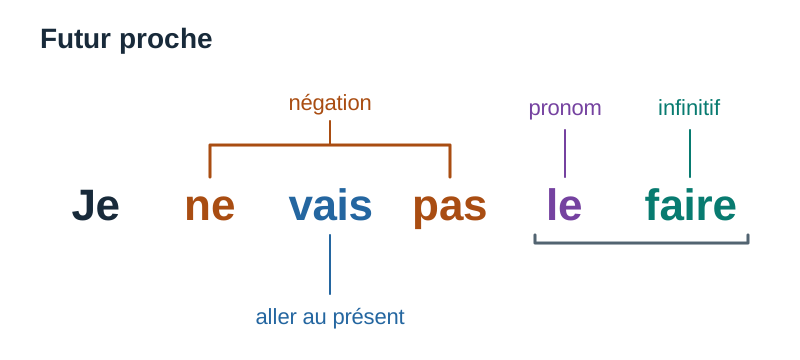
In negative sentences, ne and pas wrap strictly around the conjugated form of aller. The infinitive remains outside the negative structure:
- Je ne vais pas sortir ce soir. (I am not going to go out tonight.)
- Elle ne va pas accepter l'invitation. (She is not going to accept the invitation.)
Pronouns with the Futur Proche
Both reflexive pronouns (me, te, se, nous, vous, se) and direct or indirect object pronouns (le, la, les, lui, leur) sit immediately before the infinitive, not before aller:
- Je vais me reposer après les examens. (I am going to rest after the exams.)
- Nous allons nous amuser pendant les vacances. (We are going to have fun during the holidays.)
- Je vais le faire demain. (I am going to do it tomorrow.)
- Je ne vais pas le faire. (I am not going to do it.)
In the listening comprehension, listen carefully to distinguish the futur proche from the passé composé of partir: je vais partir (I am going to leave) sounds distinct from je suis parti (I left).
Le Futur Simple: Formation, Irregular Stems, and Time Conjunctions
The futur simple (simple future) expresses what will happen. It translates English constructions like 'I will go', 'she will succeed', or 'they will understand'. In written production—especially in opinion pieces and formal letters—it allows you to set out long-term proposals or societal predictions.
Regular Formation
Take the infinitive of the verb as your stem and add the endings: -ai, -as, -a, -ons, -ez, -ont. For verbs ending in -re, drop the final -e before adding the endings. These endings are the same for all verbs. They look like the present tense of avoir (ai, as, a, ont), except that the nous and vous forms are only -ons and -ez (not avons, avez).
| Subject | parler (to speak) | finir (to finish) | vendre (to sell) |
|---|---|---|---|
| je | parlerai | finirai | vendrai |
| tu | parleras | finiras | vendras |
| il / elle / on | parlera | finira | vendra |
| nous | parlerons | finirons | vendrons |
| vous | parlerez | finirez | vendrez |
| ils / elles | parleront | finiront | vendront |
Essential Irregular Stems
Many common verbs use an irregular stem in the future. Once you know the stem, attach the regular endings:
- être → ser- (je serai — I will be)
- avoir → aur- (j'aurai — I will have)
- aller → ir- (j'irai — I will go)
- faire → fer- (je ferai — I will do / make)
- pouvoir → pourr- (je pourrai — I will be able to)
- vouloir → voudr- (je voudrai — I will want)
- devoir → devr- (je devrai — I will have to)
- savoir → saur- (je saurai — I will know)
- venir → viendr- (je viendrai — I will come)
- voir → verr- (je verrai — I will see)
- envoyer → enverr- (j'enverrai — I will send)
- falloir → faudr- (il faudra — it will be necessary)
- tenir → tiendr- (je tiendrai); obtenir → (j'obtiendrai — I will obtain)
- recevoir → recevr- (je recevrai — I will receive)
- courir → courr- (je courrai — I will run); mourir → (il mourra — he will die)
- pleuvoir → pleuvr- (il pleuvra — it will rain)
Spelling-Change Verbs
Some regular -er verbs adjust their stem before future endings:
- Verbs with an unaccented e in the root double the consonant or take a grave accent: acheter → j'achèterai; se lever → je me lèverai; appeler → j'appellerai; jeter → je jetterai.
- Verbs in -oyer and -uyer change y to i: nettoyer → je nettoierai. Verbs in -ayer can use i or keep y: essayer → j'essaierai; payer → je paierai (or payerai).
- Verbs with é in the infinitive keep it: préférer → je préférerai; espérer → j'espérerai.
The Conjunction Rule: Quand, Lorsque, Dès Que, Aussitôt Que
In English, we say 'When I finish my exams, I will celebrate' using the present tense. In these examples, French uses a future tense after the conjunction as well as in the main clause:
- Quand je serai diplômée, je chercherai un emploi. (When I graduate, I will look for a job.)
- Dès que nous aurons les résultats, nous fêterons cela. (As soon as we have the results, we will celebrate.)
- Lorsqu'il aura le temps, il nous aidera. (When he has time, he will help us.)
- Aussitôt que j'arriverai à la gare, je t'appellerai. (As soon as I arrive at the station, I will call you.)
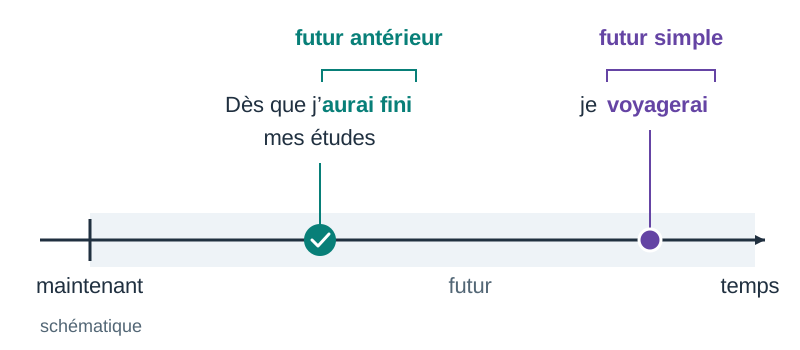
If the future action is already completed prior to another, French uses the futur antérieur: Dès que j'aurai fini mes études, je voyagerai. (As soon as I have finished my studies, I will travel.)
Le Conditionnel: Formation, Register, and Spotting the Tense
The conditionnel présent translates to 'would' in English (I would go, she would help). It is indispensable in formal correspondence, opinion essays, and polite oral responses.
Formation
The conditional combines the future stem with the imperfect endings:
Future stem + imperfect endings (-ais, -ais, -ait, -ions, -iez, -aient)
- parler → je parlerais, nous parlerions
- être → je serais, ils seraient
- avoir → tu aurais, vous auriez
- faire → elle ferait, nous ferions
- falloir → il faudrait (it would be necessary)
Polite Requests and Diplomatic Register
In requests, especially in formal letters, the conditional sounds polite and courteous rather than demanding:
- Je veux (I want) → Je voudrais de l'aide. (I would like some help.)
- Pouvez-vous m'aider ? → *Pourriez-vous m'aider ?* (Could you help me?)
- Tu dois faire attention. → Tu devrais faire attention. (You should be careful.)
- Il vaut mieux agir. → Il vaudrait mieux agir. (It would be better to act.)
Reported Speech (Future in the Past)
When reporting a future statement after a past reporting verb, the future tense shifts into the conditional:
- Il a dit : « Je viendrai. » → Il a dit qu'il viendrait. (He said he would come.)
- Note: If the reporting verb is in the present, the tense does not shift: Il dit qu'il viendra. (He says he will come.)
Spotting the Tense in Reading Comprehension
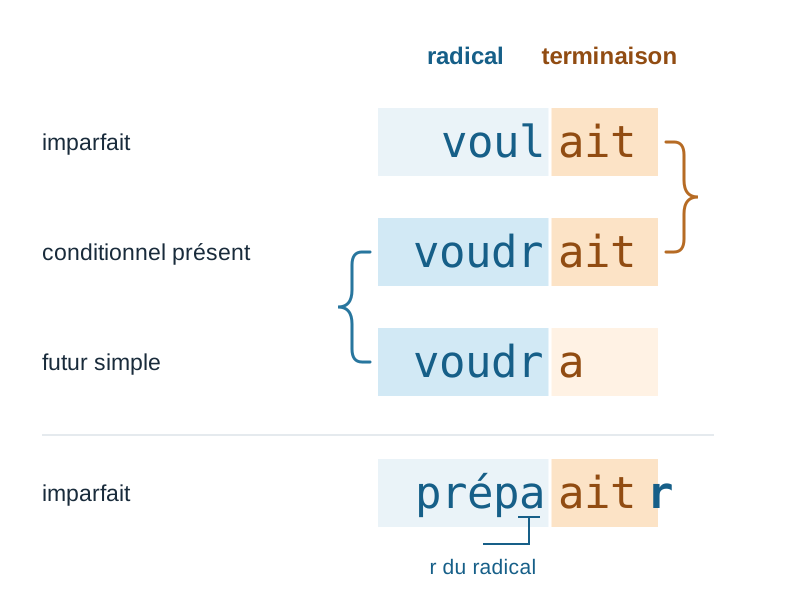
Reading questions often ask you to locate a specific tense (e.g. Trouvez dans le texte un verbe au conditionnel / à l'imparfait). The conditionnel and the imparfait share the exact same endings (-ais, -ait, -ions, -iez, -aient), so check the stem:
- Imparfait: nous-form present stem + ending (voulait, avait, finissait; être is the exception: ét- → était). No -r- appears before the ending unless the infinitive stem naturally ends in r (such as préparait from préparer).
- Conditionnel: future stem (infinitive or irregular r-stem) + ending (voudrait, aurait, serait, finirait).
- Futur simple: future stem + future endings (voudra, aura, sera, finira).
When writing your answer, copy only the verb form itself. In past marking schemes (e.g. 2016, 2018), adding any extra word or a full clause to the answer lost all the marks for the question.
Hypothetical Si Clauses: The Three Fixed Patterns
Conditional sentences with si (if) follow rigid grammatical pairings. Using the wrong tense in a si sentence is a common and costly grammar error, so learn the three patterns by heart.
The Rule of Si Clauses
Never put a futur simple or conditionnel straight after si when it means 'if'. After si, use only the présent, the imparfait, or the plus-que-parfait. The traditional classroom reminder is: « Les 'si' n'aiment pas les 'rai' ».
Watch out: the imparfait of verbs whose stem ends in r naturally ends in -rais (for example, si je préparais, si je rentrais, si je courais). That is completely correct because the tense is the imparfait, not the conditional.
Warning: When si means 'whether' (after verbs like demander or savoir), the future or conditional can follow: Je ne sais pas s'il viendra. (I do not know whether he will come.)
Type 1: Real and Probable Conditions
Describes a genuine possibility in the present or future.
si + présent → futur simple (or présent / impératif)
- Si j'ai le temps ce soir, je finirai mes devoirs. (If I have time this evening, I will finish my homework.)
- Si tu es fatigué, repose-toi. (If you are tired, rest.)
- Si vous voulez, on peut se retrouver à 18 h. (If you want, we can meet at 6 pm.)
Type 2: Imagined or Hypothetical Situations
Expresses what would happen if circumstances were different right now. This is the pattern tested in oral hypothetical questions (Que feriez-vous si...?).
si + imparfait → conditionnel présent
- Si j'avais plus de temps libre, je ferais du bénévolat. (If I had more free time, I would do volunteer work.)
- Si le gouvernement investissait dans les transports, la pollution diminuerait. (If the government invested in transport, pollution would decrease.)
Type 3: Past Speculation and Unfulfilled Regrets
Describes what would have happened in the past if things had gone differently. The conditionnel passé is formed using the conditional of avoir or être + past participle (e.g. j'aurais réussi, elle serait venue).
si + plus-que-parfait → conditionnel passé
- Si j'avais étudié plus régulièrement, j'aurais réussi tous mes examens. (If I had studied more regularly, I would have passed all my exams.)
- Si elle était venue, nous serions sortis ensemble. (If she had come, we would have gone out together.)
Clause Reversal
You can reverse the order of the clauses in all three patterns without changing the tenses. Omit the comma when si sits in the middle:
- Je ferais du bénévolat si j'avais plus de temps libre.
Vocabulary and Structures: Future Plans, Arrangements, and Advice
You will need this vocabulary to talk and write about your plans for college, work, and everyday arrangements. It appears across written tasks, listening comprehensions, and the oral interview.
High-Frequency Future and Career Vocabulary
| French | English |
|---|---|
| les projets d'avenir (m. pl.) | future plans |
| poursuivre des études | to pursue studies |
| faire un apprentissage | to do an apprenticeship |
| une formation | a training course / qualification |
| un stage en entreprise | an internship / work placement |
| une année sabbatique | a gap year |
| le marché du travail | the job market |
| un métier / une profession | a trade / profession |
| les débouchés (m. pl.) | career opportunities / job prospects |
| à court terme / à long terme | in the short term / in the long term |
| le conseiller / la conseillère d'orientation | guidance counsellor |
Words that Signal the Future and Sequence Events
| French | English |
|---|---|
| demain / après-demain | tomorrow / the day after tomorrow |
| la semaine prochaine / l'année prochaine | next week / next year |
| dans deux ans | in two years' time |
| à l'avenir | in the future |
| du 3 au 17 juillet | from 3rd to 17th July |
| d'abord … ensuite … après … enfin | first … then … after that … finally |
Example: D'abord, je vais passer le bac ; ensuite, je partirai en vacances du 1er au 15 juillet ; enfin, j'irai à l'université en septembre.
Three Everyday Future Forms
- il y aura = there will be (Il y aura moins d'emplois si l'économie ralentit.)
- il y aurait = there would be (S'il y avait plus de pistes cyclables, il y aurait moins de circulation.)
- Weather: Demain il pleuvra / il va pleuvoir ; il fera beau ; il y aura des éclaircies. (Tomorrow it will rain / it is going to rain; it will be fine; there will be sunny spells.)
Phrases for Making and Changing Arrangements
- Offering: Je peux t'aider si tu veux. / Veux-tu que je t'aide ? (I can help you if you want.)
- Willingness / Refusal: Je veux bien. (I'd be glad to.) / Je regrette, mais je refuse. (I am sorry, but I refuse.)
- Promising: Je te promets que je t'écrirai. (I promise I will write to you.)
- Arranging: On se retrouvera devant la gare à 15 h. (We'll meet in front of the station at 3 pm.)
- Cancelling: Je suis désolé(e), mais je ne pourrai pas venir samedi. (I'm sorry, but I won't be able to come on Saturday.)
- Rescheduling: Est-ce qu'on pourrait remettre ça à dimanche ? (Could we put that off until Sunday?)
Structures for Plans and Advice
- J'ai l'intention de / Je compte / J'espère + infinitive (I intend to / I plan to / I hope to)
- Il faudra + infinitive (it will be necessary to): Il faudra travailler dur.
- afin de / pour + infinitive (in order to): Je ferai un stage afin d'acquérir de l'expérience.
- Tu pourrais + infinitive (you could): Tu pourrais demander conseil à ton prof.
- Il serait préférable / plus utile de + infinitive (it would be preferable / more useful to)
Set Phrases by Format
- Informal email / letter:
- J'ai hâte de te voir. (I look forward to seeing you.)
- Après le bac, je vais d'abord me reposer. (After the Leaving Cert, I am first going to rest.)
- Si j'obtiens les points nécessaires, j'irai à l'université. (If I get the necessary points, I will go to university.)
- Formal letter:
- Je vous serais reconnaissant(e) de bien vouloir me renseigner sur... (I would be grateful if you would kindly inform me about...)
- Dans l'attente de votre réponse, je vous prie d'agréer, Madame, Monsieur, l'expression de mes salutations distinguées. (Awaiting your reply, yours faithfully.)
- Opinion piece:
- Il vaudrait mieux agir avant qu'il ne soit trop tard. (It would be better to act before it is too late.)
- Si chacun faisait un effort, la situation s'améliorerait. (If everyone made an effort, the situation would improve.)
- Dès que les gouvernements prendront des mesures, nous verrons des progrès. (As soon as governments take steps, we will see progress.)
- Note / message:
- Je t'écris ce mot pour te dire que je ne pourrai pas venir ce soir. (I am writing this note to tell you that I won't be able to come tonight.)
- On se voit demain à midi. (See you tomorrow at midday.)
- Diary entry:
- Demain, ce sera une journée chargée. (Tomorrow will be a busy day.)
- Je vais me coucher tôt car je dois me lever à 7 h. (I am going to go to bed early because I have to get up at 7 am.)
Key terms
- Futur proche
- The near future tense formed with the present tense of aller plus an infinitive (e.g. je vais faire), expressing immediate plans or decided intentions.
- Futur simple
- The simple future tense formed by adding -ai, -as, -a, -ons, -ez, -ont to the future stem, used for long-term plans, promises, predictions, and clauses after quand or dès que.
- Conditionnel présent
- The conditional mood formed by adding imperfect endings (-ais, -ais, -ait, -ions, -iez, -aient) to the future stem, used for polite requests and Type 2 hypothetical results.
- Conditionnel passé
- The past conditional formed using the conditional of avoir or être plus a past participle (e.g. j'aurais voulu, elle serait partie), expressing unfulfilled past outcomes.
- Plus-que-parfait
- The pluperfect tense formed using the imperfect of avoir or être plus a past participle, used after si in Type 3 conditional sentences.
- Conjonctions temporelles
- Time conjunctions such as quand, lorsque, dès que, and aussitôt que that require a future tense in French when referring to future events: the futur simple, or the futur antérieur when the action will already be complete.
Check yourself
Conjugate 'pouvoir' in the third person plural (ils / elles) of the futur simple.
ils / elles pourront (irregular stem 'pourr-' + regular ending '-ont').
In the sentence « Si elle voulait, elle pourrait venir », which verb is in the imparfait and which is in the conditionnel?
'voulait' is in the imparfait (present nous-stem voul- + -ait); 'pourrait' is in the conditionnel (future stem pourr- + -ait).
Correct this sentence: « Quand nous arrivons à Paris, nous visiterons le Louvre. »
« Quand nous arriverons à Paris, nous visiterons le Louvre. » (French uses the futur simple after 'quand' when referring to a future action).
Translate into French using a Type 2 si clause: 'If I had more money, I would buy a car.'
« Si j'avais plus d'argent, j'achèterais une voiture. » (si + imparfait → conditionnel présent).
How do you form the negative of « Je vais le faire »?
« Je ne vais pas le faire. » ('ne' and 'pas' wrap around the conjugated form of aller; the object pronoun 'le' stays directly before the infinitive 'faire').