

The aural examination takes place on the day of the written paper and accounts for 20% of the total marks at Leaving Certificate Higher Level (80 out of 400 marks). Conversations and interviews form the backbone of this paper, appearing across Sections 1 to 4 of the recording. You will hear native speakers discussing personal life, work, education, travel, accommodation, and social issues. Questions are answered in English or Irish. High marks do not depend on translating every word you hear; they depend on targeted listening strategies: identifying question focus words during the pre-reading time, tracking the interviewer's questions as signposts, spotting spoken negation and attitude, and noting precise figures, qualifiers, and verb tenses.
Strategic Listening: Four-Step Exam Routine
In recent Leaving Certificate papers, each conversation or interview is normally played three times: first straight through, then in segments with pauses for writing, and finally straight through again. The news items at the end are normally played only twice, so you must work more rapidly there. Always verify the exact instructions printed on your examination paper.
Step 1: Pre-reading silence
Use every second of the reading silence before the recording begins. Underline the English question word in each prompt. This identifies the category of French vocabulary to target:
- Who: Target a person, trade, or family relation (such as un collègue, ma belle-mère, l'aîné).
- Where: Target a building, room, town, or prepositional phrase (such as sur le quai, en banlieue, à l'accueil).
- When / How long ago: Target dates, clock times, or temporal prepositions (such as il y a, depuis, vers midi).
- Why: Target a reason or cause. Listen immediately after connectors like parce que, car, grâce à, or à cause de.
- How many / How much: Target numbers, fractions, percentages, or approximate quantities (such as plus de, la moitié, une vingtaine).
- How often: Target frequency phrases such as une fois par mois, tous les quinze jours.
Step 2: First hearing (straight through)
Follow the overall thread of the dialogue. Establish the relationship between the speakers, the main topic, and write down any obvious names, places, or figures.
Step 3: Second hearing (in segments with pauses)
This is where you write most of your answers. Listen for the specific nouns, adjectives, and qualifiers that complete the required detail. Do not write full sentences; concise factual phrases are quicker and reduce spelling slips.
Step 4: Third hearing (straight through)
Verify your points. Check for restrictive qualifiers like ne... que or negative plus, confirm complex numbers, and make sure that your answers do not contradict themselves.
Time Frames, Tense Recognition, and Reporting Verbs
Questions often hinge on whether an action has already occurred, is happening now, or will happen in the future. Leaving Certificate questions frequently ask what a speaker did, plans to do, or what a third party told them.
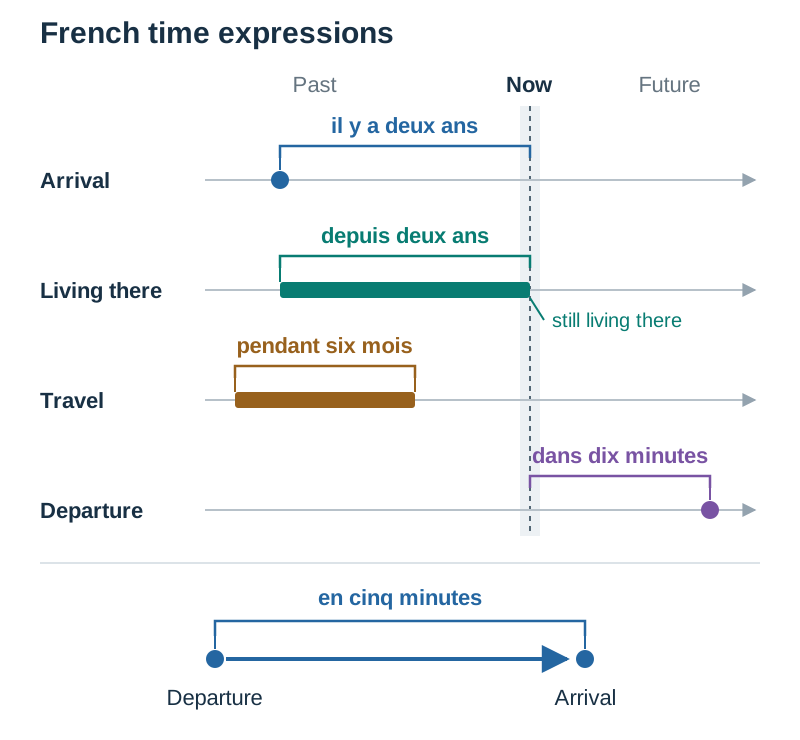
Distinguishing time markers
- il y a + time = ago: Je suis arrivé il y a deux ans means I arrived two years ago. It describes a finished past event.
- depuis + time = for / since: J'y habite depuis deux ans means I have been living there for two years (and still live there now).
- pendant + time = for (completed duration): J'ai voyagé pendant six mois means I travelled for six months (the trip is over).
- dans + time = in (future time): Le train partira dans dix minutes means The train will leave in ten minutes.
- en + time = time taken to complete something: J'y vais en cinq minutes means I get there in five minutes.
Past and future reference words
- Past markers: hier (yesterday), avant-hier (the day before yesterday), la semaine dernière (last week), en septembre dernier (last September), autrefois (in the past).
- Future markers: demain (tomorrow), après-demain (the day after tomorrow), la semaine prochaine (next week), le mois prochain (next month).
- Frequency markers: tous les jours (every day), une fois par semaine / par mois (once a week / a month), tous les quinze jours (every fortnight), souvent (often), parfois (sometimes), rarement (rarely).
Identifying verb tenses
- Passé composé: Formed with an auxiliary (avoir or être) and a past participle (J'ai travaillé, Elle est partie). It signals a single completed action.
- Imparfait: The endings sound like "-ay" (-ais, -ait, -aient), e.g. Je travaillais. It describes past routines, background settings, or ongoing past states.
- Futur proche: Aller + infinitive (Je vais partir = I am going to leave).
- Futur simple: Verb endings like -ra, -rons, -ront (Le train partira demain = The train will leave tomorrow).
- Conditionnel: Stem identical to the future, but with imperfect endings (Je voyagerais = I would travel). It frequently follows a condition: Si j'avais le temps, je voyagerais (meaning the speaker does not have time and is not travelling).
Reported speech
When questions ask what another person said (such as What did Corinne's sister tell her?), listen for reporting formulas. The core fact follows right after que or the preposition:
- Il / elle m'a dit que... (He / she told me that...)
- D'après / selon ma sœur... (According to my sister...)
- On m'a raconté que... (I was told that...)
- J'ai entendu dire que... (I've heard that...)
Interviewer Prompts, Discourse Markers, and Spoken Nuance
Interviews follow a structured sequence. The interviewer's questions act as verbal signposts, signalling when the conversation moves on to the next examination question on your paper.
Interviewer signposts
- Pourquoi avez-vous choisi ce métier ? signals a reason, childhood ambition, or career motivation.
- Depuis combien de temps faites-vous cela ? signals an answer containing depuis or a duration.
- Qu'est-ce qui est le plus difficile au quotidien ? signals an obstacle, heavy workload, or complaint.
- Quels sont vos projets pour l'avenir ? signals future study, travel, or career plans.
- Comment vos proches ont-ils réagi ? signals opinions, encouragement, or opposition from family and friends.
Recognising whether speakers use tu or vous clarifies their relationship. Strangers, officials, and formal interviewers use vous, while family members, classmates, and friends use tu.
Discourse markers and causal links
- D'abord / Tout d'abord (first of all) introduces the initial point.
- Ensuite / Puis (next / then) introduces a following step.
- Enfin / Pour finir (finally / to finish) introduces the concluding point.
- Parce que / Car (because) introduces a direct explanation.
- grâce à (thanks to) introduces a helpful cause or positive factor: J'ai trouvé du travail grâce à mon oncle (Thanks to my uncle, I found a job).
- à cause de (because of) introduces a negative cause, hurdle, or fault: On a raté le train à cause de la grève (We missed the train because of the strike).
- Cependant / Pourtant (however / yet) signals a qualification or shift in opinion.
- En revanche / Par contre (on the other hand) introduces a contrasting disadvantage or reality.
- Donc / Par conséquent (so / therefore) introduces a decision or outcome.
- En fait (in fact / actually) introduces a clarification or true explanation.
Negation in conversational French
In rapid spoken French, native speakers almost always drop the initial ne, pronouncing only the second half of the negative (pas, plus, jamais, que, guère). If you miss that second word, you will reverse the meaning of your answer:
- Je (ne) mange plus de viande: I no longer eat meat (do not write he eats more meat). Clue: negative plus is usually pronounced without the final 's' sound ('plu'), whereas plus meaning more is often pronounced with the 's' sound ('pluss').
- Il (ne) fait que se plaindre: He does nothing but complain / He only complains (ne... que indicates restriction, meaning only).
- Ce n'est guère rassurant: It is hardly / scarcely reassuring.
- Elle (ne) prend jamais la voiture: She never takes the car.
Tone and attitude
A speaker's choice of words indicates approval, irritation, or scepticism:
- Approval and satisfaction: ravi(e) (delighted), passionnant (thrilling), détendu (relaxed), c'est impeccable (it is perfect / spotless), valoir la peine (to be worth it).
- Discontent and complaint: inadmissible (unacceptable), déçu(e) (disappointed), sale (dirty), bruyant (noisy), en panne (broken down / out of order).
- Doubt and hesitation: je ne suis pas sûr(e) (I'm not sure), peut-être (maybe), il se peut que (it is possible that), tu crois ? (do you think so?).
Numbers, Quantities, and Clock Times
Numerical data carries marks in nearly every section of the aural exam. Write figures as digits in your answer, and make sure you include any accompanying qualifying words.
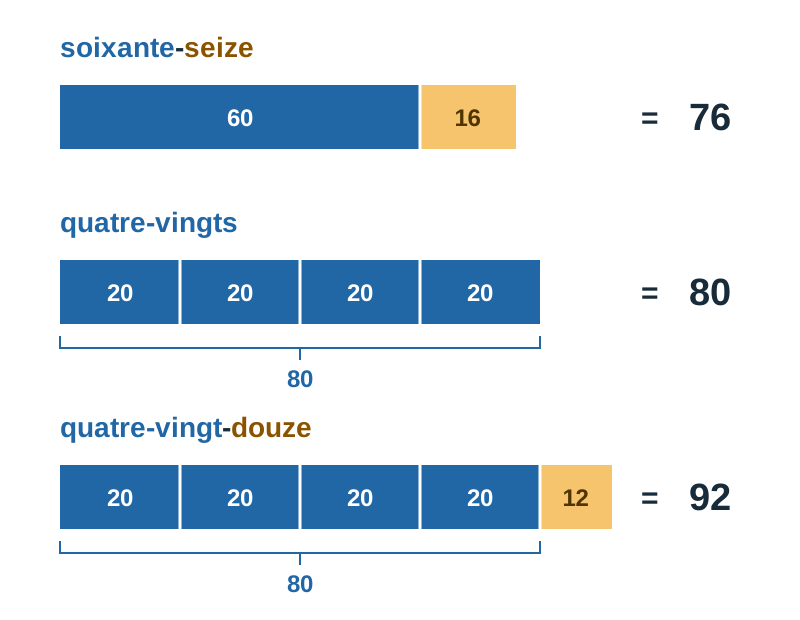
Numbers from 70 to 99
From 70 to 99, French builds numbers in twenties, requiring mental arithmetic:
- 70 to 79 (60 + 10 to 19): soixante-dix (70), soixante et onze (71 - note the et), soixante-quatorze (74), soixante-seize (76 = 60 + 16).
- 80 to 89 (4 × 20): quatre-vingts (80), quatre-vingt-un (81 - no et), quatre-vingt-cinq (85).
- 90 to 99 (4 × 20 + 10 to 19): quatre-vingt-dix (90), quatre-vingt-onze (91), quatre-vingt-douze (92 = 80 + 12, not 82), quatre-vingt-dix-neuf (99).
Approximate and qualified quantities
- plus de 28 000 = more than 28,000
- moins de = fewer / less than
- environ / à peu près = about / approximately
- près de = nearly / almost
- une vingtaine = about twenty
- une trentaine = about thirty
- une centaine = about a hundred
- des milliers = thousands
- la moitié = half
- un tiers = a third
- un quart = a quarter
- le double = twice as much / double
- trente pour cent = 30%
Telling the time
- 24-hour announcements (stations, airports, schedules): Use numbers directly, such as quinze heures quinze (15:15 / 3:15 p.m.) and seize heures quarante-cinq (16:45 / 4:45 p.m.).
- Conversational 12-hour phrasing: Uses fractions and periods of the day, such as trois heures et quart du matin (3:15 a.m.) or cinq heures et demie du soir (5:30 p.m.).
High-Yield Vocabulary Banks, Gender Pairs, and Traps
Conversations draw directly on syllabus themes. Learn these specific high-frequency terms and structural traps.
Travel, accommodation, and complaints
- se garer / le stationnement = to park / parking (Il est impossible de se garer = parking is impossible)
- la clim(atisation) = air conditioning
- en panne = broken down / out of order
- sale = dirty
- bruyant = noisy
- le séjour = the stay / holiday
- la chambre = the bedroom
- complet = fully booked / no vacancies
- le quai / la voie = the platform / the track
- un aller simple / un aller-retour = a single / a return ticket
- en retard / en avance = late / early
- annulé = cancelled
- un vélo = a bike
Family and relationships
- une petite-fille = granddaughter (hyphenated)
- une petite fille = a little girl (no hyphen)
- un petit-fils = grandson
- les petits-enfants = grandchildren
- un beau-père = stepfather or father-in-law
- une belle-mère = stepmother or mother-in-law
- un demi-frère = half-brother or stepbrother
- aîné(e) = older / eldest
- cadet(te) = younger / youngest
- un(e) jumeau / jumelle = twin
- la naissance = birth
- un(e) proche = a relative or close friend
- gagner sa vie = to earn a living
- sortir quand il veut = to go out whenever he wants
School, study, and false friends
- passer un examen = to sit an exam (not to pass it)
- réussir / être reçu à un examen = to pass an exam
- échouer / rater un examen = to fail an exam
- redoubler = to repeat a school year
- le lycée = secondary school (senior cycle)
- la fac = university
- une bourse = a grant / scholarship
- le bac(calauréat) = French school-leaving examination
- actuellement = currently / at present (not 'actually')
- la librairie = bookshop (not 'library', which is la bibliothèque)
- rester = to stay (not 'to rest', which is se reposer)
- sensible = sensitive (not 'sensible', which is raisonnable)
- la location = rental / hiring (not 'location', which is le lieu / l'endroit)
- la monnaie = change / currency (not 'money', which is l'argent)
- une déception = a disappointment (not 'deception', which is la tromperie)
- la journée = the day / daytime (not 'journey', which is le voyage)
Noun gender pairs that change meaning
In listening, the article (le/un versus la/une) is often the main clue. Then check which meaning makes sense in the conversation:
- le tour (the tour / turn / circuit) / la tour (the tower)
- le livre (the book) / la livre (the pound - currency or weight)
- le poste (the job / the television set) / la poste (the post office)
- le mode (the method / mode) / la mode (fashion)
- le mémoire (the dissertation / academic essay) / la mémoire (memory)
- le vase (the flower vase) / la vase (mud / silt)
Key terms
- Listening Comprehension (the aural)
- The Leaving Certificate French listening test: 20% of the marks at Higher Level, with answers written in English or Irish.
- Il y a (+ duration)
- A time expression meaning 'ago' that fixes an action in the completed past (e.g. 'il est parti il y a trois jours' = he left three days ago).
- Depuis
- A preposition meaning 'for' or 'since' used with a present tense verb to indicate an action that began in the past and continues in the present.
- Ne... que
- A restrictive structure meaning 'only' or 'nothing but' (e.g. 'je n'ai que dix euros' = I only have ten euros).
- Passer un examen
- A high-frequency false friend meaning to sit or take an exam, whereas 'réussir un examen' means to pass it.
- Petite-fille
- The French noun for granddaughter; easily confused in listening with 'une petite fille' (a little girl).
- Grâce à / À cause de
- Two contrasting causal prepositions: 'grâce à' introduces a positive cause (thanks to), while 'à cause de' introduces a negative cause or fault (because of).
- En panne
- An expression meaning broken down or out of order, frequently used in accommodation and travel complaint dialogues.
Check yourself
If an announcement states: « Le train partira à seize heures quarante-cinq », what time will the train depart in 12-hour format?
4:45 p.m. (or quarter to five in the afternoon).
A speaker says: « Il est parti il y a six mois ». When did the person leave?
Six months ago ('il y a' + time indicates time ago in the completed past).
An interviewee remarks: « Ma petite-fille est née en septembre ». Who was born?
His or her granddaughter (note the hyphen in 'petite-fille', distinguishing it from a little girl).
What is the English numerical value of 'quatre-vingt-treize'?
93 (calculated as 4 × 20 + 13).
« Elle a passé son bac en juin. » Does this tell you she passed the exam?
No. 'Passer un examen' means to sit or take an exam, so it only tells you she sat the bac (the French school-leaving exam) in June. Passing would be 'elle a réussi son bac' or 'elle a été reçue au bac'.
If someone claims: « Il y avait plus de trente mille manifestants », what does 'plus de' mean here?
More than (there were more than 30,000 demonstrators).