

The present tense (le présent de l'indicatif) and reflexive verbs are essential building blocks for Leaving Certificate Higher Level French. The French present tense conveys habitual routines, states of being, and ongoing actions in a single verb form without an auxiliary verb. Master regular verb families, stem-spelling changes, core irregular verbs, reflexive pronouns, and question structures to communicate with precision across the oral examination, written production tasks, and reading comprehension exercises.
The Present Tense and Regular Verbs (-er, -ir, -re)
French has no separate "-ing" present tense, so never put je suis in front of a verb. For example, je parle means "I speak", "I am speaking", and "I do speak". Translating "I am speaking" literally as je suis parle is a serious error.
Stressed Ongoing Action: être en train de
When you want to emphasise that an action is in progress right now, use être en train de + infinitive:
- Je suis en train de réviser pour mes examens. – I am (busy) revising for my exams.
- Mes parents sont en train de préparer le dîner. – My parents are making dinner right now.
Regular French verbs belong to three conjugation groups based on their infinitive endings. To conjugate, drop the infinitive ending to find the stem, then attach the correct personal ending.
Group 1: -er Verbs (e.g. parler – to speak)
- je parle
- tu parles
- il / elle / on parle
- nous parlons
- vous parlez
- ils / elles parlent
The endings for je, tu, il/elle/on, and ils/elles (-e, -es, -e, -ent) are completely silent. In speech, je parle and ils parlent sound identical. While spoken pronouns identify the subject, your written work requires exact spelling.
Group 2: -ir Verbs (e.g. finir – to finish)
- je finis
- tu finis
- il / elle / on finit
- nous finissons
- vous finissez
- ils / elles finissent
Regular -ir verbs add -iss- between the stem and the ending in all plural forms (nous finissons, vous finissez, ils finissent). Verbs following this pattern include choisir (to choose), réussir (to succeed), and grandir (to grow). Be careful: common verbs such as partir, sortir, and dormir do not use this infix and conjugate irregularly.
Group 3: -re Verbs (e.g. vendre – to sell)
- je vends
- tu vends
- il / elle / on vend
- nous vendons
- vous vendez
- ils / elles vendent
In the third-person singular (il / elle / on), regular -re verbs add no ending at all; the bare stem ending in -d stands alone (for example, il attend – he waits; elle répond – she answers).
Stem Spelling Adjustments in -er Verbs
Certain -er verbs alter their stem spelling before specific endings to preserve standard French pronunciation. These adjustments preserve sounds and do not change the core endings.
Verbs in -ger and -cer
- Verbs in -ger (e.g. manger, voyager, partager): Add a silent e before the -ons ending to keep the "g" soft: nous mangeons (we eat), not nous mangons.
- Verbs in -cer (e.g. commencer, lancer): Change the c to a cedilla (ç) before -ons to maintain the soft "s" sound: nous commençons (we begin), not nous commencons.
Stem Vowels and Consonant Doubling
- Verbs with a plain e before the stem consonant (e.g. acheter, lever): The "e" takes a grave accent (è) before a silent ending: j'achète, tu achètes, il achète, ils achètent, but nous achetons, vous achetez.
- Verbs with é in the stem (e.g. préférer, espérer): The acute changes to è before silent endings: je préfère, ils préfèrent, but the original accent remains when the ending is pronounced: nous préférons, vous préférez.
- Double consonant verbs (e.g. appeler, s'appeler, jeter): The "l" or "t" doubles before a silent ending: j'appelle, je m'appelle, ils s'appellent, je jette, but nous nous appelons, vous jetez.
Verbs in -yer
In verbs ending in -yer (e.g. s'ennuyer, envoyer, nettoyer), the y changes to i before a silent ending (je, tu, il/elle/on, ils/elles), but stays y in the nous and vous forms:
- s'ennuyer (to get bored): je m'ennuie, tu t'ennuies, il s'ennuie, nous nous ennuyons, vous vous ennuyez, ils s'ennuient
- envoyer (to send): j'envoie, nous envoyons, ils envoient
- nettoyer (to clean): je nettoie, nous nettoyons
(For verbs in -ayer such as payer, both je paie and je paye are acceptable.)
Essential Irregular, Modal, and Auxiliary Verbs
Four high-frequency verbs form the foundation of Leaving Certificate French. Their present-tense patterns must be memorised thoroughly:
| Subject | être (to be) | avoir (to have) | aller (to go) | faire (to do/make) |
|---|---|---|---|---|
| je / j' | suis | ai | vais | fais |
| tu | es | as | vas | fais |
| il / elle / on | est | a | va | fait |
| nous | sommes | avons | allons | faisons |
| vous | êtes | avez | allez | faites |
| ils / elles | sont | ont | vont | font |
Watch out for the irregular -tes ending in vous faites and the third-person plural ils font. Remember that French uses avoir for age and physical sensations (j'ai dix-sept ans, j'ai faim, j'ai froid).
Irregular Verbs: dire, venir, and prendre
- dire (to say): je dis, tu dis, il dit, nous disons, vous dites, ils disent. Note that vous dites and vous faites are the two common verbs ending in -tes.
- venir (to come): je viens, tu viens, il vient, nous venons, vous venez, ils viennent. This model applies to devenir (to become) and se souvenir de (to remember).
- prendre (to take): je prends, tu prends, il prend, nous prenons, vous prenez, ils prennent. This pattern applies to apprendre (to learn) and comprendre (to understand: je ne comprends pas).
Modal Verbs and Idiomatic Expressions
Modal verbs take a following infinitive directly without a preposition:
- pouvoir (can / to be able): je peux, tu peux, il peut, nous pouvons, vous pouvez, ils peuvent
- vouloir (to want): je veux, tu veux, il veut, nous voulons, vous voulez, ils veulent
- devoir (must / to have to): je dois, tu dois, il doit, nous devons, vous devez, ils doivent
- venir de + infinitive expresses a recent past event: Je viens de finir mes révisions. (I have just finished my revision.)
- savoir vs connaître: Use savoir (je sais, tu sais, il sait, nous savons, vous savez, ils savent) for facts or acquired skills (je sais nager). Use connaître (je connais, tu connais, il connaît, nous connaissons, vous connaissez, ils connaissent) for people and places (je connais bien Dublin).
Reflexive Verbs and Daily Routine
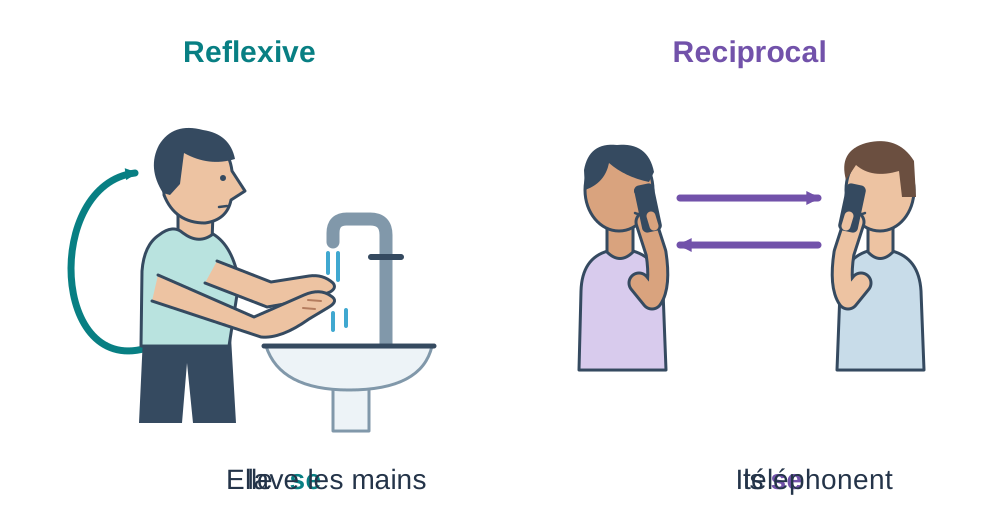
A reflexive verb (un verbe pronominal) indicates that the subject performs an action upon itself, or that multiple subjects act reciprocally upon each other. In dictionary vocabularies, reflexive verbs appear with the marker se before the infinitive.
Reflexive Pronoun Agreement
The reflexive pronoun sits directly before the conjugated verb and must match the grammatical subject:
| Subject | Reflexive Pronoun | se réveiller (to wake up) | Meaning |
|---|---|---|---|
| je | me (m') | je me réveille | I wake up |
| tu | te (t') | tu te réveilles | you wake up |
| il / elle / on | se (s') | il se réveille | he wakes up |
| nous | nous | nous nous réveillons | we wake up |
| vous | vous | vous vous réveillez | you wake up |
| ils / elles | se (s') | ils se réveillent | they wake up |
In structures such as nous nous réveillons or vous vous levez, the first word is the subject pronoun and the second is the reflexive object pronoun. Both are necessary. Before a vowel or silent h, me, te, and se elide to m', t', and s' (e.g. je m'habille).
Routine Verbs and Parts of the Body
When a reflexive verb involves a part of the body, French uses the definite article (le / la / les), not a possessive adjective (mon / ma / mes), because the reflexive pronoun already shows ownership:
- Je me brosse les dents. – I brush my teeth. (Never write je me brosse mes dents.)
- Elle se lave les mains. – She washes her hands.
- Il se sèche les cheveux. – He dries his hair.
Other essential daily verbs include: se réveiller (to wake up), se lever (to get up), s'habiller (to get dressed), se détendre (to relax), se sentir (to feel), se coucher (to go to bed), and s'endormir (to fall asleep).
Reflexive Verbs after Modal Verbs
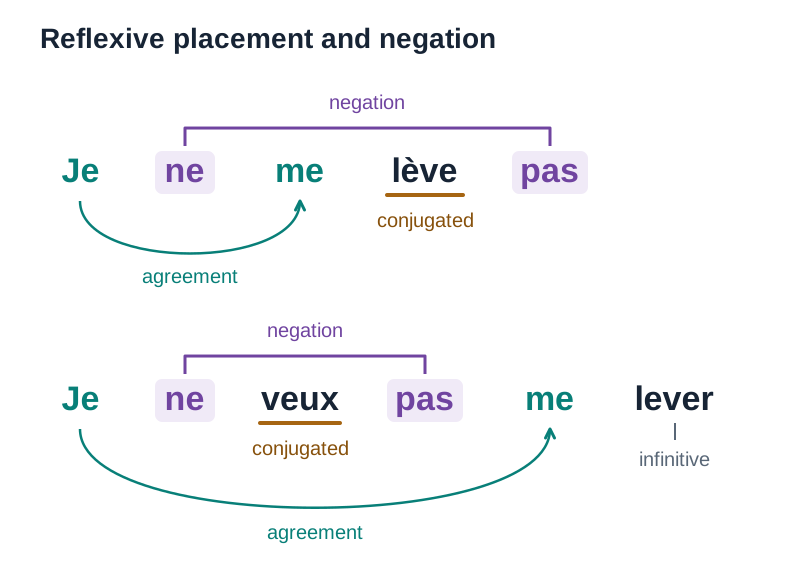
When a reflexive verb follows a conjugated verb such as devoir, pouvoir, vouloir, aller, or aimer, it remains in the infinitive. However, the reflexive pronoun must still match the subject and sits immediately before the infinitive:
- Je dois me lever tôt. – I have to get up early. (Never write je dois se lever.)
- Nous voulons nous reposer ce week-end. – We want to relax this weekend.
- Tu vas te coucher ? – Are you going to go to bed?
- Ils doivent se dépêcher. – They must hurry up.
In negative sentences, ne ... pas surrounds the conjugated auxiliary or modal verb only:
- Je ne veux pas me lever. – I do not want to get up.
Reciprocal Actions
With plural subjects (nous, vous, ils, elles), reflexive pronouns express reciprocal action ("each other"):
- Ils se téléphonent tous les soirs. – They phone each other every evening.
- Nous nous entendons très bien. – We get on very well with each other.
Depuis, Negation, Register, and Oral Interactions
Depuis + Present Tense
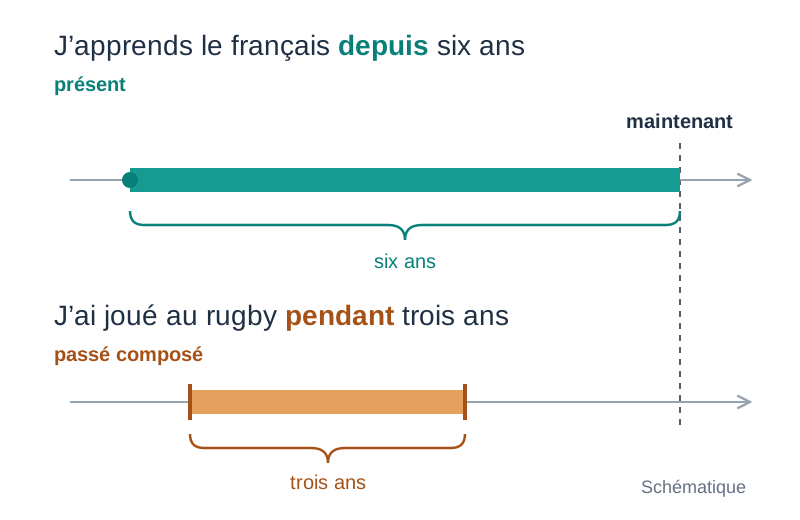
When an action started in the past and continues into the present, French uses the present tense + depuis. English uses "have been ...-ing" or "have lived/studied for":
- J'apprends le français depuis six ans. – I have been learning French for six years.
- J'habite ici depuis 2020. – I have lived here since 2020.
- Depuis combien de temps préparez-vous cet examen ? – How long have you been preparing for this exam?
Avoid writing j'ai appris le français pour six ans. Do not use pour here. If the action is still going on, use the present tense + depuis. If it is finished, use the passé composé + pendant: J'ai joué au rugby pendant trois ans (I played rugby for three years, but I have stopped).
Negation with Reflexive Verbs
In the simple present tense, the negative particles wrap around both the reflexive pronoun and the conjugated verb:
- Structure: Subject + ne + reflexive pronoun + conjugated verb + pas
- Je ne me lève pas tôt le dimanche. – I do not get up early on Sundays.
- Elle ne s'ennuie jamais en cours. – She never gets bored in class.
Asking Questions and Shifting Register in the Oral Exam
The syllabus requires proficiency across three question forms:
- Intonation: Tu te reposes après les cours ? (informal spoken register)
- Est-ce que: Est-ce que vous vous levez tôt ?
- Inversion: À quelle heure te lèves-tu ? / Vous couchez-vous tard ? A -t- is inserted if the verb ends in a vowel and the pronoun is il, elle, or on (e.g. s'appelle-t-il ?).
Use tu with friends, family, and peers (such as in an informal letter or diary entry). Use vous with adults you do not know well, in formal correspondence, and when addressing multiple people.
In the oral exam, the examiner usually addresses you as vous. Recognise the vous ending and reply in the je form:
- Examiner: Depuis combien de temps apprenez-vous le français ?
- Candidate: J'apprends le français depuis six ans.
- Examiner: À quelle heure vous levez-vous d'habitude ?
- Candidate: D'habitude, je me lève à sept heures et demie.
- Examiner: Vous vous entendez bien avec votre famille ?
- Candidate: Oui, je m'entends très bien avec mes parents et mon frère.
The Reflexive Compound Tense Link
Reflexive verbs always take the auxiliary être, never avoir, in compound tenses. In the passé composé, être is conjugated in the present tense: je me suis réveillé(e), nous nous sommes bien amusés. In this construction, the past participle agrees with the subject (e.g. elle s'est couchée), unless a direct object like a body part follows the verb (elle s'est lavé les mains).
Key terms
- le présent de l'indicatif
- The simple present tense in French, expressing habitual actions, ongoing events, or general truths without an auxiliary verb.
- le radical (stem)
- The foundational part of a verb obtained by dropping the infinitive ending (-er, -ir, -re), to which personal endings are attached.
- le verbe pronominal (reflexive verb)
- A verb conjugated with a reflexive pronoun (me, te, se, nous, vous, se) indicating an action performed on oneself or reciprocally.
- le pronom réfléchi
- The pronoun placed directly before the conjugated verb or infinitive that matches the grammatical subject (me, te, se, nous, vous, se).
- depuis + présent
- A grammatical construction pairing the simple present tense with 'depuis' to express an action that began in the past and is still ongoing.
- être en train de
- An idiomatic expression followed by an infinitive used to emphasise that an action is actively taking place at the present moment.
- la cédille (ç)
- The diacritical mark added beneath the letter 'c' before 'a', 'o', or 'u' to retain a soft 's' sound, as in nous commençons.
- l'inversion
- A formal question structure where the subject pronoun is placed immediately after the verb and joined with a hyphen (e.g. te lèves-tu ?).
Check yourself
Translate into French: 'I have been living in Ireland for ten years.'
J'habite en Irlande depuis dix ans. (Use the present tense + depuis for ongoing actions, never the passé composé with pour).
Correct the grammatical error in this sentence: 'Je dois se lever à sept heures.'
Je dois me lever à sept heures. (When a reflexive verb follows a modal verb in the infinitive, the reflexive pronoun must still match the subject 'je').
Provide the 'je' and 'nous' present-tense forms of the reflexive verb 's'ennuyer'.
Je m'ennuie and nous nous ennuyons. (The 'y' shifts to 'i' before silent endings, but remains 'y' in the nous form).
Conjugate the regular -ir verb 'choisir' for 'nous' in the present tense.
Nous choisissons. (Regular -ir verbs insert the -iss- infix before all plural endings: -issons, -issez, -issent).
Translate into French: 'She washes her hands before eating.'
Elle se lave les mains avant de manger. (Use the definite article 'les', not the possessive 'ses', when using reflexive verbs with parts of the body).
What are the present-tense forms of 'faire' and 'dire' for 'vous'?
Vous faites and vous dites. (Both verbs take the irregular -tes ending rather than -ez).