

Applied Creative Task 2 (ACT 2) is the core collaborative filmmaking project within Strand 3 of Leaving Certificate Drama, Film and Theatre Studies. Working in small production teams, students develop, record, edit, and screen an original film sequence of approximately three minutes in the edited format. The sequence must be informed by a chosen film genre, period, style, or form, drawing direct inspiration from established film practitioners. While ACT 2 is assessed formatively in the classroom by your teacher and recorded in your portfolio rather than marked directly by the State Examinations Commission (SEC), the technical craft, production discipline, and critical habits it fosters provide direct preparation for both the 50% Creativity in Practice Project and the written examination.
Understanding the Film Sequence Task
Before starting your production, keep the core requirements of ACT 2 clearly in view:
- Approximately three minutes long in the edited format
- Made through collaboration with classmates
- Informed by a chosen film genre, period, style, or form
- Shown to a live audience of your peers
- Documented in your portfolio with a treatment, design sketches, storyboard, shot list, and your written explanation, evaluation, and reflection.
In film grammar, a sequence is defined as a series of scenes which form a connected stretch of action or narrative. You are not expected to write, film, and finish a whole film with a complete beginning, middle, and end. Instead, your group creates a coherent three-minute excerpt that could serve as an opening scene, a central confrontation, or a self-contained unit within an imagined narrative. Film sequences do not always need a conventional plot; experimental work can build dramatic meaning through visual rhythms, atmosphere, or repeated imagery, provided your artistic choices remain deliberate and focused.
The requirement states approximately three minutes in the edited format for a reason. Unlike theatre, where a performance exists only live in the room, film is fundamentally crafted and finalised in post-production through editing, pacing, and sound design. You might shoot twenty minutes of raw footage to assemble three tight, coherent minutes on screen.
The Three Applied Creative Tasks Compared
| Task | Discipline | Target Duration | Working Arrangement | Timing Requirement |
|---|---|---|---|---|
| ACT 1 | Ensemble theatre piece | 4 to 6 minutes | Collaborative | Can be completed before or after ACT 2 |
| ACT 2 | Film sequence | Approximately 3 minutes (edited) | Collaborative | Can be completed before or after ACT 1 |
| ACT 3 | Theatre piece or short film | 5 to 8 mins (theatre) or 3 to 5 mins (film) | Collaborative or individual | Started only after both ACT 1 and ACT 2 are complete |
Who Works with Whom
It is important not to confuse the collaboration rules across your practical tasks:
- ACT 1: Collaborative. Students must collaborate to create an ensemble piece.
- ACT 2: Collaborative. Learning Outcome 3.7 explicitly requires you to develop, record, and edit through collaboration.
- ACT 3: Flexible. You may choose to work collaboratively or individually.
- Creativity in Practice Project: While aspects of the project may be progressed through collaborative endeavour, each student submits their own individual project journal and their own two-minute continuous video excerpt.
Connecting Creative Practice to Established Practitioners
Learning Outcome 3.8 requires you to use your engagement with established film practitioners, genres, periods, styles, or forms to inform your creative practice. You are not expected to recreate scenes shot-for-shot; the goal is to adapt an established practitioner's specific techniques to serve your own dramatic concept.
To articulate practitioner influence clearly, use a three-part connection: feature in studied work → your group's adaptation → intended audience effect.
For example: Colm Bairéad frames his protagonist in a restrictive 1.37:1 Academy ratio so domestic doorways seem to box her in. Our group shot our sequence in 4:3 and placed our character at the very bottom of the frame beneath an oversized stairwell. At our screening, peer feedback confirmed that the composition made the house feel oppressive, creating the exact psychological isolation we intended.
Choosing Your Influence and Syllabus Rules
Your film study across the course encompasses two distinct areas:
- Area 1 (Prescribed): Your school selects one focus of study from Department Circular 0061/2025: Option A, European Art Cinema (An Cailín Ciúin, dir. Colm Bairéad, 2022); Option B, The directorial style of Steven Spielberg (Jaws, dir. Steven Spielberg, 1975); or Option C, Genre: Romance (Past Lives, dir. Celine Song, 2023). This prescribed focus is studied in depth alongside extracts from at least one other film.
- Area 2 (Unprescribed): Freely chosen by your teacher and class (such as German Expressionism, Film Noir, or Dogme 95), explored through clips and extracts.
Two explicit syllabus rules govern what may inform your work:
- The Area 2 focus cannot be any of the three options listed for Area 1.
- Texts or films prescribed for study in any other Leaving Certificate subject you are taking in your examination year cannot be selected for Area 1 or Area 2.
Within those boundaries, your group can draw upon either Area 1 or Area 2 to inspire the visual framing, pacing, or audio design of your ACT 2 sequence.
Pre-Production: Design Sketches, Roles, and Planning Tools
Thorough pre-production protects your project from logistical collapse on filming days. Filmmaking relies on clear delegation: every student in your group must take ownership of specific production roles, such as directing, camera operation, sound recording, production design, or editing. While team members will often help one another on set, individual responsibilities must be clearly established.
The specification expects your group to give due consideration to aspects such as set, lighting, sound, and costume design, all with accompanying sketches. Treat these sketches as the standard expectation for your portfolio:
- Set Design: Floor plans and ground plans showing intended camera positions, furniture layouts, and acting areas.
- Lighting Design: Lighting diagrams indicating the placement of key, fill, and backlights, natural window sources, and planned shadows.
- Sound Design: Cue sheets mapping dialogue tracks, Foley sound effects, ambient background sounds, and deliberate silences.
- Costume Design: Character costume sketches noting colour palettes, fabrics, and how garments contrast against background walls.
Alongside sketches, your group compiles standard planning documentation:
| Document | Core Function in ACT 2 |
|---|---|
| Treatment | A prose document setting out the story synopsis, artistic concept, visual style, and target audience before writing scenes. |
| Screenplay / Marked Script | A script laid out in standard format, annotated with camera setups, technical cues, and character movement. |
| Storyboard | A series of drawn panels illustrating shot sizes, camera angles, and actor movements. |
| Shot List | A logistical schedule listing every camera setup by scene, shot number, angle, focal length, and location. |
| Call Sheets & Location Lists | Schedules detailing filming times, actor arrival times, contact details, location permissions, and safety checks. |
Building Roles: Screen Acting, Movement, and Voice
A successful sequence relies on believable human behaviour on camera, not just interesting framing. The ACT 2 specification requires careful consideration of role development, movement, and voice:
Building the Role
Decide what each character wants in the scene (their objective), what stands in their way (the obstacle), and what thoughts or feelings they are keeping hidden (the subtext). Write two or three lines of character background in your portfolio for each role, even if these details are never spoken aloud.
Sustaining the Role Across Takes
Because film is shot out of chronological order and broken into multiple setups, an actor must re-enter the same emotional state and physical energy across every take, whether in a wide shot or an extreme close-up. If an actor raises an arm on a specific word in the master shot, they must match that physical gesture on the exact same word during the close-up to preserve continuity.
Movement on Screen
Movement for the camera requires restraint. Stage gestures designed to project across a large auditorium look artificial and exaggerated on screen. A slight turn of the head, a frozen posture, or an averted gaze carries immense emotional weight in a medium close-up.
Voice on Screen
With a directional microphone positioned close overhead, screen actors do not need to project loudly. A natural speaking volume or a quiet whisper registers cleanly. Vocal consistency in volume, pace, and accent across takes is vital, because any sudden variation becomes jarring when two takes are cut together.
Production: Camera Coverage, Audio Capture, and Ethical Practice
During production, your group converts pre-production plans into recorded digital takes. A camera rehearsal prior to recording allows cast and crew to check framing, focus tracking, microphone placement, and lighting before rolling.
Visual Coverage
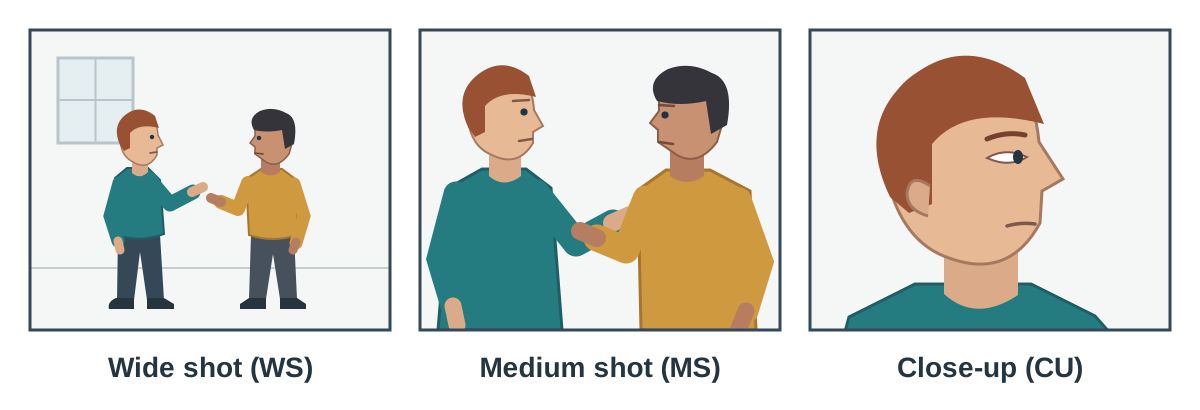
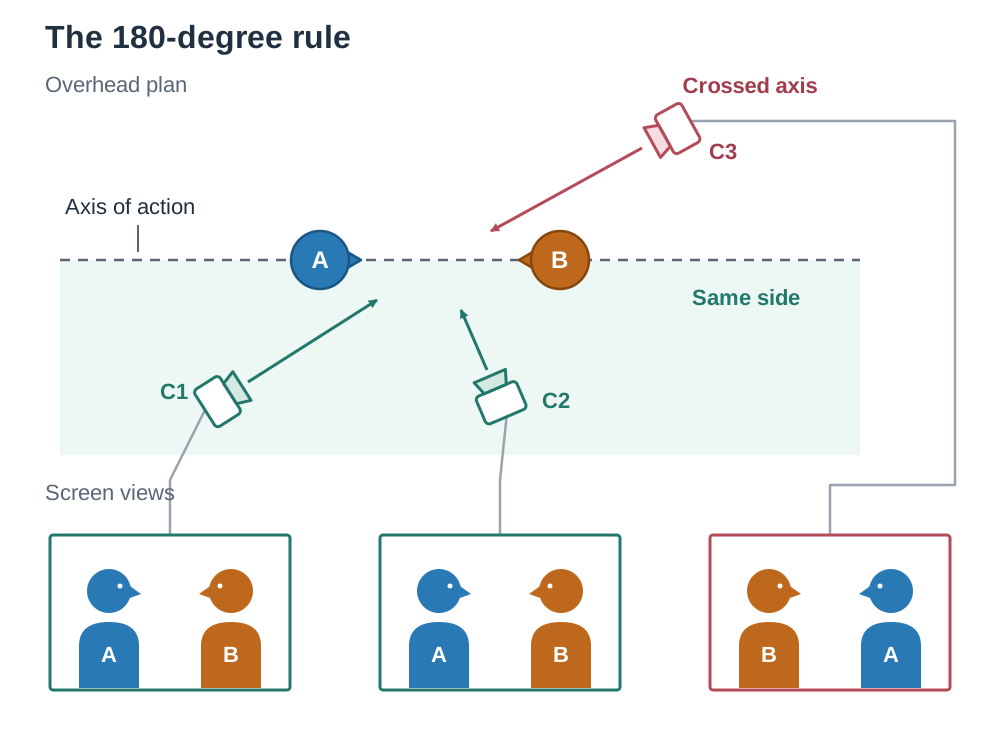
Frame each setup with dramatic intent. Capture establishing wide shots for spatial geography, medium shots for physical interactions, and close-ups for emotional reactions. Always maintain the 180-degree rule by keeping the camera on one side of the imaginary axis of action between characters; crossing this line flips screen directions and confuses the viewer's spatial awareness.
Audio Capture
Poor sound ruins student films faster than imperfect video. Use external microphones positioned close to the actors — a directional (shotgun) microphone on a boom, or a clip-on lavalier worn near the collar — rather than the camera's built-in microphone. Monitor sound through headphones during every take to catch wind noise or distortion. Record thirty seconds of room tone (silent ambient background noise) in every location; this baseline audio allows editors to patch gaps between dialogue cuts smoothly.
Ethical and Responsible Practice
Filmmaking involves legal, ethical, and personal responsibilities that must be documented in your portfolio:
- Location Permissions: Secure permission from whoever controls the property (school authorities, private owners) before shooting, and respect all agreed conditions.
- Participant Consent: Everyone visible on camera, including background extras, must understand the project and agree to be recorded.
- Copyright Compliance: Never use commercial music tracks or existing film footage without rights. Use royalty-free music, original compositions by classmates, or student-recorded sound effects, and reference every source fully.
- Honouring Intentions: If adapting an existing story or scene, credit the original creator and respect the dramatist's intentions.
- Safety and Risk Assessment: Identify hazards before shooting, such as trailing power cables, water, road traffic, stairwells, or night filming. No dramatic effect justifies risking physical injury.
Post-Production, Refinement, and Audience Screening
Post-production is the stage where raw takes are assembled, paced, and mixed into one coherent sequence. Editing is not merely cutting out errors; it is a primary storytelling tool.
Picture Editing
Import footage and assemble a rough cut following your storyboard. Apply continuity editing techniques such as cutting on action, shot-reverse-shot exchanges, and eyeline matches. Vary cut pacing to control tension: rapid cuts generate kinetic anxiety, while sustained takes create quiet intimacy or dread.
Sound Design and Mixing
Clean dialogue tracks and bed them over recorded room tone to eliminate silent dropouts. Add Foley effects (such as footsteps, handling keys, or rustling clothing) to give weight and tactile realism to on-screen objects. Balance sounds from within the story world (diegetic sound) against any musical score or atmospheric drones (non-diegetic sound), so that every spoken line stays clear and easy to hear.
Refining Through Feedback
The creative process is iterative, meaning you must move back and forth between developing and refining rather than following an inflexible line:
- Screen your rough cut to your teacher and a small group of peers before locking the final edit.
- Ask specific, constructive questions: "Was the geography of the room clear?" or "Did the dialogue stay audible over the street noise?"
- Log feedback in your portfolio and carry out practical changes: trim an overlong shot, replace a muffled line, or shoot a quick insert shot if a narrative transition is confusing.
- Documenting an artistic decision that your group reversed following feedback is powerful evidence of genuine creative process.
Screening to an Audience
Present your finalised sequence to a live audience, such as your class peers. Test projection, aspect ratios, and speaker volumes beforehand. Consider accessibility, including closed captions or adaptations for a relaxed screening (such as lowered volume levels and adjusted lighting). Observe audience reactions closely as evidence for your evaluation.
Portfolio Documentation: Explain, Evaluate, and Reflect
Every student must document their individual creative journey in their DFTS portfolio. Learning Outcomes 3.10, 3.11, and 3.12 require three distinct analytical skills defined in the syllabus glossary of action verbs:
| Command Action | Syllabus Definition | Application to ACT 2 |
|---|---|---|
| Explain (LO 3.10) | Give a detailed account including reasons or causes. | State what technical and creative choices you made (angles, cuts, lighting, Foley), why you made them, and how established practitioners influenced them. |
| Evaluate (LO 3.11) | Collect and examine work to make artistic judgements about ideas or methods. | Judge how successfully the finished sequence realised the original treatment, using evidence from the screened film and audience reactions. |
| Reflect on (LO 3.12) | Give thoughtful and careful consideration to actions, experiences, values, and learning to gain new insights. | Analyse your personal learning, collaboration dynamics, problems solved, and how this experience shapes your future creative work. |
Your portfolio must hold your treatment, design sketches for set, lighting, sound, and costume, storyboards, shot lists, notes on edits made after feedback, a digital copy of the sequence, and your written evaluation.
How ACT 2 Feeds Into Your Two Assessed Components
While ACT 2 is assessed formatively by your teacher to guide skill development, the knowledge and technical craft it develops directly underpin your two Leaving Certificate assessment components:
1. The Creativity in Practice Project (50%, 300 marks)
In Year 2, the SEC assesses this Additional Assessment Component based on a common brief (for example, the 2027 brief: The Use of Colour in Theatre and Film). The brief issues in Term 2 of Year 1, takes up to 25 hours to complete, and must be submitted by the deadline set by the SEC. Students choosing the film option apply the exact pre-production, filming, editing, and reflective writing skills practiced in ACT 2.
Be mindful of the technical submission differences:
- ACT 2: A classroom sequence of approximately three minutes in the edited format.
- Creativity in Practice Project: An individual submission consisting of a 1,700-word digital project journal (covering Imagining and Conceptualising, Exploring Ideas, Developing and Refining, The Production, and Evaluation and Reflection) and a continuous two-minute video excerpt taken from the screened film. The excerpt must be in MP4 format, no longer than two minutes, and no larger than 1GB (standard definition 720 x 480 at 25 frames per second easily satisfies this).
2. The Written Examination (50%, 300 marks)
The written examination assesses learning across all three strands and is divided into three sections:
- Section A: 100 marks
- Section B: 160 marks
- Section C: 40 marks
Section B accounts for more than half of the paper, demanding extended, structured answers. You will be required to write critically about your practical creative decisions, using precise cinematic vocabulary and explaining how established film practitioners directly shaped your creative work.
Key terms
- Film Sequence
- A series of scenes which form a sequence of action or narrative in a film. In ACT 2, it can be a scene or series of scenes from a larger imagined work rather than a complete film.
- In the Edited Format
- The finalised, assembled version of a film following post-production trimming, pacing, sound mixing, and colour correction; for ACT 2, this must be approximately three minutes in duration.
- Treatment
- A document that presents the story, concept, and visual idea of a film or theatre production before the script is written or the action devised.
- Storyboard
- A sequential series of illustrations or sketches depicting planned camera framing, actor movement, and visual compositions for each shot.
- Shot List
- A comprehensive operational schedule listing every camera setup required for filming, categorised by location, angle, focal length, and shot size.
- Mise en Scène
- Everything placed in front of the camera to be filmed: set design, props, costumes, lighting, and the physical positioning and movement of actors.
- Blocking
- The process of organising the action and movement of a piece of film or theatre in rehearsal which is then realised in production, led by the director.
- 180-Degree Rule
- A cinematography convention that establishes an imaginary axis of action between interacting characters; keeping the camera on one side of this line preserves consistent spatial orientation and eyelines across cuts.
- Continuity Editing
- A system of cutting shots together that maintains consistent, smooth, and logical narrative action across time and space.
- Room Tone
- The baseline ambient sound recorded on a quiet location set, used by sound editors to fill gaps and smooth transitions between dialogue edits.
- Foley
- The creation and recording of everyday physical sound effects (such as footsteps, rustling clothes, or handling props) in post-production to enhance sonic realism.
- Diegetic Sound
- Any sound whose source exists visibly or invisibly within the world of the film, audible to the characters on screen.
- Non-Diegetic Sound
- Sound originating from outside the fictional story world, such as an orchestral musical score, voiceover narration, or stylised sound cues.
- Practitioner Influence
- The deliberate adoption and adaptation of specific techniques, aesthetics, or conventions from professional filmmakers to inform student creative work.
- Relaxed Screening
- A screening in which conventions are adapted to make the event accessible for audience members with sensory sensitivities, such as ASD; adaptations include reduced volume, house lights left on, and freedom of movement.
- Portfolio
- A student's collection of evidence documenting the creative and critical response processes across the Applied Creative Tasks, including treatments, sketches, logs, video files, and reflections.
Check yourself
What is the recommended target duration for the completed ACT 2 film sequence?
Approximately three minutes in the edited format.
In what order are the three Applied Creative Tasks completed?
ACT 1 and ACT 2 can be completed in either order, but both must be fully finished before commencing ACT 3.
Which design aspects does the ACT 2 task name, and what should accompany them?
Aspects such as set, lighting, sound, and costume design, all with accompanying sketches.
Why is recording 30 seconds of clean room tone essential on every filming set?
Room tone provides a consistent ambient background track that sound editors use to fill gaps between dialogue edits, preventing unnatural audio dropouts.
Name one technique from a film practitioner you have studied, one way your group could adapt it, and the intended audience effect.
Steven Spielberg withholds a clear view of the threat in Jaws to build dread; our group could keep an antagonist off-screen, revealing only their shadow; the audience would use their imagination to fill the gap, creating greater psychological tension.
What working arrangement distinguishes ACT 2 from ACT 3 and the Creativity in Practice Project?
ACT 2 must be completed through collaboration; ACT 3 offers a choice between working collaboratively or individually; the Creativity in Practice Project may involve collaborative aspects, but each student must submit an individual project journal and video excerpt.
What are the technical specifications for the video excerpt submitted for the Creativity in Practice Project?
A continuous two-minute video excerpt in MP4 format, maximum 1GB file size (standard definition 720 x 480 at 25 fps is recommended), taken from the film as screened or from the unedited recording of the theatrical performance.