

In this topic you learn how to work in a creative group, what each job in a theatre or film production actually does, the basic performance skills of voice, body, and timing, the technical craft behind staging, lighting, sound, and editing, and how to use your portfolio to track your own skill development. These are the Foundations of Performance and Production, set out in Learning Outcomes 1.1 to 1.5 of the Leaving Certificate specification. Leaving Certificate Drama, Film and Theatre Studies is assessed through two components of equal weighting: - The Creativity in Practice Project (50%, 300 marks): an individual project completed in response to a common brief issued by the State Examinations Commission (SEC). For the 2027 examination, the prescribed topic is The Use of Colour in Theatre and Film. - The Written Examination (50%, 300 marks): a terminal examination paper divided into Section A (100 marks), Section B (160 marks), and Section C (40 marks). Because June 2027 is the first-ever sitting of this subject, there are no past exam papers. Preparation relies on the specification, the coursework brief, the assessment guidelines, and the sample examination papers published by the SEC. The foundational skills you master here give you the vocabulary for the written paper and the hands-on evidence you need to log in your coursework journal.
The Creative Process Framework and Collaborative Foundations (LO 1.1)
Where the Foundations sit in Strand 1
The Foundations of Performance and Production (LO 1.1–1.5) form the base layer of Strand 1. On top of them sit the five stages of the creative process:
- Imagining and Conceptualising
- Developing
- Refining
- Producing and Performing
- Evaluating
The creative process is iterative, meaning you move back and forth between stages rather than travelling in a straight line. Feedback and refinement take place throughout, and you can vary the order of stages to suit the task. Even while you are first exploring performance and technical basics, you are already engaging with these stages. The three course strands—Creative Process, Critical Response Process, and Applied Creative Tasks—are interwoven and studied concurrently.
This same foundational layer, along with your portfolio and the Specified Areas of Learning, underpins the three stages of Strand 2's Critical Response Process: appraising and responding, analysing and interpreting, and refining and evaluating. Mastering practical skills like voice control or lighting design supports both your own creative work and your critical analysis of professional plays and films.
Building Group Cohesion and Trust
Drama and filmmaking rely heavily on ensemble work. Group cohesion is the shared sense of unity and purpose that enables an ensemble to work towards a common artistic goal. Cohesion does not happen by accident; it grows through shared practice, mutual respect, and active compromise.
- Turn-taking: Allowing each person to voice ideas and lead practical exercises. It prevents dominant voices from taking over rehearsals and gives quieter students the space to contribute.
- Active listening: Focusing fully on a collaborator's verbal ideas and physical offers without interrupting. In rehearsal, this means accepting what someone brings and building on it (the improvisational principle of 'yes, and').
- Group awareness: Reading the room to spot flagging energy, rising tension, or someone feeling excluded, so the group can pause and reset before communication breaks down.
Personal Boundaries and Establishing Ground Rules
Creative work requires emotional vulnerability and physical contact. Before rehearsal starts, an ensemble must establish clear ground rules regarding:
- Which roles members take on for the task, rotating leadership so everyone directs or leads at some point.
- Boundaries around physical touch, sensitive themes, and personal disclosure.
- How disputes will be settled when disagreements arise—whether by majority vote, a director's call, or testing both options on stage.
Establishing these boundaries in advance creates the safe space needed for creative risk-taking, curiosity, playfulness, and open-mindedness.
Giving and Responding to Constructive Feedback
Feedback is the engine of the refining stage. To be useful, feedback must be specific, honest, balanced, actionable, and focused on the work rather than the person.
A reliable classroom structure for giving feedback is observation, effect, and suggestion:
- Observation: Pinpoint the exact moment ('When you turned upstage during your final line...').
- Effect: Explain how it affected the audience ('...your vocal projection was lost, so we missed the character's motivation.').
- Suggestion: Propose a concrete change to test ('Try maintaining an open posture downstage right so the line carries across the acoustic space.').
Responding to feedback is an assessable skill. When receiving notes:
- Listen without interrupting or defending your choices.
- Check your understanding by repeating the note back ('So the turn upstage lost the line—was that due to volume or angle?').
- Test the suggestion practically before judging it. Even a note you disagree with reveals how the work landed.
- Decide whether to keep the adjustment or retain your original choice, and make sure you can justify your decision with valid reasons in your portfolio.
Roles, Responsibilities, and Who Runs the Room (LO 1.2)
Creating theatre or film involves several distinct, interdependent job functions across six operational domains:
| Operational Domain | Stage / Theatre Focus | Screen / Film Focus |
|---|---|---|
| Writing / Devising / Adapting | Playwright writes a script; ensemble uses devising to workshop ideas from a stimulus; adapter reworks an existing text. | Screenwriter formats a screenplay with scene headings, action descriptions, and dialogue. |
| Directing | Leads the artistic interpretation, blocks actor movement, manages dramatic pacing, and coordinates design elements. | Defines visual style, plans camera coverage, guides naturalistic screen acting, and oversees editing. |
| Production | Producer secures performance rights, manages budgets, books venues, sets schedules, and ensures health and safety. | Producer manages funding, location permits, equipment hire, call sheets, legal clearances, and scheduling. |
| Performance | Actors project vocals across an auditorium, maintain physical energy, and use readable physical gestures. | Actors scale performance for close-up lenses, adjusting eye-lines and sustaining micro-expressions across discontinuous takes. |
| Design | Set, costume, lighting, and sound designers build a coherent, physical three-dimensional world seen in real time. | Production designers establish the overall mise en scène, coordinating costumes, set dressing, and practical lighting. |
| Technical | Technicians rig lights, patch cables, mix live sound, and handle stage machinery and scenic changes. | Camera operators, boom operators, sound recordists, and video editors capture clean footage and audio, then shape narrative rhythm in post-production. |
Creative Team vs Production Team
The specification makes a clear distinction between these two groups:
- Creative Team: The collective responsible for the artistic vision and leadership in making a piece of film or theatre (director, playwright or screenwriter, lead designers).
- Production Team (Crew): The collective, other than the creative team, responsible for the practical elements of production (stage managers, camera operators, sound recordists, lighting technicians) who execute logistics, technical rigging, operation, and safety.
Who Runs the Room?
The chain of command differs fundamentally between theatre and film:
- In theatre, the director's active control ends on opening night. From that moment, the stage manager runs the production. They hold the prompt book (the marked script), call every lighting, sound, and scenic cue over headsets, and take responsibility for company safety. The director can give notes after a performance, but they do not operate the show.
- In film, the director remains in command on the floor during shooting, calling 'action' and 'cut', and guides the project through post-production alongside the editor. The producer maintains management, financial, and legal control throughout the entire lifecycle of the film.
This explains why a role like lighting designer sits within the creative team (defining the visual mood and palette), while the lighting technician sits within the production team (hanging fixtures and operating the desk). During a stage performance, it is the stage manager, not the designer, who calls when each cue is executed.
Foundational Performance Skills: Body, Voice, and the Medium (LO 1.3)
Performance is the actor's craft of using body, voice, and imagination to communicate dramatic action truthfully.
Vocal Mechanics and Warm-ups
- Warm-ups: Physical and vocal exercises done before every rehearsal or shoot. They prevent strain and injury, focus the group, and get voices and bodies ready to work.
- Projection: Producing the voice so it carries clearly across the performance space without shouting. On stage, this relies on diaphragmatic breath support; on screen, microphones eliminate the need for projection, allowing quiet, conversational delivery.
- Articulation: Clear pronunciation of vowels and consonants so dialogue remains intelligible.
- Pitch and Tone: Pitch refers to how high or low the voice sounds; tone describes its emotional colour or quality (such as harsh, gentle, or resonant).
Physical Vocabulary: Gesture, Movement, and Stillness
- Gesture: A specific, expressive movement—usually of the hands, arms, head, or face—that communicates meaning, subtext, status, or emotional state. A single, focused gesture is often far more powerful than restless fidgeting.
- Movement: How a character walks, carries weight, and occupies space. Posture and gait instantly communicate age, confidence, or social power.
Space, Sightlines, and Improvisation
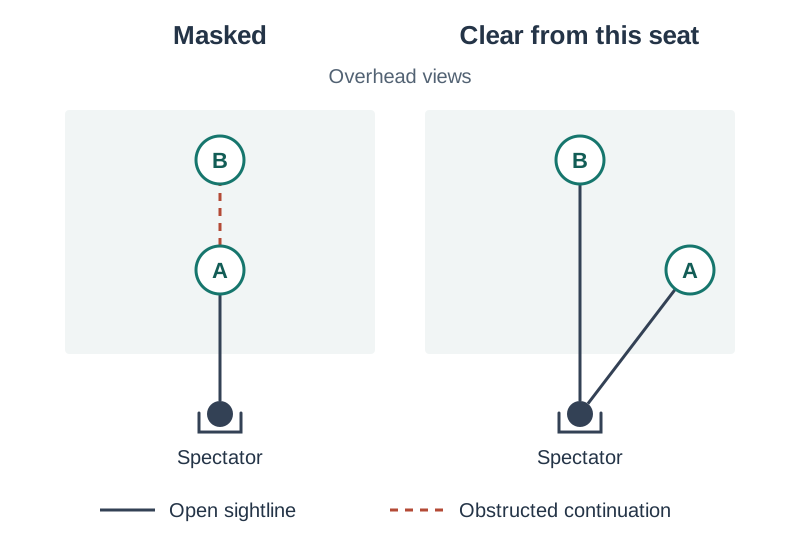
- Spatial Awareness: A performer's conscious perception of their body's position relative to set pieces, fellow actors, sightlines, the audience, and the camera. Performed well, it prevents accidental masking (unintentionally blocking another actor, prop, or key action from view).
- Improvisation: Creating and performing spontaneously without preparation, commonly used in rehearsal during the early stages of blocking or when developing new material through devising.
- Pace and Rhythm: Pace is the tempo of delivery and movement; rhythm is the deliberate pattern of fast and slow, tension and release. Rushing lines destroys subtext, while dragging slows momentum; varying pace keeps an audience engaged.
Technical Craft, Staging, Scripting, and Accessibility (LO 1.4)
Staging Configurations and Sightlines
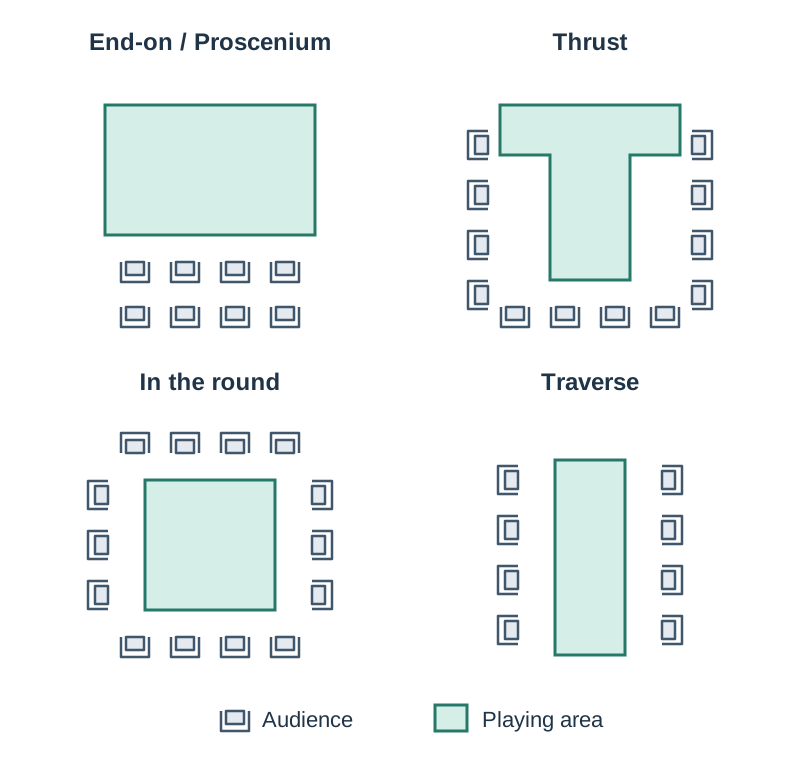
The shape of the performance space determines what the audience can see and dictates how a director blocks the action:
- End-on / Proscenium: The audience sits on one side facing the stage. Composing strong visual pictures is straightforward, but masking is a constant risk, and actors must 'cheat out'—angle their bodies slightly toward the auditorium so their faces and voices carry.
- Thrust: The audience sits on three sides of the playing area. Actors must vary their angles constantly so no section of the house is excluded for long.
- In the round: The audience surrounds the acting area on all four sides. There is no upstage wall to hide behind, furniture must be low to preserve sightlines, and blocking requires continuous, circular movement.
- Traverse: The audience sits on two opposite sides facing each other with the action down the middle. This layout suits confrontations and journeys, presenting actors largely in profile.
- Site-specific / Promenade: The performance takes place in a non-traditional setting (such as a hallway or courtyard), with the audience moving through the space.
A sightline is the line of vision from any seat in the house to the stage action. Blocking must ensure key dramatic moments remain visible across all sightlines.
Theatre Stage Geography
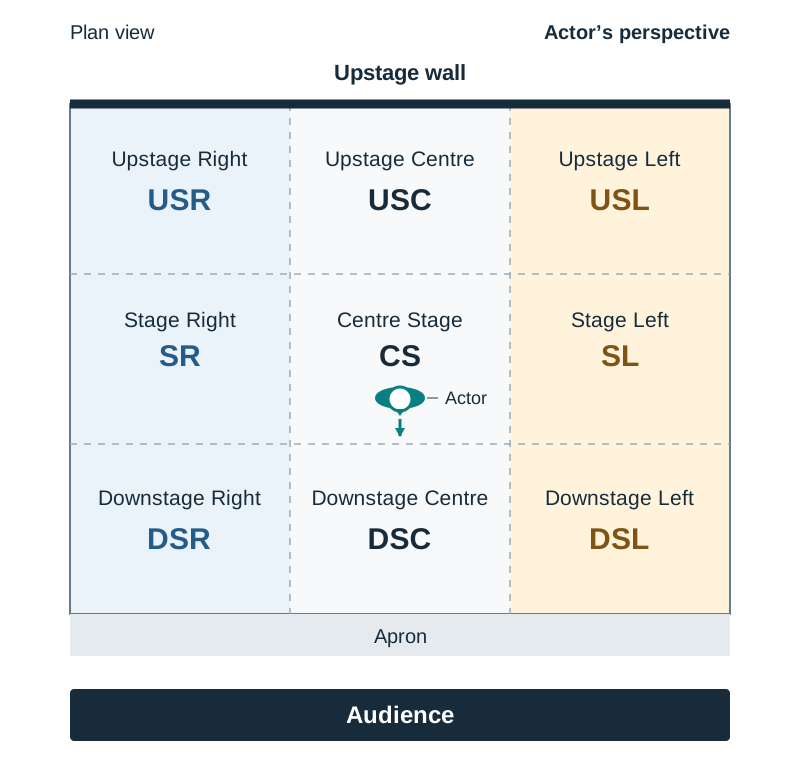
Stage positions are always named from the perspective of an actor standing on stage facing the audience:
- Downstage (DS): Towards the audience.
- Upstage (US): Towards the back wall, away from the audience.
- Stage Left (SL) / Stage Right (SR): The actor's left and right when facing the house.
- Centre Stage (CS): The middle of the playing space.
Technical Hardware and Post-Production
- Lighting: Lanterns (profiles, fresnels, floods) are patched to channels on a lighting desk to control intensity, colour, focus, and cue timing. Lighting defines mood, sculpts performer silhouettes, directs audience focus, and signals shifts in time or setting.
- Sound: Directional microphones, audio mixers, and monitors capture and balance audio. Film requires capturing clean location dialogue using boom poles and directional shotgun mics to minimise ambient noise.
- Camera: In film, lenses, shot types (close-up, mid-shot, wide shot), camera angles, and movement (pans, tilts, tracks) establish point of view and visual narrative.
- Mise en Scène*: The arrangement of everything that appears before the camera or on stage—scenery, props, costumes, lighting, and composition.
- Editing and Post-Production: Film is assembled after shooting. Selecting takes, trimming frames, and laying in dialogue, sound effects recorded to picture (foley), and music controls the rhythm and flow of the story. Live theatre has no post-production phase.
Scripting for Theatre and Film
Scripting is both a creative and a technical production skill; formatting on the page gives clear instructions to cast and crew:
- Script: A written work created by a playwright for theatre, now sometimes derived after devising. Built from scenes—units of action generally set in one location and time involving the same characters.
- Screenplay: A written work created by a screenwriter for film or television. Built into sequences—series of scenes forming a continuous narrative arc.
| Element | Theatre Script | Film Screenplay |
|---|---|---|
| Unit heading | Act and Scene ('Act 1, Scene 2'). | Slugline ('INT. RAILWAY STATION - NIGHT'). |
| Action / Stage directions | Italicised directions using actor perspective (She crosses downstage left). | Present-tense action blocks describing only what can be seen and heard on camera. |
| Camera shots | Not specified; blocking is determined by the director. | Implied or noted sparingly (CLOSE ON, CUT TO). |
| Character names | Placed on the left or above dialogue depending on style. | Centred in capital letters above the dialogue block. |
In devised work, writing often happens in reverse: dramatic action is workshopped through improvisation, and the script is drafted afterwards to capture and fix the performance.
Comparing the same moment in both formats:
Theatre Script: MAEVE crosses downstage right and stops at the bench. A long pause. MAEVE: You didn't come.
Film Screenplay: INT. RAILWAY STATION CONCOURSE - NIGHT Maeve stops at the wooden bench. She remains standing. CLOSE ON her hand, gripping the strap of her bag. MAEVE You didn't come.
The theatre version specifies physical positioning on a stage for an audience viewing the whole room; the film version defines a camera frame for an audience who can only see what the lens captures.
Stage vs Screen Production Summary
- Voice: Auditorium projection on stage vs close microphone intimacy on screen.
- Physicality: Broad, legible gestures on stage vs subtle micro-expressions and eye-lines on camera.
- Space: Three-dimensional staging within sightlines vs two-dimensional composition inside a camera frame.
- Time: Continuous performance in real time vs fragmented takes filmed out of sequence.
- Completion: Polished through rehearsal for live delivery vs shaped in post-production through editing and colour grading.
- Show control: Run on the night by the stage manager vs directed take-by-take on set by the director.
Accessibility Provisions
Accessibility should be planned during pre-production rather than tacked on at the end:
- Close Captioning: On-screen text displaying spoken dialogue alongside descriptions of key non-speech audio cues (
[train whistle blows],[whispering]) for deaf or hard-of-hearing audiences. - Relaxed Screening / Performance: A screening or performance in which conventions are adapted to make the event more accessible for audience members with additional needs, such as autism spectrum disorder (ASD). As defined in the specification glossary, adaptations may include reducing volume levels, leaving house lights on, and allowing the free movement of audience members during the event.
Reflective Practice and Tracking Skills in the Portfolio (LO 1.5)
Course Portfolio vs Project Journal
You must keep the purpose of your coursework documents clear:
- Two-Year Course Portfolio: An ongoing classroom archive supporting day-to-day learning. It contains drafts, rehearsal notes, sketches, ground plans, evidence from the three Applied Creative Tasks, and written reviews of at least one live, public theatre performance and one cinema screening attended during the course.
- Creativity in Practice Project Journal: The formal coursework document submitted to the SEC in Year 2 for 50% of your Leaving Certificate marks (300 marks). It is completed in response to the common brief.
Tracking Skill Progression
Learning Outcome 1.5 requires you to reflect on your technical, production, and performance skill development. In Section C of your project journal, you must explain a specific skill you developed and justify your creative decisions.
One practical classroom method to track this progress is to rate, comment, and re-rate:
- Establish a baseline: Score your competence in a specific skill (such as vocal breath control or lantern focusing) on a simple 1 to 5 scale at the start of a rehearsal block.
- Note the specific diagnostic challenge ('My vocal volume drops at the end of long sentences because my breath collapses.').
- Re-rate after deliberate practice and input: Re-score your competence following rehearsal ('4/5 after running diaphragmatic exercises.').
- Record the evidence: Connect the improvement directly to teacher feedback, peer input, or rehearsal adjustments.
There is no single official reflection template, but high-level reflections address four core questions:
- What did I do? (Identify the exact skill or technical action attempted).
- How did I do it? (Detail the rehearsal exercises, equipment adjustments, or feedback used).
- Why did it matter? (Explain how this choice served the artistic vision or communicated meaning to the audience).
- Where next? (Explain how this technique will be applied to future work or the Creativity in Practice Project).
Coursework Rules That Carry Mark Penalties
The SEC sets strict rules for the Creativity in Practice Project journal and recording:
- Word count: The journal must not exceed 1,700 words across Sections A to E. The Reference Section is exempt. Marks may be lost if you exceed this limit.
- Images: You may include up to 20 images (sketches, ground plans, storyboards, production stills). Any words used to annotate images count toward the 1,700-word limit.
- Format: Arial font, black text only, size 12 with 1.5 line spacing. Section headings must be Arial 14 bold, and each section must begin on a new page. Document margins must be 20 mm on all sides, with no text placed in margins. The SEC cover page must be the first page, and the final file must be converted to PDF.
- Video submission: An excerpt of exactly two continuous minutes in MP4 format, no larger than 1 GB (standard definition 720 x 480 at 25 fps). Montages or highlight reels are not permitted.
- Theatre recordings: A theatrical performance must be recorded in full by a single fixed camera positioned to capture the viewpoint of an audience member, with the audience kept out of frame.
- Authentication and integrity: All work must be your own authentic effort, submitted to your class teacher by 23 April 2027. All research sources, including any permitted use of generative AI, must be cited in the Reference Section. Unreferenced material will be treated as plagiarism.
Seeing the Foundations Work Together: The 2027 Brief Context
The 2027 Creativity in Practice Project brief topic is 'The Use of Colour in Theatre and Film'. To understand how Learning Outcomes 1.1 to 1.5 operate as an integrated system, consider an ensemble creating a short piece of theatre, from which they will later select a continuous two-minute excerpt for submission:
- 1.1 Collaborative Environment: The ensemble agrees ground rules and boundaries during early brainstorming. When exploring grief and emotional coldness, they establish turn-taking so that every member contributes visual metaphors without interruption.
- 1.2 Roles and Responsibilities: Tasks are assigned deliberately. One student directs blocking and actor eyelines; another acts as production designer selecting monochromatic grey costumes with a single amber item; a third acts as lighting technician programming cue transitions.
- 1.3 Performance Skills: The actors use spatial awareness to maintain physical estrangement, staying far apart downstage. Gestures are restrained, and vocal pace slows to a halting rhythm, communicating emotional paralysis.
- 1.4 Technical and Production Skills: The lighting technician rigs a profile lantern with a warm gel, keeping it focused on an empty armchair Downstage Centre. Staging ensures sightlines remain open. In film, the camera frames an extreme close-up of the amber fabric to make colour carry thematic weight.
- 1.5 Reflective Tracking: In their portfolio, the lighting operator documents their progression: starting at 2/5 on dimmer cross-fades, applying peer feedback to slow the fade down to eight seconds, and re-rating at 4/5. In Section C of their project journal, this provides the exact evidence required for their chosen skill, while selecting the amber contrast against the grey set serves as one of the two significant creative decisions they must identify and explain.
Key terms
- Director
- The individual with the primary vision for a performance and responsible for leading the creative team and overseeing every aspect of the process from individual acting performances to the visual elements of the production.
- Producer
- The person responsible for the management, legal and financial control of the making of a film or theatre production.
- Creative Team
- The collective responsible for the artistic vision and leadership in making a piece of film or theatre.
- Production Team / Crew
- The collective, other than the creative team, responsible for the elements of production for a piece of theatre or film.
- Devising
- An artistic practice used to build a piece of dramatic action working from a starting point other than a written text.
- Improvisation
- To create and perform spontaneously or without preparation, generally in rehearsal as part of an early phase of blocking.
- Blocking
- The process of organising the action and movement of a piece of film or theatre in rehearsal which is then realised in production. Led by the director.
- Spatial Awareness
- A performer's conscious perception of their body's position in space relative to set pieces, fellow actors, sightlines, the audience, and the camera framing.
- Masking
- The unintentional or deliberate obstruction of an actor, prop, or vital piece of stage action from the audience's or camera's line of sight.
- Mise en Scène
- The arrangement of everything appearing before the camera or on stage, including sets, costumes, props, lighting, and actor placement.
- Script
- A written work created by a playwright for theatre. Now sometimes derived latterly from the devised performance.
- Screenplay
- A written work created by a screenwriter for film or television.
- Scene
- A unit of action in drama or film, generally set in the same location, time-frame and involving the same characters.
- Sequence
- A series of scenes which form a sequence of action or narrative in a film.
- Close Captioning
- An accessibility feature displaying on-screen text that reproduces spoken dialogue and describes relevant dramatic sound effects for deaf or hard-of-hearing viewers.
- Relaxed Screening / Performance
- A screening or performance in which conventions are adapted in order to make the event more accessible for audience members with additional needs such as ASD. These adaptations may include reducing volume levels, leaving house lights on and allowing the free movement of audience members during the event.
Check yourself
What is the difference between the creative team and the production team?
The creative team leads the artistic vision and concept (such as the director, playwright, and designers), while the production team (crew) handles logistics, equipment rigging, operation, and practical execution (such as stage managers, camera operators, and technicians).
Name the five stages of the creative process in order, and state one reason why the specification describes this process as iterative.
The five stages are Imagining and Conceptualising, Developing, Refining, Producing and Performing, and Evaluating. It is iterative because feedback and refinement occur throughout, requiring creators to move back and forth between stages rather than following a rigid line.
A group creates a scene through improvisation from a photograph and writes down the script only after the action is fixed. Which term describes this practice, and how is it defined?
Devising. The specification defines it as 'an artistic practice used to build a piece of dramatic action working from a starting point other than a written text.'
Why is accidental masking considered a breakdown in spatial awareness on stage?
Accidental masking occurs when an actor unintentionally blocks another performer, prop, or vital piece of dramatic action from the audience's line of sight, obscuring visual storytelling.
Name two adaptations commonly made for a relaxed performance.
Any two of: reducing volume levels; leaving the house lights on rather than blacking out the auditorium; allowing audience members to move freely during the event.
How do layout instructions differ between a theatre script and a film screenplay?
A theatre script is divided into acts and scenes with italicised stage directions using actor-perspective terms (such as Downstage Left), while a screenplay uses scene heading sluglines (such as INT. ROOM - DAY) with action descriptions written in the present tense detailing only what the camera sees and hears.