

Applied Creative Task 3 (ACT 3) is the third and final practical task in Strand 3 of Leaving Certificate Drama, Film and Theatre Studies. You watch a live theatre performance or a film in a cinema, then make an original piece in response to it — either a 5 to 8-minute piece of theatre or a 3 to 5-minute edited short film — and show it to an audience. ACT 3 directly connects the critical response skills you build in Strand 2 with the hands-on making of Strand 1. You can work solo or in a collaborative group. Your class teacher assesses ACT 3 formatively in class rather than sending it to the State Examinations Commission (SEC) for marking. Because it exercises the complete creative cycle, it serves as your main classroom rehearsal for the 300-mark Creativity in Practice Project and the final written examination.
Core Requirements, Format Choices, and Sequencing
In ACT 3 you choose whether to work in theatre or in film, but the rules governing duration, sequencing, and stimulus are strict.
Mandatory Sequencing Rule
You cannot begin ACT 3 until you have finished both ACT 1 and ACT 2. While ACT 1 and ACT 2 can be completed in either order, both must precede ACT 3 so that you have gained direct, practical experience of both stagecraft and camera workflows before selecting your final discipline.
Comparing the Three Applied Creative Tasks
| Feature | ACT 1 | ACT 2 | ACT 3 |
|---|---|---|---|
| Discipline | Theatre only | Film sequence only | Choice: Theatre or Film |
| Required Duration | Approximately 4 to 6 minutes | Approximately 3 minutes (edited sequence) | Theatre: 5 to 8 minutes; Film: 3 to 5 minutes (edited) |
| Working Mode | Ensemble (collaborative group) | Collaborative group | Solo or collaborative |
| Stimulus Source | Theatrical tradition/genre | Film tradition/genre | Live theatre performance or cinema screening attended firsthand |
| Sequence Order | First or second practical task | First or second practical task | Must be completed last |
Format Familiarity
Whichever medium you select, you must demonstrate genuine craft competence. A film piece must use the visual and auditory language of cinema: deliberate shot framing, lighting setups, clear audio recording, and edited pacing. It cannot simply be a wide recording of a stage play captured on a smartphone. A theatre piece must fully exploit the live space, the physical distance between performers on stage, vocal projection, and the actor–audience relationship.
The Stimulus: Starting from the Critical Response Process
ACT 3 must be made in response to a live theatre performance or a cinema screening that you attended firsthand. The syllabus defines a live performance as one shown in real time at a physical venue. Streaming a film on a television, laptop, or mobile phone at home does not meet the requirement. Watching your prescribed set film in a classroom is study of the set film, not a cinema screening. Plan a theatre visit or cinema screening, and record the date, venue, production company, and director in your portfolio.
Your school studies only one prescribed film option (out of A, B, or C) and one prescribed drama/theatre option (out of A, B, or C) in Area 1, alongside an unprescribed topic in Area 2. You will therefore study one prescribed film and one designated theatre performance in depth, not all six.
Because ACT 3 begins with an existing production, it starts in Strand 2 using the three stages of the critical response process:
- Appraising and responding: You record your immediate, emotional reaction to the production you attended, noting how your personal background or values shaped that initial response.
- Analysing and interpreting: You examine how the director, actors, and designers achieved their impact, looking closely at stagecraft, camera framing, lighting states, and sound design.
- Refining and evaluating: You articulate a considered interpretation of the work, explaining how deeper analysis shifted your viewpoint from your initial impression.
Three Ways to Respond to a Live Production
Responding does not mean copying a plot or staging a remake. You take a specific artistic spark and build an original piece:
- Thematic translation: Seeing a play that addresses political posturing and social division might inspire an original contemporary short film about peer pressure or school community conflict.
- Stylistic adaptation: Watching a production that uses non-naturalistic physical theatre and stylised ensemble movement could inspire you to stage a symbolic drama about grief or guilt.
- Technical exploration: Observing the use of prolonged master shots and low ambient sound in an art cinema screening might lead you to direct a short film driven by visual subtext and deliberate silence.
Creative Process Stages and Pre-Production Workflows
ACT 3 requires you to engage actively with all five stages of the creative process in Strand 1. When writing exam answers, name these exact stages to locate your decisions:
- Imagining and conceptualising: You respond to your live stimulus, gather source materials (images, artefacts, music, practitioner techniques), establish your core artistic vision, and test whether your concept is feasible.
- Developing: You choose your discipline, compose a statement of intention (for theatre) or a treatment (for film), establish timelines, allocate cast and crew responsibilities, and create your pre-production paperwork.
- Refining: You move into rehearsals, test camera angles or stage blocking, gather peer and teacher feedback, and refine the work. Because the process is iterative, you will frequently loop back between developing and refining as creative or practical challenges emerge.
- Producing and performing: You stage the theatrical piece or make the final post-production cut of your short film, presenting it to an audience.
- Evaluating: You assess the finished piece against your original goals, analyse audience feedback, and explain your key creative choices.
Theatre versus Film Pre-Production Workflows
| Creative Process Stage | Theatre Track (5–8 minutes) | Film Track (3–5 minutes in edited format) |
|---|---|---|
| Imagining and conceptualising | Core dramatic concept, mood boards, practitioner research, initial pitch. | Film concept pitch, visual tone references, feasibility check on locations and cast. |
| Developing | Statement of intention, devised script or marked play-text, ground plans, costume/prop lists, lighting cue sheets. | Film treatment, screenplay, storyboard, detailed shot list, call sheets, location scouting records. |
| Refining | Blocking rehearsals, vocal warm-ups, movement pacing, technical and dress rehearsals. | Camera rehearsals, filming, review of rushes, rough-cut assembly, fine cut. |
| Producing and performing | Staging live before an audience of peers, operating live sound and lighting cues. | Final edited format, colour grading, sound mixing, screening to an audience of peers. |
| Evaluating | Reviewing audience reactions, appraising live stagecraft choices, portfolio reflection. | Analysing viewer response to pacing and visual cuts, portfolio reflection. |
In pre-production, a film project requires a treatment, while a theatre project requires a statement of intention. Both documents set out the story, dramatic concept, visual approach, and intended audience impact before scriptwriting, devising, or filming begins.
Learning outcome 3.14 requires you to use your engagement with the work of established practitioners to inform your creative practice. The task description adds that you may communicate with film or theatre practitioners in your local or wider community. While contacting local professionals through an interview or workshop is an enriching option, it is not compulsory; studying productions, published interviews, and reliable craft accounts also satisfies outcome 3.14.
Audience, Ethics, Safety, and Accessibility
From the earliest conceptual stage of ACT 3, you must make deliberate choices about your audience, working ethics, and safety.
Audience and Genre Requirements
The specification requires that your work considers the audience and works within a recognised genre, period, style, or form. You must decide in advance whether you are making a verbatim theatre piece, a tragicomic dialogue, a naturalistic relationship drama, or a psychological thriller. Decide who your audience is and what emotional or intellectual reaction you intend to evoke, so that your later evaluation can measure whether you succeeded.
The syllabus footnote explicitly confirms that an audience can consist of fellow students or peers. A presentation staged in a drama room, school hall, or classroom satisfies the requirement. The piece must be shown to real people in the room so that you can gather authentic audience feedback.
Ethical Practice and Safety
Under learning outcome 1.10, you must follow established ethical and responsible practices:
- Performance rights: If you use an existing play-script, screenplay, or commercial music track, you must verify that you have permission to use or record it. Devising original drama or using royalty-free music avoids copyright issues.
- Honouring intentions: When adapting source material or quoting real interviews, represent the source fairly and acknowledge all influences in your portfolio.
- Respectful collaboration: Ensure all cast and crew members agree on roles, observe personal boundaries, and exchange constructive feedback.
- Safety: Identify practical hazards before rehearsing. Plan physical falls or combat on safety mats, secure floor cables, mount lighting safely, and avoid filming in dangerous public areas or near roads without supervision.
Accessibility at the Point of Showing
Learning outcome 1.14 expects you to consider accessibility when presenting your work:
- Close captioning: Adding dialogue and key audio descriptions on screen ensures that viewers who are deaf or hard of hearing can follow your short film.
- Relaxed screening / performance: Adapting presentation conventions — such as lowering audio playback volume, leaving low ambient house lighting on, and allowing viewers to move freely — accommodates audience members with sensory or additional needs.
The Explain, Evaluate, and Reflect Cycle (LOs 3.16–3.18)
Presenting your theatre performance or screening your film to an audience (LO 3.15) does not complete ACT 3. Three of the six learning outcomes occur after the presentation. In the official glossary of action verbs, each post-presentation requirement carries a distinct standard:
| Action Verb | Syllabus Definition | What to Show in Your Portfolio |
|---|---|---|
| Explain (LO 3.16) | Give a detailed account including reasons or causes. | State the artistic choice made, explain why it was chosen, cite the live performance or practitioner that influenced it, and outline the intended effect. |
| Evaluate (LO 3.17) | Collect and examine work to make artistic judgements and appraisals about ideas or methods. | Judge how well the piece achieved the aims set out in your statement of intention or treatment, comparing your intended effect against recorded audience responses. |
| Reflect on (LO 3.18) | Give thoughtful and careful consideration to actions, experiences, values, and learning to gain new insights. | Analyse your development as a creative practitioner, explaining how practical challenges altered your perspective and what you would do differently in future projects. |
Describing what you did ('we dimmed the lights') gains very few marks. Explaining why you did it ('we dropped to a cool-blue overhead wash to signal the character's internal withdrawal, drawing on the minimalist lighting used in the live production we attended') demonstrates authentic craft competence.
Portfolio Evidence and the SEC Project Bridge
Your work on ACT 3 is documented continuously inside your Leaving Certificate Drama, Film and Theatre Studies portfolio. The portfolio is an ongoing working repository holding stimulus reflections, treatment drafts, marked scripts, ground plans, storyboards, audio cue sheets, footage logs, and evaluative notes.
ACT 3 is assessed formatively by your teacher. It is not marked by the SEC. However, completing ACT 3 equips you with the exact technical language and practical habits needed for the certified components.
Distinguishing ACT 3 from the Creativity in Practice Project
| Feature | Applied Creative Task 3 (ACT 3) | Creativity in Practice Project (SEC Component) |
|---|---|---|
| Assessment Mode | Formative, marked in class by your teacher; no SEC marks. | Additional Assessment Component (AAC), marked by the SEC; 50% (300 marks). |
| Stimulus Source | Live theatre performance or cinema screening attended firsthand. | SEC Common Brief (for 2027: The Use of Colour in Theatre and Film). |
| Submitted Material | Complete piece shown in class: Theatre (5–8 mins) or Film (3–5 mins edited). | 1,700-word digital project journal + continuous 2-minute video excerpt (MP4, max 1GB). |
| Collaboration Rules | Individual or collaborative. | Solo or collaborative making, but each candidate submits an individual journal. |
Video Submission Rules for the SEC Project Excerpt
If your practical work informs your SEC Creativity in Practice Project, follow the submission specifications strictly:
- The excerpt must be exactly two continuous minutes taken from the screened film or from the unedited live recording of the theatrical performance — highlighting reels or stitched clips are forbidden.
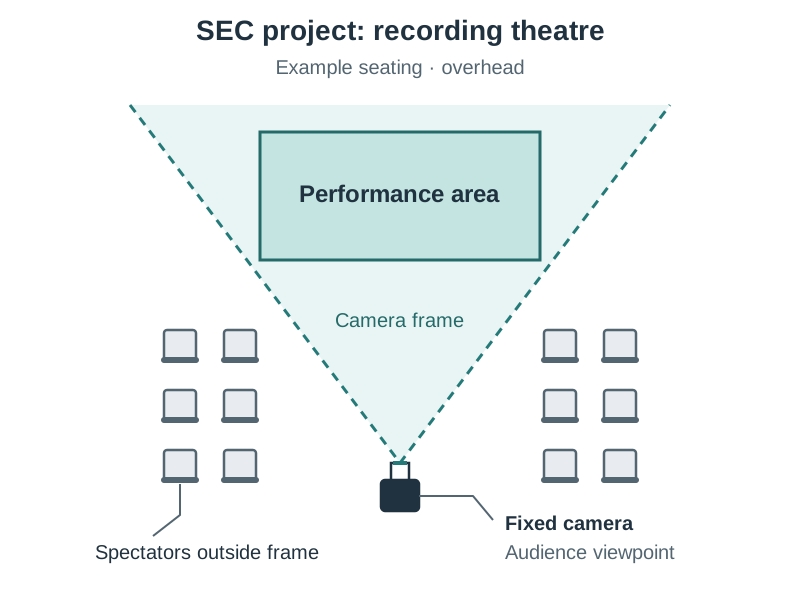
- A theatre piece must be recorded in full by a single fixed camera positioned from the perspective of an audience member, and the audience must not appear in the frame.
- The file format must be MP4, not exceeding two minutes and under 1GB in size (standard definition, 720 x 480 at 25 frames per second). The school must retain the full recording for authentication.
Key terms
- Applied Creative Task 3 (ACT 3)
- The capstone practical task in Strand 3 where students create an original 5 to 8-minute theatre piece or a 3 to 5-minute edited film in response to a live theatre performance or cinema screening.
- Live performance
- A performance or production shown in real time at a physical venue, required as the initial stimulus for ACT 3.
- Edited format
- The completed, assembled version of a film following post-production; the 3 to 5-minute ACT 3 film limit applies to this final cut, not the raw rushes.
- Treatment
- A pre-production document used in film that outlines the story, concept, visual style, and tone before the screenplay is written or footage is recorded.
- Statement of intention
- A pre-production document used in theatre that outlines the dramatic concept, themes, staging choices, and intended audience impact before rehearsals begin.
- Blocking
- The process of planning and organising the action and movement of performers in rehearsal, led by the director and realised on stage or on camera.
- Iterative process
- A cyclical creative workflow where ideas, rehearsals, designs, or rough cuts are repeatedly tested, evaluated, and refined based on feedback and practical constraints.
- Practitioner
- A professional artist including performers, directors, designers, and production team members whose techniques inform student creative practice.
- Devising
- An artistic practice used to build a piece of dramatic action working from a starting point other than a written text.
- Actor–audience relationship
- The dynamic and spatial connection established between performers and spectators, determining whether the fourth wall is maintained or broken through direct address.
- Diegetic sound
- Sound whose source exists within the world of the film or play, audible to the characters (e.g. dialogue, footsteps, a radio playing in the room).
- Non-diegetic sound
- Sound added over the action that characters cannot hear, such as an orchestral musical score, voiceover narration, or sound effects added for dramatic emphasis.
- Non-naturalistic
- A theatrical or cinematic style that moves away from realistic reproduction, using physical theatre, heightened movement, symbolic lighting, or abstract sets to communicate meaning.
- Verbatim theatre
- A theatrical form created using the exact transcribed spoken words of real people gathered through interviews or recorded testimony.
- Relaxed screening / performance
- A presentation where conventions are adapted (e.g. lowering sound levels, keeping house lights on, permitting movement) to make the event accessible for audience members with sensory or additional needs.
- Close captioning
- On-screen text displaying dialogue, sound effects, and musical cues to allow viewers who are deaf or hard of hearing to access a film production.
- Formative assessment
- Ongoing classroom-based evaluation and feedback provided by the teacher to support student learning, distinct from terminal marks awarded by the SEC.
- Portfolio
- The cumulative student repository holding research, drafts, pre-production materials, performance records, and reflective logs across all Applied Creative Tasks.
Check yourself
What are the exact duration limits for a piece of theatre versus a short film in ACT 3?
A theatre performance must run between 5 and 8 minutes; a short film must run between 3 and 5 minutes in its finished, edited format.
What mandatory sequencing rule must be satisfied before beginning ACT 3?
Both ACT 1 (ensemble theatre) and ACT 2 (film sequence) must be completed first.
What counts as a live performance or screening for the ACT 3 stimulus?
A performance or production experienced in real time at a physical venue (such as a local theatre or cinema). Streaming at home or watching a DVD in a classroom does not meet the requirement.
Who can make up the audience for your ACT 3 performance or screening?
Your fellow students or peers in a classroom or school hall. A paying public audience is not required, but the work must be presented to real people in the room.
Which action verb does this sentence answer, and what is missing? 'We used a red wash on the final tableau.'
It answers none of them fully; it merely describes what was done. To explain (LO 3.16), add the artistic rationale and practitioner influence. To evaluate (LO 3.17), judge whether it achieved the intended effect on the audience. To reflect on (LO 3.18), explain what you learned about lighting design and what you would adjust in future.
Does the State Examinations Commission (SEC) directly mark your ACT 3 piece?
No. ACT 3 is assessed formatively by your class teacher. However, the craft skills, vocabulary, and reflective habits you build in ACT 3 are tested in the written examination and in the SEC Creativity in Practice Project.