

Producing and performing is the fourth stage of the five-stage creative process in Drama, Film and Theatre Studies. Learning outcome 1.14 requires students to finalise their creative work and either stage and perform a piece of theatre or produce and screen a film sequence before an audience, with deliberate planning for accessibility. Learning outcome 1.15 focuses on using a range of performance skills: building on acting skills for stage and screen, establishing a relationship with the audience, creating and sustaining a character or role in performance, visual composition, vocal work, and using appropriate pace and rhythm. These outcomes underpin the classroom-based Applied Creative Tasks and culminate in Section D (60 marks) of the 50% Creativity in Practice Project.
The Producing and Performing Stage
The creative process in Strand 1 moves through five stages: Imagining and Conceptualising, Developing, Refining, Producing and Performing, and Evaluating. The specification does not present these stages as a rigid, one-directional conveyor belt. The process remains fluid, flexible, and iterative. Reaching Producing and Performing, however, marks an intentional transition where open experimentation stops and execution begins.
An essential discipline at this stage is recognising when to stop refining and commit to presenting the work. Over-rehearsing can drain a live performance of freshness and energy, while endless re-editing can paralyse a film project. At this point, practitioners commit to their chosen pre-production materials and discard unused exploratory ideas.
The specification pairs its action verbs deliberately:
Theatre: staged and performed
Theatre is finalised through technical and dress rehearsals and realised as a live performance in real time before an audience in a physical venue. There are no retakes or second chances.
Film: produced and screened
Film is finalised in post-production through the final edit. The performance is captured in fragments during filming and assembled before an audience watches the completed screening.
The film timeline
Film candidates often confuse the shoot with the performance. In the official project process, camera rehearsals and filming take place during Stage 3 (Refine), along with editing. Stage 4 (Producing and Performing) is the moment you screen the finished, locked edit to a live audience.
In both disciplines, an audience is defined as any person or persons who view or engage with creative work. For classroom tasks and coursework, an audience of peers meets every syllabus requirement.
Finalising Work: Selection of Materials and the Final Edit
By Stage 4, you have accumulated pre-production materials such as sketches, ground plans, shot lists, costume designs, and marked scripts. Finalising does not mean packing every early idea into the finished show. Instead, you select only the materials that survived the refining stage.
| Document | Live Theatre Role | Film Screening Role |
|---|---|---|
| Marked script / prompt copy | Guides stage management cues for lanterns, sound effects, and actor entrances. | Tracks script supervisor continuity notes and recorded takes. |
| Ground plan | Fixes set placement and marks out clear actor sightlines. | Establishes spatial layout for camera movement and lighting rigs. |
| Storyboard / shot list | Not used in live theatre (the theatre equivalent is the marked script and ground plan). | Dictates shot selection, visual framing, and camera transitions in the edit. |
The Final Edit (Film Only)
While theatrical performance is locked in real time on the night, screen performance is shaped inside the editing suite. Editors choose which takes to use, decide how long each shot stays on screen, assemble the shots into sequences, balance dialogue against music and sound effects (including foley audio: everyday sounds such as footsteps recorded afterwards and added to the soundtrack), and colour grade the footage so the whole sequence looks consistent.
In Steven Spielberg's Jaws (1975)—prescribed under Area 1 Option B—the shark's menace is built without showing the shark: subjective underwater point-of-view camerawork on the shoot, then editing that cuts between the water and Brody's anxious scanning of the beach, with the score timed to the cuts. A cut within the same shot that visibly breaks continuity is a jump cut, used to jolt the viewer or compress time; the shocks in Jaws are sudden cuts to a new shot, timed with John Williams's score.
Foundational Performance Skills: Stage versus Screen
Learning outcome 1.15 requires students to demonstrate controlled performance skills across both mediums. Both stage and screen acting demand concentrated focus, active listening, and responsive emotional choices, but the scale of delivery depends on the medium.
Vocal Technique
- Theatre: Demands sustained breath support, crisp articulation, and vocal projection to carry dialogue across an auditorium to the back row without shouting. Pitch and tonal variation communicate emotion across distance.
- Screen: Directional microphones capture quiet whispers and subtle breathing. Theatrical projection looks and sounds false on camera. The actor instead focuses on conversational naturalism, micro-inflections, and vocal restraint.
Physicality, Movement, and Sightlines
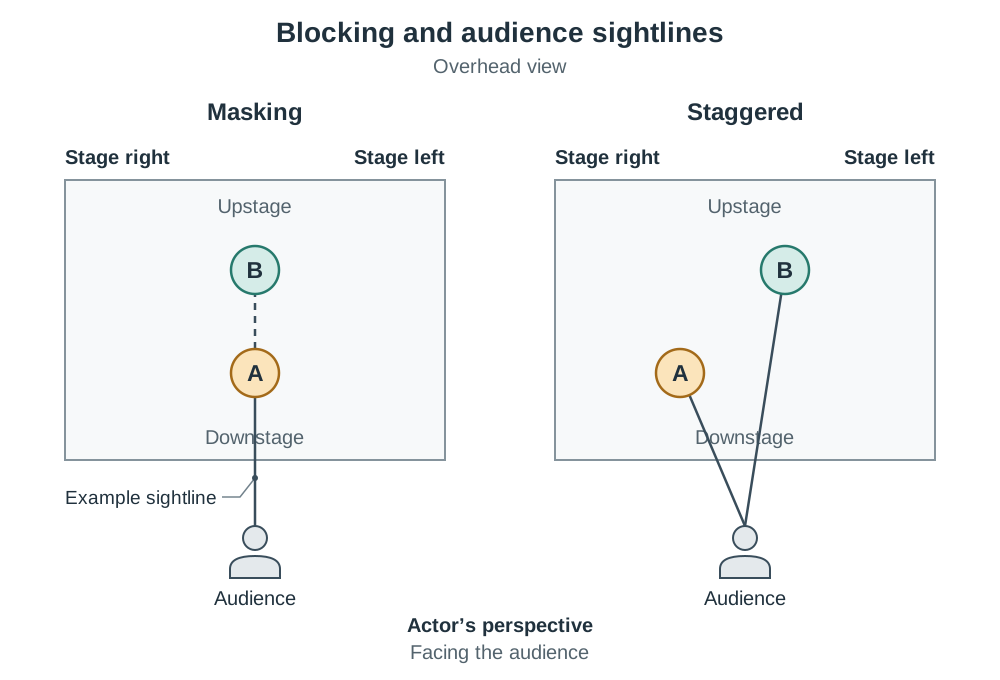
- Theatre: Physical choices must be readable from a distance. Performers use stage blocking (downstage, upstage, stage left, stage right) to create dynamic stage pictures. Performers must avoid accidental masking, which occurs when an actor stands directly between another performer and the audience, obscuring important action from the audience's sightlines.
- Screen: The camera frame defines the physical boundary. A subtle twitch of the jaw or a slight eye shift conveys deep subtext in a close-up. Uncontrolled physical fidgeting destroys a composed camera shot.
Sustaining a Character
Sustaining a character means keeping physical posture, vocal cadence, and inner motivation consistent and truthful throughout changing dramatic circumstances. In theatre, this requires unbroken focus for the entire duration of the play, especially when another performer is speaking. In film, it requires sustaining continuity across separate takes filmed hours or days apart.
Connecting with the Audience and Visual Composition
Performance skills are not only about what happens between characters; they include the deliberate connection the performer builds with the people watching.
The Actor/Audience Relationship on Stage
In theatre, the audience is physically present in the room, allowing the actor to shape that relationship directly:
- Fourth wall: The imaginary 'wall' separating the stage from the auditorium. When kept intact, characters behave as though nobody is watching, leaving the audience as unseen observers.
- Direct address: The performer speaks or looks straight out to the audience (soliloquy, narration, or a shared glance). This breaks the fourth wall, turns the spectator into a confidant, and is common in non-naturalistic work.
- Proximity and configuration: End-on staging keeps the audience in front; thrust, traverse, and in-the-round staging place spectators on two or more sides. Performers must 'cheat out' (angle the body slightly towards the house) so no section of the auditorium is shut out.
- Reading the room in real time: A live audience laughs, gasps, or falls silent. The performer holds a beat longer while a laugh dies, or tightens the pace if attention is drifting.
The Audience Relationship on Screen
In film, the camera acts as the proxy for the audience. The performer builds the connection by playing to the lens size (subtle gestures for close-ups, broader movement for wide shots), respecting eyelines, and trusting the microphone. Looking directly down the lens is the screen equivalent of breaking the fourth wall.
Visual Composition
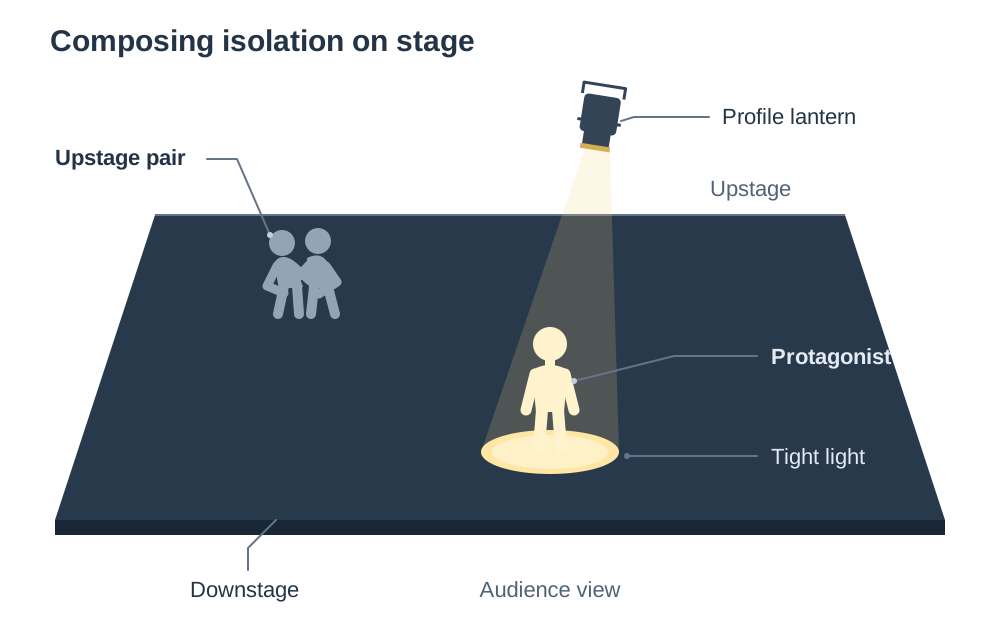
Visual composition is the deliberate arrangement of performers, scenic elements, and lighting within the stage space or camera frame to direct audience attention and reveal status.
- On stage, visual composition relies on levels, light, and grouping. For example, placing two characters huddled together in upstage shadow while the protagonist stands alone downstage centre under a single, tight profile lantern creates an immediate image of isolation and vulnerability that reads clearly from the back row.
- On screen, mise en scène works alongside camera angles and shot sizes. A high-angle long shot diminishes a character's authority, while a low-angle close-up magnifies power.
Professional Standards: Safety, Rights, and Accessibility
Learning outcome 1.10 and Stage 4 guidelines require students to apply professional, ethical standards when staging or screening work.
Safety and Performance Rights
- Stage and location safety: Before admitting an audience, walk the space. Check that cables are taped down, lanterns and stands are secured with safety chains, step edges and set marks are flagged with glow tape for blackouts, and exit routes remain clear. Location filming requires equal care regarding traffic, public permissions, and weather hazards.
- Performance rights and intentions: Staging an existing script requires obtaining performance rights from the copyright holder and honouring the writer's artistic intentions. In film, all music, imagery, and third-party footage must be legally cleared and credited in your reference section.
Planning for Accessibility
Accessibility removes barriers so that audience members with additional needs can engage with your work. It should be built into your pre-production planning rather than added as an afterthought.
| Provision | Discipline | Core Modifications and Conventions |
|---|---|---|
| Close captioning | Film | On-screen text transcribing spoken dialogue alongside significant non-speech acoustic cues in brackets (e.g. [sombre cello music], [abrupt metallic click]). Unlike standard subtitles that only translate dialogue, captions describe the complete acoustic landscape for deaf and hard-of-hearing viewers. |
| Relaxed screening / performance | Theatre & Film | The specification glossary defines relaxed events for both theatre and film, though learning outcome 1.14 mentions it in a film context. In practice, apply relaxed conventions to whichever discipline you present: <br>1. Reducing volume levels to soften harsh sound peaks.<br>2. Leaving house lights on at a dim ambient level rather than plunging the room into darkness.<br>3. Allowing the free movement of audience members, permitting them to exit and re-enter without restriction during the event. |
Applied Creative Tasks and Coursework Execution
Practical performance skills are developed and assessed across two distinct curricular frameworks:
Applied Creative Tasks (Strand 3)
Classroom tasks assessed by your teacher, not the State Examinations Commission (SEC):
- ACT 1 (Ensemble-driven theatre): Duration approximately 4 to 6 minutes.
- ACT 2 (Film sequence): Duration approximately 3 minutes in edited format.
- ACT 3 (Theatre or short film): 5 to 8 minutes for theatre, or 3 to 5 minutes in edited format for short film.
The Creativity in Practice Project (50%, 300 Marks)
The project is completed under a common brief across Higher and Ordinary level. It is assessed by the SEC via a digital project journal (maximum 1,700 words, up to 20 images) and a recorded excerpt. Note the mark structure: the written examination has Sections A, B, and C (100, 160, and 40 marks), whereas the project journal has Sections A to E (40, 60, 80, 60, and 40 marks, plus 20 marks for overall coherence and communication). All project work concludes by a date set annually by the SEC.
Rules for Section D (The Performance / Production — 60 Marks)
- Two continuous minutes: You submit an excerpt of continuous footage that must not exceed two minutes in length and should be no more than 1 GB in size, in MP4 format. Exporting at standard definition (720 × 480) at 25 frames per second is the recommended way to keep the file small.
- Discipline rules: For theatre, the excerpt must come from an unedited recording filmed on a single, fixed camera positioned to capture the experience of an audience member (the audience must not appear in the recording). For film, the excerpt is an uninterrupted two-minute section taken directly from the final screened edit, retaining its internal cuts.
- Validation: The full theatrical performance must be recorded and retained in school for SEC validation. Excerpts must come from the live performance or screening given to the audience, never from a rehearsal or post-show re-shoot.
- Gathering audience response for Section E: Descriptors of Quality reward insightful reflection that includes audience response. Plan during the performance to gather evidence: assign a peer to log audience reactions (gasps, stillness, laughter) and conduct brief post-show interviews.
Key terms
- Producing and Performing
- The fourth stage of the creative process where a creative task is finalised, then either screened (film) or staged and performed live (theatre) before an audience.
- Audience
- Any person or persons who view or engage with creative work. An audience can consist of fellow students or peers.
- Live Performance
- A performance or production shown in real time at a physical venue without stops, retakes, or post-production alteration.
- Final Edit
- The completed, assembled post-production version of a film sequence or short film, locked and ready for public screening.
- Blocking
- The process of organising the action and movement of a piece of film or theatre in rehearsal, led by the director and realised in production.
- Sightlines
- The visual lines of sight from audience seating to the stage, ensuring performers, props, and actions remain visible.
- Accidental Masking
- The unintentional obstruction of a performer, prop, or action from the audience's view by another actor or scenery.
- Visual Composition
- The deliberate spatial arrangement of performers, scenery, and lighting within the stage space or camera frame to convey meaning and status.
- Mise en Scène
- Everything placed within the camera frame or on stage, including set dressing, costume, props, lighting, and performer positioning.
- Sustaining a Character
- Maintaining consistent physical posture, vocal cadence, and inner motivation throughout a performance, including reacting truthfully in role.
- Pace
- The speed and tempo at which dialogue and dramatic action unfold across a performance.
- Rhythm
- The structured patterning of contrasts (fast and slow, loud and quiet, tension and release) across a piece of theatre or film.
- Fourth Wall
- The imaginary invisible barrier separating actors on stage from the audience in naturalistic theatre.
- Actor/Audience Relationship
- The deliberate bond established between performer and spectator, shaped through direct address, spatial proximity, staging configuration, or camera lens interaction.
- Close Captioning
- On-screen text displaying spoken dialogue along with descriptions of significant non-speech acoustic effects and music for deaf and hard-of-hearing viewers.
- Relaxed Screening / Performance
- A presentation in which conventions are adapted (reducing volume levels, leaving house lights on, permitting free movement) to assist audience members with additional needs such as ASD.
- Two Continuous Minutes
- The mandatory video excerpt submitted for Section D of the coursework project, taken from the live performance recording (theatre) or final screened edit (film).
Check yourself
Your group's piece is rehearsed, but two actors want another week of rehearsal. Give one reason the syllabus treats knowing when to stop refining as an essential skill.
Over-rehearsal drains energy and spontaneity from a live performance; recognising when to stop refining and commit to presenting the work to an audience is an explicit part of the creative process.
How does the recording requirement for a theatre submission in Section D differ from a film submission?
Theatre requires an unedited continuous excerpt filmed from a single fixed camera capturing the live audience performance, whereas film requires a continuous two-minute timeline extract from the final screened edit, retaining its internal cuts.
What three environmental modifications define a relaxed screening or performance?
Reducing volume levels, leaving house lights on, and allowing the free movement of audience members during the event.
Why is accidental masking considered a failure of performance skill on stage?
Because it unintentionally blocks another performer, action, or essential prop from the audience's clear sightlines.
What are the approximate duration requirements for Applied Creative Tasks 1, 2, and 3?
ACT 1 is 4–6 minutes; ACT 2 is approximately 3 minutes (edited); ACT 3 is 5–8 minutes for theatre or 3–5 minutes for short film (edited).
What technical file limits govern the Section D video submission in the Creativity in Practice Project?
An MP4 video file of maximum two minutes duration, under 1 GB in size (standard definition 720 × 480 at 25 fps is the recommended setting).
You are performing a devised piece in the round. Name two adjustments you would make to establish a relationship with the whole audience.
Continually vary your body angle and cheat out so each side sees your face at some point, and keep key moments on a diagonal or centre to avoid masking; where the style permits, use brief direct address to different sections of the house.