

Applied Creative Task 1 (ACT 1) is a collaborative theatre project undertaken in Strand 3 of Leaving Certificate Drama, Film and Theatre Studies. Working in groups, you devise, develop, design, and stage an original piece of theatre lasting approximately four to six minutes for an audience of your peers. The dramatic action must be consciously grounded in the features, techniques, and conventions of a chosen theatrical genre, period, style, or form, drawing direct inspiration from established practitioners. Staging the performance is only one phase of the task. To complete the learning cycle across learning outcomes 3.1 to 3.6, you must explain your creative choices, evaluate the performance against your artistic intentions, and reflect on the collaborative process. While ACT 1 is assessed in class by your teacher rather than directly marked by the State Examinations Commission (SEC), the practical stagecraft and reflective habits it builds provide the groundwork for the Creativity in Practice Project (50%) and the written examination in June (50%).
Understanding Ensemble-Driven Theatre in ACT 1
In Drama, Film and Theatre Studies, ensemble-driven theatre means the dramatic action derives from and is inspired by the collective work of the group of performers and the creative team. It is not an exercise where one student writes a script in isolation and directs classmates as passive actors. Instead, the whole group collaborates to devise material, workshop ideas, and shape dramatic tension through shared improvisation and continuous dialogue.
Due Considerations for ACT 1 Planning
The specification sets out five core areas your ensemble piece must give due consideration to:
- Creating and sustaining dramatic action: The piece needs a coherent progression of rising conflict or tension across the four to six minutes, rather than a sequence of disconnected images. For example, a group exploring migration might build from the physical packing of a single suitcase, to an escalating farewell confrontation, to a silent held tableau of departure.
- Developing a role or roles: Each performer creates and sustains a character or theatrical function, whether that is a single named figure, a chorus member, or several small parts sustained through multi-roling.
- Establishing the actor/audience relationship: Deciding the physical proximity of spectators, whether performers acknowledge them directly, and what emotional or intellectual impact the piece intends to provoke.
- Engaging with aspects of staging: Considering set, lighting, sound, and costume design, supported by visual sketches as appropriate to the piece.
- Making decisions about movement and voice: Determining how vocal delivery, physical posture, rhythm, and tempo communicate meaning in your chosen theatrical style.
Collaborative and Ethical Working Practices
Working effectively as an ensemble requires specific habits from Strand 1:
- Active listening and turn-taking: Ensuring an open rehearsal room where everyone tests physical ideas and respects alternative artistic viewpoints.
- Shared creative ownership: Agreeing on a unified concept so that performers, directors, and technicians share the same creative vision.
- Defined production roles: Taking responsibility for areas such as stage management, lighting, sound, or costume alongside acting.
- Ethical and responsible practice: The specification highlights three requirements: maintaining respectful behaviour and agreed physical boundaries across cast and crew; honouring the playwright's intentions if adapting existing material; and obtaining performance rights when using copyrighted scripts, texts, or recorded music. If your work is completely original, note in your portfolio that no rights were required.
Grounding Practice in Theatrical Traditions and Conventions
Your ensemble piece cannot be created in an artistic vacuum. The ACT 1 task description requires your piece to be informed by a chosen theatrical genre, period, style, or form, and learning outcome 3.2 asks you to use the work of established practitioners to inform your own practice. Working from an established tradition gives you a ready-made set of rules to devise inside—such as a chorus, a placard, or verbatim testimony—instead of starting from a blank page.
Your class studies one of the three prescribed Area 1 theatre options, plus extracts from at least one other play, plus a freely chosen Area 2 focus. Your ensemble piece can be informed by any of these traditions. The three prescribed Area 1 options for 2027–2029 are:
- Option A (Style): Use of non-naturalistic production elements (Tóraíocht by Philip Doherty, the 2018 Fíbín sa Taibhdhearc production directed by Mikel Murfi).
- Option B (Form): Verbatim theatre (Home, written and directed by Nadia Fall, National Theatre London, 2013).
- Option C (Genre): Tragicomedy (The Shadow of a Gunman by Sean O'Casey, the 2023 Druid production directed by Garry Hynes).
| Category | Syllabus Definition | Practical Ensemble Application |
|---|---|---|
| Genre | A style or classification of creative work (e.g. Tragicomedy, Melodrama). | Juxtaposing farcical physical comedy with sudden political violence; using heightened emotional stakes and musical underscoring. |
| Period | An historical timeframe (epoch) associated with creative work (e.g. Ancient Greek, Jacobean). | Using a chorus that comments on the action between episodes, with unison chanting and simple formal patterns of movement. |
| Style | Signature artistic features of a particular practitioner or movement (e.g. Brechtian Epic Theatre). | Using direct address, visible projection, placards, and gestus to encourage critical detachment rather than emotional absorption. |
| Form | The shape or structure of an artistic work, defined by conventions (e.g. Verbatim Theatre, Physical Theatre). | Structuring dialogue strictly from edited real-world interviews; using motif repetition, synchronised weight transfers, and lifts. |
Essential Ensemble Conventions
- Direct address: A performer speaks straight out to the audience, breaking the fourth wall (the imaginary barrier separating stage reality from spectators).
- Multi-roling: A single performer plays multiple characters, signalling switches quickly through changes in physical posture, vocal register, or a single accessory rather than a full costume change.
- Gestus: A Brechtian convention where an actor uses a clear gesture, pose, or attitude to expose the underlying social or political relationship in a scene (such as an employer repeatedly tapping a pocket watch while an employee apologises).
- Choral work: Performers speaking, moving, or breathing in unison to create atmospheric rhythm, represent a crowd, or offer collective commentary.
- Tableau: A held, frozen stage picture used to open a scene, create dramatic emphasis, or crystallise conflict.
- Proxemics: The dramatic meaning generated by the physical distance between characters on stage, or between actors and the audience.
The Creative Process, Staging, and Pre-Production Materials
ACT 1 moves through the five iterative stages of the creative process outlined in Strand 1. You will move back and forth between these stages as practical discoveries reshape your plans:
- Imagining and Conceptualising: The ensemble responds to an initial stimulus (a photograph, news event, spoken testimony, or musical piece), agrees on a dramatic idea, identifies an informing style or practitioner, and drafts a statement of intention outlining the narrative premise, visual concept, and intended audience reaction.
- Developing: You workshop action through structured improvisation, block stage movement, and create pre-production materials.
- Refining: The group rehearses against the four-to-six-minute time limit, runs technical and dress rehearsals, gathers feedback, and tightens rhythm.
- Producing and Performing: You stage the completed work for a live audience of your peers.
- Evaluating: You analyse your creative decisions, measure success against your statement of intention, and record reflections in your portfolio.
Pre-Production Materials to Build in Your Portfolio
Under learning outcome 1.11, you must develop pre-production materials to guide rehearsal. These include:
- Mood board: A collage of visual references, colour palettes, textures, and historical images establishing the world of the play.
- Ground plan: A scaled bird's-eye drawing of the stage showing entrances, exits, audience placement, and scenic pieces.
- Model box: A three-dimensional miniature model of the set (a simple card or shoebox scale model) to test spatial relationships.
- Storyboard: Frame-by-frame sketches capturing key stage pictures, tableaux, and focal shifts.
- Marked script or scenario: A working document containing dialogue or action sequences alongside director's blocking notes, lighting cues, and sound triggers.
- Actor/scene breakdown: A grid tracking which performers are on stage during each section.
- Props, furniture, and call sheets: Practical organisation tools detailing objects required and scheduling deadlines.
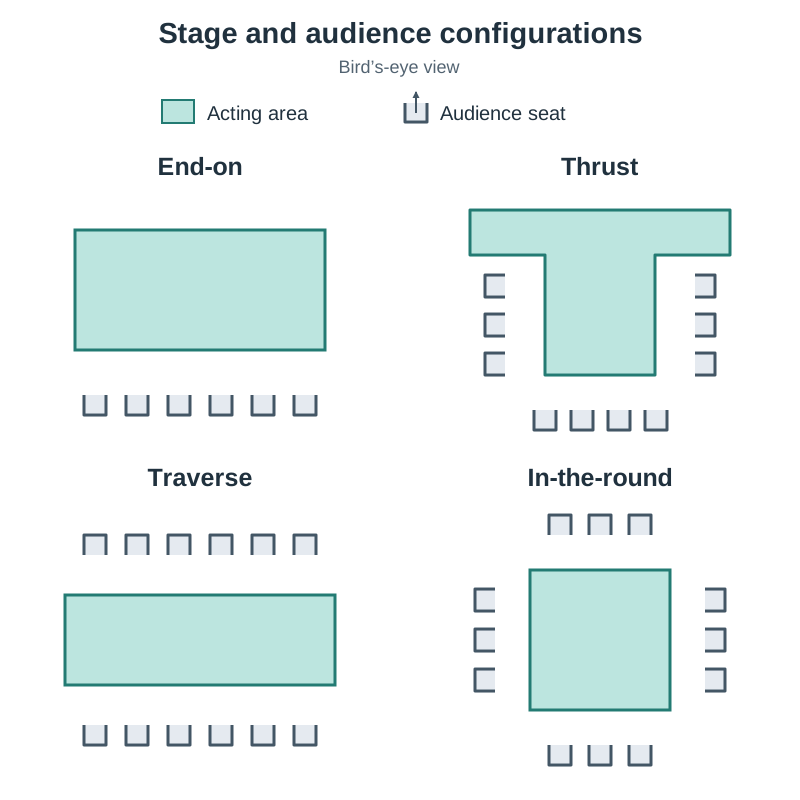
Staging Configurations
Your stage layout dictates the actor/audience relationship before dialogue begins. Keep sightlines—what audience members can see from every angle—in mind:
- End-on (Proscenium): Audience faces the stage from one side. Offers tight control over visual composition, framing, and hidden backstage areas, but creates greater physical separation.
- Thrust: The acting area projects forward with the audience seated on three sides. Increases intimacy and three-dimensional immersion, but requires actors to rotate continually so they do not block sightlines.
- Traverse: Audience sits in two opposing rows facing each other across a central acting corridor. Ideal for confrontations, courtroom scenes, or journeys, making spectators consciously aware of other viewers reacting across the space.
- In-the-round: Audience surrounds the performance space on all four sides. Maximum intimacy and immediacy, but demands minimal set furniture and continuous dynamic movement.
Engaging with Staging Elements and Design Sketches
The ACT 1 task description states that your ensemble should engage with aspects of staging—such as set, lighting, sound, and costume design, all with accompanying sketches—and make decisions about movement and voice, as appropriate to your piece. In practice, this means your portfolio should contain design sketches for the elements your piece uses, with justifications for choices:
- Worked costume decision: In an ensemble piece exploring social conformity, all performers wear identical grey boilersuits, but one character wears a single red armband. Design sketch note: The sketch shows the armband positioned at chest level using high-contrast crimson cotton to ensure instant visibility under stage light, marking the character's quiet defiance.
- Lighting sketch: Illustrate lighting angles, intensity, and gel colours (e.g. a 30° cold blue profile spot isolating a solo speaker against an unlit background).
- Sound cue plan: Detail diegetic sound (sound existing within the world of the piece, which the characters can hear) and non-diegetic sound (underscore heard only by the audience), noting for each whether it is produced live on stage or played back as a recording.
Refining Work with the Critical Response Process
Rehearsal is an iterative cycle of testing and adjustment. Under learning outcome 1.13, you refine your task using constructive feedback structured through the three stages of the critical response process:
- Appraising and responding: Observers offer immediate, non-judgemental impressions of what stood out. Example: 'I noticed the abrupt transition between the market shouting and the silent held pose.'
- Analysing and interpreting: Observers describe the meaning suggested by the techniques used. Example: 'The frozen pose combined with the snap to cold blue light made the crowd appear trapped in a sudden military lockdown.'
- Refining and evaluating: The ensemble and observers suggest specific technical adjustments to sharpen the dramatic effect. Example: 'Extend the silence by three seconds before the solo voice enters so the shift in mood fully registers across the audience.'
Sample Rehearsal Timeline
Setting feasible goals and timelines is essential when developing an ensemble piece across class periods:
- Period 1: Agree on stimulus, core concept, informing tradition, and draft the statement of intention.
- Periods 2–3: Workshop initial scenes through improvisation; establish roles, blocking, and choreographic motifs.
- Period 4: Draft the scenario or running order; compile the marked script and actor breakdown.
- Period 5: Create ground plans, costume/lighting sketches, and sound cue lists.
- Period 6: Complete a full run-through; gather peer feedback using the critical response process and cut sagging action.
- Period 7: Conduct technical and dress rehearsals with props, costumes, and cues.
- Period 8: Perform for a live peer audience; record immediate evaluative notes in your portfolio.
The Analytical Cycle: Explain, Evaluate, and Reflect
Staging the performance is only the midpoint of ACT 1. Learning outcomes 3.4, 3.5, and 3.6 require you to complete a three-part analytical reflection in your course portfolio. Clear distinctions between these three command verbs are vital for Leaving Certificate written responses:
| Command Verb | Syllabus Definition | Practical Application Sample |
|---|---|---|
| Explain (LO 3.4) | Give a detailed account including reasons or causes. | 'We kept the house lights on throughout the opening monologue, drawing on Brechtian non-naturalism to expose the mechanics of the theatre and prevent the audience from losing themselves in fictional illusion.' |
| Evaluate (LO 3.5) | Collect and examine work to make artistic judgements and appraisals. | 'Our choice of traverse staging succeeded in intensifying tension during the argument, as spectators audibly gasped at the actors' close proximity; however, our vocal projection dropped during the whispering sequence, causing the dialogue to be lost to audience members at the far end of the room.' |
| Reflect on (LO 3.6) | Give thoughtful and careful consideration to actions, experiences, and learning in order to gain new insights and make meaning for yourself. | 'Through this project, I realised that resolving staging disagreements through physical improvisation on stage yields better creative results than arguing around a table. In future work, I will test blocking ideas immediately on their feet.' |
Quick Application
- Weak narrative statement: 'We put a red spotlight on the protagonist at the end.'
- Evaluative revision: 'The tight red spotlight on the protagonist successfully communicated their moral guilt, drawing a hushed silence from the audience; however, holding the cue for fifteen seconds caused the dramatic energy to stall before the blackout.'
Connecting ACT 1 to Certified Assessment
Applied Creative Tasks are classroom-based projects designed to develop practical competence. While ACT 1 is assessed by your teacher as part of ongoing teaching and learning—and is not marked directly by the SEC—the skills you build underpin both certified examination components:
- Creativity in Practice Project (50% / 300 marks): In Year 2, you complete an individual project in response to a common brief issued by the SEC (such as the 2027 brief, The Use of Colour in Theatre and Film). You submit a digital project journal of no more than 1,700 words (with up to 20 images) across five lettered sections (A to E) plus an uncounted Reference Section, along with two continuous minutes of recorded footage. ACT 1 teaches you the exact habits required for this submission.
- Written Examination (50% / 300 marks): The examination assesses your learning across all three strands and your specified areas of learning. When answering questions from the perspective of a director, performer, or designer, your hands-on experience solving sightline issues, structuring dramatic tension, and annotating ground plans in ACT 1 supplies the concrete technical evidence examiners reward.
Mapping ACT 1 Stages to the Creativity in Practice Project Journal
| ACT 1 Practical Stage | Project Journal Section |
|---|---|
| Imagining stimulus and agreeing concept | Section A: Imagining and Conceptualising (300 words) |
| Researching traditions and practitioner conventions | Section B: Exploring Creative Ideas (400 words) |
| Devising, blocking, and refining two major decisions | Section C: Developing and Refining (400 words) |
| Staging live performance and documenting your role | Section D: The Performance / Production (300 words) |
| Assessing outcome against intention and audience reaction | Section E: Evaluation and Reflection in Practice (300 words) |
Note on terminology: Do not confuse the five stages of the creative process in Strand 1 (Imagining & Conceptualising, Developing, Refining, Producing & Performing, Evaluating) with the six stages of the Creativity in Practice Project (which adds Stage 6: Review and finalise your project journal) or the five lettered sections of the project journal.
Key terms
- Ensemble-driven
- Dramatic action derived from and or inspired by the work of the collective group of performers and creative team.
- Devise
- An artistic practice used to build a piece of dramatic action working from a starting point other than a written text.
- Improvisation
- To create and perform spontaneously or without preparation, generally in rehearsal as part of an early phase of blocking.
- Workshopping
- The process of creatively exploring new ideas for production, often based in improvisation work and based on responses to a stimulus.
- Statement of Intention
- A document that presents the story, concept and visual idea of a film or theatre production before the script is written or the action devised.
- Dramatic Action
- The unfolding events, conflicts, and progression of dramatic tension that drive a theatre piece forward.
- Actor/Audience Relationship
- The dynamic physical, spatial, emotional, and intellectual connection established between performers and spectators during a live performance.
- Blocking
- The process of organising the action and movement of a piece of film or theatre in rehearsal which is then realised in production; led by the director.
- Genre
- A style or classification of creative work. Sometimes synonymous with period.
- Period
- An historical timeframe (epoch) associated with creative work. Sometimes synonymous with genre.
- Style
- The signature artistic features of a particular practitioner, or more generally a genre or period; informs the creative process of making new work.
- Form
- The shape or structure of an artistic work, defined by conventions and usually within the rules of a genre or period.
- Conventions
- The artistic processes regarded as standard working practice within a specific genre, form or style, which can be realised through various techniques.
- Direct Address
- A theatrical convention where an actor speaks straight out to the audience, breaking the fourth wall.
- Multi-roling
- A performance convention in which an actor portrays more than one character within the same production, often signalled by swift physical, vocal, or prop changes.
- Gestus
- A Brechtian theatrical convention where an actor uses a clear, held gesture or physical attitude to expose the social and economic relationships between characters.
- Proxemics
- The use of spatial distance between performers, and between performers and spectators, to communicate relationships, power dynamics, and emotional tension.
- Ground Plan
- A bird's-eye architectural drawing of the stage layout showing the position of set pieces, furniture, entrances, exits, and sightlines.
- Model Box
- A three-dimensional scale model of the set design used to plan spatial relationships and staging before full production.
- Explain
- Give a detailed account including reasons or causes.
- Evaluate
- Collect and examine work to make artistic judgements and appraisals; make artistic judgements about the ideas or methods.
- Reflect on
- Give thoughtful and careful consideration to actions, experiences, values and learning in order to gain new insights and make meaning for oneself.
Check yourself
What is the recommended performance duration for the ACT 1 ensemble piece?
Approximately four to six minutes.
Which staging elements does the specification name as needing accompanying sketches?
Set, lighting, sound, and costume design, as appropriate to the piece.
Who assesses Applied Creative Task 1?
Your classroom teacher assesses it formatively through ongoing feedback; it is not marked directly by the SEC.
What order does the specification set out for the three Applied Creative Tasks?
ACT 1 and ACT 2 can be completed in either order, and both should be completed before commencing ACT 3.
How do the action verbs 'Explain' and 'Evaluate' differ in post-performance portfolio work?
'Explain' requires giving the reasons, causes, and theatrical influences behind your decisions; 'Evaluate' requires making supported artistic judgements about whether your intentions succeeded in performance.
What are the five core areas of consideration when planning an ACT 1 ensemble piece?
Creating and sustaining dramatic action, developing a role or roles, establishing the actor/audience relationship, engaging with aspects of staging, and making decisions about movement and voice.