

In Strand 2 (Critical Response Process), Learning Outcomes 2.7 to 2.9 guide your study from initial impressions into disciplined critical analysis. You learn how to deconstruct live public theatre performances and cinema screenings using exact disciplinary language, examine how practitioners make deliberate aesthetic and technical stagecraft choices to elicit audience responses, investigate how historical, social, cultural, and personal contexts shape productions, and evaluate how technological developments in lighting, sound, cameras, editing, and staging systems continue to influence both art forms.
The Analysing and Interpreting Stage and Disciplinary Action Verbs
The Critical Response Process moves through three stages: Appraising and Responding, Analysing and Interpreting, and Refining and Evaluating. In the first stage, you register your immediate emotional reaction. In this middle stage, you look beneath the surface to examine how the work was built, why particular decisions were made, and how effectively they operate on stage or screen.
The Leaving Certificate specification uses four distinct action verbs across Learning Outcomes 2.7, 2.8, and 2.9. Understanding the exact requirement of each verb keeps your writing focused on what examiners assess:
- Analyse (LO 2.7): Study or examine something in detail; identify component parts and relationships, and interpret them to reach supported conclusions.
- Critique (LO 2.7): Give a detailed analysis paired with a reasoned assessment or judgement of quality, effectiveness, and coherence.
- Investigate (LO 2.8): Observe, study, or make a detailed and systematic examination in order to establish facts and reach new conclusions.
- Discuss (LO 2.9): Offer a considered, balanced review that includes a range of arguments, perspectives, or artistic viewpoints, with opinions or conclusions supported by evidence.
Every lighting cue, camera move, sound effect, and performer movement is the result of a deliberate choice by a practitioner—whether director, designer, actor, cinematographer, or editor. Your job as a critic is to explain the mechanics behind that dramatic impact.
The Identify–Interpret–Evaluate Sequence
To move beyond casual opinion, use this three-step sequence in every analytical paragraph:
- Identify: Pinpoint the concrete artistic choice made on stage or screen.
- Interpret: Explain what meaning, subtext, or emotional atmosphere that choice communicates to the audience.
- Evaluate: Make a supported judgement on how successfully the choice realised the production's artistic intention.
You can use these reliable sentence stems to build your answers under exam conditions:
- In the moment where [scene occurs], the practitioner chose to [specific technique]...
- The effect of this on the audience is [subtext or emotion], because [explanation of mechanism]...
- This choice works effectively / does not fully succeed because [supported judgement]...
- This is characteristic of [prescribed genre, style, or form], where [convention]...
Critiquing Practitioners' Choices: Aesthetic and Technical Features (LO 2.7)
The specification requires you to evaluate creative stagecraft choices, distinguishing between aesthetic features and technical features, and showing how the technical means produce the aesthetic effect.
- Aesthetic features are the artistic, sensory, and atmospheric qualities of a work—its look, emotional tone, mood, rhythm, and visual style.
- Technical features are the practical methods, tools, and mechanical craft used to achieve those qualities, such as lantern rigging, colour temperature, camera lenses, microphone setups, or cut transitions.
In theatre, this practical execution is called stagecraft—the craft of staging live theatre, incorporating blocking, set design, scenic lighting states, soundscapes, and costume. In film, it encompasses camera framing, camera movement, location, lighting, sound design, and editing.
The Film Critic's Toolkit
When critiquing a cinema screening or set film, name the exact screen technique before interpreting its dramatic impact:
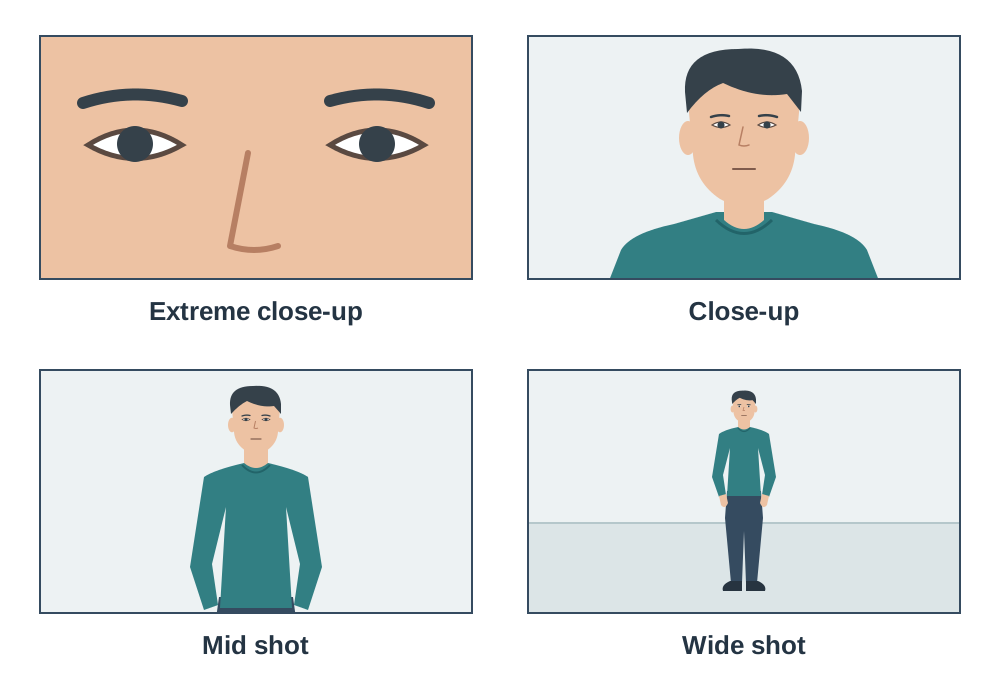
- Shot types and framing: Extreme close-up, close-up, mid shot, wide shot, establishing shot, two-shot, over-the-shoulder. Framing choices include high angle (can diminish or disempower), low angle (can empower or threaten), eye-level, Dutch (tilted) angle, and the use of headroom or open space around a figure.
- Camera movement: Static or locked-off, pan, tilt, tracking or dolly shot, crane, handheld, Steadicam, zoom, dolly zoom.
- Mise en scène: Everything arranged within the frame—set, props, costume, make-up, actor placement, colour palette, and compositional depth (foreground and background relationships).
- Lighting: High-key (bright, even) and low-key (dark, high-contrast chiaroscuro); hard and soft light; key, fill, and back light; motivated lighting (light that appears to come from an identifiable source within the world of the film, such as a domestic lamp or window).
- Sound: Diegetic sound (sound whose source is visible or implied within the world of the story, heard by characters), non-diegetic sound (sound outside the story world, such as the musical score or voiceover narration); dialogue, sound effects, foley, and silence; on-screen and off-screen sound.
- Editing: Continuity editing, cut, shot/reverse shot, match cut, jump cut, cross-cutting, montage, dissolve, fade, long take, and editing pace.
Tying Analysis to the Prescribed Genre, Style, or Form
Every prescribed text in Area 1 of the circular was chosen to illustrate a specific category. Your analysis must show how the practitioner's technique operates as an example of that category:
- An Cailín Ciúin (European Art Cinema): An observational camera, long takes, restrained naturalistic performance, meaning carried by silence and domestic gesture, and a deliberately unresolved ending.
- Jaws (The directorial style of Steven Spielberg): Suspense constructed by withholding visual confirmation of the threat, eye-level identification with an ordinary protagonist, expressive one-off camera techniques, and sound leitmotifs that signal off-screen danger.
- Past Lives (Romance): The structural obstacle of time, geography, and memory, with emotional longing expressed through physical pauses and shared silences rather than overt melodrama.
- Druid's The Shadow of a Gunman (Tragicomedy): Comic tenement banter juxtaposed abruptly against military violence and death, where laughter deepens the eventual tragedy.
- National Theatre's Home (Verbatim Theatre): Dialogue recorded from real-life interviews with residents and staff of a London hostel, direct address to the audience, and documentary authenticity replacing invented narrative.
- Fíbín sa Taibhdhearc's Tóraíocht (Use of non-naturalistic production elements): Mask work, stylised movement, puppetry, and theatrical visual invention in place of naturalistic staging.
Modes of Review and Engaging with Established Critics (LO 2.7)
A review translates your personal response into structured critical evaluation. The specification notes that students learn about the language and the various modes of review. Critical appraisal reaches audiences through several standard formats, and you should be comfortable working in more than one:
- The Written Review: The traditional structured article or essay format, allowing sustained textual analysis, detailed scene breakdown, and formal argument.
- The Spoken or Broadcast Review: An oral critique delivered for radio or a podcast, using clear vocal signposting and a conversational yet disciplined register.
- The Video Review or Video Essay: A multi-modal critique combining voiceover commentary with film clips, production stills, or diagrams, directly showing the visual evidence while analysing it.
- Discussion and Debate: A collaborative exchange where differing interpretations are presented, challenged, and refined in conversation with peers.
- The Personal and Critical Appraisal: The reflective format used in your Portfolio, blending rigorous stagecraft analysis with personal reflection on how your background shaped your reading.
Engaging with Established Critics
Reading published theatre and film critics gives you models for how professionals dissect productions. A strong review places the work (company, venue, genre), describes specific moments of performance and design, makes a supported judgement, and evaluates how well the production served the text or concept.
You may agree or disagree with a critic in your written work, provided you support your stance with concrete evidence from the performance. Quoting a professional critic is not a replacement for your own analysis; it is a viewpoint you critically evaluate.
Live Experience, Recordings, and the Portfolio
Outcome 2.7 requires you to analyse and critique at least one live public theatre performance and one cinema screening attended in person. A live performance takes place in real time in a physical venue with performers and audience sharing the space. While recordings of productions are central to the course—such as the designated performances studied in Area 1—a recording cannot substitute for attending a live theatre event, where the real-time energy exchange between actors and audience directly alters comic timing, rhythm, and tension.
Your responses are recorded in your Drama, Film and Theatre Studies Portfolio. To ensure your live visits provide reliable exam evidence, maintain a brief performance log within 24 hours of attending any production:
- Title, venue, date, and producing company
- Director and lead designers (set, costume, lighting, sound)
- Genre, style, or form demonstrated
- Three to five concrete moments with the exact techniques named (blocking, lighting shift, sound cue, camera angle, cut)
- Your initial emotional reaction versus your considered critical appraisal
Investigating Historical, Social, Cultural, and Personal Context (LO 2.8)
Works of art are not created in a vacuum; they reflect the personal, social, and historical circumstances of their makers. Investigating context under Learning Outcome 2.8 is an active enquiry that explains why specific stagecraft or cinematic choices were made. Never isolate context into a dry history summary detached from artistic choices.
When investigating context, distinguish between three distinct timeframes:
- The time depicted: The era in which the story is set.
- The time of creation: The historical period in which the text was written or the film was made.
- The time of the production: The contemporary moment of a specific revival or screening, which may interpret older themes for a modern audience.
Examine these timeframes through five interconnected lenses:
- Historical Context: Major political conflicts, economic conditions, and material realities of the period (such as the 1920 Irish War of Independence in The Shadow of a Gunman).
- Social Context: Class structures, gender roles, power relations, and community codes that the piece reflects, critiques, or subverts.
- Cultural Context: Traditions, religious beliefs, folklore, communal rituals, and language (such as the cultural resonance of the Irish language and unspoken grief in An Cailín Ciúin).
- Artistic Context: The genres, periods, styles, forms, and movements that influenced the practitioners (such as Tragicomedy, European Art Cinema, or Verbatim Theatre).
- The Practitioner's Personal Context: The artist's own lived experience, background, and artistic formation. Sean O'Casey's working-class tenement upbringing directly informs his unsentimental treatment of tenement life; Colm Bairéad's adaptation of Claire Keegan's novella Foster informs his focus on quiet domestic intimacy.
Your Evidence Base Across the Course
Your critical evidence is drawn from four complementary sources across the specification:
- The prescribed Area 1 set film and designated theatre performance.
- At least one additional film extract and one additional theatre extract studied alongside Area 1.
- An Area 2 focus in film and an Area 2 focus in theatre (a genre, period, style, or form chosen by your school that is not among the Area 1 options), explored through scenes, extracts, and clips.
- The live public theatre performance and live cinema screening documented in your Portfolio.
The Evolution of Technology in Cinema and Theatre (LO 2.9)
Learning Outcome 2.9 asks you to discuss a range of technologies and technological developments that influence the development of theatre and cinema. While the specification highlights lighting, sound, cameras, and editing, the field also includes stage automation, projection, special effects, and access technologies.
| Technological Area | Medium Focus | Historical Evolution | Creative Possibilities and Trade-offs |
|---|---|---|---|
| Lighting | Theatre and Film | Candle and gaslight → incandescent tungsten fixtures → automated LED and moving fixtures | Enables instant shifts in colour temperature, sharp isolation of performers on a bare stage, and pre-programmed states. Trade-off: over-reliance on flashy colour effects can distract from nuanced acting and subtext. |
| Sound | Theatre and Film | Acoustic projection / silent film with live pit music → synchronised sound ('talkies') → multi-channel surround sound and digital processing | Multi-track sound and radio mics allow intimate vocal delivery and immersive spatial soundscapes. Trade-off: over-amplification can flatten dynamic vocal range in live spaces. |
| Cameras | Film (and live video in multimedia theatre) | Heavy static studio cameras → lightweight handheld rigs → Steadicam → compact digital cinema sensors | Handheld cameras freed filmmakers to shoot on authentic locations with documentary immediacy; high-sensitivity sensors allow filming in low, natural light. |
| Editing | Film (no direct live equivalent on traditional stages) | Physical splicing of celluloid film strips → computerised non-linear digital editing suites | Allows non-destructive experimentation with rhythm, montage, and temporal juxtaposition. Trade-off: rapid cutting can fragment physical performance and destroy spatial continuity. |
| Projection and Scenography | Primarily Theatre | Painted scenic backdrops → slide projection → high-lumen video mapping and LED stage walls | Allows instant transformation of physical environments on stage. Live feeds can project close-up performer expressions to large auditoriums. |
| Stage Automation | Theatre | Hand-pulled hemp ropes and counterweight flying → computerised winches, revolves, and tracked stage wagons | Enables complex scenic shifts to occur invisibly and safely in seconds, expanding visual storytelling possibilities. |
| Special Effects and CGI | Primarily Film (and physical stage effects) | In-camera optical effects and physical models → computer-generated imagery (CGI) | Expands narrative scope to impossible worlds. Trade-off: CGI spectacle can disconnect audiences emotionally if visual effects overpower character vulnerability. |
| Access Technologies | Theatre and Film | Uniform presentation → captioned screens, audio description headsets, and relaxed performances | Modifies lighting levels, lowers peak audio, and permits movement for neurodivergent or sensory-sensitive audiences, reshaping the communal audience experience. |
Because the action verb is discuss, your answer must remain balanced. Never write a catalogue of equipment. Balance the creative possibilities against artistic limitations and economic trade-offs, such as the resource divide between major national institutions and smaller independent companies.
Synthesising Critical Analysis for Examination
The Leaving Certificate written examination carries 300 marks (50% of the overall award), alongside the 300-mark Creativity in Practice Project (50%). Assessment arrangements structure the written paper into Section A (100 marks), Section B (160 marks), and Section C (40 marks). At Higher Level, top responses do not isolate technique, context, and technology into disconnected paragraphs. They synthesise them into an integrated argument.
A complete analytical paragraph builds through four layers:
- The Concrete Choice (LO 2.7): Name the exact stagecraft or cinematic technique used by the practitioner.
- The Interpretation and Critique (LO 2.7): Explain what the choice communicates, how it elicits an audience response, and judge its artistic success.
- The Contextual Root (LO 2.8): Connect the choice to historical circumstances, cultural values, or the practitioner's personal artistic context.
- The Technological Execution (LO 2.9): Acknowledge the equipment, system, or medium-specific process that made the choice possible.
Engaging in this analysis also prepares you for the final stage of the Critical Response Process—Refining and Evaluating (LO 2.10 and 2.11)—where you will evaluate how your informed critical interpretation differs from your instinctive initial response.
Key terms
- Analyse
- To study or examine something in detail; identify parts and relationships and interpret to reach conclusions.
- Critique
- To give a detailed analysis and assessment of an action, idea, artistic work, or perspective, combining close examination with reasoned judgements on quality and effectiveness.
- Investigate
- To observe, study, or make a detailed and systematic examination in order to establish facts and reach new conclusions.
- Discuss
- To offer a considered, balanced review that includes a range of arguments, perspectives, or artistic viewpoints, with opinions or conclusions supported by appropriate evidence.
- Practitioner
- A professional artist working in theatre or film, including performers, the creative team (director, designers, writers), and the production team (crew, technicians).
- Aesthetic Features
- The artistic, sensory, and expressive attributes of a work, including tone, visual composition, mood, colour palette, and performance rhythm.
- Technical Features
- The practical mechanics, tools, and craft used to realise an artistic effect, such as lantern rigging, lens focal lengths, sound mixing, or cutting styles.
- Stagecraft
- The craft and technical skill of staging theatre, encompassing set design, lighting states, soundscapes, costume design, stage management, and blocking.
- Mise en Scène
- In film, everything arranged within the frame (set, props, costume, lighting, and actor placement). In theatre, the total visual and spatial staging within the performance environment.
- Blocking
- The process of organising the action, positioning, and movement of performers within a stage space or camera frame, led by the director.
- Live Performance
- A performance or production shown in real time at a physical venue, where performers and audience share the same physical space.
- Modes of Review
- The various formats used to communicate critical appraisal, including written reviews, spoken/broadcast critiques, video essays, structured debates, and personal/critical appraisals.
- Diegetic Sound
- Sound whose source exists within the world of the film or play, audible to the characters (e.g. dialogue, footsteps, a radio playing in the room).
- Non-diegetic Sound
- Sound whose source does not exist within the story world and is heard only by the audience, such as a musical score, voiceover, or mood-enhancing sound effects.
- Continuity Editing
- A visual editing system in cinema designed to maintain continuous, clear, and logical narrative action across time and physical space.
- Montage
- An editing technique that juxtaposes a series of distinct shots to compress time, convey rapid information, or generate symbolic meaning.
- Motivated Lighting
- Lighting designed to appear as if it originates from a plausible physical source within the scene, such as a window, candle, streetlamp, or table light.
- Synchronised Sound
- The technical alignment of recorded sound with moving images on screen, commercially established in the late 1920s to end the silent film era.
- Non-linear Editing
- Digital editing software that allows an editor direct, instant access to any frame of footage, enabling non-destructive cuts and flexible restructuring of scenes.
Check yourself
What three steps make up the core analytical sequence used to critique a practitioner's choice?
Identify the concrete choice made, interpret what it communicates or achieves, and evaluate how successfully it fulfilled the production's artistic intention.
Explain the difference between an aesthetic feature and a technical feature using a stage lighting example.
The aesthetic feature is the resulting sensory atmosphere or look (such as a cold, menacing, isolated mood). The technical feature is the practical equipment and craft used to produce it (such as a cool-white 5600K LED spotlight focused with a narrow shutter cut).
What three distinct timeframes must you differentiate when investigating the context of a theatrical revival?
The timeframe depicted in the narrative, the timeframe when the play was written, and the timeframe of the specific production or revival.
Why can't a recorded broadcast take the place of attending a live public theatre performance?
Live theatre requires a shared physical space where the real-time energy exchange between actors and the assembled audience directly affects performance timing, vocal cadence, and spatial tension in ways a camera cannot capture.
Which core technologies named in Learning Outcome 2.9 are shared across both theatre and film, and which are primarily film-specific?
Lighting and sound are shared across both disciplines; cameras and editing define screen grammar and are primarily film-specific.
What four elements does an effective professional review generally include?
Placing the work (company, venue, genre), describing specific moments of performance and design, making a supported judgement of quality, and evaluating how well the production realised its text or concept.
Write a three-sentence critique of a lighting or sound choice in your set play's designated performance, using the Identify–Interpret–Evaluate sequence.
In the Act II raid of Druid's The Shadow of a Gunman, the lighting cuts suddenly from domestic tungsten warmth to blinding white beams through the window. This choice shatters the tenement's sanctuary and visually externalises the brutal intrusion of military law into civilian life. It works with exceptional power because the sudden glare implicates the audience in the characters' panic, making the subsequent tragedy feel immediate and inevitable.