

Foundations of Critical Response establishes the technical vocabulary, classification frameworks, and analytical habits required across Strand 2 (Learning Outcomes 2.1 to 2.4). In Leaving Certificate Drama, Film and Theatre Studies, critical response does not mean finding fault. It is an organised examination of how practitioners' choices are made and what they do to an audience. This foundation directly supports the written examination (worth 50% / 300 marks: Section A 100, Section B 160, Section C 40) and enriches your practical work in the three classroom-assessed Applied Creative Tasks (ACTs) and the externally assessed Creativity in Practice Project (worth 50% / 300 marks).
The Critical Response Stance: Initial Reaction to Informed Reading
Every critical encounter begins with an initial response: the immediate, instinctive thoughts and emotional reactions you experience when watching a performance or film. You might feel a sudden knot of tension, laugh out loud, or find yourself disoriented by an unusual staging choice. The specification treats your initial response as valid: the critical response process begins with it, recognising your personal values and life experiences as an authentic baseline.
However, critical maturity requires withholding judgement—resisting the urge to lock in an inflexible verdict before investigating how the work was actually put together. Strand 2 moves through three connected stages:
- Appraising and responding: acknowledging your immediate emotional reaction and noting what your personal background brings to the viewing.
- Analysing and interpreting: examining the practitioner's choices in detail and interpreting what they communicate using precise technical vocabulary.
- Refining and evaluating: comparing your developed informed response against your first impression, explaining why your reading shifted or deepened.
An informed response does not have to contradict your initial reaction, but it must be justified by concrete evidence from the staging, framing, sound, or performance.
The Language and Conventions of Film and Theatre (LO 2.1)
To score well in written analysis, you must replace vague reactions like 'the scene was dramatic' with precise craft terminology. Learning Outcome 2.1 requires you to understand nine core areas across stage and screen.
| Area | Stage (Theatre) | Screen (Film) |
|---|---|---|
| Visual world | Production design: physical sets, practical props, spatial layout, and costumes that establish the world of the play. | Mise en scène: everything arranged within the film frame—set dressing, props, costume, colour palette, lighting quality, and actor placement. |
| Movement | Blocking: the positioning and movement of actors across stage areas, led by the director in rehearsal to signal status and relationships. | Blocking: actor movement choreographed in precise relation to camera setups, lens choices, and camera movement. |
| Visual focus | Focus directed through lighting specials, physical stage levels, vocal projection, and actor stillness. | Shot types and framing: extreme close-up, close-up, mid-shot, wide shot, establishing shot, camera angles (low/high), and point-of-view (POV) framing. |
| Aural world | Live acoustics, vocal modulation, live or recorded sound effects, practical instruments, and atmospheric silence. | Sound design: diegetic sound (originating inside the story world, visible or off-screen), non-diegetic sound (musical score, voiceover), foley, and audio mixing. |
| Atmosphere | Lighting: lanterns, gels, colour temperatures, spotlights, side-lighting, and blackouts to set mood and time. | Lighting: three-point lighting (key, fill, backlight), low-key contrast, natural light, and post-production colour grading. |
| Transitions | Scene changes, blackouts, curtains, revolves, and fluid ensemble-led transitions in continuous live time. | Editing: the selection, timing, and joining of shots; cuts, dissolves, cross-cutting, and montage to shape narrative pace. |
| Special effects | Practical stage illusions, haze, pyrotechnics, flying rigs, and trapdoors. | Physical practical effects, prosthetics, mechanical rigs, computer-generated imagery (CGI), and digital compositing. |
| Location | The physical venue or fictional world represented through theatrical design. | The real-world setting or studio backlot chosen for filming and what its geography adds to meaning. |
| Performance style | Naturalistic (everyday behaviour) versus non-naturalistic (stylised, choral, physical, or heightened). | Understated, screen-scale subtlety (the camera does the work) versus heightened, expressionistic performance. |
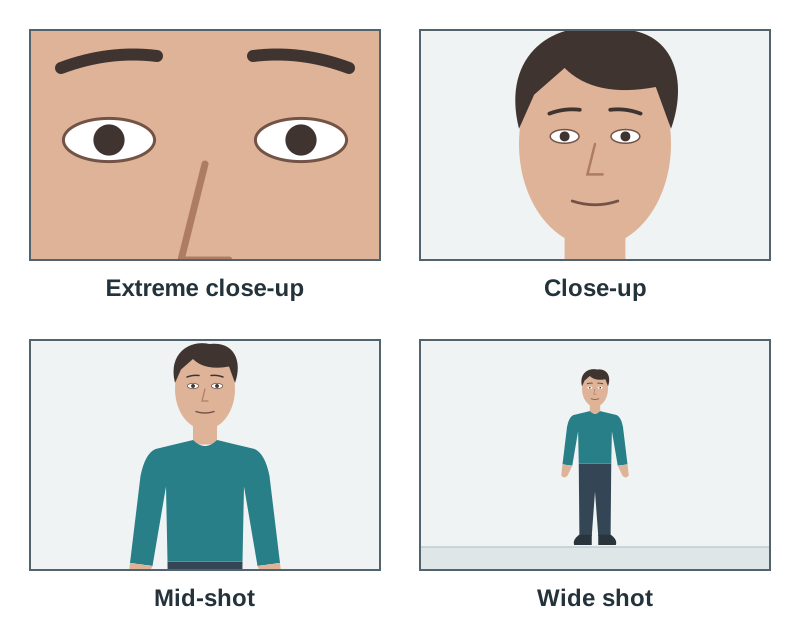
Quick Revision: Vocabulary Sorting
- Film only: shot types and framing, editing, continuity, colour grading.
- Theatre only: stage management, stage areas, live transitions, vocal projection to the back row.
- Both disciplines: production design, lighting, sound, blocking, special effects, location, performance style.
Maintaining Consistency: An Important Distinction
- Continuity (film): Because films are recorded out of chronological order over weeks or months, script supervisors track details (props, costumes, eyelines, screen direction) to ensure visual coherence across cuts.
- Stage management (theatre): Theatre unfolds live. The stage management team maintains consistency across a run of performances by managing rehearsals, tracking props, and calling technical cues (lighting, sound, flys) to execute the director's vision night after night.
Defining Performance Style
A naturalistic style aims to reproduce recognisable everyday behaviour: conversational delivery, overlapping or hesitant speech, ordinary gesture, a believable environment, and the fourth wall kept intact. A non-naturalistic style openly admits the audience is watching a made performance. Look for direct address, narration, heightened voice and movement, mask and puppetry, choral or unison ensemble work, symbolic set pieces, and visible scene changes.
Classifying Creative Work: Genre, Period, Style, and Form (LO 2.2)
Creative works belong to artistic traditions. Learning Outcome 2.2 requires you to understand the distinctive features, conventions, and techniques defining particular genres, periods, styles, and forms.
- Genre: a style or classification of creative work based on shared narrative tropes, themes, and emotional expectations (such as Romance, European Art Cinema, or Tragicomedy).
- Period: a historical timeframe (epoch) associated with creative work, reflecting the social norms, politics, and technologies of its day (such as Elizabethan theatre or 1970s New Hollywood).
- Style: the signature artistic features of a particular practitioner, movement, or era (such as Steven Spielberg's fluid tracking shots, or non-naturalistic staging).
- Form: the shape or structure of an artistic work, defined by conventions and usually within the rules of a genre or period (such as Verbatim Theatre, the short film, or an ensemble-driven play).
These categories overlap. For example, Nadia Fall's Home is simultaneously Verbatim Theatre (form), contemporary British (period), and socially engaged documentary (genre).
The Three Layers of Analysis
- Feature: the distinctive characteristic or marker (in romance, an obstacle keeping two lovers apart).
- Convention: the accepted standard practice used to express that feature (using close-ups and shared two-shots to convey emotional intimacy).
- Technique: the practical craft method used by the practitioner to execute the convention (the actors holding a sustained pause before speaking; shallow depth of field blurring the background).
Area 1 Prescribed Options (Circular 0061/2025)
Schools choose one film option and one drama/theatre option. One option in each discipline is available through Irish (An Cailín Ciúin and Tóraíocht), and schools may choose either language regardless of their school setting.
| Option & Category | Prescribed Production | Features / Conventions / Techniques |
|---|---|---|
| Film Option A<br>Genre: European Art Cinema | An Cailín Ciúin (dir. Colm Bairéad, 2022) | Focus on internal character experience over plot; slow, deliberate pacing; long takes; silence and landscape carrying meaning; restrained acting; ambiguous or quiet ending; 4:3 frame. |
| Film Option B<br>Style: Directorial style of Steven Spielberg | Jaws (dir. Steven Spielberg, 1975) | Long fluid takes and tracking/dolly moves instead of fast cutting; slow push-in onto a reacting face; low camera angles; suspense built by withholding the threat; recurring musical motifs; deep blocking. |
| Film Option C<br>Genre: Romance | Past Lives (dir. Celine Song, 2023) | Central pair separated by obstacles (time, distance, choices); meeting–separation–reunion structure; intimacy built through two-shots, eye-contact, and shared framing; bittersweet resolution. |
| Theatre Option A<br>Style: Non-naturalistic production elements | Tóraíocht by Philip Doherty (dir. Mikel Murfi, Fíbín sa Taibhdhearc, 2018) | Rejection of real-life illusion; narration and direct address; mask, puppetry, and physical ensemble movement; symbolic set; visible stagecraft; character doubling; live music and song. |
| Theatre Option B<br>Form: Verbatim Theatre | Home, written and directed by Nadia Fall (National Theatre, London, 2013) | Script built word for word from recorded interviews; vocal hesitations and unfinished thoughts preserved; actors playing multiple interviewees; minimal staging; direct address to the audience. |
| Theatre Option C<br>Genre: Tragicomedy | The Shadow of a Gunman by Sean O'Casey (dir. Garry Hynes, Druid, 2023) | Comic and tragic tones interwoven; domestic banter alongside political terror; late tonal turn making laughter uncomfortable; a flawed, self-deceiving protagonist; violence intruding from off-stage. |
Placing Work in Context
A strong exam answer links a named convention to the historical or social context it grew out of:
- European Art Cinema developed in post-war Europe as an alternative to commercial, formula-driven studio films, backed by national arts funding and film festivals. This reflects why personal directorial voice and open endings are valued over neat Hollywood resolutions.
- Verbatim Theatre grew out of the documentary theatre tradition as a way to place real, marginalised voices on a public stage during periods of political distrust. This was made practically possible by the availability of portable recording technology, allowing writers to capture real speech rhythms exactly.
- Tragicomedy in Sean O'Casey's work reflects the lived reality of the Dublin tenements during the 1920 War of Independence, where everyday domestic survival, sharp Dublin wit, and deadly political raids coexisted in the very same hallway.
Designated Performance of a Set Play
In theatre, you are examined on a specific production (a named company, year, and director), not just the written play. The playwright wrote the dialogue, but the director, actors, and designers made the choices you must analyse: set, costume, lighting, sound, blocking, and performance style. You must also study extracts from at least one other film and at least one other piece of theatre beyond your chosen prescribed works.
Mandatory Exclusions for Area 2
Area 2 allows you to choose an unprescribed genre, period, style, or form explored through extracts and clips. Two strict rules apply:
- The focus chosen for Area 2 cannot be any of the three options prescribed for Area 1, even if your school did not study that option.
- Texts prescribed for study in any other Leaving Certificate subject in your exam year cannot be chosen for Area 2 or as additional material in Area 1.
The Practitioner-Audience Relationship: Stage versus Screen (LO 2.4)
Theatre and film establish distinct relationships with their audiences, but they also share important artistic ground.
What Stage and Screen Audiences Share
- Both audiences are guided deliberately: practitioners control attention through lighting, vocal focus, and staging in theatre, or through framing, camera movement, and editing in film.
- Both experiences are collective and social: watching in a crowded theatre auditorium or cinema screening amplifies laughter, shock, and tension through shared human presence.
- Both rely on a willing agreement to enter the fictional world for the duration of the performance.
- Both bring personal beliefs and life experiences to the event, meaning different spectators can have completely different, equally valid responses to the same moment.
- Both can be addressed directly: an actor speaking to the auditorium on stage, or a character looking straight into the camera lens on screen.
Key Differences Between the Disciplines
- Co-presence: A theatre audience shares the same physical room and live time with the actors. A responsive crowd energises performers; a quiet crowd alters delivery tempo. Film audiences are completely absent when the film is shot; the finished movie cannot adjust to viewer reactions.
- Control of the gaze: In theatre, the spectator's eyes can wander across the entire stage, so the director must use blocking, lighting specials, and movement to earn focus. In film, the camera dictates exactly what the viewer sees, from what angle, and for how long.
- Fixed versus fluid: Every live theatre performance is unique and unrepeatable. A film screening is mechanically identical every time it runs.
Accessible Viewing
A relaxed performance or screening adapts standard theatre or cinema conventions to make the event accessible for audience members with additional needs, including sensory sensitivities or autism spectrum conditions. Adaptations include lowering sound levels, keeping house lights dimly on, and allowing audience members to make noise or move around freely. A live performance is one experienced in real time at a physical venue.
Eliciting Audience Response: The Technique-to-Effect Chain (LO 2.4)
To elicit a response means to deliberately draw it out. Practitioners do not leave audience reactions to luck. The specification names four groups of techniques and elements that practitioners use to elicit responses:
- Direction: pacing, tempo, emphasis, blocking, and performance modulation.
- Design elements: sets, costumes, props, lighting states, and soundscapes.
- Technical features: camera angles, shot scale, editing rhythms, cue timing, and special effects.
- Conventions: fulfilling expectations to provide satisfaction, or subverting them to create surprise, dread, or comic relief.
The Three-Step Analytical Method: Identify, Interpret, Evaluate
Structure your written paragraphs around this cause-and-effect sequence:
- Identify: name the practitioner's concrete choice using precise technical vocabulary.
- Interpret: explain what that choice communicates, how it works, and what mood or subtext it creates.
- Evaluate: judge how successfully that choice elicited the intended audience response.
| Technique | How It Works | Elicited Audience Response |
|---|---|---|
| Sudden ambient silence | Sound is cut abruptly after loud action; the viewer starts listening for the smallest sound. | Heightened suspense, vulnerability, and dread. |
| Rapid cross-cutting | Alternates quickly between two converging lines of action. | Panic, urgency, and breathless momentum. |
| Prolonged unbroken take | The camera refuses to cut away from an uncomfortable interaction. | Intensified intimacy, awkwardness, or claustrophobia. |
| Low-angle framing | The camera looks up from below eye level, enlarging the subject. | Intimidation, authority, or awe. |
| Wide blocking distance | Characters are positioned at opposite sides of the performance space. | Emotional alienation and unspoken conflict. |
| Single lighting special | A tight pool of light isolates one actor while the rest of the stage fades to black. | Sharp focus on the character's internal crisis or loneliness. |
| Direct address mid-scene | An actor suddenly turns away from the action to look directly at the auditorium. | The audience is implicated as witnesses rather than passive observers. |
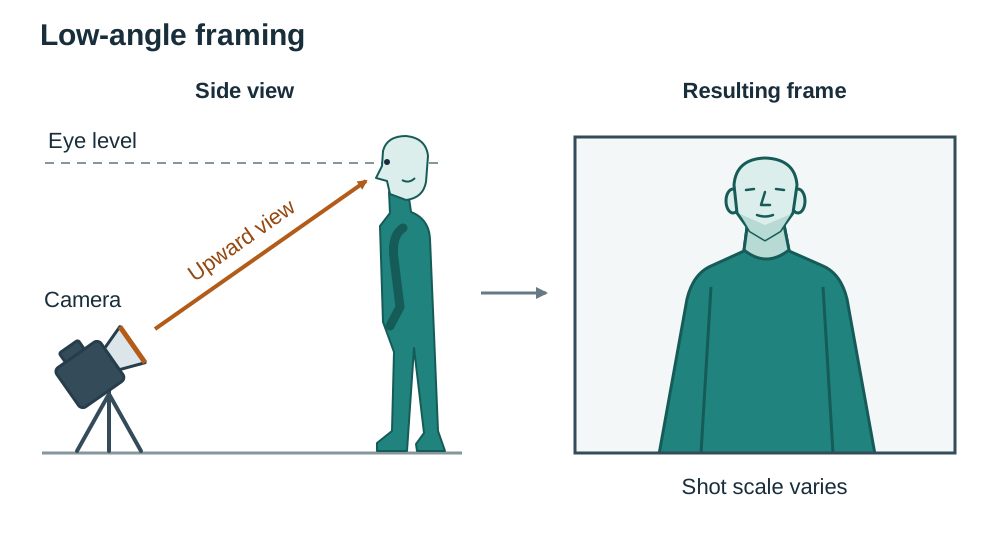
The Bridge Between Analysis and Making (LO 2.3)
Strand 1 (Creative Process) and Strand 2 (Critical Response Process) are taught together. Learning Outcome 2.3 asks you to describe how your study of genres, periods, styles, forms, and practitioners directly influences the development and execution of your own creative work.
- Development: the research, planning, improvising, scripting, and design stage.
- Execution: the technical staging, filming, directing, editing, or live performance.
Note that the three Applied Creative Tasks (ACTs) are assessed by your teacher in class as part of everyday learning—they are not marked by the State Examinations Commission (SEC). However, the skills you develop across ACT 1 (ensemble theatre), ACT 2 (film sequence), and ACT 3 (piece of theatre or short film in response to live work) directly prepare you for the externally marked Creativity in Practice Project (300 marks / 50%). ACT 1 and ACT 2 may be completed in either order, but both must be finished before starting ACT 3.
The Five-Step Formula for Showing Practical Influence
When reflecting in your digital project journal or answering exam questions on creative influence, follow this sequence:
- Name the source: identify the specific practitioner, genre, period, style, or form studied.
- Isolate the technique: state the exact craft method or convention you observed.
- Explain your artistic intention: describe what you wanted to communicate in your own project.
- Detail your adaptation: explain how you adapted that technique during rehearsal or pre-production.
- Evaluate the execution: provide evidence from your final performance or film screening, noting how your peers responded.
Key terms
- Initial Response
- The immediate, instinctive thoughts, emotional reactions, and first impressions experienced when first encountering a piece of theatre or film.
- Informed Response
- A considered, evidence-based interpretation developed through systematic analysis of techniques, practitioner choices, and context.
- Withholding Judgement
- The deliberate critical practice of refraining from forming a fixed final verdict about a work until its technical, contextual, and aesthetic elements have been analysed.
- Mise en Scène
- Everything composed and arranged within the film frame, including set design, practical props, costumes, lighting quality, actor positioning, and colour palette.
- Blocking
- The process of organising the action, positioning, and movement of performers in rehearsal, led by the director and realised in production.
- Continuity
- The film production system ensuring spatial, visual, and temporal consistency of action, props, costumes, and eyelines across shots filmed out of chronological sequence.
- Stage Management
- The theatrical team and system responsible for coordinating rehearsals, managing backstage operations, tracking props, and calling technical cues during live performances.
- Genre
- A style or classification of creative work based on shared narrative tropes, themes, and conventions, such as Romance or Tragicomedy.
- Period
- A historical timeframe (epoch) associated with creative work, reflecting the social values, politics, and technologies of its era.
- Style
- The signature artistic features and aesthetic approach of a particular practitioner, movement, genre, or historical period.
- Form
- The shape or structure of an artistic work, defined by conventions and usually within the rules of a genre or period, such as Verbatim Theatre or the short film.
- Convention
- An established artistic process or standard working practice regarded as normal within a particular genre, form, or style.
- Technique
- A specific practical craft method, skill, or procedure used by a practitioner to realise an artistic convention or effect.
- Feature
- A distinctive, identifiable attribute or characteristic that marks out a piece of artwork, style, genre, or period.
- Fourth Wall
- The imaginary, invisible barrier separating the performers on stage from the spectators in naturalistic theatre.
- Direct Address
- A performance technique where an actor speaks directly to the live theatre audience or looks straight into the camera lens in film, breaking dramatic illusion.
- Diegetic Sound
- Any sound whose source exists within the fictional story world of the film or play, whether visible on screen or originating from an off-screen space.
- Non-Diegetic Sound
- Sound added outside the story world for the audience's benefit, such as a musical score, voiceover commentary, or dramatic sting.
- Elicit
- To deliberately draw out or produce a specific emotional, sensory, or intellectual response from an audience through craft choices.
- Aesthetic Judgement
- The cultivated capacity to assess, critique, and evaluate artistic quality, effectiveness, and coherence based on reasoned evidence.
- Verbatim Theatre
- A theatrical form in which the play's dialogue is constructed word for word from the recorded transcripts of real-life interviews.
- Relaxed Screening / Performance
- A screening or performance adapted to make the event accessible for audiences with sensory or additional needs, such as reduced volume, dim house lights, and free movement.
Check yourself
What are the three main stages of the Strand 2 Critical Response Process?
1. Appraising and responding; 2. Analysing and interpreting; 3. Refining and evaluating.
A character switches on a radio off-screen and music begins playing. Is this diegetic or non-diegetic sound?
Diegetic sound, because the sound source exists within the fictional story world, even though the radio itself is off-screen.
Distinguish between an artistic convention and an artistic technique.
A convention is an accepted standard working practice within a genre, form, or style (e.g. maintaining the fourth wall). A technique is the practical craft method used by a practitioner to realise that convention (e.g. an actor holding a long pause before speaking).
How is Tragicomedy classified under Department Circular 0061/2025 for Area 1?
Tragicomedy is classified as a Genre (Drama/Theatre Option C, exemplified by Druid's 2023 production of Sean O'Casey's The Shadow of a Gunman).
State two strict restrictions governing the selection of material for Area 2.
Area 2 cannot duplicate any of the three options prescribed for Area 1, and it cannot use any texts prescribed for study in other Leaving Certificate subjects in that examination year.
Name the four groups of techniques and elements practitioners use to elicit audience responses under LO 2.4.
Direction, design elements, technical features, and conventions.
State two shared characteristics of theatre and film audiences.
Both audiences have their focus deliberately guided by practitioners (via staging/lighting or camera/editing), and both bring personal beliefs and life experiences that shape their interpretation.
Are the three Applied Creative Tasks (ACTs) assessed by the State Examinations Commission (SEC)?
No. The Applied Creative Tasks are assessed by your class teacher as part of ongoing learning. The externally assessed component is the Creativity in Practice Project (300 marks / 50%).