

Refining and evaluating is where critical thinking and practical making meet. In the critical response process (Strand 2), refining and evaluating forms the third and final stage. In the creative process (Strand 1), they operate separately: refining is stage 3, taking place before you produce and perform, while evaluating is stage 5, carried out after the audience has engaged with your work. These outcomes are part of the course at both Higher and Ordinary Level; at Higher Level you receive less structured support and more depth is expected in your aesthetic judgement. Your task is to evaluate how structured critical analysis turns instinctive first impressions into evidence-based, informed interpretations (LO 2.10), and to explain how the critical and creative processes continually feed each other (LO 2.11).
How Refining and Evaluating Fit into the Two Processes
Drama, Film and Theatre Studies runs two interdependent processes side by side. Rather than moving in a rigid straight line, both processes are iterative—you move back and forth between stages as ideas develop, setbacks arise, and discoveries occur.
| Critical Response Process (Strand 2) | Creative Process (Strand 1) |
|---|---|
| 1. Appraising and responding | 1. Imagining and conceptualising |
| 2. Analysing and interpreting | 2. Developing |
| 3. Refining and evaluating | 3. Refining |
| 4. Producing and performing | |
| 5. Evaluating |
Notice that in the creative process, refining comes before performance, while evaluating comes after. The specification emphasises that feedback and refinement happen routinely throughout the course, not merely at the end of a project.
The Three Records
Do not confuse your three primary working records:
- Portfolio: Your personal two-year working folder containing sketches, learning logs, drafts, goals, evidence of your three Applied Creative Tasks, and written responses to live events. It is a classroom and revision tool; it is not submitted to the SEC.
- Applied Creative Tasks (ACTs): Three practical class projects assessed by your teacher with classroom feedback. The SEC does not mark them, but the practical learning gained from them is examined directly in your written exam and project.
- Project Journal: The single digital document you submit to the SEC for the Creativity in Practice Project, structured into six specific sections.
Your portfolio must record your critical and personal response to at least one live, public theatre performance and at least one live cinema screening you attended in person. Record the title, playwright or director, company, venue, date, your initial response, and your informed response. Your school studies one of the three prescribed film options and one of the three prescribed drama/theatre options, plus extracts from at least one other film and one other piece of theatre and a freely chosen Area 2 focus in each discipline. The examples used here illustrate method—substitute the option you actually studied. An exam question on LO 2.10 can be answered using a live production you attended, not only your prescribed text.
From Initial to Informed Response (LO 2.10)
Every critical encounter with drama or cinema begins with an initial response. This is your immediate, emotional, and visceral reaction upon first viewing. The syllabus affirms that your initial reaction is entirely valid as an authentic starting point. However, critical maturity requires withholding judgement—holding back from forming an inflexible final verdict until you have gathered sufficient dramatic and technical evidence.
Through systematic analysis of craft, context, and conventions, your first impression matures into an informed response. When evaluating this shift, structure your answer using a four-part progression:
- State the initial response: Record your raw emotional reaction, confusion, or gut assumption upon first viewing.
- Identify the analytical turning point: Pinpoint the exact technical features (camera framing, lighting states, non-diegetic sound—music or audio the characters cannot hear, editing rhythm) or contextual factors you investigated.
- Articulate the informed response: Explain your deepened interpretation, showing whether your initial view was confirmed, deepened, qualified, or reversed.
- Evaluate the process: Explain why that specific analytical investigation caused the shift in your aesthetic judgement.
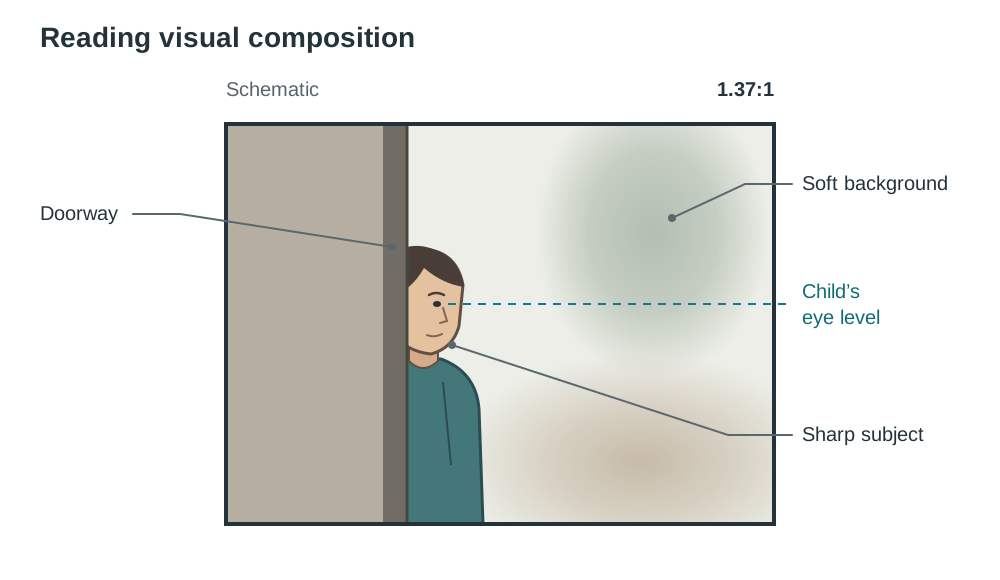
For example, on first viewing Colm Bairéad's An Cailín Ciúin (2022), you might find the opening sequence painfully slow and emotionally remote. In the analysing stage, you deconstruct Kate McCullough's cinematography: the boxed-in 1.37:1 Academy ratio (a nearly square frame, much narrower than the widescreen shape we are used to), shallow depth of field (where the subject is sharp while the background stays soft), and low camera height aligned with Cáit's eye-line, frequently framing her obstructed by doorways. Your informed response reveals that the visual claustrophobia and the refusal to cut quickly are deliberate directorial choices reflecting Cáit's emotional neglect. Evaluating the process demonstrates how analysing visual composition transformed your reading from perceived narrative stagnation into an appreciation of empathetic visual restraint.
Questioning Attitudes, Values, and Assumptions
The specification states that works of art are not created in a vacuum; they reflect the personal, social, and historical context of their makers. Refining your interpretation requires looking inward as well as outward:
- Inward reflection (Self-directed): Interrogating your own habitual attitudes, core values, and unexamined assumptions. Using what is often called a critical lens (a useful shorthand, not a term from the specification), you recognise that your initial reaction is conditioned by your personal background, culture, and life experiences rather than being a universal truth.
- Outward recognition (Other-directed): Identifying, understanding, and empathising with the differing cultural traditions, moral complexities, and social values of the practitioners and the characters depicted.
In Steven Spielberg's Jaws (1975), an initial viewing might dismiss Mayor Vaughn's refusal to close the beaches as two-dimensional villainy. Contextual research reveals the economic desperation of a 1970s island community dependent on summer tourism. Outward reflection allows you to understand the social pressures driving his choices, while inward reflection forces you to confront your own assumptions regarding political responsibility versus economic survival.
The Reciprocal Feedback Loop (LO 2.11 & 1.13)
Learning outcome 2.11 requires you to explain how the critical response process and the creative process continually inform each other. Analysing other people's work changes the choices you make in your own, and making your own work changes what you notice in other people's.
Critical Response Informs Creative Practice
- Practitioner craft as a toolkit: Deconstructing how professional directors solve artistic problems gives you tangible conventions to apply in your own practical work (for example, analysing Nadia Fall's verbatim technique in Home provides concrete methods for editing real speech rhythms into an original devised script).
- Predicting audience impact: Analysing how sudden silence or low-key lighting (scenes that are mostly dark, with small pools of light and hard shadows) elicits dread allows you to deploy those sensory tools intentionally in your Applied Creative Tasks.
Creative Practice Informs Critical Response
- Empathy for professional craft: Once you have managed the practical challenges of rigging and balancing a three-point lighting setup (key, fill, and back light) or sustaining spatial tension across an ensemble on stage, you recognise the discipline required in professional productions.
- Sharper critical perception: Wrestling with cut points in an editing suite changes how you watch cinema. You stop experiencing pacing as an abstract feeling and begin reading shot duration and a sound bridge (sound carrying across a cut from one scene to the next) as deliberate directorial solutions.
The Iterative Cycle and Feedback
Under LO 1.13, refinement relies on moving through a four-step loop:
- Draft, rehearse, or shoot your material.
- Share your work with your working group, the class, and your teacher.
- Critically analyse the feedback received against your statement of intention or treatment.
- Implement targeted refinements during a technical, dress, or camera rehearsal—then repeat as needed.
Giving feedback is an active critical skill (LO 2.6). Use a four-step method: describe what you actually saw using technical terms; ask about the maker's intention before judging; relate what you observed to that intention; and offer one actionable change rather than a vague verdict.
The Discipline of Refining: Limits, Decisions, and Justification
Refining has a natural stopping point. The specification notes that an important part of the creative process is recognising when to stop refining and perform or show the work to an audience.
Knowing When to Stop and the Risk of Over-Rehearsal
- Knowing when to stop: Further adjustments eventually stop improving the piece and begin unsettling the cast or crew. You have reached this point when the performance is consistent across two full runs, technical cues land reliably, and remaining notes are matters of taste rather than clarity.
- The risk of over-rehearsal: Pushing beyond that point causes a performance to go stale—actors become mechanical, stop listening to each other, and lose spontaneity. Avoid this by varying the rehearsal task (such as running a scene at half pace, in a different room, or from a different character's point of view) rather than mindlessly repeating full runs.
Legitimate Changes to Your Vision
The glossary defines refine as making minor changes. However, during a practical project your piece may evolve significantly. Legitimate reasons for major adjustments include:
- The original vision proved overly ambitious for the time, cast, or equipment available.
- Practical constraints (such as loss of a filming location or venue limitations).
- Unanticipated setbacks (such as an absent actor, damaged props, or camera files that failed to cut together).
When this happens, do not pretend the plan never altered. Keep a refinement log documenting: (1) what you intended, (2) what changed, (3) why it changed, and (4) the effect on the audience. Explaining and justifying significant changes meets the requirements of the coursework brief far better than claiming an unbroken path to perfection.
Assessment Structure and the Creativity in Practice Project
Assessment for Leaving Certificate Drama, Film and Theatre Studies consists of two equal components:
- Creativity in Practice Project (50%, 300 marks): Completed on a common brief issued by the SEC in Term 2 of Year 1, containing a digital project journal and a two-minute recorded excerpt.
- Written examination (50%, 300 marks): Higher and Ordinary Level papers, divided into Section A (100 marks), Section B (160 marks), and Section C (40 marks).
Project Journal Structure (1,700 words maximum)
- Section A: Imagining and Conceptualising (300 words, 40 marks)
- Section B: Exploring Creative Ideas (400 words, 60 marks)
- Section C: Developing and Refining (400 words, 80 marks)
- Section D: The Performance / Production (300 words, 60 marks)
- Section E: Evaluation and Reflection in Practice (300 words, 40 marks)
- Overall Coherence and Communication (20 marks across the whole journal)
Division of Labour: Section D vs Section E
- Section D: Set the context of the two-minute excerpt (where it falls in the complete piece and what is happening) and state your individual contribution.
- Section E: Appraise the piece using that excerpt and evaluate the overall project. Do not waste Section E's word count retelling the story or explaining context already covered in Section D.
Essential Coursework Regulations
- Exceeding the 1,700-word limit across the journal risks mark penalties. Words used to annotate up to 20 images count towards the 1,700 words.
- References (including any permitted use of generative AI tools) belong in the separate reference section, which does not count toward the 1,700-word limit.
- The continuous two-minute recorded excerpt must be in MP4 format and under 1GB in size. Standard definition (720x480 at 25 fps) is a dependable way to keep file sizes low.
- For theatre, recordings must use a fixed camera capturing the full stage from the audience perspective, without audience members visible on screen.
Command-Word Discipline in DFTS
The specification glossary defines action verbs precisely. Your responses must match what the command verb demands:
- Appraise: Evaluate, judge, or consider information or a piece of work.
- Evaluate: Collect and examine work to make artistic judgements and appraisals; make judgements about the ideas or methods used.
- Critique: Give a detailed analysis and assessment of an action, idea, or perspective.
- Explain: Give a detailed account including reasons or causes.
- Justify: Give valid reasons or evidence to support an answer or conclusion.
- Reflect on: Give thoughtful and careful consideration to actions, experiences, values, and learning in order to gain new insights and make meaning for yourself.
- Discuss: Offer a considered, balanced review that includes a range of arguments, perspectives, or artistic viewpoints, supported by appropriate evidence.
- Refine: Make minor changes in order to improve or clarify a piece of work.
The most frequent mark loss in this topic is answering an evaluate or appraise question with pure description. If asked to evaluate, every paragraph must include an explicit artistic judgement backed by evidence.
Key terms
- Initial Response
- The immediate, instinctive emotional reaction or first impression experienced upon encountering a theatrical performance or film, valid as a starting point before detailed analysis.
- Informed Response
- The considered, evidence-based interpretation developed after thoroughly analysing practitioners' craft, technical features, conventions, and contextual factors.
- Withholding Judgement
- The deliberate critical practice of pausing final artistic appraisal until sufficient dramatic, cinematic, and contextual evidence has been analysed.
- Refine
- To make minor changes in order to improve or clarify a piece of work (official specification glossary verb).
- Evaluate
- To collect and examine work to make artistic judgements and appraisals; to make artistic judgements about the ideas or methods used (official specification glossary verb).
- Reflect on
- To give thoughtful and careful consideration to actions, experiences, values, and learning in order to gain new insights and make meaning for oneself (official specification glossary verb).
- Explain
- To give a detailed account including reasons or causes (official specification glossary verb).
- Appraise
- To evaluate, judge, or consider information or a piece of work (official specification glossary verb).
- Critique
- To give a detailed analysis and assessment of an action, idea, or perspective (official specification glossary verb).
- Justify
- To give valid reasons or evidence to support an answer or conclusion (official specification glossary verb).
- Discuss
- To offer a considered, balanced review that includes a range of arguments, perspectives, or artistic viewpoints, supported by appropriate evidence (official specification glossary verb).
- Iterative Process
- A fluid working method involving cyclical movement back and forth between planning, executing, receiving feedback, and refining work rather than following a rigid line.
- Constructive Feedback
- Specific, balanced, actionable, and informed commentary grounded in theatrical and cinematic conventions, designed to help creators improve work.
- Statement of Intention / Treatment
- A pre-production document that presents the story, concept, and visual idea of a theatrical production (statement of intention) or film (treatment) before scripting or devising.
- Aesthetic Judgement
- The capacity to make reasoned, analytical, and discerning appraisals of artistic quality and craft, balancing emotional response with critical evidence.
- Descriptors of Quality
- The official assessment criteria describing high, moderate, and low levels of student achievement across the creative process, execution of ideas, skills, and evaluation.
Check yourself
Where does refining occur in the creative process compared to the critical response process?
In the creative process (Strand 1), refining is stage 3, occurring before producing and performing. In the critical response process (Strand 2), refining and evaluating is combined as stage 3, occurring after analysing and interpreting.
What is the distinct division of labour between Section D and Section E of the project journal regarding the two-minute excerpt?
Section D establishes the context of the excerpt within the full piece and outlines your individual contribution. Section E appraises the piece using that excerpt and evaluates the overall project against your original intentions.
Give one legitimate reason why a student's creative work might deviate from their original statement of intention or treatment, and state what they must do in their journal.
A project may deviate due to practical constraints, unanticipated technical setbacks, or realizing an idea was overly ambitious. In the journal (Section C), the student must clearly explain and justify the creative decisions that led to the change.
What are the two warning signs that a piece has reached the end of its refinement stage and risks over-rehearsal?
The piece runs consistently with cues landing reliably across full runs, and actors begin delivering lines mechanically without listening to one another, losing spontaneity.
What live attendance experiences are compulsory for your Leaving Certificate DFTS portfolio?
You must attend and write a critical appraisal of at least one live, public theatre performance and at least one live cinema screening.
What are the word limit, image limit, and mark allocation for the Creativity in Practice Project journal?
The project journal has a strict maximum of 1,700 words (including words annotating images), allows up to 20 images, and carries 300 marks total (including 20 marks for overall coherence and communication).