

The developing stage is the second phase of Strand 1: Creative Process, covering Learning Outcomes 1.9 to 1.12. In simple terms: 1.9 is the decisions you make; 1.10 is the ethical and legal standards you work to; 1.11 is the paperwork that records those choices; and 1.12 is where your ideas come from as you draw on established practitioners. In this phase, you take an initial concept from a statement of intention or treatment and test it through active experimentation in rehearsal or on camera. Developing matters in both certification components: it supplies the content for Section C of the Creativity in Practice Project (worth 80 of 300 project marks), and the written examination assesses learning across all three strands, including Strand 1.
Active Decision-Making and Workshopping (LO 1.9)
Once you set down an initial concept, you move into the developing phase. The syllabus defines an experiment as approaching creative work either playfully or systematically, but always with an unknown outcome. Developing is not sitting at a desk picking options off a checklist. You test possibilities on your feet and through the camera, see what happens, and adapt.
Workshopping in Practice
Workshopping is the hands-on process of creatively exploring new ideas, usually starting from a stimulus or improvisation, before committing to a script. A practical session typically uses several core exercises:
- Improvisation: Creating action and dialogue spontaneously without a script to find authentic moments that land.
- Tableaux (still images): Freezing physical action so the group can examine visual composition, status, and spatial relationships.
- Hot-seating: Questioning an actor who stays strictly in role to uncover character motivations, contradictions, and backstory.
- Transcribing: Writing down the strongest improvised lines and beats immediately after a run so they can be shaped into working text.
For example, an ensemble exploring family conflict might improvise a silent mealtime scene. Discovering that physical distance communicated tension far better than arguing, they might cut their dialogue down to three lines and focus on stage business with plates and cutlery.
Core Decisions During Developing
During this stage, you make distinct artistic and technical choices:
- Form and genre: Form is the overarching shape or structure of the artwork defined by conventions, such as verbatim theatre or documentary film. Genre is the classification or style of the work, such as tragicomedy, romance, or melodrama.
- Production and performance style: Choosing between naturalistic acting (believable, everyday human behaviour) and non-naturalistic approaches (heightened movement, direct address, chorus work, or symbolic staging).
- Scripting versus devising: Choosing whether to begin from a written text (scripting) or to build dramatic action through group exploration from a stimulus (devising).
- Character building: Defining wants, obstacles, and physical traits. Techniques like Role on the Wall map what others think of the character on the outside of a drawn figure, and what the character privately desires or fears on the inside.
- Staging and camera techniques: In theatre, the director leads blocking—the planned movement, spatial relationships, and actor levels on stage. In film, the director and camera operator determine framing, shot scale, and camera moves.
- Target audience: Tailoring the piece to the people who will actually watch it. For example, staging a piece for peers in an intimate drama studio rules out a slow ten-minute exposition; the central shift must land quickly, and actors can rely on subtle facial details that would disappear in a large hall.
Deciding Design and Testing Feasibility (LO 1.9)
Assessing options for creative design means testing choices in physical space or on camera rather than just describing them. For the 2027 live brief topic, 'The Use of Colour in Theatre and Film', colour is your central design choice, so you must trial options deliberately.
Testing Colour in Theatre and Film
- Theatre: Test the same scene under two or three different lighting gels—a gel is a coloured filter placed in front of a stage lantern, identified by a catalogue number (such as Lee 105 for an amber wash or Lee 161 for steel blue). Observe what each colour does to the actors' faces, the costume fabrics, and the mood. You might trial one costume in a saturated hue against an otherwise neutral, muted set to pull audience focus instantly to a key character.
- Film: Shoot a test sequence under warm and cold practical light sources, then experiment with digital colour grading in post-production. Try a desaturated, near-monochrome palette with one key colour isolated in the frame, and compare its emotional impact against a fully saturated grade.
Document what you trialled, what failed, and what you selected. An examiner rewards: 'We tested three gels and selected steel blue because it drained all warmth from the mother's face in her final monologue.' An examiner cannot reward: 'Our lighting design was blue.'
Checking Feasibility Before Committing
The assessment guidelines require you to check whether an idea can actually be achieved before you lock it down:
- Time: How many rehearsal or shooting sessions remain before the completion date of 23 April 2027?
- People: Are the required performers and crew reliable, available, and clear about their responsibilities?
- Resources: Do you have the lanterns, gels, costumes, microphones, camera gear, and editing software needed?
- Space: Can your venue accommodate the set, and can you control ambient sound and lighting effectively?
Scaling back an over-ambitious idea is a mature creative decision that earns credit. Moving from an unrealistic five-location film shoot down to a single well-lit corridor sequence shows genuine professional judgement.
Ethical and Responsible Creative Practices (LO 1.10)
Creative exploration requires professional accountability across people, intellectual property, and statutory obligations:
- Cast and crew welfare: Collaborative work relies on agreed physical and emotional boundaries, active listening, and mutual respect. Rehearsal spaces must be safe for risk-taking. Nobody should ever feel pressured or intimidated when exploring sensitive dramatic themes.
- Honouring intentions: When adapting an existing play, novel, or real-life testimony, treat the creator's or subject's core meaning with integrity. Reinterpretation is welcome, but altering an author's or interviewee's central themes without reasoned artistic justification weakens the work.
- Copyright and performance rights: Copyright is the legal ownership of creative work. Do not assume that being a student project removes the need for permission. Staging an existing play script or using commercial music in work that is recorded, submitted, or performed publicly requires formal performance rights or synchronisation licences. The safest route for coursework is to devise original material, adapt out-of-copyright public domain texts, and use royalty-free or student-composed music.
- Statutory compliance (health and safety and GDPR): Production work involves hazards. Follow safety procedures when rigging lanterns, securing floor cables, and moving through darkened wings. Filming on private or public property requires landowner permission. Under General Data Protection Regulation (GDPR), recording recognisable individuals requires informed written consent.
Pre-Production Materials and Annotation (LO 1.11)
Pre-production materials are practical blueprints that turn ideas into clear instructions for cast and crew. Learning Outcome 1.11 names a range of materials across theatre and film. You are not expected to produce every document; you choose the ones your specific role, task, and medium actually require.
Core Pre-Production Documents
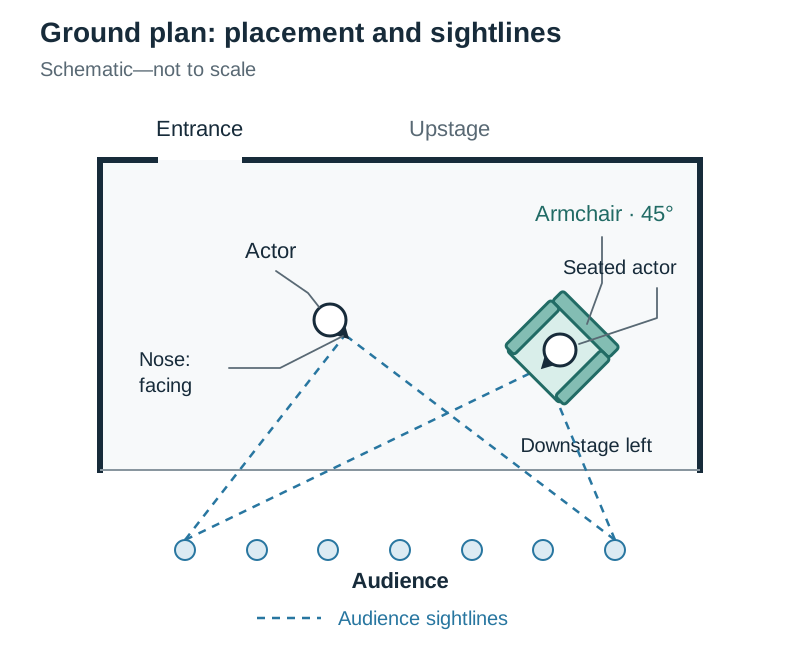
- Ground plan: A scaled bird's-eye technical diagram of the stage showing set walls, furniture, entrances, and audience sightlines.
- Model box: A three-dimensional miniature scale model of the set within the stage space, used to test spatial depth, lantern angles, and sightlines.
- Storyboard: A sequential series of illustrated panels depicting planned camera framing, lens angles, subject movement, and screen direction.
- Shot list: A schedule cataloguing every planned camera set-up—shot number, framing size, lens focal length, and camera movement—so filming runs efficiently.
- Call sheet: A daily logistical schedule listing arrival times, scene shooting order, locations, required cast, and safety notices.
- Marked script: A copy of the script annotated with role-specific details, such as actor blocking or stage management lighting and sound cue triggers.
- Mood board: A curated collection of images, fabric swatches, colour palettes, and lighting references that communicates the intended visual atmosphere.
- Other supporting materials: Location lists, actor/scene breakdowns, props lists, costume sketches, and choreography notes.
The Value of Annotation
Pre-production paperwork is not decorative art. It is functional evidence of your problem-solving. An unannotated storyboard or ground plan only shows what you decided. Thoughtful annotations reveal your artistic reasoning:
- Ground plan annotation: 'Armchair placed at 45-degree angle downstage left so the audience can see both actors' facial expressions during the cross-examination.'
- Storyboard annotation: 'Extreme close-up on hands, 50mm lens: audience sees the forged signature before the employer enters the frame.'
- Lighting plot annotation: 'Cue 4 cross-fades from amber wash to narrow blue backlight to signal the character's psychological isolation.'
Experimenting with Practitioners (LO 1.12)
Learning Outcome 1.12 requires you to experiment with features, conventions, and techniques of established practitioners. Understanding the exact distinction between these three terms is essential:
- A convention is the standard working practice accepted within a genre, form, or style (such as breaking the fourth wall in verbatim theatre, or building dread through off-screen sound in a thriller).
- A technique is the practical method used to execute that convention (such as an actor delivering real interview transcripts directly to audience members, or using discordant violin strings while keeping the threat out of frame).
- A feature is the distinctive artistic attribute of the finished work (such as raw documentary realism, or sustained psychological suspense).
Prescribed Material (Circular 0061/2025)
For the 2027, 2028, and 2029 examinations, schools study one Prescribed Film and one Prescribed Drama/Theatre performance in Area 1, alongside supplementary extracts:
- Film Option A: Genre: European Art Cinema | Film: An Cailín Ciúin (Dir. Colm Bairéad, 2022)
- Film Option B: Style: The directorial style of Steven Spielberg | Film: Jaws (Dir. Steven Spielberg, 1975)
- Film Option C: Genre: Romance | Film: Past Lives (Dir. Celine Song, 2023)
- Theatre Option A: Style: Use of non-naturalistic production elements | Performance: Tóraíocht by Fíbín sa Taibhdhearc (2018; Playwright: Philip Doherty; Dir. Mikel Murfi)
- Theatre Option B: Form: Verbatim Theatre | Performance: Home by the National Theatre, London (2013; Playwright & Dir. Nadia Fall)
- Theatre Option C: Genre: Tragicomedy | Performance: The Shadow of a Gunman by Druid (2023; Playwright: Sean O'Casey; Dir. Garry Hynes)
In Area 2, schools freely choose an unprescribed genre, period, style, or form. This choice cannot be any of the three options specified for Area 1 in that discipline, nor can it use texts prescribed in another Leaving Certificate subject for that examination year.
Stimulus Material in the 2027 Brief
The live brief illustrates its topic ('The Use of Colour in Theatre and Film') with six works: Barbie (2023), The Lion King (2022 stage production), Three Colours: Blue (1993), Schindler's List (1993), The Artist (2011), and Dancing at Lughnasa (2024). Use these as reference points by identifying one precise technique and adapting it. For example, Spielberg's technique of isolating a single red coat in an otherwise black-and-white frame in Schindler's List can be adapted into theatre by isolating a single brightly coloured prop on a monochrome set under cold white light.
Stage 3: Refine the Work and Written Exam Context
Developing does not stop when pre-production paperwork is drafted. It transitions directly into Stage 3: Refine the work (5–6 hours), where your choices face real performance conditions.
What Happens in Refining
- Theatre: Hold a technical rehearsal (stopping and starting to program lighting and sound cues and check transitions), followed by a dress rehearsal (a full run-through in costume with all technical elements running). Then finalise the piece for performance.
- Film: Conduct a camera rehearsal to test framing and actor marks, proceed to filming during this stage, and complete the rough-cut editing in post-production.
- Iterative adjustment: The creative process is never a straight line. If your dress rehearsal reveals that a blue wash looks muddy from the back row, you return to the ground plan, adjust lantern angles, and swap the gel. Documenting this back-and-forth movement between developing and refining is evidence of the iterative process.
Section C Coursework Checklist
In your project journal, Section C carries 80 of the 300 project marks. It has a suggested maximum of 400 words. The rule that carries a penalty is the journal total: the whole journal must not exceed 1,700 words, including image annotations (the reference list is excluded). Tick these mandatory items off in your draft:
- State your statement of intention (theatre) or treatment (film).
- Name one specific skill developed in performance, production, or technical work, explaining how you developed it with concrete evidence.
- Identify and explain two significant creative decisions made during development and refinement, giving artistic reasons and expected audience effects.
- Ensure any embedded images (up to 20 across the whole journal) are tightly annotated.
- Keep the journal as your own authentic, individual account. While you may collaborate on staging or filming, your journal must reflect your individual perspective and decisions.
Planning for the Excerpt and Referencing
Remember that you will later submit a continuous two-minute MP4 video excerpt of your work. Make sure the skill you write about in Section C is visible in that two-minute recording. For theatre, the performance must be recorded from an audience perspective by a fixed camera without filming the audience.
Any external images, practitioner quotes, or research sources must be cited in-text and recorded in your final reference section. Any permitted use of AI must also be acknowledged with the tool, date, and shareable link or prompt. In the written examination (300 marks: Section A 100, Section B 160, Section C 40), you will draw on this same understanding of the creative process and the Specified Areas of Learning.
Key terms
- Develop
- To evolve; make apparent or expand in detail.
- Experiment
- To approach creating either playfully or systematically but always with an unknown outcome.
- Form
- The shape or structure of an artistic work, defined by conventions and usually within the rules of a genre or period.
- Genre
- A style or classification of creative work. Sometimes synonymous with period.
- Style
- The signature artistic features of a particular practitioner, or more generally a genre or period. Informs the creative process of making new work.
- Conventions
- The artistic processes regarded as standard working practice within a specific genre, form or style, which can be realised through various techniques.
- Techniques
- The artistic methods used to realise a performance within a convention.
- Features
- The distinctive attributes or characteristics of a piece of artwork or of a period, style or genre.
- Devising
- An artistic practice used to build a piece of dramatic action working from a starting point other than a written text.
- Workshopping
- The process of creatively exploring new ideas for production. Often based in improvisation work and based on responses to a stimulus.
- Blocking
- The process of organising the action and movement of a piece of film or theatre in rehearsal which is then realised in production. Led by the director.
- Treatment / Statement of Intention
- A document that presents the story, concept and visual idea of a film or theatre production before the script is written or the action devised. Sometimes communicated via a pitch. In practice, treatment is used for film and statement of intention for theatre.
- Performance Rights
- Legal permission obtained from a copyright holder or licensing agency to publicly stage, broadcast, or perform a protected dramatic or musical work.
- Ground Plan
- A bird's-eye scale diagram showing the stage setting, entrances, set pieces, furniture, and audience sightlines.
- Model Box
- A 3D miniature scale model of the set within the playing space, used to test spatial depth, sightlines, and lantern angles.
- Storyboard
- A chronological series of illustrated panels depicting planned camera framing, angles, actor movement, and visual composition for a film.
- Shot List
- A detailed technical breakdown cataloguing every camera set-up for a shoot, including shot number, framing size, lens choice, and camera movement.
- Call Sheet
- A daily operational schedule issued to cast and crew specifying arrival times, filming locations, scene order, and safety notices.
- Marked Script
- A copy of the play-script or screenplay annotated with role-specific technical cues, blocking notation, or character intentions.
- Technical Rehearsal
- A stopping-and-starting rehearsal dedicated to integrating and timing technical elements such as lighting cues, sound effects, and scenic changes.
- Dress Rehearsal
- A full, uninterrupted run-through of a production in full costume with all technical, set, and audio elements operating exactly as in performance.
- Camera Rehearsal
- A rehearsal in film production where the director, performers, and camera crew coordinate movements, marks, framing, and focus before recording takes.
Check yourself
What does the 2027 live coursework brief ask candidates to create?
An original piece of work in theatre or film that uses colour to enhance meaning and influence the audience experience of the production.
What is the official specification definition of the action verb 'experiment'?
To approach creating either playfully or systematically, but always with an unknown outcome.
How do form, genre, and style differ under the official syllabus definitions?
Form is the shape or structure of an artistic work defined by conventions; genre is the classification or category of creative work; and style is the signature artistic features of a practitioner, genre, or period.
What three ethical practices are explicitly prescribed in Learning Outcome 1.10?
Ensuring all cast and crew behave respectfully and ethically, honouring the dramatist's or filmmaker's intentions, and obtaining performance rights.
What are the core differences between a technical rehearsal and a dress rehearsal in theatre?
A technical rehearsal stops and starts to test and time lighting, sound, cues, and set changes, whereas a dress rehearsal is a full, uninterrupted run-through in complete costume with all technical elements running as in a live performance.
What are the mandatory elements and word count rules for Section C of the project journal?
Section C requires a statement of intention or treatment, one developed skill backed by evidence, and two explained creative decisions. It has a suggested maximum of 400 words, but the enforced rule is that the whole journal must not exceed 1,700 words.