

Decarbonising an economy means systematically transforming how we produce goods, travel, heat buildings, generate electricity, and manage land so that we eliminate greenhouse gas emissions and reach net-zero emissions. In Strand 3 of Leaving Certificate Climate Action and Sustainable Development, Higher Level students examine technological solutions (wind, solar, hydro, geothermal energy, and geological carbon storage), water efficiency, and nature-based approaches (biological storage in bogs, forests, soils, and oceans). To answer well in the examination, you need to explain how each solution physically reduces emissions, connect it to the relevant sector of the economy, and evaluate its practical, economic, and ecological drawbacks.
The Mitigation Hierarchy and Decarbonisation by Sector
Decarbonisation is a form of mitigation because it tackles the root causes of climate change by cutting emissions or capturing carbon. It is distinct from adaptation, which involves adjusting to unavoidable impacts, such as constructing tidal flood barriers or breeding drought-resilient crops. Some solutions, like peatland restoration, deliver both: they halt greenhouse gas venting (mitigation) and store heavy rainfall to lower downstream flood surges (adaptation).
Under the Climate Action and Low Carbon Development (Amendment) Act 2021, Ireland is legally bound to reduce national greenhouse gas emissions by 51% by 2030 relative to 2018 levels, and to achieve net-zero emissions by 2050. Net-zero means any unavoidable residual emissions are counterbalanced by permanent carbon removals. To evaluate any decarbonisation policy, apply the mitigation hierarchy:
- Avoid: prevent emissions at source (for example, compact town planning that removes the need for car travel).
- Reduce: lower energy demand through efficiency (such as deep home retrofitting or repairing leaking water mains).
- Replace: swap fossil fuels for clean energy alternatives (including wind, solar, and heat pumps).
- Sequester: capture and lock away genuine residual emissions that cannot be engineered out of biological or industrial systems.
The order matters. Carbon capture and tree planting are for the emissions left over after we have avoided, reduced, and replaced. Using future capture to justify continuing fossil fuel emissions is known as moral hazard.
Decarbonising the Irish Economy by Sector
Emissions are not distributed evenly across the economy. Recent Environmental Protection Agency (EPA) inventories show clear sectoral divisions:
- Agriculture (~38% of national emissions): mainly biogenic methane () from ruminant livestock digestion and nitrous oxide () from synthetic fertilisers and animal waste. Key actions include switching from straight calcium ammonium nitrate to protected urea, adopting low-emission slurry spreading (LESS, such as trailing shoes), planting multi-species swards with clover to fix nitrogen biologically, and using anaerobic digestion to produce biomethane. Limitation: measures affect farm incomes and rural livelihoods, making a just transition essential.
- Transport (~20%): heavily reliant on imported petrol and diesel. Strategy follows avoid-shift-switch: avoid unnecessary journeys through remote working, shift commutes to active travel and public transit (DART+, BusConnects, MetroLink), and switch remaining vehicles to electric vehicles (EVs). Limitation: EVs eliminate tailpipe emissions but require clean grid electricity, cause tyre-wear particulates, and carry high embedded manufacturing emissions.
- Energy Industries (~15%): burning coal, oil, and fossil gas for electricity. Solutions focus on deploying onshore wind, offshore wind, utility solar, battery storage, and interconnection. Limitation: weather-dependent generation requires grid modernisation and dispatchable backup.
- Residential and Commercial Buildings (~10%): fossil heating in poorly insulated buildings. Solutions require deep retrofit programmes (external wall insulation, triple glazing, airtightness) paired with heat pumps, alongside municipal district heating. Limitation: high upfront capital costs and shortages of skilled retrofit contractors.
Possible Futures: Scientific, Technological, and Nature-Based
The specification frames decarbonisation around alternative futures driven by three distinct families of solutions:
- Scientific approaches: observational tools and models that measure, verify, and project climate processes. Examples include satellite tracking of methane plumes, atmospheric eddy-covariance towers monitoring bog emissions, and EPA national emissions inventories. Science does not eliminate emissions on its own, but it tells policymakers which interventions work and provides the accounting foundation for carbon budgets.
- Technological approaches: engineered infrastructure that replaces fossil systems or isolates carbon. These include wind turbines, photovoltaic arrays, grid interconnectors, high-efficiency heat pumps, and geological carbon capture. Technological solutions are measurable, scalable, and dispatchable, but they require heavy capital investment, lengthy planning procedures, and significant critical raw materials (such as lithium, copper, and rare earth elements).
- Nature-based approaches: actions that protect, sustainably manage, and restore ecosystems to capture carbon and strengthen ecological resilience. Examples include rewetted peatlands, permanent native woodlands, and coastal saltmarsh conservation. Nature-based solutions are comparatively low-cost per hectare and deliver vital ecological co-benefits, but their carbon storage is vulnerable to reversal through wildfires, drought, and biological disease.
A balanced Leaving Certificate response recognises that no single pathway is sufficient on its own. A purely technological future risks high material costs and moral hazard, while a purely nature-based future lacks the speed and scale required to meet Ireland's binding 2030 targets.
Renewable Energy Systems and the Electricity Grid
Decarbonising the power sector requires substituting combustible fossil fuels with natural, self-replenishing energy sources:
- Wind Energy: Kinetic energy in moving air turns turbine blades to spin an electrical generator. Ireland possesses an exceptional wind regime along the Atlantic seaboard. Wind power has generated roughly a third of Ireland's electricity in recent years, almost entirely from onshore wind farms (Arklow Bank remains Ireland's sole operational offshore installation). National policy targets 5 GW of offshore wind capacity by 2030. Turbines produce zero operational emissions and hedge against imported fossil fuel price spikes, but their intermittency poses operational challenges. A useful metric is capacity factor (the ratio of actual electrical energy delivered over a year to maximum theoretical output). Irish onshore wind achieves capacity factors around 30%, whereas solar PV averages roughly 10% to 11%.
- Solar Energy: Solar systems take two forms. Solar photovoltaic (PV) uses semiconductor cells to generate electricity from direct and diffuse daylight. It is quick to install, modular, silent, and matches daytime commercial and agricultural cooling loads. Solar thermal uses dark roof-mounted collector plates to heat domestic water directly, supplying hot water between April and September to displace boiler fuels. The key trade-off for solar in Ireland is seasonal mismatch: output peaks during long summer days, whereas peak electricity demand occurs on dark winter evenings.
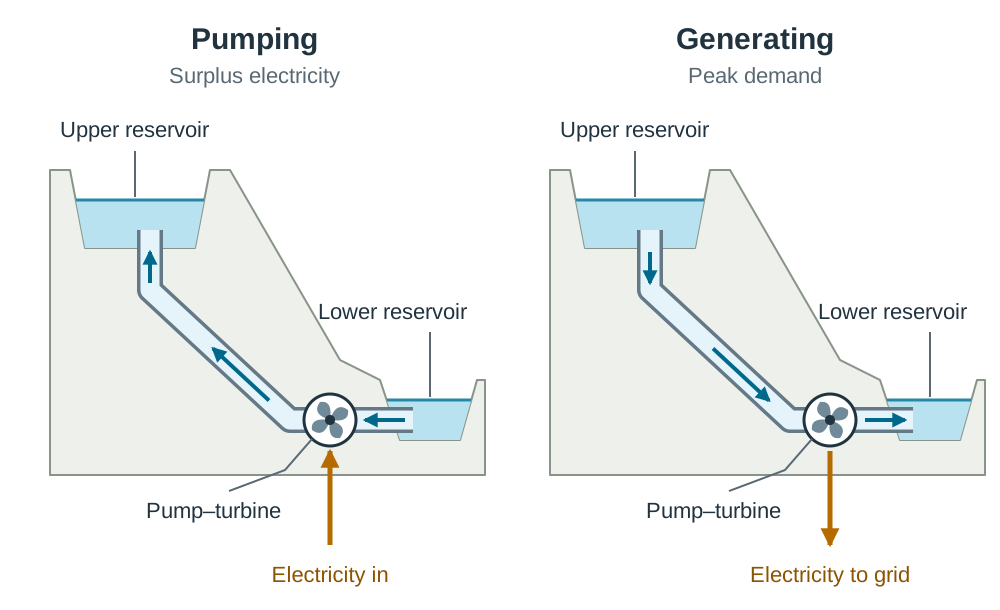
- Hydroelectric Power: Water flowing downhill spins hydraulic turbines. Ardnacrusha on the River Shannon (86 MW) is Ireland's largest conventional hydroelectric station; water is diverted along a headrace canal from Parteen Weir, generating clean power from downstream flow, though it cannot store energy. In contrast, Turlough Hill in County Wicklow is a 292 MW pumped storage facility that functions like a giant grid battery: it pumps water to an upper mountain reservoir using cheap surplus night-time electricity, then releases it through turbines down into Lough Nahanagan during peak demand. Globally, mega-dams like the Three Gorges Dam in China generate vast electricity, but they displaced roughly 1.3 million people, flooded prime agricultural land, blocked fish migrations, and release biogenic methane as flooded vegetation decomposes in low-oxygen reservoir depths.
- Geothermal Energy: Heat extracted from the Earth's interior. Tectonic regions like Iceland tap high-temperature subterranean volcanic steam to supply over 90% of home heating and over a quarter of national electricity. In geologically stable countries like Ireland, shallow geothermal systems use ground-source heat pumps to extract low-grade warmth (8°C to 12°C) from soil or boreholes. Heat pumps do not create heat; they transfer it using an electrically driven compressor cycle, yielding 3 to 4 units of thermal energy for every unit of electricity consumed. Consequently, a heat pump is only as clean as the electricity grid powering it, and it operates inefficiently in poorly insulated buildings, meaning deep retrofitting must come first.
Integrating variable renewables requires robust network infrastructure: battery energy storage systems (BESS), cross-border electricity interconnectors (such as the East-West Interconnector to Britain and the Celtic Interconnector to France), dynamic demand flexibility (smart charging of EVs during windy nights), and network reinforcement to prevent curtailment (turning down turbines because local wires cannot carry the power).
Water Efficiency and the Energy-Water Nexus
Water management connects directly to decarbonisation through the energy-water nexus. Raw water abstraction, chemical purification, pressurised pumping across extensive pipe networks, and wastewater treatment consume massive volumes of national electricity. In Ireland, Uisce Éireann operates as one of the single largest commercial consumers of grid electricity in the state. Furthermore, heating water for residential showers, taps, and industrial washing requires substantial combustion of fossil gas, heating oil, or peak electricity.
Water efficiency operates across three distinct pillars:
- Water Conservation: Stopping demand waste at the tap. Simple interventions include fitting aerators to commercial taps, installing dual-flush cisterns, taking shorter showers, and using domestic rainwater harvesting barrels for non-potable garden washdowns.
- Responsible Use: Changing production and consumer systems. In agriculture, transitioning from overhead spray guns to precision drip irrigation delivers water straight to root zones, eliminating evaporative loss and reducing diesel pumping hours. In industrial settings, closed-loop process water cooling eliminates continuous mains intake.
- Infrastructure Modernisation: Upgrading utility distribution networks. Uisce Éireann has reported national leakage rates falling from close to half of all treated water in the late 2010s to roughly a third in recent years, though this remains high by European standards. Replacing brittle cast-iron pipes with durable high-density polyethylene mains, deploying acoustic leak-detection sensors, and installing variable-speed electric pumps saves millions of kilowatt-hours (kWh) of generation energy every year.
Carbon Sequestration: Biological and Geological Sinks
Carbon sequestration means capturing carbon dioxide () — either by taking it out of the atmosphere, or by trapping it at an industrial source before it is released — and storing it in long-term reservoirs. Environmental scientists distinguish three states:
- A carbon store is any system holding an accumulated pool of carbon.
- A carbon sink absorbs more carbon than it releases over a given timeframe.
- A carbon source releases more carbon into the atmosphere than it absorbs.
Biological Carbon Sequestration
Biological sequestration captures atmospheric carbon through plant photosynthesis, locking it into living biomass, soils, and marine sediments:
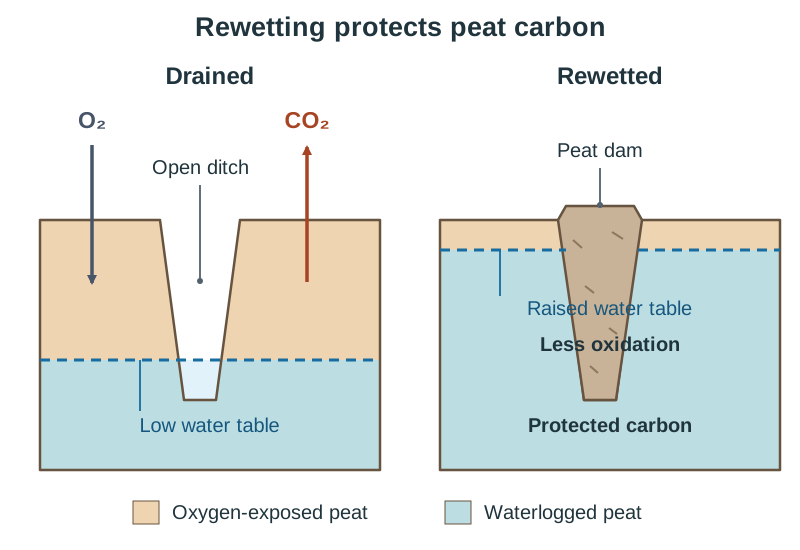
- Peatlands: Peat soils cover roughly 20% of Ireland's land surface. In an intact, waterlogged bog, low-oxygen (anaerobic) conditions stop dead Sphagnum mosses from decaying, locking carbon into peat layers over thousands of years. However, when bogs are drained for industrial turf harvesting or upland grazing, oxygen enters the profile, triggering aerobic bacterial breakdown that vents massive volumes of . Drained organic soils make Ireland's land-use sector a net carbon source. Rewetting bogs by blocking drainage ditches raises the water table, shutting off oxidation immediately and enabling moss recolonisation.
- Forest Ecosystems: Trees assimilate into woody biomass and root systems. Ireland's forest cover stands at roughly 11% to 12%, far below the European Union average of approximately 40%. Fast-growing exotic conifers like Sitka spruce absorb carbon rapidly over short commercial rotations, but soil disturbance and clear-felling release carbon back into the atmosphere. Establishing permanent native broadleaf woodlands (such as sessile oak, hazel, and birch) delivers long-term carbon storage and richer habitat structure.
- Soils: Farmland soils hold vast carbon stores in decomposing organic matter. Conventional deep inversion ploughing exposes this carbon to atmospheric oxygen, causing rapid oxidation. Regenerative agriculture practices (minimum tillage, multi-species cover crops, rotational mob grazing) draw root exudates deeper into the ground, raising soil organic carbon levels until soil reaches saturation equilibrium.
- Oceans and Coastal Systems: The open ocean is the planet's largest active carbon store, having absorbed roughly a quarter of all human emissions. It takes up carbon via physical solubility (cold polar waters dissolve and sink) and the biological carbon pump (microscopic phytoplankton photosynthesise in sunlit surface layers, die, and drift into the abyss as 'marine snow', burying carbon in deep sediments). However, ocean carbon uptake is declining as waters warm, and dissolved forms carbonic acid, driving ocean acidification that dissolves the calcium carbonate shells of molluscs and corals. Along coastlines, blue carbon habitats (saltmarshes and seagrass meadows) bury carbon in anoxic mud ten to thirty times faster per hectare than dry terrestrial forests, though their small global area limits their absolute planetary capacity.
Geological Carbon Storage (CCS)
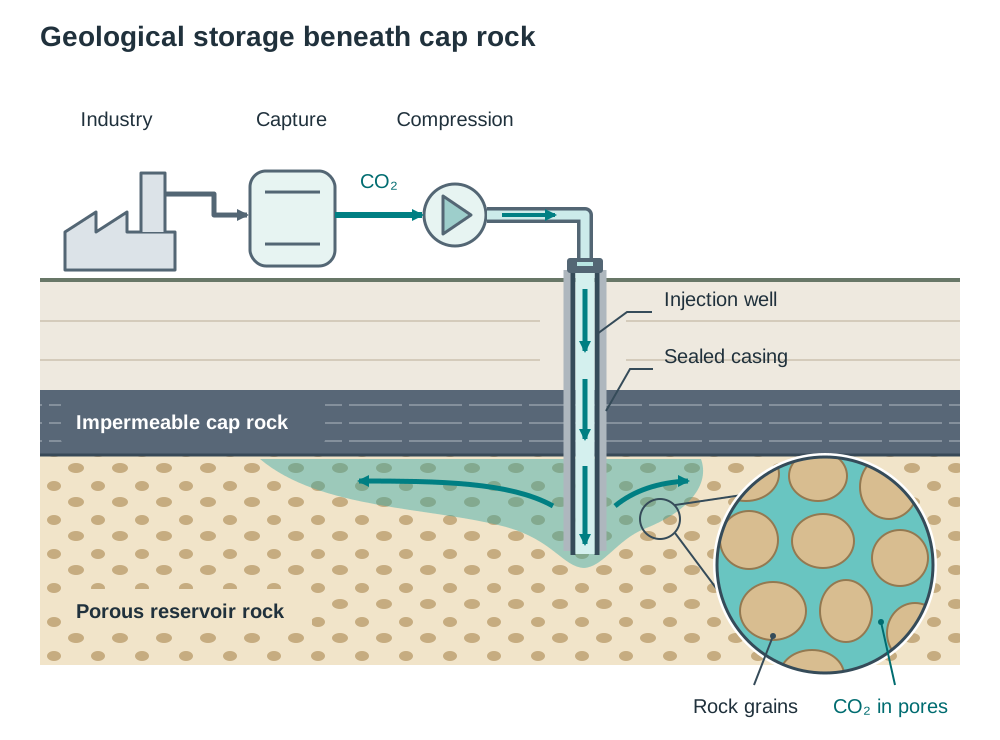
Geological Carbon Capture and Storage (CCS) is an engineered industrial process built for heavy manufacturing sectors where emissions are chemically unavoidable, such as the chemical release from limestone heating during clinker production in cement manufacturing (these are called hard-to-abate sectors):
- Capture: Post-combustion or chemical process gases pass through liquid amine solvents that selectively strip out .
- Compression: The separated is compressed under intense pressure into a dense supercritical fluid.
- Injection: The fluid is pumped thousands of metres underground into deep porous rock formations (such as permeable sandstones in depleted offshore gas fields or deep saline aquifers).
- Sealing: A thick, non-porous layer of impermeable cap rock (such as shale or evaporite salt) overlays the reservoir, stopping the buoyant, pressurised carbon dioxide from rising back to the surface or contaminating groundwater aquifers.
At the Sleipner field in the Norwegian North Sea, engineers strip directly from raw natural gas and inject approximately one million tonnes annually into the deep Utsira sandstone formation. While geological storage can securely store carbon for geological epochs, industrial CCS carries a steep energy penalty (consuming 15% to 25% of the industrial plant's gross energy output to run capture machinery) and involves massive capital expense.
Comparative Evaluation of Decarbonisation Solutions
Before reviewing the table, cover the last two columns and try to reproduce the permanence level and practical trade-offs from memory; those two columns are where 'discuss' and 'evaluate' marks are won.
| Solution Family | Operating Mechanism | Decarbonisation Impact | Economic & Capital Cost | Permanence Level | Key Practical Trade-offs |
|---|---|---|---|---|---|
| Renewable Electricity (Wind, Solar, Hydro) | Converts kinetic, radiant, or potential natural energy flows into electricity via turbines or semiconductor cells. | Direct avoidance: displaces fossil fuel combustion across power generation, electrified heating, and EVs. | High upfront installation cost; zero fuel expense and low ongoing operations. | Permanent avoidance for each kilowatt-hour produced without fuel combustion. | Intermittent weather dependency; requires grid-scale batteries, interconnectors, and grid expansion; local planning objections. |
| Shallow Geothermal & Heat Pumps | Uses electrically powered compressor circuits to concentrate low-grade thermal energy from soil or air into buildings. | Direct reduction: substitutes oil and gas boilers with high-efficiency heat delivery (3 to 4 units of heat per unit of power). | High initial capital cost for ground loops, equipment, and required building insulation. | Long-lasting operational emission cuts, provided building envelopes are kept airtight. | Performance drops sharply in uninsulated buildings; grid electricity must be clean; high upfront domestic installation cost. |
| Water Supply & Demand Efficiency | Fixes municipal pipe leaks, deploys low-flow fittings, and upgrades utility pumping stations. | Indirect reduction: saves grid power used in treatment and pumping, and cuts boiler fuel used to heat water. | High capital expense for digging and replacing buried mains; low cost for consumer water fittings. | Permanent structural energy savings while distribution pipes and meters are maintained. | Urban street excavation disrupts transport; high public investment required; changing household usage habits is slow. |
| Biological Sequestration (Peatlands, Forests, Oceans) | Uses photosynthesis to take in , accumulating carbon in wood, peat, soils, and ocean mud. | Emission cessation and slow removal: rewetted bogs stop venting carbon; expanding forests sequester carbon. | Low to moderate cost per hectare; low ongoing mechanical running costs. | Vulnerable to reversal: wildfires, drought, bark beetle pests, and land clearance release carbon back to the atmosphere. | Land competition with agricultural food production; slow annual accumulation rates; transient methane pulses after initial bog rewetting. |
| Geological CCS (Industrial Point-Source) | Strips from flue gases using chemical solvents, then pumps supercritical gas into deep porous rock beneath cap rocks. | Point-source capture: prevents up to 90% of unavoidable chemical emissions from heavy industrial chimneys. | Extremely high capital expenditure; high ongoing operations and solvent maintenance. | Highly permanent (thousands of years) provided underground cap rocks remain intact. | High energy penalty (15% to 25%); carries moral hazard risks by prolonging fossil fuel extraction; requires extensive transport pipelines. |
Key terms
- Decarbonisation
- The systematic reduction and elimination of greenhouse gas emissions across all sectors of an economy, moving towards net-zero.
- Net-Zero Emissions
- A condition in which remaining human-caused greenhouse gas emissions are completely balanced by verifiable removals from the atmosphere.
- Mitigation Hierarchy
- A prioritised framework for climate action: first avoid emissions, second reduce energy demand, third replace fossil fuels with clean energy, and fourth sequester residual emissions.
- Energy-Water Nexus
- The direct connection between water use and energy consumption, where treating, pumping, and heating water uses significant electricity and fossil fuel.
- Intermittency
- The variable and weather-dependent nature of renewable resources such as wind and solar, which do not generate power constantly.
- Pumped Storage
- A hydroelectric facility (such as Turlough Hill) that pumps water to an elevated reservoir during periods of low demand and releases it through turbines to generate electricity during peak demand.
- Carbon Store
- A natural or artificial reservoir that holds an accumulated quantity of carbon, such as a peat bog, woodland, or ocean sediment.
- Carbon Sink
- A system that absorbs more greenhouse gases from the atmosphere than it emits over a specific period.
- Carbon Source
- A degraded or burning ecosystem, or an industrial process, that releases more greenhouse gases into the atmosphere than it absorbs.
- Peatland Rewetting
- Raising the water table in drained bogs using peat dams to restore anaerobic conditions, stopping carbon oxidation and letting Sphagnum mosses regrow.
- Blue Carbon
- Carbon captured by coastal and marine ecosystems, such as saltmarshes, seagrass meadows, and mangrove forests, and buried in waterlogged, oxygen-poor mud.
- Geological Carbon Sequestration
- An industrial technology that captures carbon dioxide from point-source flue gases, compresses it, and injects it deep into porous rock formations beneath an impermeable cap rock.
- Porous Rock
- A geological formation, such as sandstone, that contains microscopic interconnected spaces capable of holding injected carbon dioxide.
- Cap Rock
- A dense, impermeable layer of rock (such as shale or mudstone) located above a porous reservoir that prevents injected carbon dioxide from rising to the surface.
- Energy Penalty
- The share of an industrial facility's total energy output consumed internally to operate carbon capture, solvent regeneration, and compression machinery.
- Nature-Based Solutions (NbS)
- Actions to protect, sustainably manage, and restore natural or modified ecosystems that address societal challenges while benefiting biodiversity and human wellbeing.
- Co-benefits
- Additional positive social, economic, or environmental outcomes produced by a climate action beyond direct emissions reduction, such as cleaner water or flood attenuation.
- Moral Hazard
- The risk that promising future technological solutions, such as carbon capture or speculative offsets, will be used as a justification to delay reducing fossil fuel emissions today.
- Protected Urea
- Nitrogen fertiliser treated with an active chemical inhibitor that slows its conversion to ammonia gas, lowering both nitrous oxide emissions and nitrate leaching while maintaining crop yields.
- Low-Emission Slurry Spreading (LESS)
- An agricultural technique that applies liquid animal manure directly to the soil surface beneath the grass canopy using trailing shoes or dribble bars, cutting atmospheric ammonia and nitrous oxide emissions compared to splash plates.
- Retrofit
- Upgrading an existing building's thermal envelope through external wall insulation, attic insulation, airtightness seals, and high-performance windows to cut space heating demand.
- Biological Carbon Pump
- The natural process where marine phytoplankton fix carbon dioxide at the sea surface through photosynthesis, and their organic remains sink into the deep ocean as marine snow.
Check yourself
What is the difference between climate change mitigation and climate change adaptation?
Mitigation tackles the causes of climate change by reducing greenhouse gas emissions or enhancing carbon sinks, whereas adaptation adjusts human and natural systems to manage and reduce the harm of climate impacts that are already occurring or unavoidable.
State the four stages of the mitigation hierarchy in order of priority.
1. Avoid emissions before they occur; 2. Reduce energy demand through efficiency; 3. Replace fossil fuels with renewable alternatives; 4. Sequester unavoidable residual emissions.
Which economic sector is the largest single contributor to Ireland's greenhouse gas emissions, and what are its two primary greenhouse gases?
Agriculture, which accounts for roughly 38% of national emissions in recent EPA reports; its two primary gases are biogenic methane (from ruminant enteric fermentation) and nitrous oxide (from synthetic nitrogen fertilisers and animal manure).
What is the primary operational difference between the Ardnacrusha and Turlough Hill hydroelectric facilities in Ireland?
Ardnacrusha generates electricity from river flow diverted through its turbines and cannot store energy, whereas Turlough Hill is a pumped-storage station that acts as a giant battery, using surplus electricity to pump water uphill and releasing it to generate at peak demand.
Explain the biochemical reason why a drained peat bog becomes a carbon source, whereas a waterlogged bog acts as a carbon sink.
In a waterlogged bog, low-oxygen (anaerobic) conditions stop dead plants from decomposing, locking carbon into peat. When drained, oxygen penetrates the dry peat, enabling aerobic bacteria to break down organic matter and release stored carbon as carbon dioxide gas.
What is meant by an 'energy penalty' in industrial Carbon Capture and Storage?
The proportion of an industrial facility's total energy output (typically 15% to 25%) consumed internally to run the solvent regeneration, capture, and compression equipment.
Why must deep home insulation and retrofitting be completed before installing a domestic heat pump?
Heat pumps produce heat at lower, steady flow temperatures; in an uninsulated, leaky house, heat escapes rapidly, forcing the heat pump to run inefficiently on backup electric immersion heaters, which raises running costs and electricity demand.