

This topic asks you to do four things: say where the Sustainable Development Goals (SDGs) came from, explain what they were designed to do differently, show how the goals pull on each other, and judge honestly how far the world has got with them. Adopted on 25 September 2015 by all 193 United Nations member states as part of Transforming our world: the 2030 Agenda for Sustainable Development, the 17 goals and 169 targets provide a shared blueprint for peace, human dignity, and environmental stability.
Historical Origins: From Brundtland and Rio to the 2030 Agenda
To understand the Sustainable Development Goals, you need to trace the evolution of international development policy across five decades.
Where the Idea Came From (1987)
Before there were any global goals, there was a core concept. In 1987, the UN World Commission on Environment and Development, chaired by former Norwegian Prime Minister Gro Harlem Brundtland, published Our Common Future (known as the Brundtland Report). It established the definition that remains the benchmark today:
Sustainable development is development that meets the needs of the present without compromising the ability of future generations to meet their own needs.
Two essential concepts are packed into that definition:
- Needs: in particular the essential needs of the world's poorest people, which must be given overriding priority.
- Limits: the limitations imposed by the state of technology and social organisation on the environment's ability to meet present and future needs.
The 1992 Rio Earth Summit
In 1992, the UN Conference on Environment and Development met in Rio de Janeiro. This Earth Summit turned the Brundtland principles into intergovernmental commitments, producing:
- Agenda 21: a comprehensive voluntary action plan to implement sustainable development globally, nationally, and locally (giving rise to local authority environmental plans in Ireland).
- The UN Framework Convention on Climate Change (UNFCCC): the treaty that later established annual Conferences of the Parties (COP), the Kyoto Protocol, and the Paris Agreement.
- The Convention on Biological Diversity (CBD): addressing global habitat loss and species decline.
The Millennium Development Goals (2000–2015)
In 2000, world leaders agreed the Millennium Development Goals (MDGs): eight anti-poverty goals, containing 21 targets, running to 2015. The MDGs halved global extreme poverty, expanded primary school enrolment, and made progress against malaria and tuberculosis. However, the MDG framework suffered from three major design flaws:
- A donor-recipient divide: drafted mainly by international technocrats, the MDGs treated poverty as an issue for low-income countries in the Global South that could be solved through external aid, rather than examining systemic global trade and economic inequalities.
- A narrow environmental view: MDG 7 (Ensure environmental sustainability) treated nature as an isolated sector with weak targets, separate from economic policies.
- Masked inequalities: progress was tracked using national aggregate averages, which hid persistent poverty among minority groups, rural communities, and women.
| Feature | Millennium Development Goals (MDGs: 2000–2015) | Sustainable Development Goals (SDGs: 2015–2030) |
|---|---|---|
| Scope | 8 goals, 21 targets | 17 goals, 169 targets |
| Geographic reach | Targeted low-income nations (Global South) | Universal: applies politically to all 193 UN member states, including high-income countries like Ireland (non-binding) |
| Core focus | Basic social assistance (poverty, primary schooling, disease) | Integrated social fairness, economic transformation, and planetary boundaries |
| Design process | Top-down formulation by UN technocrats | Global public consultations, Open Working Group, and member state negotiations |
Rio+20 to Adoption (2012–2015)
In 2012, twenty years after the first Earth Summit, the UN held the Conference on Sustainable Development in Rio de Janeiro, known as Rio+20. Its outcome document, The Future We Want, called for a single universal set of goals integrating poverty reduction with ecological boundaries. Between 2013 and 2014, an Open Working Group prepared the draft goals. Ireland played a central diplomatic role: Ireland's UN Ambassador, David Donoghue, alongside Kenya's Permanent Representative, Macharia Kamau, served as co-facilitators of the intergovernmental negotiations. On 25 September 2015, all 193 member states adopted the 2030 Agenda, coming into effect on 1 January 2016.
The Historical Chain to Recite: 1987 Brundtland Report (concept and definition) → 1992 Rio Earth Summit (Agenda 21 and UNFCCC) → 2000 MDGs (eight goals, Global South focus) → 2012 Rio+20 (decision to build successor framework) → 2013–2014 Open Working Group → 25 September 2015 Adoption → 1 January 2016 Entry into force.
Architecture of the 2030 Agenda: The 5 Ps and the Wedding Cake Model
The 2030 Agenda's preamble groups its ambitions under five themes, known as the 5 Ps. The UN does not officially allocate numbered goals to each P, but they are commonly organised as:
- People (Goals 1–5): Ending poverty and hunger, ensuring health, education, and gender equality.
- Planet (Goals 6, 12, 13, 14, and 15): Protecting freshwater, terrestrial ecosystems, oceans, and the climate.
- Prosperity (Goals 7–11): Ensuring thriving economic, technological, and social lives in harmony with nature.
- Peace (Goal 16): Fostering peaceful, just, and inclusive societies backed by accountable institutions.
- Partnership (Goal 17): Mobilising finance, technology, capacity building, and credible data.
You do not need to memorise all seventeen goals in numerical order. Use the list below as a reference guide, making sure you are familiar with the climate and ecological goals (Goals 6, 7, 11, 12, 13, 14, and 15).
| No. | Goal Title | Core Focus Area |
|---|---|---|
| 1 | No Poverty | Eradicate extreme poverty and provide social protection floors |
| 2 | Zero Hunger | End hunger, achieve food security, and promote sustainable agriculture |
| 3 | Good Health and Well-being | Ensure healthy lives and access to healthcare across all ages |
| 4 | Quality Education | Inclusive, equitable education and lifelong learning opportunities |
| 5 | Gender Equality | End discrimination, violence, and harmful practices against women and girls |
| 6 | Clean Water and Sanitation | Safe water access and sustainable freshwater ecosystem management |
| 7 | Affordable and Clean Energy | Universal access to reliable, sustainable, and modern renewable energy |
| 8 | Decent Work and Economic Growth | Inclusive economic growth, productive employment, and labour protection |
| 9 | Industry, Innovation and Infrastructure | Resilient infrastructure, sustainable industrialisation, and clean innovation |
| 10 | Reduced Inequalities | Reduce income and opportunity gaps within and between nations |
| 11 | Sustainable Cities and Communities | Safe, resilient, and sustainable human settlements and public transit |
| 12 | Responsible Consumption and Production | Efficient resource use, waste reduction, and sustainable supply chains |
| 13 | Climate Action | Urgent measures to combat climate change and manage its impacts |
| 14 | Life Below Water | Conserve and sustainably use oceans, seas, and marine resources |
| 15 | Life on Land | Protect, restore, and promote sustainable terrestrial ecosystems and forests |
| 16 | Peace, Justice and Strong Institutions | Peaceful societies, access to justice, and accountable institutions |
| 17 | Partnerships for the Goals | Global cooperation in finance, technology transfer, and reliable trade |
The Three Dimensions and the Wedding Cake Model
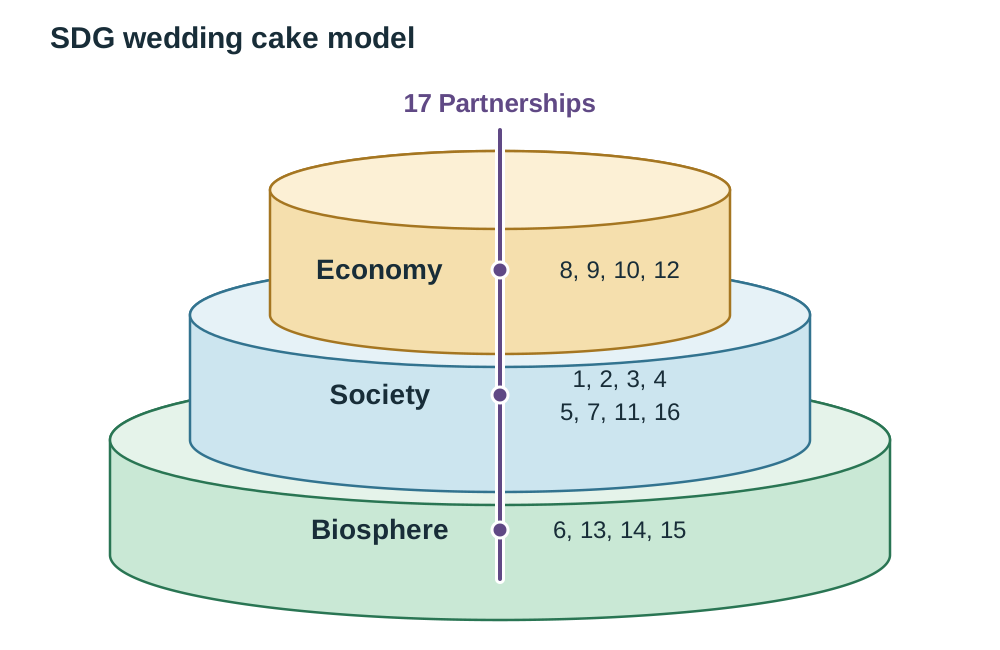
Sustainable development rests on three dimensions: social, economic, and environmental. The Stockholm Resilience Centre visually structured this through the wedding cake model, illustrating that the goals are hierarchical and indivisible:
- Biosphere (base tier): Goals 6, 13, 14, and 15. Safe climate, clean freshwater, healthy oceans, and thriving biodiversity form the non-negotiable ecological foundation.
- Society (middle tier): Goals 1, 2, 3, 4, 5, 7, 11, and 16. Human wellbeing, food security, and health sit directly on top of a stable biosphere.
- Economy (top tier): Goals 8, 9, 10, and 12. Economic activity and manufacturing sit inside society, serving human needs rather than expanding without limits.
- Goal 17 (Partnerships) acts as the central vertical axis connecting all three tiers.
This structure shows that the economy is a subsystem of society, which is wholly contained within the biosphere. If the bottom ecological tier collapses, the social and economic tiers cannot stand.
Core Operating Principles and Systemic Interconnectedness
Three principles run through the entire 2030 Agenda. If you can explain these, you can explain what the SDGs were designed to do differently from previous development plans.
1. Universality
Universality means the goals apply to every country, regardless of its income level. Developed nations like Ireland cannot treat development simply as an overseas aid programme. Ireland is expected to report on its domestic performance, including cutting its agricultural greenhouse gas emissions, reducing high material waste, and addressing housing and income inequality.
2. Leaving No One Behind (LNOB)
Leaving No One Behind is the moral commitment to reach the poorest and most vulnerable populations first. Progress cannot be measured by national averages alone. Fulfilling this requires disaggregated data: breaking statistics down by income, gender, age, disability, ethnicity, and geography to identify communities that standard figures conceal.
3. Indivisibility, Synergies, and Trade-offs
The 17 goals operate as an interconnected whole. Governments are not permitted to cherry-pick straightforward social goals while ignoring demanding ecological ones. Every policy action produces systemic ripples:
- A synergy occurs when advancing one goal accelerates progress on another. For instance, an extensive home retrofitting scheme improves energy efficiency under Goal 7, cuts domestic fuel costs to reduce poverty under Goal 1, lowers cold-related respiratory illness under Goal 3, and cuts household emissions under Goal 13.
- A trade-off occurs when progress on one target conflicts with or damages another. In Ireland, commercial agriculture provides rural jobs and export revenue (supporting Goal 8 and Goal 2). However, intensive livestock farming generates significant methane and nitrogen runoff, creating direct trade-offs with Goal 13 (Climate Action), Goal 6 (Clean Water), and Goal 15 (Life on Land).
Managing these frictions requires Policy Coherence for Sustainable Development (PCSD): ensuring that decisions made in agricultural or finance departments do not actively undermine national climate, water, and biodiversity commitments.
Measurement, Irish Governance, and the 2027 Action Project
To monitor progress objectively, the 2030 Agenda uses a three-part hierarchy:
- Goal: A broad global aim (e.g., Goal 13: Climate Action).
- Target: A specific, time-bound result within that goal (e.g., Target 13.2: Integrate climate change measures into national policies, strategies and planning).
- Indicator: A precise metric used to evaluate progress (e.g., Indicator 13.2.2: Total greenhouse gas emissions per year).
Across the framework there are 169 targets and 231 unique indicators. The indicators are defined by the UN Statistical Commission, ensuring tracking is grounded in empirical data rather than political rhetoric.
How the SDGs are Tracked in Ireland
- The Department of the Environment, Climate and Communications (DECC) leads and co-ordinates Ireland's SDG implementation across government departments, publishing a National Implementation Plan.
- The Central Statistics Office (CSO) maintains an online national reporting platform, publishing Ireland's performance against the global SDG indicators.
- Ireland reports its progress to the UN High-level Political Forum through Voluntary National Reviews (VNRs), which Ireland presented in 2018 and 2023.
Goal 13 and the Climate Treaties: Voluntary Goal vs Binding Law
Goal 13 is deliberately distinctive. The 2030 Agenda acknowledges that the UNFCCC is the primary forum for negotiating climate agreements. This creates an important distinction:
- SDG 13 is a political commitment. It contains no legal sanctions, relying entirely on voluntary reporting via VNRs.
- The Paris Agreement and Irish national law are legally binding. Under the Climate Action and Low Carbon Development (Amendment) Act 2021, Ireland is legally bound to reduce greenhouse gas emissions by 51% by 2030 (against 2018 levels) and achieve net-zero emissions by 2050, enforced through statutory five-year carbon budgets.
Bringing the SDGs into Your 2027 Action Project
The Action Project accounts for 40% (200 marks) of your Leaving Certificate grade, with the 2027 common brief focused on Reducing Ireland's Greenhouse Gas Emissions. The SDG framework provides an established vocabulary for two key parts of your project journal:
- Section A (Research to inform action, 30 marks): identify which goals your project addresses. A home retrofit or energy audit addresses Goal 7 and Goal 13; an active travel initiative addresses Goal 11 and Goal 13; a food waste project addresses Goal 12 and Goal 2.
- Section C (Reflection and evaluation, 60 marks): use synergies and trade-offs to evaluate your results. For example: My project encouraged active travel to support Goal 13, but under the principle of Leaving No One Behind, I had to consider that students with mobility impairments or long rural commutes cannot simply switch to cycling.
Remember to write the complete link: action taken → physical mechanism → named SDG advanced.
Progress, Systemic Critiques, and Post-2030 Horizons
UN progress assessments indicate that the world is severely off track. At the halfway point of the 2030 Agenda, only about 15% to 17% of targets are on course. Nearly half show weak progress, and over one-third have stalled or reversed.
Factors Stalling Progress
- Compounding Global Shocks: The Covid-19 pandemic disrupted schooling, strained healthcare, and pushed millions back into poverty. Geopolitical conflicts drove up food, fertiliser, and energy costs, setting back Goal 2.
- Accelerating Climate Impacts: Severe droughts, heatwaves, and flooding continue to destroy housing and agricultural land, falling hardest on vulnerable communities in the Global South.
- Finance Shortfalls: Wealthy countries delivered the promised 300 billion annually by 2035 was set, which low-income states noted falls far short of actual adaptation needs.
Fundamental Structural Critiques
- The Economic Growth Contradiction: Goal 8 calls for sustained annual GDP growth (including at least 7% growth in least-developed countries). Ecological economists argue that global GDP growth remains historically coupled with raw material extraction and carbon emissions. Promoting continuous economic expansion on a finite planet directly conflicts with planetary boundaries and the environmental aims of Goals 12, 13, 14, and 15.
- Lack of Enforcement Mechanisms: Because reporting via VNRs is voluntary, states face no fines or sanctions when they miss their targets, allowing governments to make public announcements without passing enforceable laws.
Looking Beyond 2030
In September 2024, UN member states adopted the Pact for the Future, reaffirming support for the 2030 Agenda while exploring post-2030 global governance. Key proposals for post-2030 development include:
- Planetary Boundaries as a Policy Baseline: Replacing separate environmental targets with firm biophysical limits (such as ocean acidification thresholds, freshwater depletion, and nitrogen cycles).
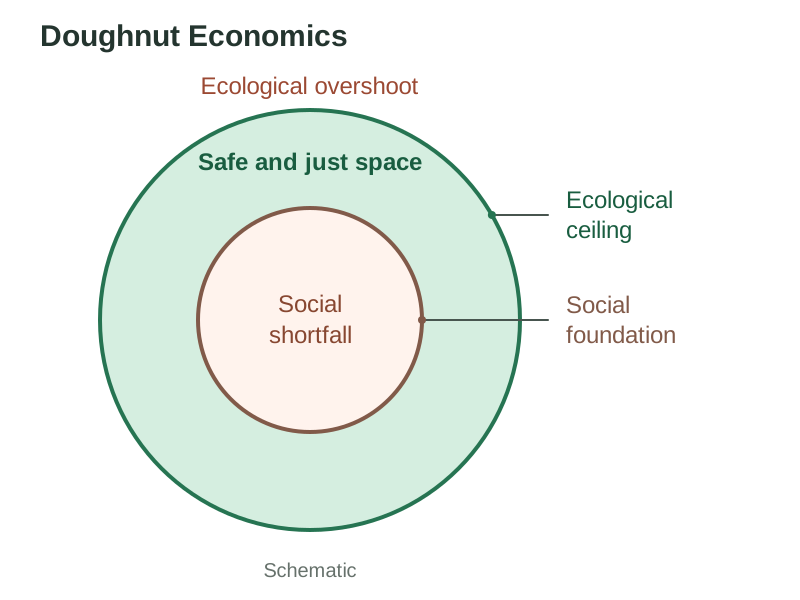
- Moving Beyond GDP: Adopting wellbeing and ecological indicators, such as Kate Raworth's Doughnut Economics framework, which seeks to meet human social foundations without exceeding ecological ceilings.
- Binding Climate Justice: Setting enforceable rules on multinational corporate supply chains, properly capitalising the Loss and Damage Fund (agreed at COP27 and operationalised at COP28 in 2023), and addressing historical ecological debts owed by high-emitting countries.
Key terms
- Sustainable Development
- Development that meets the needs of the present without compromising the ability of future generations to meet their own needs, first defined in the 1987 Brundtland Report.
- Brundtland Report
- The 1987 report ('Our Common Future') of the UN World Commission on Environment and Development that formally defined sustainable development around human needs and environmental limits.
- Sustainable Development Goals (SDGs)
- A collection of 17 interconnected global goals and 169 targets adopted by 193 UN member states in 2015 to eradicate poverty, protect the biosphere, and build shared prosperity by 2030.
- Millennium Development Goals (MDGs)
- The precursor framework of eight anti-poverty goals (2000–2015) targeting low-income countries in the Global South, which treated environmental sustainability as an isolated sector.
- Universality
- The principle that the SDGs apply politically to every country regardless of income, requiring domestic economic and environmental reform in high-income states like Ireland.
- Leaving No One Behind (LNOB)
- The core commitment of the 2030 Agenda to prioritise the most marginalised and vulnerable populations first, ensuring progress is not measured purely by aggregate national averages.
- Disaggregated Data
- Statistical data broken down by sub-categories such as income, gender, age, disability, and geographic region to identify inequalities masked by overall national figures.
- Synergy
- A mutually reinforcing interaction where policy action taken to advance one SDG target directly accelerates progress toward one or more other targets.
- Trade-off
- A policy conflict where action taken to achieve one SDG target creates negative social, economic, or environmental consequences for another target.
- Policy Coherence for Sustainable Development (PCSD)
- A governance approach that integrates economic, social, and environmental priorities across government departments to minimise trade-offs and maximise synergies.
- Voluntary National Review (VNR)
- A voluntary report presented by a UN member state to the High-level Political Forum detailing its domestic and international progress toward the SDGs.
- The 5 Ps
- The five broad themes set out in the 2030 Agenda preamble: People, Planet, Prosperity, Peace, and Partnership.
- Doughnut Economics
- An economic model created by Kate Raworth that balances a social foundation of basic human rights with an ecological ceiling of planetary boundaries.
- Loss and Damage Fund
- A UN fund agreed at COP27 and operationalised at COP28 to provide financial assistance to climate-vulnerable developing nations facing irreversible climate impacts.
Check yourself
State the Brundtland definition of sustainable development and the year and report in which it appeared.
Sustainable development is development that meets the needs of the present without compromising the ability of future generations to meet their own needs. It appeared in Our Common Future, the 1987 Brundtland Report of the World Commission on Environment and Development.
Why was the 2012 UN conference in Rio de Janeiro called 'Rio+20'?
It marked twenty years since the 1992 Rio Earth Summit (the UN Conference on Environment and Development) and was held in the same city.
Name Ireland's diplomat who co-facilitated the final intergovernmental negotiations for the SDGs, and name the country that co-facilitated alongside Ireland.
Ambassador David Donoghue co-facilitated the negotiations alongside Ambassador Macharia Kamau of Kenya.
List the '5 Ps' that frame the ambitions of the 2030 Agenda.
People, Planet, Prosperity, Peace, and Partnership.
Distinguish between a Goal, a Target, and an Indicator in the SDG framework, giving an example of each from clean energy.
A Goal is a broad global ambition (Goal 7: Affordable and Clean Energy); a Target is a specific, time-bound outcome within that goal (Target 7.2: Increase substantially the share of renewable energy in the global energy mix by 2030); an Indicator is a statistical metric used to measure progress (Indicator 7.2.1: Renewable energy share in total final energy consumption).
What is the primary structural critique made by ecological economists against Goal 8?
Goal 8 promotes sustained GDP growth, which historically remains coupled with resource consumption and greenhouse gas emissions, creating a direct conflict with ecological boundaries and the environmental aims of Goals 12, 13, 14, and 15.
Which Irish government department leads national SDG implementation, and which body publishes Ireland's indicator data?
The Department of the Environment, Climate and Communications (DECC) leads national implementation, and the Central Statistics Office (CSO) publishes the indicator data.
In the Stockholm Resilience Centre 'wedding cake' model, which four SDGs form the biosphere foundation at the base?
Goal 6 (Clean Water and Sanitation), Goal 13 (Climate Action), Goal 14 (Life Below Water), and Goal 15 (Life on Land).