

Economic systems determine how a society extracts resources, produces goods, distributes wealth, and treats the biosphere. Since the mid-twentieth century, mainstream economic policy has treated Gross Domestic Product (GDP) growth as the primary indicator of national progress, frequently ignoring natural resource depletion and environmental degradation. Under Strand 3 (Learning Outcome 3.1) of the Leaving Certificate Climate Action and Sustainable Development specification, you must outline five specific economic approaches to sustainable development: capitalism, degrowth, the bioeconomy, doughnut economics, and the circular economy. For Higher Level, you need to understand their core theoretical assumptions, evaluate at least one positive and one negative aspect of each against social and environmental benchmarks, and assess their practical feasibility using both Irish and international real-world evidence.
Core Definitions: Sustainable Development, GDP, and Decoupling
The core memory summary
If you need the quick bird's-eye view for revision, keep these five core stances in mind:
- Capitalism: private ownership and profit; economic growth is the central goal.
- Degrowth: high-income countries deliberately shrink material and energy throughput.
- Bioeconomy: swap fossil inputs for renewable biological feedstocks.
- Doughnut economics: meet everyone's fundamental needs without overshooting planetary boundaries.
- Circular economy: design out waste and keep materials looping at high value.
What sustainable development means
Before judging any economic model, you need the yardstick you are judging it against. The standard definition, from the UN Brundtland Report (Our Common Future, 1987), is:
Development that meets the needs of the present without compromising the ability of future generations to meet their own needs.
Sustainable development balances three interconnected dimensions:
- Environmental: staying within what natural ecosystems and the climate can absorb and regenerate.
- Social: meeting basic human needs fairly and upholding human rights across generations.
- Economic: distributing work, income, and goods efficiently and equitably.
A reliable technique in exam questions: when you evaluate a positive or negative aspect of a model, state which dimension it affects. For instance, the bioeconomy scores well environmentally by replacing fossil carbon, but it can score poorly socially if it drives up staple food prices for low-income households.
GDP and the decoupling debate
Gross Domestic Product (GDP) is the total market value of all finished goods and services produced within a country in a year. It measures market throughput, not human wellbeing or planetary health. An oil spill or post-storm reconstruction increases GDP through cleanup spending, while clean air and unpaid community care do not register at all.
Historically, industrial societies operated on a linear take-make-dispose trajectory. The central debate in sustainability is whether continuous GDP growth can be decoupled from environmental destruction. Decoupling means growing economic output without a matching growth in resource extraction or emissions. Higher Level students must distinguish between two forms:
- Relative decoupling: resource use or emissions continue to rise, but at a slower rate than GDP. Each euro of output is cleaner, but overall environmental destruction still increases. This occurs routinely with energy-efficiency upgrades.
- Absolute decoupling: GDP rises while total resource extraction or greenhouse gas emissions actively fall. While territorial carbon emissions have fallen in some developed countries (including Ireland in recent years) while GDP rose, absolute global decoupling of total material use has not occurred at the pace required by climate science.
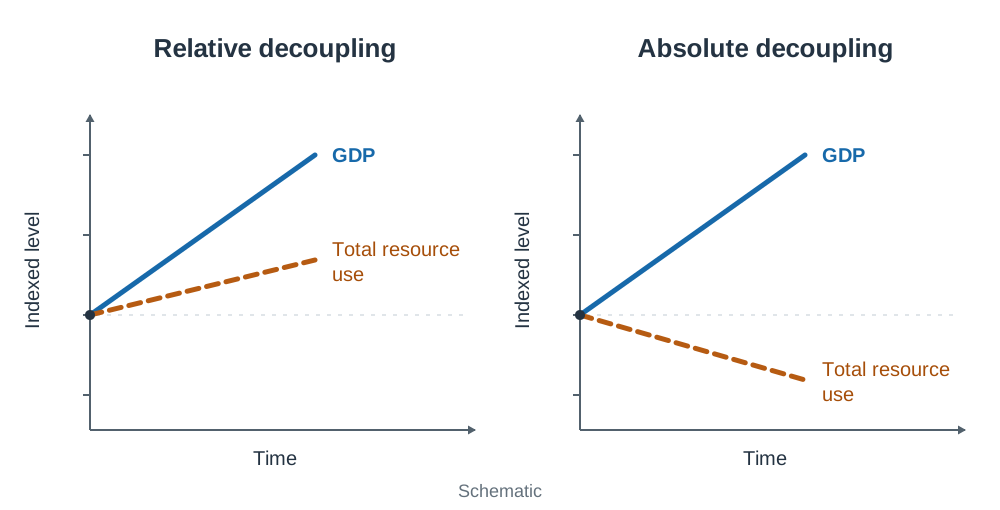
The course models divide into three broad growth stances:
- Pro-growth models: capitalism, the bioeconomy, and the circular economy assume output can continue expanding if markets innovate, biological feedstocks replace petrochemicals, or technical loops are closed.
- Growth-agnostic models: doughnut economics treats GDP as beside the point. It focuses strictly on meeting human needs within ecological boundaries; whether GDP happens to rise or fall is not the test of success.
- Post-growth models: degrowth argues that affluent nations must deliberately downscale overall energy and resource throughput because absolute global decoupling is physically unachievable in time.
Capitalism: Market Innovation and Externalised Costs
Capitalism is the prevailing economic system in Ireland and across the global economy. It is built around private ownership of property and business, wage labour, voluntary exchange in competitive markets, and the reinvestment of capital to generate profit. Contemporary capitalist states operate as mixed economies, combining private enterprise with public infrastructure, social welfare, and statutory regulation.
Positive aspect: market innovation and capital deployment
Competitive markets give private companies strong financial incentives to develop cost-effective, high-efficiency technologies. When price signals change or government legislation alters the market, private enterprise can scale solutions rapidly. Over the past decade, private manufacturing scale and competitive investment drove down the unit cost of solar photovoltaic panels and lithium-ion batteries by approximately 90%, accelerating renewable energy deployment faster than centralised state planning alone managed.
Negative aspect: externalised costs and overconsumption
Capitalism depends on continuous, compounding growth — the economy expanding by a percentage each year, so the absolute amount of physical production keeps growing — and on rising sales volumes. This dynamic encourages overconsumption and planned obsolescence, where products are deliberately designed with artificially short lifespans or restricted repairability so customers must buy replacements.
Crucially, market prices omit environmental damage. A negative externality occurs when commercial activity imposes ecological or public health damage on society without the polluter paying for it. For decades, fossil fuel companies extracted oil, gas, and coal for private profit while leaving society and vulnerable communities in the Global South to bear the catastrophic costs of storms, heatwaves, and rising sea levels.
Real-world evidence: pricing the externality through carbon taxes
The standard capitalist policy response to a negative externality is to place a price on the damage so it registers in the market price of the good. Ireland implements this through the carbon tax on fossil fuels (petrol, diesel, gas, and heating oil), set on a statutory rising path towards €100 per tonne of CO₂ by 2030.
- How it works as a positive: it uses price signals to redirect behaviour without central rationing; businesses and households choose their own most economical way to cut fuel use.
- The limitation: a flat carbon tax is regressive. Low-income and rural households spend a higher proportion of their income on home heating and car transport and often have fewer public transport alternatives. To prevent inequality, the state must give the tax revenue back by ring-fencing funds for targeted social protection (such as the fuel allowance) and free home-energy retrofits.
Degrowth: Planned Downscaling for Wellbeing
Associated with ecological economists such as Serge Latouche and Jason Hickel, degrowth rejects the premise that infinite economic growth can continue on a finite planet. It proposes a planned, democratic, and equitable downscaling of energy and material throughput in high-income nations to bring human activity back within planetary limits, eliminate poverty, and narrow global inequality.
Degrowth is fundamentally different from an economic recession:
- An economic recession is an unplanned, chaotic collapse inside a system built on growth. Businesses fail, unemployment spikes, and governments slash public services.
- Degrowth is a planned, democratic reduction of ecologically destructive and socially unnecessary industries (such as private aviation, fast fashion, weapons manufacturing, and industrial livestock), while deliberately protecting and expanding public healthcare, education, clean transit, and the care economy.
Positive aspect: direct reduction of ecological pressure
By cutting absolute extraction and manufacturing directly, degrowth addresses the root driver of ecological breakdown rather than waiting for speculative technologies. Moving past GDP enables societies to focus on genuine quality of life: shorter working weeks reduce burnout and commuting emissions, while community wealth building fosters local resilience. Internationally, rich countries reducing their excessive resource consumption frees up ecological space and raw materials for developing nations to build basic infrastructure.
Negative aspect: political resistance and fiscal dependency
Modern democratic welfare systems, pensions, healthcare budgets, and sovereign debt repayments depend structurally on tax revenues generated by expanding GDP. A government proposing to deliberately reduce national economic output faces intense electoral opposition. Furthermore, if a country acts alone without international agreements, it risks capital flight — investors and businesses moving capital abroad to growing economies, weakening the national currency and raising government borrowing costs.
Real-world evidence
Practical policies aligned with degrowth include trials of a four-day working week without loss of pay (tested in Ireland, the UK, and Spain), which reduces transport emissions and redistributes working hours. Another policy is curbing high-consumption advertising: in 2021, Amsterdam became the first city to ban fossil-fuel and aviation adverts across its public transit metro system, and The Hague went further in 2024 by banning fossil-fuel and airline advertising city-wide.
Bioeconomy: Renewable Biological Feedstocks
The bioeconomy replaces fossil-based raw materials, synthetic fertilisers, and petrochemicals with renewable biological resources from land, forests, and aquatic ecosystems. It processes farm crops, agricultural manures, forestry residues, algae, and organic municipal waste to produce food, biochemicals, bioplastics, construction timber, and bioenergy.
Positive aspect: fossil substitution and biogenic cycling
The bioeconomy relies on biogenic carbon (carbon captured from the atmosphere by living plants through photosynthesis) instead of unearthing fossil carbon locked underground for millions of years. Using sustainably harvested timber in multi-storey construction locks carbon into buildings for decades while displacing carbon-intensive concrete and steel. For rural and coastal communities, biorefineries create local employment by turning low-value agricultural slurry and forestry trimmings into valuable biomethane and green chemicals.
Negative aspect: land competition and indirect land-use change
The physical boundary of the bioeconomy is land and freshwater availability. Dedicating arable soil to biofuel crops or bio-based packaging triggers the food versus fuel conflict, pushing up food crop prices and harming lower-income households. It can also cause indirect land-use change (ILUC): when prime agricultural land is converted to energy crops, food production is displaced elsewhere, incentivising the clearing of biodiverse tropical forests or drained peatlands to establish replacement cropland.
Real-world evidence: agricultural anaerobic digestion in Ireland
In Ireland, agricultural anaerobic digestion is a central bioeconomy measure. Farm slurry, organic food waste, and grass silage are placed into sealed bioreactors, where microbes digest the matter without oxygen to produce biogas (roughly 60% methane and 40% carbon dioxide). The biogas is then upgraded — scrubbing out carbon dioxide and trace impurities — to produce biomethane, which is chemically almost identical to fossil gas and can be injected into the national gas grid. The remaining nutrient-rich digestate replaces fossil-fuel-derived synthetic fertilisers. However, if digester numbers expand too quickly, farmers may convert land from food production into intensive silage monocultures, illustrating the resource boundary.
Doughnut Economics: Thriving in the Safe and Just Space
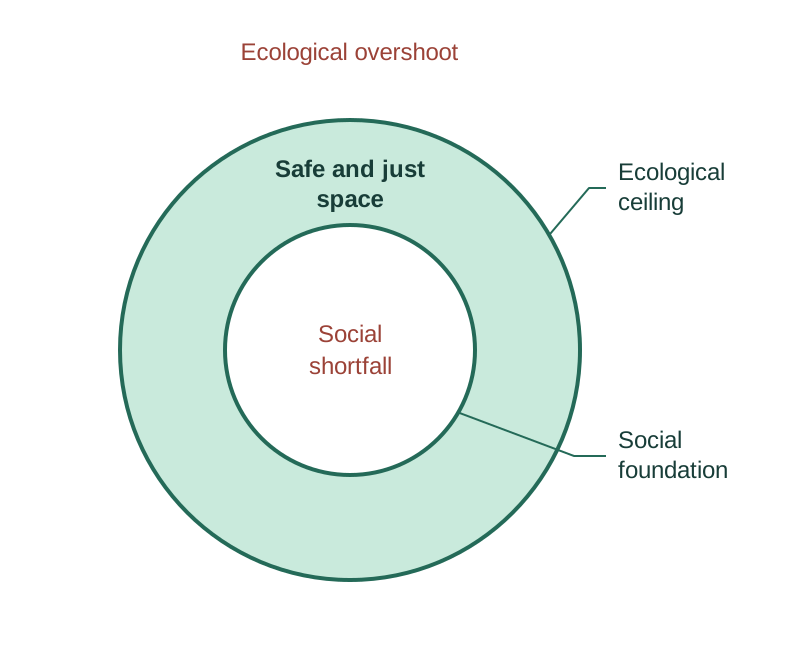
Formulated by British economist Kate Raworth, doughnut economics is an overarching visual compass designed to steer economic policy in the twenty-first century. It rejects GDP growth as an end in itself, focusing instead on dynamic balance between human rights and planetary survival. The model consists of two concentric rings:
- The Inner Ring (The Social Foundation): derived from the minimum human standards set out in the United Nations Sustainable Development Goals (SDGs). It contains dimensions of human wellbeing, such as nutritious food, clean water, adequate housing, healthcare, education, gender equality, clean energy, and political voice. Falling short of this ring leaves people in deprivation and poverty.
- The Outer Ring (The Ecological Ceiling): defined by the nine critical planetary boundaries established by Earth system scientists, including climate change, ocean acidification, chemical pollution, land-system change, and freshwater use. Breaching this outer boundary triggers irreversible ecological tipping points.
The space between the two rings represents the environmentally safe and socially just space for humanity. An economy succeeds when every citizen enjoys life above the social foundation without society overshooting the ecological ceiling.
Positive aspect: systemic, balanced policy design
The framework unifies social equity and environmental limits into one visual tool. It prevents governments from pursuing climate actions that worsen poverty (such as uncompensated fuel taxes), or pursuing short-term social welfare by liquidating natural ecosystems.
Negative aspect: operational and metric complexity
Doughnut economics functions as a compass rather than an off-the-shelf statutory blueprint. Translating global planetary boundaries into municipal planning laws is technically complex, and local governments often lack legal power over the multinational corporate supply chains supplying goods to their communities.
Real-world evidence: Amsterdam's circular recovery
In April 2020, Amsterdam became the first city to formally adopt the Doughnut framework to guide its post-pandemic recovery. Working with Raworth's team, the city set a target to halve its consumption of virgin raw materials by 2030 and achieve full circularity by 2050. In practice, this meant writing circular and bio-based material requirements into municipal construction tenders, and evaluating housing policy directly against social-foundation needs rather than commercial market output.
Circular Economy: Closing Material Loops
A circular economy decouples economic prosperity from the extraction of finite virgin resources. It transitions industry away from the linear take-make-dispose pattern towards restorative cycles based on three principles:
- Designing out waste and pollution before products are manufactured.
- Keeping materials and products circulating at their highest utility and value.
- Regenerating natural living systems.
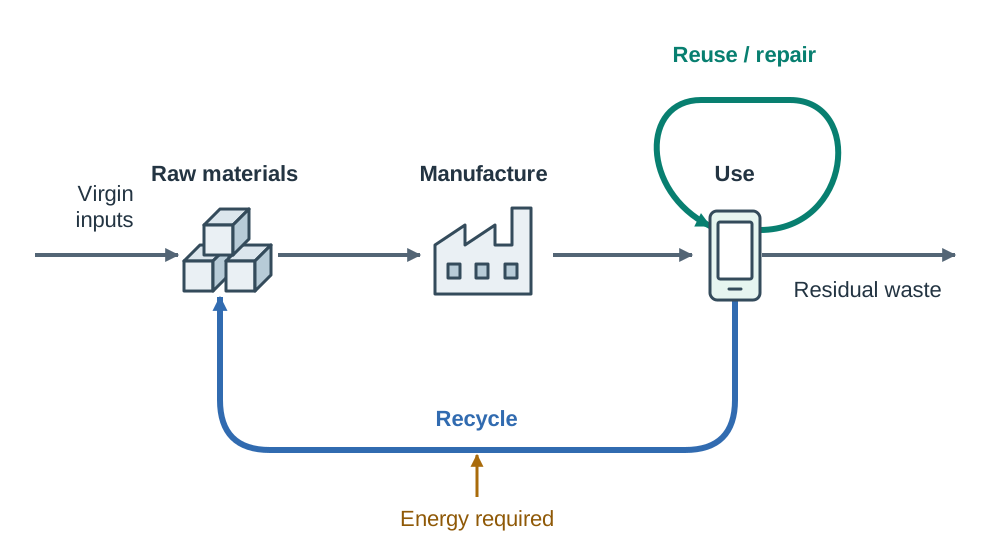
The circular retention hierarchy
Rather than treating all waste management as equal, circularity prioritises a clear hierarchy. Upstream loops preserve the most embodied energy, labour, and economic value:
- Refuse / rethink: eliminate unnecessary items entirely.
- Reduce: minimise raw material use per product.
- Reuse: pass clean, intact products to new users.
- Repair: service and fix broken components to prolong lifespan.
- Refurbish / remanufacture: rebuild products to original factory standards.
- Recycle: mechanically or chemically break materials down to make new items (lowest circular loop: consumes energy and degrades material).
- Recover: incinerate unrecyclable waste to recover energy (last resort before landfill).
Positive aspect: virgin resource conservation and local skilled jobs
Repairing, refurbishing, and leasing products cuts mining and virgin material processing, lowering industrial emissions and landfill waste. Shifting from rapid product turnover to maintenance services creates skilled local jobs (in electronics repair, precision fabrication, and reverse logistics) that cannot be offshored.
Negative aspect: downcycling, energy demands, and rebound effects
Recycling is constrained by thermodynamics. Processing materials requires significant energy, and materials like plastics and paper degrade structurally during processing — a process known as downcycling — meaning virgin material must continually be introduced.
Furthermore, circular initiatives are vulnerable to the rebound effect: if circular efficiency makes products cheaper to purchase and run, consumers use them more frequently, or spend saved money on other carbon-intensive goods. In the extreme scenario, where total consumption ends up higher than before the efficiency gain, it is known as Jevons paradox.
Real-world evidence: Irish legislation and EU directives
Ireland's Circular Economy and Miscellaneous Provisions Act 2022 put the national Circular Economy Strategy on a statutory footing, established a Circular Economy Fund, and empowered the Minister to introduce environmental levies on single-use items (such as disposable coffee cups). In February 2024, Ireland introduced its nationwide Re-turn deposit return scheme for PET plastic drinks bottles and aluminium and steel cans (150ml to 3 litres; glass is excluded), separating material streams to achieve food-grade closed loops.
At EU level, the Circular Economy Action Plan (2020) set the policy direction, which was made binding by the EU Right to Repair Directive (2024) and the Ecodesign for Sustainable Products Regulation (2024). These require manufacturers to repair goods like washing machines and smartphones at reasonable prices and supply spare parts and schematics.
Model short answer: outline style
Question: Outline the circular economy as an economic approach to sustainable development, including one positive and one negative aspect.
A circular economy is an economic framework that eliminates waste by keeping products, components, and materials circulating at their highest value for as long as possible, replacing the linear take-make-dispose model. It designs out pollution at the blueprint stage and regenerates natural systems.
Positive: it reduces the need for virgin raw materials, cutting ecological damage from mining and landfill accumulation while generating skilled local repair jobs.
Negative: recycling processes are energy-intensive and subject to downcycling, where material quality degrades with successive cycles. Efficiency savings can also be eroded by the rebound effect if cheaper goods drive higher consumption.
Example: Ireland's Re-turn deposit return scheme (launched 2024) recovers PET plastic bottles and aluminium and steel cans in a clean, separated stream suitable for food-grade recycling.
Comparative Synthesis and Evaluative Toolkit
In longer questions that ask you to compare approaches, do not review each model in isolation. Group them by their underlying mechanisms: the bioeconomy and circular economy change how goods are produced; degrowth changes how much society produces; doughnut economics redefines what human societies aim for; and capitalism is the baseline market system that the other frameworks seek to reform, balance, or replace.
| Economic Model | Primary Objective | Stance on Economic Growth | Core Positive Aspect | Critical Negative Aspect | Named Real-World Application |
|---|---|---|---|---|---|
| Capitalism | Private profit generation and market resource allocation | Growth is essential; market price signals spur efficiency | Competition drives clean technology cost drops (solar PV, batteries) | Negative externalities and carbon emissions are unpriced by default | Ireland's carbon tax escalating to €100/tonne by 2030; solar feed-in tariffs |
| Degrowth | Equitable human wellbeing within ecological limits | Growth in rich nations must be deliberately scaled down | Directly halts resource depletion; addresses global inequality | Politically difficult; threatens growth-dependent state welfare budgets | Four-day working week trials; Amsterdam and The Hague fossil advertising bans |
| Bioeconomy | Replacing fossil inputs with renewable biological feedstocks | Compatible with growth through input substitution | Displaces petroleum feedstocks; regenerates rural incomes | Food vs fuel competition; indirect land-use change (ILUC) | Agricultural anaerobic digestion for biomethane in Ireland; timber construction |
| Doughnut Economics | Meeting human rights without overshooting Earth systems | Growth-agnostic: economies should thrive, not just grow | Integrates social justice and planetary science into one tool | Complex to translate global ecological boundaries to local municipal law | Amsterdam City Doughnut post-pandemic recovery plan (2020) |
| Circular Economy | Eliminating waste by keeping resources in closed loops | Compatible with growth via resource decoupling | Cuts virgin mining; creates local repair and remanufacturing jobs | Downcycling limits; energy-intensive recycling; rebound effects | Ireland's Re-turn scheme (2024); EU Right to Repair Directive (2024) |
The four critical evaluative tests
When examining policy proposals at Higher Level, evaluate them using these four tests, leading with concrete evidence:
- Lead with the impact shift: An electric vehicle eliminates tailpipe emissions, but its manufacturing requires intensive cobalt and lithium extraction, causing water contamination and habitat damage in mining regions. The test: Does the policy reduce total environmental pressure, or simply shift it from the atmosphere to land and water?
- Lead with the social balance: A flat fuel tax without rebates forces low-income rural drivers to pay a larger share of their income for essential heating and commuting. The test: Who gains, and who bears the economic and social cost? Genuine climate action requires giving tax revenues back through retrofitting grants and welfare increases.
- Lead with public feasibility: Deposit return schemes for cans and bottles are adopted easily because they integrate smoothly into existing retail shops, whereas degrowth policies proposing lower consumption face intense public resistance. The test: Is the approach politically, culturally, and economically feasible under current democratic systems?
- Lead with the systemic reality: A fashion retailer selling a small product line made from 20% ocean plastic while manufacturing millions of disposable polyester garments each week is using marketing to disguise its footprint. The test: Is the proposal genuinely transformative, or vulnerable to greenwashing?
Note for coursework: The circular economy and bioeconomy examples here are also useful background for the Action Project, where you must demonstrate that your chosen action tackles a root cause of emissions.
Key terms
- Sustainable Development
- Development that meets the needs of the present without compromising the ability of future generations to meet their own needs, balancing environmental, social, and economic dimensions.
- Gross Domestic Product (GDP)
- The total monetary value of all finished goods and services produced within a country in a year; it measures market transactions rather than human wellbeing or environmental health.
- Decoupling
- Separating economic growth from environmental harm; relative decoupling means impacts grow slower than GDP, whereas absolute decoupling means impacts fall while GDP rises.
- Capitalism
- An economic system based on private ownership of productive assets, wage labour, competitive markets, and the continuous pursuit of profit and capital accumulation.
- Degrowth
- An ecological economic framework advocating a planned, democratic downscaling of material and energy throughput in wealthy nations to restore ecological balance and advance equity.
- Bioeconomy
- An economic approach that uses renewable biological resources from land, forests, and aquatic ecosystems to produce food, materials, chemicals, and energy, replacing fossil feedstocks.
- Doughnut Economics
- A visual framework developed by Kate Raworth that balances human rights (the social foundation) against planetary boundaries (the ecological ceiling) to define a safe and just operating space.
- Circular Economy
- An industrial model that replaces the linear take-make-dispose system by designing out waste and keeping materials, components, and products in use at high value for as long as possible.
- Negative Externality
- A harmful environmental or social side-effect generated by commercial activity that is not reflected in the market price of the good, such as greenhouse gas emissions.
- Planned Obsolescence
- A manufacturing strategy where products are deliberately designed with short operational lifespans or restricted repair options to compel consumers to purchase new models.
- Biogenic Carbon
- Carbon captured directly from the atmosphere by living organisms (such as plants and trees) via photosynthesis, forming part of the active biological carbon cycle.
- Food versus Fuel
- The dilemma arising when agricultural land, freshwater, and fertilisers are diverted away from growing food for humans to cultivate energy crops for biofuels and bioplastics, inflating food prices.
- Indirect Land-Use Change (ILUC)
- The unintended clearing of carbon-rich forests or grasslands to grow food elsewhere because existing agricultural fields were converted to bioenergy or bioeconomy crops.
- Social Foundation
- The inner ring of Doughnut Economics, based on the UN Sustainable Development Goals, below which lies critical human deprivation in food, housing, healthcare, education, and equality.
- Ecological Ceiling
- The outer ring of Doughnut Economics, defined by Earth system planetary boundaries, beyond which human activity triggers dangerous, irreversible environmental collapse.
- Downcycling
- A recycling process in which recovered materials suffer physical or chemical degradation, resulting in materials of lower quality and utility than the original product.
- Rebound Effect
- The reduction in expected environmental gains from energy-efficient or circular technology because reduced operating costs lead consumers to use the product more or buy other goods.
- Jevons Paradox
- The extreme form of the rebound effect, where increased efficiency in using a resource leads to an overall increase, rather than a decrease, in total consumption of that resource.
- Greenwashing
- The deceptive practice of misleading consumers or the public regarding the environmental practices of an organisation or the genuine ecological benefits of a commercial product.
Check yourself
What are the five economic approaches to sustainable development specified in Strand 3 of the syllabus?
Capitalism, degrowth, the bioeconomy, doughnut economics, and the circular economy.
What is the difference between relative decoupling and absolute decoupling?
Relative decoupling occurs when resource use or emissions grow more slowly than GDP. Absolute decoupling occurs when GDP rises while total resource use or emissions fall in real terms.
How does Ireland's carbon tax use market principles to address a negative externality, and why must its revenue be recycled?
It adds a rising price to fossil fuels to reflect environmental damage, motivating consumers and firms to reduce fuel use. Because a flat fuel tax is regressive, taking a larger share of income from lower-income and rural households, revenue must be given back through social welfare increases and free home retrofits.
Explain the 'food versus fuel' conflict within the bioeconomy.
It is the competition for fertile soil, freshwater, and fertiliser between growing food for human consumption and growing crops for biofuels or bioplastics, which can inflate staple food prices.
In Doughnut Economics, what do the inner ring and the outer ring represent?
The inner ring represents the Social Foundation (essential human needs based on the UN SDGs), and the outer ring represents the Ecological Ceiling (planetary boundaries protecting Earth's climate and ecosystems).
Why is product repair ranked higher than material recycling in the circular economy hierarchy?
Repair preserves the product's physical structure, high economic value, and embodied energy, whereas mechanical or chemical recycling consumes significant energy and degrades material quality (downcycling).
Which economic approach does each of the following policies best illustrate? (a) A supermarket chain leases refrigeration equipment from a manufacturer who maintains and reclaims it. (b) A city measures its progress by tracking local air quality, housing access, and biodiversity rather than commercial turnover. (c) A brewery sells spent barley grain to a food manufacturer to make protein flour.
(a) Circular economy (product-as-a-service keeps assets in the manufacturer's closed loop); (b) Doughnut economics (growth-agnostic, balancing a social foundation against ecological health); (c) Bioeconomy (organic food-processing residue becomes a valuable biological feedstock).