

Here is the whole topic in one idea. At UN summits, countries promise to cut the gases that heat the planet. The European Union turns those promises into laws that bind its member states. Ireland then turns EU law into its own Act, into five-year limits on total emissions, and finally into a separate limit for each part of the economy. Each step down the ladder makes the promise more specific and harder to avoid, and that is exactly what this topic asks you to trace. Under the United Nations Framework Convention on Climate Change (UNFCCC) and the 2015 Paris Agreement, global treaties require developed countries to lead in cutting emissions. These international commitments enter Irish law through European Union regulations and become binding domestic obligations under the Climate Action and Low Carbon Development (Amendment) Act 2021. Ireland is legally bound to pursue and achieve a climate-neutral economy no later than the end of 2050 (the National Climate Objective, often called 'net zero' in the media), with an interim statutory target of a 51% reduction in total greenhouse gas emissions by 2030 compared with 2018 levels. Delivering these commitments requires five-year carbon budgets, statutory Sectoral Emissions Ceilings across farming, power generation, transport, buildings, and industry, as well as grant contributions to international climate finance for the Global South.
The Global Framework: UNFCCC, Kyoto, and the Paris Agreement
Global climate governance began formally in 1992 with the United Nations Framework Convention on Climate Change (UNFCCC). The convention introduced the foundational principle of Common but Differentiated Responsibilities and Respective Capabilities (CBDR-RC). This principle recognises that while every country must act, wealthier industrialised nations carry greater historical responsibility for cumulative greenhouse gas emissions and have more economic resources to deploy solutions.
Annual negotiating summits known as the Conference of the Parties (COP) convert these principles into practical rules:
- The Kyoto Protocol (1997): Established the first legally binding emission limits exclusively for developed countries. Under EU burden-sharing, Ireland agreed to limit emissions growth to 13% above 1990 levels between 2008 and 2012. Irish emissions rose steeply during the Celtic Tiger years, well above the path needed to stay within that limit. Ireland did ultimately comply with its Kyoto commitment for 2008–2012, but only with the help of the emissions collapse after the 2008 economic crash, forestry removals, and state purchases of international credits, not because domestic policy had systematically cut emissions. The lesson is that a target with no detailed domestic plan behind it does not, on its own, cut emissions.
- The Paris Agreement (2015): Replaced top-down quotas with a universal, hybrid model agreed at COP21. Its overarching goal is holding the increase in global average temperature to well below 2°C above pre-industrial levels, while pursuing active efforts to limit the increase to 1.5°C. Signatories submit Nationally Determined Contributions (NDCs) detailing domestic mitigation plans, which must be updated and strengthened every five years through a ratchet mechanism informed by a Global Stocktake.
- Recent COP Decisions: Annual summits continue to negotiate implementation details. COP26 in Glasgow accelerated commitments to phase down unabated coal. COP27 in Sharm El-Sheikh agreed to establish a dedicated Loss and Damage Fund to support climate-vulnerable countries. COP28 in Dubai concluded the first Global Stocktake, calling on nations to transition away from fossil fuels in energy systems and triple global renewable capacity by 2030.
The EU and Irish Policy Cascade: Turning Pledges into Domestic Law
International agreements do not operate in a vacuum. They shape Irish domestic policy through European Union directives and regulations. The EU acts as a single negotiating bloc under the UNFCCC, submitting a joint NDC. Through the European Climate Law (2021), the EU made climate neutrality by 2050 and a net greenhouse gas emissions reduction of at least 55% by 2030 (compared to 1990 levels) legally binding across the bloc.
To share this collective burden, the EU splits emissions into two regulatory systems:
- EU Emissions Trading System (EU ETS): Covers electricity generation, civil aviation, and heavy manufacturing. Large emitters must buy and surrender tradeable allowances for every tonne of carbon dioxide emitted, with the total volume of allowances capped and reduced each year across Europe. Note for class review: from 2027, a separate system (ETS2) is scheduled to introduce a carbon fuel price for road transport and buildings.
- Effort Sharing Regulation (ESR): Applies to all non-ETS sectors: agriculture, domestic transport, heating in buildings, waste, and small enterprise. Under Effort Sharing, Ireland is legally bound to reduce non-ETS emissions by 42% by 2030 compared to 2005 levels. Because national targets reflect gross domestic product per capita, Ireland carries one of the highest percentage reduction targets in the EU. Missing this target does not trigger an administrative fine; instead, the State is legally required to buy compliance units from other member states with public money.
Domestic climate accountability shifted fundamentally after the Supreme Court decision in Climate Case Ireland (2020). The court quashed the Government's 2017 National Mitigation Plan because it failed to provide the level of specificity required by the Climate Action and Low Carbon Development Act 2015 regarding how Ireland would reach its long-term objective. The case did not establish a general constitutional right to a safe climate, as the court held that the environmental organisation, as a corporate entity, lacked standing to claim personal human rights. However, it established that statutory climate plans can be struck down in court if they are too vague, which directly informed the much stricter Climate Action and Low Carbon Development (Amendment) Act 2021.
The 2021 Act introduced four core legal mechanisms:
- A statutory National Climate Objective to pursue and achieve a climate-neutral economy no later than the end of 2050. Climate neutrality means balancing the greenhouse gases Ireland emits with the amounts removed from the atmosphere by forests, soils, and technological sinks.
- A statutory target to cut national emissions by 51% by 2030 relative to a 2018 baseline.
- Legally binding five-year carbon budgets proposed by the independent Climate Change Advisory Council (CCAC), approved by the Government, and adopted by Dáil Éireann.
- Mandatory annual Climate Action Plans specifying exact mitigation measures for every government department.
The Governance Cascade
To visualise how international pledges become local actions, trace this chain:
Paris Agreement (1.5°C goal) → European Climate Law (55% net cut vs 1990) → EU Effort Sharing Regulation (42% cut vs 2005) → Climate Action and Low Carbon Development (Amendment) Act 2021 (51% cut vs 2018) → Five-Year Carbon Budgets (CCAC / Dáil Éireann) → Sectoral Emissions Ceilings (agreed by Government) → Annual Climate Action Plan and Local Authority Climate Action Plans.
Statutory Carbon Budgets, Ceilings, and Sectoral Contributions
A carbon budget places an absolute cap on the total cumulative volume of greenhouse gases the State can emit over a five-year period. It covers all major greenhouse gases expressed in million tonnes of carbon dioxide equivalent (Mt CO₂eq).
Ireland's first two statutory carbon budgets set the following caps:
- Carbon Budget 1 (2021–2025): Total cap of 295 Mt CO₂eq, permitting an average allowance of 59 Mt CO₂eq per year.
- Carbon Budget 2 (2026–2030): Total cap of 200 Mt CO₂eq, permitting an average allowance of 40 Mt CO₂eq per year.
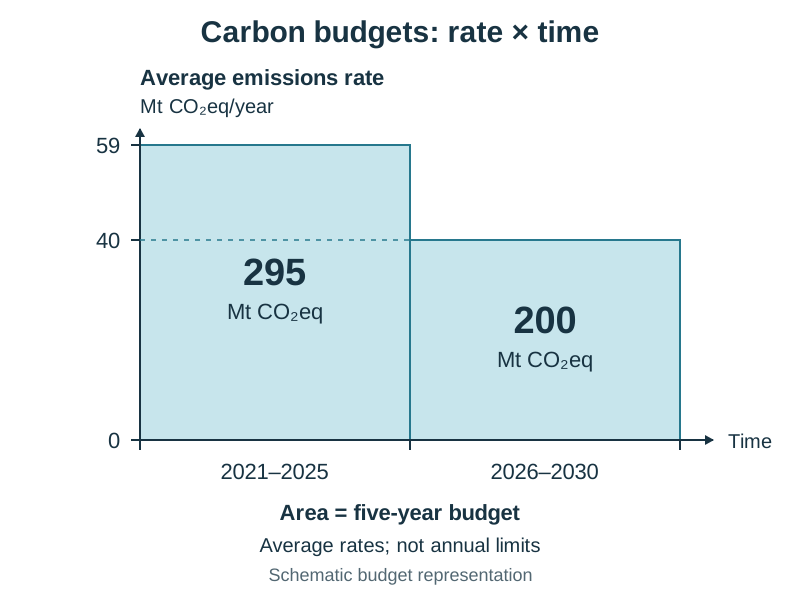
The average annual allowance falls from 59 Mt to 40 Mt, a drop of about 32% between the first and second budget periods. Because these caps govern cumulative emissions over time, any overshoot in the first budget period is carried forward and deducted from the second, forcing steeper cuts later.
The carbon budgets are proposed by the Climate Change Advisory Council and approved by the Government and then by Dáil Éireann. The Government then divides each carbon budget between sectors by setting Sectoral Emissions Ceilings (first agreed in July 2022), which represent the maximum emissions allowed to each sector:
| Sector | Approximate share of national emissions (EPA inventory; check latest year) | 2030 Statutory Reduction Target (vs 2018) | Core Sectoral Actions and Infrastructure Demands |
|---|---|---|---|
| Electricity | ~14% | 75% | Phase out commercial coal and oil generation; target 80% renewable electricity by 2030; install 5 GW of offshore wind and 8 GW of solar PV; expand interconnectors. |
| Transport | ~21% | 50% | Accelerate electric vehicle deployment; expand rural active travel; build major urban public transport infrastructure (BusConnects, DART+, MetroLink). |
| Commercial & Public Buildings | ~4% | 45% | Install commercial heat pumps; retrofit public-sector buildings; roll out district heating schemes in urban centres. |
| Residential Built Environment | ~11% | 40% | The National Retrofit Plan: upgrade 500,000 homes to Building Energy Rating (BER) B2 or cost-optimal level; install 400,000 heat pumps to replace oil and gas boilers. |
| Industry & Enterprise | ~7% | 35% | Electrify low-temperature process heat; substitute clinker in cement manufacturing; switch industrial fuel sources. |
| Agriculture | ~34–38% (largest emitting sector) | 25% | Switch to protected urea fertilisers; introduce feed additives to cut enteric methane; establish multi-species swards; expand farm-scale anaerobic digestion; voluntary herd management. |
| Land Use, Land-Use Change and Forestry (LULUCF) | Currently a net emissions source | Unallocated in 2022 | Rewet drained peatlands; increase afforestation rates under the Forestry Programme; reduce drainage on organic grassland soils. |
Sectoral shares change each year as the EPA updates the inventory. What does not change is the ranking: agriculture remains the largest emitting sector (roughly one third), followed by transport (roughly one fifth) and electricity (roughly one seventh).
Land Use (LULUCF) as an Implementation Gap
Ireland's land is currently a net source of greenhouse gases rather than a carbon sink. The main causes are drained organic soils, which release carbon dioxide continuously once the water table is lowered, and an ageing, under-replanted forest estate. When sectoral emissions ceilings were agreed in 2022, no ceiling was set for land use; it was deferred for further scientific review. This provides concrete evidence that a legally binding national target can sit on top of an incomplete sectoral allocation: the 51% must be delivered by sectors with ceilings alongside a sector that initially had none.
Domestic Policy Instruments: Carbon Tax
Ireland's domestic policy relies heavily on carbon pricing. The statutory carbon tax increases by €7.50 per tonne of carbon dioxide each year, on a legislated trajectory reaching €100 per tonne by 2030. It applies to fossil fuels including petrol, diesel, home heating oil, natural gas, and coal. Its purpose is to increase the cost of high-carbon fuels so consumers and businesses switch to cleaner alternatives. Because energy costs take up a larger share of lower incomes, the carbon tax revenue is ring-fenced by law for three targeted uses: home-energy retrofitting (including free energy upgrades for low-income households), targeted social protection payments to prevent fuel poverty, and a national Just Transition Fund.
Local Authority and Public Sector Obligations
The 2021 Act and annual Climate Action Plans reach into every public body and community. Public bodies, including schools, hospitals, and local councils, must cut their greenhouse gas emissions by 51% and improve energy efficiency by 50% by 2030. Furthermore, each of Ireland's 31 local authorities adopted a statutory Local Authority Climate Action Plan in 2024 covering local mitigation and adaptation. Each plan establishes at least one Decarbonising Zone: a designated test-bed area within the county where energy efficiency, active travel, and renewable generation are deployed together.
Critical Examination: Policy Tensions, Progress, and Accountability
At Higher Level, the action verb examine requires uncovering the underlying assumptions and relationships in climate policy. A legally binding target does not guarantee delivery on the ground, and Environmental Protection Agency (EPA) projections repeatedly indicate that Ireland risks missing its 2030 target without faster policy execution.
Structural Policy Tensions
- Agricultural asymmetry: In most industrialised economies, energy and transport produce the vast majority of emissions. In Ireland, agriculture generates over a third of national emissions, driven by biological sources: enteric methane from cattle digestion and nitrous oxide from fertilised pasture. Agriculture received a 25% reduction target, while electricity was assigned 75%. This decision reflects political negotiation, farm family income concerns, and biological realities. Cutting ruminant methane without reducing livestock numbers remains technically challenging, placing heavier decarbonisation pressure on electricity, transport, and buildings.
- Cross-sectoral dependencies: Meeting the targets for transport and residential heating relies on deep electrification, such as hundreds of thousands of electric vehicles and residential heat pumps. This strategy dramatically increases total electricity demand, requiring major reinforcements of the national grid and rapid commissioning of offshore wind farms.
- Deployment bottlenecks: In 2023, Ireland had only 25 MW of operational offshore wind capacity. Reaching the 2030 target of 5,000 MW requires a 200-fold expansion. While the Maritime Area Planning Act 2021 established the Maritime Area Regulatory Authority (MARA) to streamline marine planning consents, projects still face bottlenecks in planning appeals, grid connection capacity, and deep-water port infrastructure.
- Just transition realities: Phasing out high-emission industries causes regional economic dislocation. In the Midlands, the end of industrial peat harvesting by Bord na Móna reduced emissions but eliminated long-standing semi-state employment. A genuine Just Transition requires dedicated re-skilling programmes, local development funds, and alternative green employment so vulnerable communities do not bear an unfair share of transition costs.
What Is Working
A balanced examination must also recognise evidence of real progress. EPA inventory data showed an overall national emissions drop of roughly 6.8% in 2023, the largest annual fall outside an economic recession. This was driven by power generation, where wind and solar displaced coal, oil, and peat, alongside a significant decline in chemical nitrogen fertiliser sales in agriculture. The policy challenge is that an annual reduction rate of roughly 8% to 9% is needed every year to 2030 to achieve the statutory 51% cut.
Accountability Mechanisms
The 2021 Act contains no financial fines for domestic non-compliance. Instead, accountability works through four specific mechanisms:
- Ministers must appear before an Oireachtas Joint Committee annually to account for their sector's progress against its ceiling.
- The Climate Change Advisory Council (CCAC) publishes an annual review evaluating whether the State and individual sectors are on track.
- The EPA publishes annual greenhouse gas inventories (actual emissions) and greenhouse gas projections (forecasts to 2030), providing an objective evidence base.
- Decisions and statutory plans can be challenged in court by way of judicial review if the Government fails to follow statutory procedures or creates plans lacking operational specificity.
Climate Justice, Climate Debt, and International Finance
Ireland's international obligations do not stop at its own borders. Under the UNFCCC principles of climate justice, developed nations that built their wealth using fossil fuels carry a historical duty of support toward vulnerable countries in the Global South.
This is the practical expression of climate debt and ecological debt: the concept that industrialised nations have consumed more than their fair share of global carbon space and natural resources, leaving poorer nations to face severe climate impacts such as droughts, sea-level rise, and intensified storms.
Ireland meets this obligation through public climate finance mechanisms:
- Grant-based climate finance: Ireland committed to delivering €225 million annually by 2025 in public climate funding. Unlike international development banks that offer loans and risk increasing sovereign indebtedness, Ireland delivers its public climate finance almost entirely as non-repayable grants. These funds prioritise climate adaptation projects, such as drought-resistant agriculture and coastal defences, in Least Developed Countries (LDCs) and Small Island Developing States (SIDS).
- The Loss and Damage Fund: Established at COP27 and operationalised at COP28, this fund supports developing countries facing irreversible climate harms that mitigation and adaptation can no longer prevent. Crucially, the international decisions establishing the fund state that contributions are based on financial support and solidarity, without any admission of legal liability or financial compensation. Ireland pledged direct initial funding to this mechanism at COP28.
This is the contradiction to name in an examine answer: Ireland is a recognised leader in grant-based adaptation funding for the Global South, while remaining one of the highest per-capita greenhouse gas emitters in the European Union. In other words, Ireland is generous in helping others cope with climate change and slow at cutting the emissions that cause it.
Key terms
- UNFCCC
- United Nations Framework Convention on Climate Change; the 1992 international treaty that established the global framework for intergovernmental climate negotiations.
- Conference of the Parties (COP)
- The annual supreme decision-making body of states that have ratified the UNFCCC, where international targets, rules, and finance mechanisms are negotiated.
- Common but Differentiated Responsibilities (CBDR)
- The principle in international environmental law that all states are responsible for addressing climate change, but developed nations must lead due to greater historical emissions and financial capacity.
- Paris Agreement (2015)
- A legally binding international treaty adopted at COP21 aiming to keep global average temperature rise well below 2°C above pre-industrial levels while pursuing efforts to limit it to 1.5°C, based on procedural obligations for national plans.
- Nationally Determined Contributions (NDCs)
- Mandatory non-punitive climate plans submitted every five years by parties under the Paris Agreement outlining national emission reduction targets and policies.
- European Climate Law
- The 2021 EU regulation making climate neutrality by 2050 and a collective net greenhouse gas emissions cut of at least 55% by 2030 (vs 1990) legally binding across member states.
- Effort Sharing Regulation (ESR)
- EU legislation setting binding national greenhouse gas reduction targets for non-ETS sectors (agriculture, transport, buildings, waste, small enterprise); Ireland's target is a 42% cut by 2030 relative to 2005.
- Climate Action and Low Carbon Development (Amendment) Act 2021
- The Irish statute committing the State to legally binding five-year carbon budgets, a 51% reduction in total greenhouse gas emissions by 2030 (vs 2018), and a climate-neutral economy by 2050.
- Carbon Budget
- A statutory cap on the total cumulative volume of greenhouse gas emissions permitted across the Irish economy over a five-year period, measured in Mt CO₂eq.
- Sectoral Emissions Ceilings
- The maximum permissible volume of greenhouse gas emissions assigned by the Government to specific sectors of the economy within Ireland's five-year carbon budgets.
- Loss and Damage Fund
- A dedicated international fund agreed at COP27 to provide financial support to vulnerable developing countries experiencing irreversible climate impacts, without legal liability or compensation.
- Just Transition
- A framework ensuring that the shift to a low-carbon economy is fair to workers and communities, providing retraining, social protection, and regional investment to prevent economic disadvantage.
Check yourself
What core temperature goal was established by the 2015 Paris Agreement at COP21?
To hold the increase in global average temperature well below 2°C above pre-industrial levels, while pursuing active efforts to limit the increase to 1.5°C.
State the national emissions reduction target, target year, and statutory baseline year set out in Ireland's 2021 Climate Act.
A legally binding 51% reduction in total national greenhouse gas emissions by 2030 compared with 2018 levels.
What are the total emissions caps for Ireland's first two statutory five-year carbon budgets?
Carbon Budget 1 (2021–2025) is 295 Mt CO₂eq, and Carbon Budget 2 (2026–2030) is 200 Mt CO₂eq.
Agriculture emitted approximately 23 Mt CO₂eq in 2018 and has a 25% reduction target by 2030. Calculate its 2030 emissions ceiling in Mt CO₂eq.
23 × (1 − 0.25) = 23 × 0.75 = 17.25 Mt CO₂eq. (This shows that even after a 25% cut, agriculture remains Ireland's single largest emitting sector).
What is the key difference between the EU Emissions Trading System (EU ETS) and the Effort Sharing Regulation (ESR)?
The EU ETS regulates heavy industry and power generation through an EU-wide allowance market, while the ESR sets binding national targets for domestic sectors (agriculture, transport, buildings, waste, small business) where member states must buy compliance units if they overshoot.
What legal precedent was established in Climate Case Ireland (2020)?
The Supreme Court quashed the 2017 National Mitigation Plan for lacking the specificity required by statute, establishing that national climate plans can be struck down in court if they lack clear operational detail.
Name two ways the statutory carbon tax revenue is ring-fenced in Irish law.
Revenues are ring-fenced for residential retrofitting programmes (including free upgrades for low-income homes), targeted social protection payments to counter fuel poverty, and the national Just Transition Fund.