

Climate change demands two fundamental, interconnected responses: mitigation to tackle root causes by cutting greenhouse gas emissions and expanding carbon sinks, and adaptation to adjust human and natural systems to unavoidable impacts. When the physical or social limits of adaptation are breached, communities suffer permanent climate loss and damage. Because industrialised nations generated roughly half of all cumulative emissions while developing nations face the earliest and most severe hazards, these responses are not merely technical. Evaluated through a climate justice lens, they involve historical responsibility, procedural democracy, and the recognition of climate debt and ecological debt.
Two Responses to One Crisis: Mitigation and Adaptation
A useful way to grasp the twin responses is the overflowing bath analogy. Turning off the tap stops more water from flooding into the room; that is climate change mitigation. Mopping the floor, laying sandbags, and moving valuables onto high shelves reduces the damage from water already spilled; that is climate change adaptation.
Mitigation tackles the causes; adaptation tackles the consequences. If an intervention does not reduce the concentration of greenhouse gases in the atmosphere, it is adaptation, no matter how environmentally friendly it appears.
Neither response can succeed alone. Past emissions have already locked in atmospheric warming and sea level rise for decades, making adaptation urgent. Conversely, if global mitigation fails and temperatures blow past critical ecological tipping points, adaptation will become physically or financially impossible for entire regions.
| Feature | Climate Change Mitigation | Climate Change Adaptation |
|---|---|---|
| Primary Aim | Tackle the root cause by limiting atmospheric greenhouse gases | Tackle the symptoms by reducing vulnerability and building resilience |
| Mechanism | Cut emissions at source or enhance a carbon sink (e.g. peatlands, forests) | Adjust infrastructure, agriculture, and policies to withstand hazards |
| Geographic Scope | Global benefit: a tonne of CO₂ avoided anywhere helps the global atmosphere | Localised benefit: directly protects the specific community that adapts |
| Timescale | Long-term: takes decades to centuries to stabilise global surface temperatures | Immediate to medium-term: provides protection from the next severe weather event onwards |
| Irish Example | Deep retrofitting homes or rewetting harvested bogs | Demountable flood defence barriers in Clonmel along the River Suir |
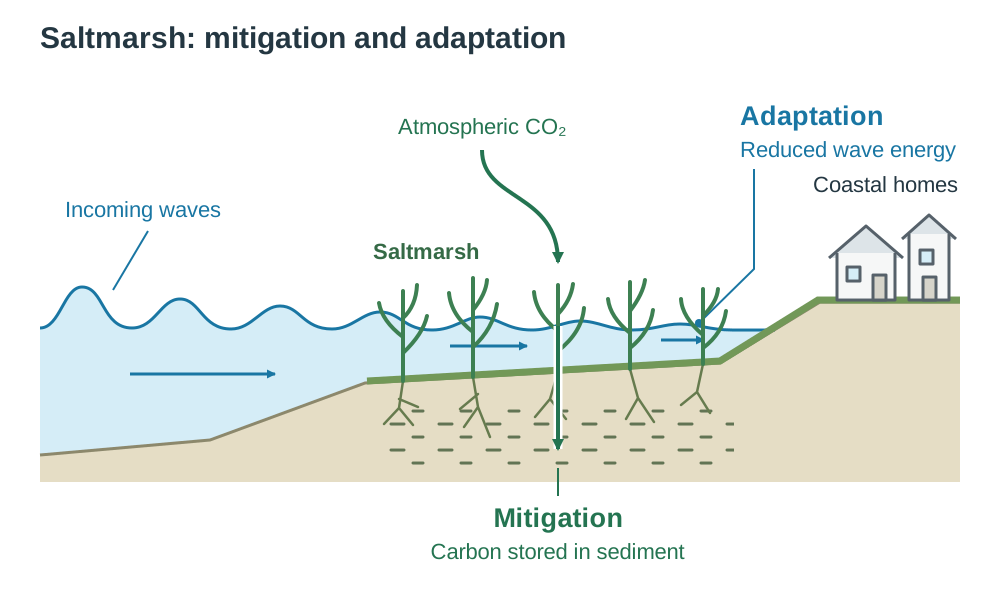
Some measures achieve both simultaneously. Restoring coastal saltmarshes acts as mitigation by sequestering blue carbon in tidal sediment, while providing adaptation by absorbing storm surge energy and buffering coastal communities against sea level rise.
Mitigation: Decarbonisation, Targets, and Irish Policy
Climate change mitigation refers to human interventions that reduce greenhouse gas emissions at their source or enhance natural and artificial sinks that remove greenhouse gases from the atmosphere.
The Paris Agreement and NDCs
The global framework governing mitigation is The Paris Agreement (2015). Its central goal is holding the increase in global average temperature to well below 2 °C above pre-industrial levels, while pursuing efforts to limit the rise to 1.5 °C. Under Paris, every signatory submits a Nationally Determined Contribution (NDC) every five years, outlining its self-set emissions reduction targets.
A fundamental climate justice critique of the Paris Agreement is that NDCs are voluntary pledges. The treaty contains no legal mechanism forcing historically high-emitting states to make the deepest or fastest cuts. Closing the gap between what equity demands and what states pledge relies on political pressure, youth mobilisations, and climate litigation.
Ireland's Mitigation Machinery
Under the Climate Action and Low Carbon Development (Amendment) Act 2021, Ireland is legally bound to reduce greenhouse gas emissions by 51% by 2030 (relative to a 2018 baseline) and to achieve a climate neutral economy by no later than the end of 2050.
This target is operationalised through specific statutory instruments:
- Carbon budgets: Legally binding five-year caps on total economy-wide greenhouse gas emissions, proposed by the independent Climate Change Advisory Council and approved by the Oireachtas.
- Sectoral emissions ceilings: Maximum limits placed on the greenhouse gas emissions permitted from each sector (such as transport, agriculture, and electricity) within each budgetary period.
- Climate Action Plan: An annually updated statutory roadmap detailing the precise regulations, investments, and timelines required to keep sectors within their allocated ceilings.
| Irish Sector | Mitigation Focus | Key Sectoral Measure |
|---|---|---|
| Agriculture | Enteric methane and nitrous oxide | Reducing chemical fertiliser usage and using protected urea |
| Transport | Fossil fuel combustion in vehicles | Electrifying public transport and developing active travel routes |
| Energy Industries | Power generation emissions | Phasing out coal and expanding offshore and onshore wind |
| Built Environment | Heat loss and oil/gas boilers | Deep retrofitting insulation and installing domestic heat pumps |
| Land Use & Forestry | Peat oxidation and deforestation | Rewetting drained peat bogs and planting native woodlands |
Adaptation: Frameworks, Limits, and Maladaptation
Climate change adaptation means adjusting ecological, social, or economic systems in response to actual or expected climatic changes and their effects, seeking to moderate harm or exploit beneficial opportunities.
Core Adaptation Concepts
Three concepts determine how severe climate impacts will be on any group:
- Exposure: Whether people, property, or ecosystems are physically placed where hazards occur (for example, building homes directly on an unembanked floodplain).
- Vulnerability: The susceptibility of a population to harm when a hazard strikes, shaped by wealth, age, housing stability, healthcare infrastructure, and institutional support.
- Resilience: The capacity of an ecosystem, community, or infrastructure network to absorb a shock, maintain core functions, and recover quickly afterwards.
Two communities facing the exact same meteorological hazard will experience entirely different outcomes depending on their vulnerability and resilience.
Types of Adaptation
- Hard adaptation: Capital-intensive engineering structures, such as concrete sea walls, rock armouring along coastlines, and raised road bridges.
- Soft adaptation: Institutional and behavioural adjustments, such as early-warning text alerts, municipal planning laws restricting development in flood-prone zones, and subsidised crop insurance.
- Nature-based adaptation: Working with natural ecosystems, such as restoring upland blanket bogs to hold rainfall and prevent downstream flooding.
Bangladesh illustrates effective soft and hard adaptation. The 1970 Bhola cyclone killed several hundred thousand people. In response, Bangladesh developed its Cyclone Preparedness Programme, combining community volunteer warning networks with thousands of raised concrete cyclone shelters. During comparable recent cyclones, fatalities dropped to the low hundreds. The storm hazard remained intense, but vulnerability was radically reduced.
Maladaptation and Irish Adaptation Policy
Maladaptation occurs when an intervention intended to reduce climate vulnerability inadvertently increases risk, shifts harm onto another group or future generations, or locks in fossil fuel dependence. Constructing an uncoordinated flood wall that simply deflects river surge water directly into an unprotected downstream village is classic maladaptation. Similarly, relying exclusively on fossil-powered air conditioning during urban heatwaves provides short-term individual relief while raising outdoor ambient heat and driving grid emissions upward.
In Ireland, adaptation is governed by the statutory National Adaptation Framework, which mandates government departments to establish sectoral adaptation plans (e.g. for transport infrastructure, agriculture, and flood risk management) and requires every local authority to adopt and implement its own climate action plan covering both mitigation and adaptation.
Limits of Adaptation: Climate Loss and Damage
Adaptation cannot absorb every climate shock. When warming overwhelms physical engineering, biological survival thresholds, or domestic financial reserves, communities encounter adaptation limits. Beyond those thresholds lies climate loss and damage.
Loss and damage describes the permanent destruction and unavoidable harms caused by anthropogenic climate change that cannot be avoided through mitigation or addressed through adaptation. It is driven by sudden severe events (super-cyclones, flash flooding) and slow-onset processes (sea level rise, glacial retreat, desertification).
Economic versus Non-Economic Harms
- Economic loss and damage: Readily quantified financial destruction, including collapsed road networks, shattered bridges, ruined crops, and condemned residential property.
- Non-economic loss and damage (NELD): Irreversible harms that cannot be compensated with a monetary sum. Examples include loss of human life, psychological trauma, biodiversity loss, submergence of ancestral burial grounds, and the destruction of sovereign territory and cultural heritage as low-lying island nations like Tuvalu face inundation.
During the 2022 floods in Pakistan, unprecedented rainfall left around one-third of the country under water at the peak, killing over 1,700 people and inflicting over US$30 billion in damage, despite Pakistan producing less than 1% of global emissions.
The Loss and Damage Fund and its Critical Gaps
Years of persistent campaigning by frontline developing nations culminated in the creation of the Loss and Damage Fund at COP27 (2022) in Sharm El-Sheikh, which was operationalised at COP28 (2023) in Dubai. The fund aims to direct financial transfers from historical polluters to vulnerable states.
From a critical perspective, the fund suffers from a massive scale gap. Early financial pledges totalled roughly US$700 million, while developing nations face hundreds of billions in annual losses. Pledges remain voluntary with no formula tying payments to historical emissions, and a large share of international climate finance continues to be disbursed as interest-bearing loans rather than non-repayable grants, worsening the sovereign debt burdens of vulnerable countries.
Climate Debt, Ecological Debt, and Climate Justice
Arguments about who should act and who should pay come down to history. The atmosphere can safely absorb only a finite cumulative volume of greenhouse gases—the global carbon budget—and industrialised countries have already burned through far more than an equal per capita share.
Defining Climate and Ecological Debt
Climate debt is the ethical, financial, and legal obligation owed by wealthy nations in the Global North to the Global South for the disproportionate consumption of the atmospheric commons. It consists of two sub-debts:
- Emissions debt: The historical overconsumption of atmospheric carbon space by industrial economies since 1750.
- Adaptation debt: The uncompensated financial and social costs imposed on developing nations that must build protection against climate impacts caused by foreign emissions.
Ecological debt is the broader concept. It represents the historical accumulation of environmental degradation, resource plunder, and hazardous waste dumping inflicted by imperial and industrialised states on the Global South. Examples include decades of oil pollution in the Niger Delta and the dumping of electronic waste in West Africa. Climate debt is one component of this wider ecological debt.
The Pillars of Climate Justice
Climate justice treats global warming as an ethical and human rights issue rather than a purely technical challenge. It rests on three pillars:
- Distributive justice: Fair sharing of both climate benefits and climate burdens, guided by the international principle of Common But Differentiated Responsibilities and Respective Capabilities (CBDR-RC).
- Procedural justice: Ensuring that marginalised communities, youth, and Indigenous peoples have direct, democratic seats at policy-making tables.
- Intergenerational justice: The obligation of present generations not to strip away the stability and resource security of future generations.
Every climate transition policy must be evaluated for equity: does it deliver a just transition? In Ireland, the Midlands Just Transition Fund was established to support Bord na Móna workers with retraining and regional employment when peat harvesting ceased. Because a flat carbon tax is regressive—taking a larger percentage of income from poorer homes—the State ring-fences a portion of carbon tax revenue to fund free retrofits for low-income households at risk of energy poverty.
Named Climate Justice Movements
A justice argument is far stronger when you identify who is mobilising:
- Global North: Fridays for Future / school climate strikes, sparked by Greta Thunberg in 2018. Demands include radical, science-based emissions reductions aligned with 1.5 °C and the formal declaration of national climate emergencies. Achievements include driving mass public awareness, shifting political agendas across Europe, and securing youth observer presence at UN negotiations.
- Global South: The Pacific Climate Warriors, organising under the banner 'We are not drowning, we are fighting'. Demands include a rapid phase-out of fossil fuel extraction in industrialised nations, dedicated grant finance for loss and damage, and international recognition of territorial sovereignty threatened by sea level rise. Their combination of direct action (canoes blockading Australian coal export terminals) and international diplomacy proved vital in securing both the 1.5 °C Paris target and the Loss and Damage Fund.
Key terms
- Climate Change Mitigation
- Human interventions aimed at reducing the sources of greenhouse gas emissions or enhancing the natural and artificial sinks that remove greenhouse gases from the atmosphere.
- Climate Change Adaptation
- Adjustments in ecological, social, or economic systems in response to actual or expected climatic changes and their effects, aimed at moderating harm or exploiting beneficial opportunities.
- Carbon Sink
- A natural or artificial reservoir that absorbs and stores more carbon dioxide from the atmosphere than it releases, such as peat bogs, growing forests, soils, and ocean ecosystems.
- Maladaptation
- An action taken with the intention of adapting to climate change that inadvertently increases vulnerability, locks in emissions, or shifts climate harms onto other communities or future generations.
- Climate Loss and Damage
- The harmful, unavoidable consequences of anthropogenic climate change that occur when adaptation limits are breached or when communities lack the resources to adapt.
- Non-Economic Loss and Damage (NELD)
- Irreversible climate-induced harms that cannot be measured in monetary terms, including loss of human life, cultural heritage, sacred sites, biodiversity, and national territory.
- Climate Debt
- The ethical, legal, and financial obligation owed by high-emitting industrialised nations to developing nations, comprising emissions debt and adaptation debt.
- Ecological Debt
- The cumulative historical debt incurred by industrialised states through centuries of resource extraction, habitat destruction, uncompensated ecological damage, and waste dumping in the Global South.
- Climate Justice
- An ethical, social, and political approach that frames climate change as a human rights crisis, demanding the fair distribution of burdens, democratic participation, and redress for historical inequities.
- CBDR-RC
- Common But Differentiated Responsibilities and Respective Capabilities: an established principle within the UNFCCC asserting that while all states share a duty to address climate change, developed countries must lead because of their historical emissions and greater wealth.
- Just Transition
- A framework ensuring that the shift away from fossil fuels protects the livelihoods, rights, and living standards of workers, vulnerable communities, and low-income households.
- Exposure
- The presence of people, livelihoods, infrastructure, or ecosystems in places and settings that could be adversely affected by climate hazards.
- Vulnerability
- The propensity or predisposition of a human or natural system to be adversely affected by climate hazards, determined by sensitivity and lack of capacity to cope.
- Resilience
- The capacity of social, economic, and environmental systems to cope with a hazardous event, trend, or disturbance by responding or reorganising in ways that maintain their essential function and identity.
- The Paris Agreement (2015)
- A legally binding international treaty on climate change adopted at COP21, setting a global goal to limit warming to well below 2 °C above pre-industrial levels and pursue efforts to limit it to 1.5 °C.
- Nationally Determined Contribution (NDC)
- A self-set national climate action plan submitted every five years under the Paris Agreement, detailing how a country will cut its emissions and build adaptation resilience.
- Carbon Budget
- A legally binding limit on the total volume of greenhouse gases that may be emitted across a jurisdiction over a defined five-year period.
- Sectoral Emissions Ceiling
- The maximum permissible total greenhouse gas emissions allocated to a specific economic sector over a defined budgetary period in Ireland.
- Loss and Damage Fund
- A dedicated international fund established under the UNFCCC at COP27 to assist vulnerable developing nations in responding to unavoidable climate harms.
Check yourself
What is the core difference between climate change mitigation and climate change adaptation?
Mitigation tackles the causes of climate change by reducing emissions or expanding carbon sinks, whereas adaptation tackles the effects by adjusting systems and infrastructure to minimise harm.
Why does restoring a coastal saltmarsh provide both mitigation and adaptation benefits?
It provides mitigation by capturing and sequestering blue carbon in marine soils, and adaptation by dissipating wave energy, reducing coastal erosion, and absorbing storm surges.
What two distinct sub-debts make up climate debt?
Emissions debt (the disproportionate overconsumption of the global atmospheric carbon budget) and adaptation debt (the uncompensated costs imposed on developing nations to adapt to climate damage caused by foreign emissions).
What is the difference between climate debt and ecological debt?
Climate debt specifically addresses overconsumption of atmospheric space and the resulting adaptation costs; ecological debt is the broader historical accumulation of resource exploitation, local environmental degradation, and waste dumping inflicted on the Global South.
Give one example of economic loss and damage and one example of non-economic loss and damage (NELD).
Economic: destroyed transport infrastructure or agricultural harvest losses. Non-economic: loss of human life, community trauma, or the loss of ancestral territory and cultural sovereignty in low-lying island nations.
What is maladaptation? Provide one clear example.
An adaptation measure that inadvertently increases climate vulnerability, locks in emissions, or shifts harms onto others. For example, relying on fossil-fuelled air conditioning during heatwaves cools indoor spaces but expels heat outside and drives up power grid emissions.
If Ireland's 2018 emissions were 68.0 Mt CO₂eq, what is its legal emissions ceiling for 2030 under the 51% reduction target, and how many Mt must be cut?
The target ceiling is 33.32 Mt CO₂eq (49% of 68.0), requiring an absolute reduction of 34.68 Mt CO₂eq.
How did Bangladesh demonstrate successful adaptation against tropical cyclones?
By establishing the Cyclone Preparedness Programme, building raised concrete storm shelters, and organising trained community volunteer warning networks, reducing cyclone death tolls from hundreds of thousands in 1970 to low hundreds during recent severe storms.