

Ireland must stop burning fossil fuels, but thousands of livelihoods, home heating systems, and farm incomes depend on high-carbon practices. Learning Outcome 2.8 asks you to outline the concept of just transitions and identify an example in Ireland. Any suitable Irish example is acceptable; the winding down of industrial peat extraction by Bord na Móna in the Midlands is the best documented. Learning Outcome 2.9 asks you to examine what a just transition would look like across three sectors: transport, residential, and agriculture, with an emphasis on inclusive employment. At Higher Level, you must also evaluate how well transitions work in practice. This links directly to the 2027 Action Project brief on reducing Ireland's greenhouse gas emissions, which allows you to focus on any sector.
Principles, Legal Architecture, and Funding Mechanisms
A just transition ensures that the shift to a climate-neutral economy happens fairly, sharing the burdens and benefits equitably while protecting workers, communities, and vulnerable households.
The idea began in the trade union movement to prevent high-carbon industries from closing abruptly without supporting workers. It is now recognised internationally in the preamble to the Paris Agreement (2015), which refers to the imperatives of a just transition of the workforce. The International Labour Organization (ILO) set out guidelines in 2015 based on social dialogue, social protection, and rights at work. Ireland's Climate Action Plan uses four similar principles: an evidence-based approach, equipping workers with skills, sharing costs so existing inequalities do not widen, and social dialogue with affected groups.
Why Every Sector Has a Target to Hit
The Climate Action and Low Carbon Development (Amendment) Act 2021 committed Ireland to a legally binding 51% reduction in emissions by 2030 compared to 2018 levels, and net-zero emissions by 2050. To deliver this, the government establishes five-year carbon budgets, which are then divided into legally binding sectoral emissions ceilings:
- Transport: 50% reduction by 2030
- Built environment (residential): 40% reduction by 2030
- Agriculture: 25% reduction by 2030
These targets are unequal on purpose. Agriculture's 25% target reflects the technical difficulty of cutting biogenic methane from cattle and sheep and the need to protect farm incomes, though critics argue this places a heavier burden on other sectors. Transport has the steepest cut at 50%, yet its emissions have grown since 1990, meaning the required changes are the most abrupt.
How a Carbon Tax Can Be Made Fair: Revenue Recycling
Ireland's carbon tax is legislated to reach €100 per tonne of CO₂ by 2030. A carbon tax on its own is regressive: it takes a larger share of income from lower-income and rural households because they spend more of their budget on essential home heating and private transport. To prevent hardship, the State uses ring-fencing to return every euro of additional revenue to three areas: social welfare increases (such as the Fuel Allowance), fully funded home retrofits under the Warmer Homes Scheme, and agri-environmental projects alongside Midlands transition funds.
Irish Case Studies: Bord na Móna and Moneypoint
A just transition is climate justice applied inside a single country. The differences in power and social position that influence climate vulnerability globally also determine who can afford a heat pump, who can buy an electric car, and who carries the cost when a local employer closes.
The Midlands: Peat Phase-Out
For decades, semi-state company Bord na Móna harvested milled peat across Offaly, Longford, Westmeath, Laois, and Roscommon to supply ESB power stations at Lough Ree (Lanesborough, Co. Longford) and West Offaly (Shannonbridge, Co. Offaly). Peat was among the most carbon-intensive fuels used for electricity in Ireland, emitting more carbon dioxide per unit of power than coal or gas. The phase-out accelerated when commercial subsidies ended, planning permission to burn biomass alongside peat at Shannonbridge was refused, and national climate targets took effect.
Bord na Móna phased down harvesting from 2018, both ESB power stations ceased generation in December 2020, and the company permanently ended peat harvesting in January 2021, rebranding as a climate solutions firm.
Key state and community supports included:
- Appointing a Just Transition Commissioner in 2019 to lead discussions with trade unions, councils, and local communities.
- Establishing the National Just Transition Fund (2020) from carbon tax revenue for local enterprise, alongside the EU Just Transition Fund territorial programme for the Midlands, providing over €100 million in combined funding with national co-financing.
- Launching the Peatlands Climate Action Scheme, redeploying several hundred former machine operators and rail staff to rehabilitate and re-wet roughly 33,000 hectares of bogs, turning degraded bogs back into active carbon sinks.
- Developing commercial wind farms (such as Mount Lucas), solar sites, and amenity facilities like Lough Boora Discovery Park.
Evaluating the Midlands transition reveals clear trade-offs. It protected jobs through redeployment and restored bogs without sudden mass redundancies. However, many replacement roles were fixed-term and lacked the pension security of older semi-state contracts. Furthermore, stopping peat cutting disrupted local traditions, causing tensions that financial grants cannot easily resolve.
Moneypoint, Co. Clare
Moneypoint was Ireland's only coal-fired power station and its single largest industrial source of carbon dioxide. ESB ended routine coal burning there in 2025, retaining the plant only as an emergency reserve. To protect west Clare from losing a major rural employer, ESB launched plans to convert the site into a green energy hub: a deep-water staging port for floating offshore Atlantic wind, a synchronous compensator to stabilise the power grid, and potential green hydrogen facilities. This reuses existing grid connections and retains technical jobs, though offshore construction work can be temporary and operating teams are smaller than those needed to run a coal plant.
Analytical Framework: Examining Sectoral Transitions
Under Learning Outcome 2.9, a question asking you to examine a sector requires uncovering the underlying assumptions, relationships, and trade-offs rather than simply listing clean technologies. Use this five-step plan for any sector:
- Quantify the environmental impact: state the sector's share of national emissions, its 2030 sectoral emissions ceiling, and the main greenhouse gases involved.
- Identify what must change: outline the required technical, structural, and behavioural shifts.
- Identify who is at risk: name the workers, households, or regions that bear the highest costs, and identify the barriers blocking them from changing.
- Address employment and social inclusion: explain where new green jobs will appear and how training can include underrepresented groups, young people, and displaced workers.
- Define what makes the policy fair: explain how targeted supports, public investments, and ring-fenced revenues ensure the transition does not increase inequality.
Put It Into Practice
Try this scenario: a local authority plans to remove all on-street car parking in a town centre to install segregated cycle lanes. Using steps 3 and 5, identify who loses out and explain how to make the plan fairer.
Who loses out: older residents and people with mobility impairments who cannot walk or cycle long distances, alongside small business owners concerned about passing trade. Fairer measures: keep dedicated accessible parking bays close to key shops, and establish a high-frequency Local Link or town shuttle bus before removing car spaces, while running an accessibility audit with local disability groups.
Sector 1: Transport (Aviation, Shipping, Public, and Private)
Transport generates roughly a fifth of Ireland's greenhouse gas emissions (about 21% in recent EPA inventories), making it the second largest emitting sector after agriculture. It carries the steepest 2030 target: a 50% sectoral emissions reduction. Because car travel expanded rapidly alongside urban sprawl and dispersed rural housing, car dependency is deeply entrenched.
Transport Poverty and Regressive Policies
If the primary climate policy is simply raising carbon taxes on petrol and diesel, the effect is regressive. Rural commuters without a bus route cannot switch and end up paying higher taxes on essential journeys. This causes transport poverty, where a household struggles to afford or access the travel required for work, school, and medical appointments. Furthermore, early EV purchase grants benefited wealthier households with driveways for home chargers, leaving lower-income drivers behind.
Examining the Four Modes
- Private transport: emissions must fall by shifting short journeys to active travel (walking, wheeling, and cycling), expanding car-sharing, and phasing out the sale of new petrol and diesel cars. A fair transition redirects grants toward cheaper and second-hand electric vehicles, installs public on-street chargers in terraced streets and social housing estates, and funds targeted scrappage schemes for low-income drivers.
- Public transport: reliable public transit is the core of a fair transition. The Connecting Ireland Rural Mobility Plan funds higher-frequency rural bus services (TFI Local Link), electrifies urban buses, and reopens regional rail links. Subsidised fares, such as the Young Adult Leap Card, reduce daily travel costs for students and low-income workers.
- Aviation: as an island nation, Ireland depends on flights for connectivity and tourism. Decarbonisation involves blending sustainable aviation fuels (SAF) and ending short domestic flights where rail is available. Fairness requires avoiding punitive flat flight taxes that harm family visits, applying higher levies to private jets and frequent flyers, and protecting airport ground staff through green fuel handling roles.
- Shipping: maritime transport moves over 90% of Ireland's physical trade. Ports need shore-to-ship electricity so docked vessels turn off diesel generators. A just transition protects subsidised ferry services for offshore island communities and retrains port and dock workers to support offshore wind logistics at deep-water harbours such as Shannon Foynes, Cork, and Rosslare.
Employment and Social Inclusion
Meeting the 50% target creates jobs in bus mechanics, rail signalling, and electric vehicle servicing. State-funded apprenticeships can offer opportunities to school-leavers and long-term unemployed individuals in communities with few alternatives.
Sector 2: Residential Housing, Energy Ratings, and Construction
The residential sector produces roughly 10% to 12% of Ireland's greenhouse gas emissions, carrying a 2030 target of a 40% sectoral emissions reduction. Most emissions come from burning oil, gas, coal, or peat in poorly insulated dwellings.
Building Energy Ratings and Retrofitting Goals
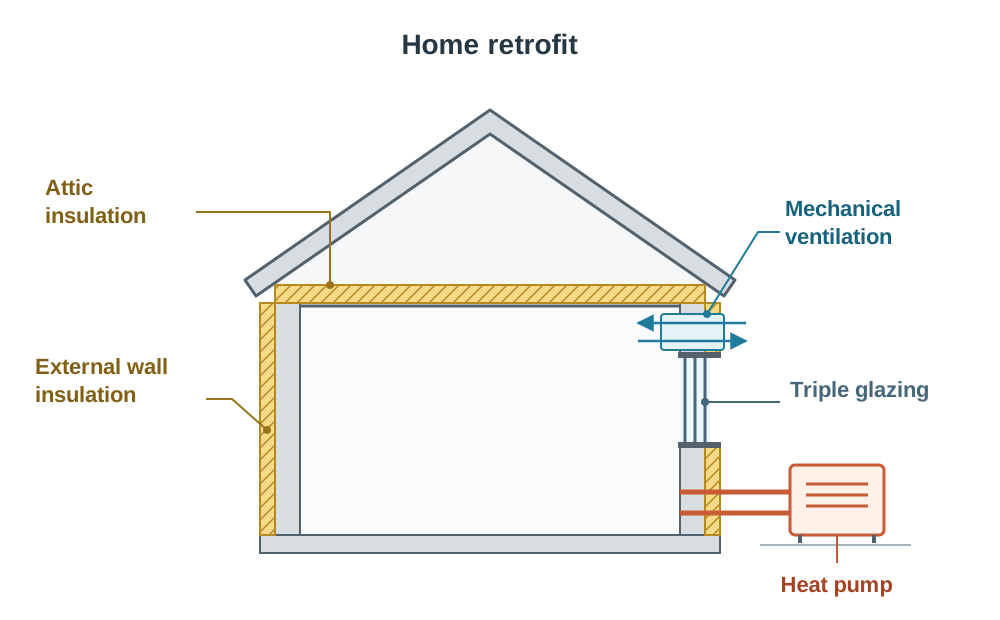
A Building Energy Rating (BER) rates home energy efficiency from A1 (most efficient) down to G (least efficient). Ireland's Climate Action Plan aims to retrofit 500,000 homes to a minimum standard of B2 and install 400,000 heat pumps by 2030. Deep retrofitting includes external and attic insulation, triple glazing, mechanical ventilation, and replacing fossil-fuel boilers with heat pumps.
The Social Risk: Energy Poverty and the Rental Sector
Residential heating directly connects to energy poverty, where households cannot afford to keep their homes adequately warm. If retrofits rely only on partial SEAI matching grants, wealthier homeowners get public subsidies while low-income families remain stuck in draughty BER E, F, or G homes paying rising carbon taxes on heating fuel.
In private rentals, tenants and landlords face a split incentive: the landlord pays for insulation, but the tenant pays the heating bills. Without legal safeguards, upgrading rented properties can lead to renovictions, where tenants are evicted under the cover of refurbishment and the property is re-let at a higher rent.
Construction: Embodied Carbon and New Builds
A home causes emissions twice: operational emissions from heating and lighting while in use, and embodied carbon released during the manufacturing, transport, and assembly of building materials. Cement and concrete release significant carbon dioxide during chemical reactions and fuel combustion. With Ireland's acute housing shortage, building new homes risks adding emissions to a sector required to cut them by 40%.
A just transition in construction includes:
- Using lower-carbon materials, such as Irish timber frames and lower-clinker cements, alongside off-site modular manufacturing to reduce waste.
- Enforcing the Nearly Zero Energy Building (NZEB) standard so all new homes achieve an A-rating from the start, avoiding costly retrofits later.
- Upgrading and reusing vacant town-centre properties instead of demolishing them, saving embodied carbon and reusing existing public infrastructure.
Just Policy Interventions and Green Jobs
- Free retrofits for low-income homeowners and social housing tenants through the fully funded SEAI Warmer Homes Scheme.
- Low-interest, state-supported green loans for middle-income households, paired with tenancy laws preventing renovictions.
- Meeting retrofit goals requires an estimated 17,000 additional workers. Education and Training Boards (ETBs) offer funded apprenticeships in heat pump installation, airtightness testing, and timber-frame building, creating high-wage paths for younger workers and displaced tradespeople.
Sector 3: Agriculture (Production, Policy Demands, and Regenerative Farming)
Agriculture generates roughly 37% to 38% of Ireland's total greenhouse gas emissions, carrying a 2030 target of a 25% sectoral emissions reduction. Emissions are driven by biogenic methane from cattle and sheep digestion and slurry storage, alongside nitrous oxide from synthetic fertilisers and animal manures.
Production Growth versus Emissions Ceilings
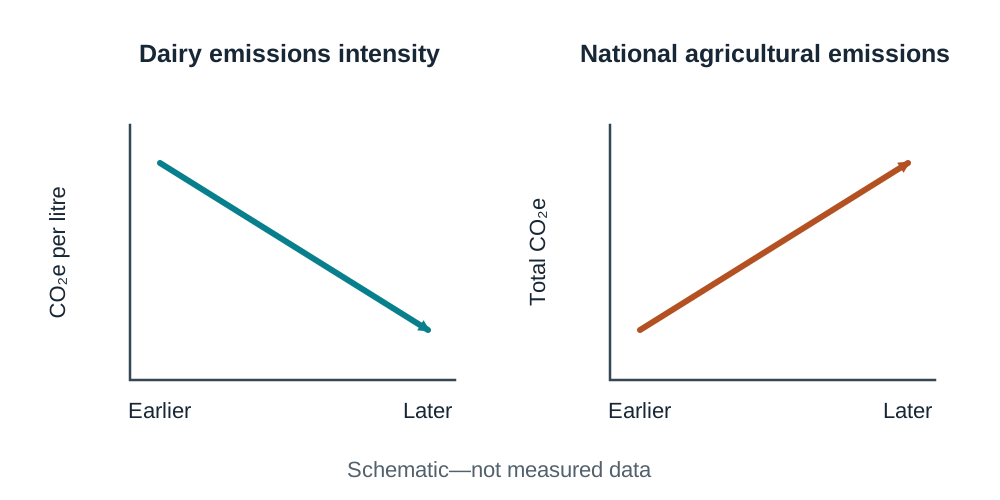
Farming underpins rural community life and employment. However, when the EU abolished milk quotas in 2015, national policy encouraged rapid dairy expansion. While Ireland's grass-based dairy production improved its emissions intensity (greenhouse gases emitted per litre of milk produced), total cattle numbers grew so much that absolute national agricultural emissions rose. Technical efficiency alone cannot lower total emissions without managing herd size, input intensity, or overall land use.
Farm Incomes and Cost Demands
Farmers face increasing rules, including limits on synthetic nitrogen, water buffer zones, and mandatory low-emission slurry spreading (LESS). Intensive dairy enterprises often generate healthy incomes, but drystock (beef and sheep) farms run on low family farm incomes, relying heavily on Common Agricultural Policy (CAP) payments and off-farm work. Imposing costly rules without targeted grant aid threatens the survival of small family holdings.
Regenerative Agriculture and Just Solutions
- Regenerative agriculture: methods that restore soil organic matter and lower inputs. Integrating multi-species swards (ryegrass mixed with clover, plantain, and chicory) uses legumes to fix nitrogen biologically, allowing farmers to reduce synthetic fertiliser use while protecting forage yields during dry spells, cutting nitrous oxide and input bills.
- Results-based payments: schemes like ACRES pay farmers directly for verified environmental outcomes, such as hedgerow planting, carbon storage in soils, and wetland protection, rather than paying simply for land area or herd numbers.
- Income diversification: grants and fast-track grid connections for farm-based solar generation, farm-scale anaerobic digestion to produce biomethane, and planting native broadleaf forestry.
- Generational renewal: funded farm succession schemes allowing older farmers to retire with financial security while young farmers trained in agroecology take on land management.
Comparative Synthesis Across the Sectors
Comparing the three sectors highlights shared patterns: the technology to cut emissions exists, but progress stalls when costs land on vulnerable groups.
| Sector | 2030 Ceiling & Main Emissions | Groups Most at Risk | Just Policy Interventions | Inclusive Green Job Opportunities | Hardest Trade-off in This Sector |
|---|---|---|---|---|---|
| Transport | 50% cut; petrol/diesel combustion, road freight, aviation, shipping | Rural commuters without buses, low-income drivers, island residents | Subsidised rural bus routes, active travel paths, progressive EV grants, port electrification | Rail engineering, electric bus driving, EV battery maintenance, offshore wind port logistics | Entrenched rural car dependency makes cutting transport emissions quickly conflict with protecting mobility. |
| Residential | 40% cut; oil/gas boilers, draughty homes, embodied carbon in concrete | Low-income homeowners, private renters, occupants in uninsulated houses | 100% free retrofits under Warmer Homes Scheme, social housing upgrades, anti-renoviction tenancy laws | Heat pump plumbing, airtightness testing, BER assessing, off-site timber construction | The draughtiest homes often belong to the households least able to afford the upfront cost of deep retrofitting. |
| Agriculture | 25% cut; biogenic methane from livestock, nitrous oxide from fertilisers | Low-margin beef and sheep farmers, tenant farmers, farm labourers | Results-based environmental payments (ACRES), multi-species swards support, farm diversification | Ecological surveying, native forestry management, biomethane plant maintenance | Dairy emissions intensity per litre has improved while absolute emissions grew, meaning efficiency alone cannot deliver the ceiling. |
Key terms
- Just Transition
- A framework ensuring that the shift to a low-carbon, sustainable economy protects workers' rights, promotes decent work, and distributes economic costs and benefits equitably without leaving vulnerable groups behind.
- Carbon Budget
- The total legally permitted amount of greenhouse gas emissions, measured in tonnes of carbon dioxide equivalent, that a country may emit over a five-year period.
- Sectoral Emissions Ceiling
- The maximum volume of greenhouse gas emissions permitted from a specific sector of the economy over a set budgetary period, established under the Climate Action and Low Carbon Development (Amendment) Act 2021.
- Transport Poverty
- A situation where a household cannot afford or practically access the transport options required to reach employment, education, healthcare, and essential community services.
- Bord na Móna
- An Irish commercial semi-state company that historically harvested peat from the Midlands for electricity generation and fuel, which transitioned to renewable energy development, peatland rehabilitation, and eco-tourism.
- Just Transition Fund
- A targeted funding mechanism operated by the Irish Government and the European Union to finance retraining, local economic diversification, and community resilience in regions affected by peat phase-out.
- Carbon Sink
- A natural or artificial reservoir that absorbs and stores more atmospheric carbon dioxide than it emits, such as re-wetted peat bogs, native forests, and healthy soils.
- Energy Poverty
- The condition where a household is unable to afford adequate heating, cooling, or electrical power in their dwelling due to a combination of low income, high energy costs, and poor building energy efficiency.
- Building Energy Rating (BER)
- An official Irish energy efficiency rating scale from A1 (most efficient) to G (least efficient) that measures the energy use and carbon emissions of a home under standard operating conditions.
- Retrofitting
- The process of upgrading an existing building to improve its thermal efficiency, typically involving external wall and attic insulation, triple glazing, draught-proofing, and installing heat pumps.
- Biogenic Methane
- Methane (CH4) produced by living organisms through biological processes, predominantly enteric fermentation in ruminant livestock such as cattle and sheep.
- Nitrous Oxide
- A potent greenhouse gas (N2O) emitted from agricultural soils following the application of synthetic nitrogen chemical fertilisers and animal manures.
- Regenerative Agriculture
- A farming approach that focuses on restoring soil health, rebuilding organic matter, enhancing biodiversity, and reducing synthetic chemical inputs through methods such as multi-species swards and rotational grazing.
- Multi-species Sward
- A pasture mix combining diverse grasses, herbs (such as plantain and chicory), and legumes (such as clover) that biologically fix nitrogen, reducing the need for synthetic chemical fertilisers.
- Emissions Intensity
- The volume of greenhouse gas emissions generated per unit of economic output or agricultural product (for example, emissions per litre of milk produced), distinct from total national absolute emissions.
- Active Travel
- Making journeys by physically active, non-motorised means, specifically walking, wheeling, and cycling.
Check yourself
What are the 2030 sectoral emissions reduction targets for transport, residential housing, and agriculture under Ireland's carbon budgets?
Transport has a 50% reduction ceiling, residential housing has a 40% reduction ceiling, and agriculture has a 25% reduction ceiling, compared to 2018 levels.
Why is an uncompensated carbon tax considered regressive, and how does ring-fencing address this?
It is regressive because lower-income and rural households spend a larger share of their income on heating and fuel with fewer alternatives. Ring-fencing returns the revenue to those households through social welfare increases and free home retrofits.
Name the two peat-fired electricity generating stations in the Irish Midlands that permanently closed in December 2020.
Lough Ree power station in Lanesborough, County Longford, and West Offaly power station in Shannonbridge, County Offaly.
Explain the difference between operational emissions and embodied carbon in the residential sector.
Operational emissions come from energy used for heating, hot water, and lighting while living in the home. Embodied carbon is the greenhouse gas emitted during the extraction, manufacture, transport, and construction of building materials like concrete and steel.
What is the split incentive in the private rental sector, and what risk does it pose during retrofits?
Landlords pay for retrofitting work while tenants pay the utility bills, leaving landlords little financial incentive to upgrade. Unregulated upgrades can lead to renovictions, where tenants are evicted and rents increased post-retrofit.
How does a multi-species sward help reduce greenhouse gas emissions in agriculture?
It includes legumes such as clover that biologically fix atmospheric nitrogen into the soil, substantially reducing the need for synthetic chemical fertilisers and lowering nitrous oxide emissions.
Why did absolute agricultural emissions increase after 2015 even though emissions intensity per litre of milk improved?
Following the removal of EU milk quotas, total dairy cow numbers and overall production expanded significantly, meaning the growth in animal numbers outweighed efficiency gains per animal.