

Local action for sustainability explores how communities, schools, and civic groups design and carry out initiatives to tackle environmental degradation and climate change. Under Strand 2 (People, Power, and Place) of Leaving Certificate Climate Action and Sustainable Development, Higher Level students investigate the effectiveness of these actions. This requires looking past good intentions to examine empirical data, qualitative testimony, power dynamics, equity of access, and whether an initiative merely treats local symptoms or helps drive wider systemic change.
Investigating Local Action: The Core Standard and Framing
The specification defines the command verb investigate as: to observe, study, or make a detailed and systematic examination, in order to establish facts and reach new conclusions. When evaluating a project in a school or community setting, an investigation goes beyond describing activities to test whether claims stand up to evidence.
Local actions generally address two broad areas of climate and environmental challenge:
- Mitigation: Action that reduces greenhouse gas emissions or removes carbon from the atmosphere, tackling the root cause of climate change. Examples include installing solar PV or heat pumps in a community centre, upgrading a school to LED lighting, organising a cycle bus to replace car trips, and cutting food waste.
- Adaptation: Action that reduces the harm or vulnerability caused by the unavoidable effects of climate change that are already locked in. Examples include planting native deciduous trees to shade asphalt schoolyards during summer heatwaves, building rain gardens, and installing permeable paving to soak up flash-flooding downpours.
Some local initiatives deliver both. For instance, restoring a community wetland or planting an urban woodland sequesters carbon (mitigation) while absorbing excess stormwater runoff and buffering local temperatures (adaptation).
The National Context and Scale
Under the 2015 Paris Agreement, nations committed to limiting global warming to well below 2 °C above pre-industrial levels. Ireland has set a legally binding target of a 51% reduction in greenhouse gas emissions by 2030 compared to 2018 levels, leading to net-zero by 2050. Emissions are accounted for across sectors—including agriculture, transport, energy industries, residential, and manufacturing combustion—measured in kt CO₂ eq (kilotonnes of carbon dioxide equivalent). Ireland is not currently on track to meet these binding carbon budgets. Investigating a local action requires understanding this national picture: a school project saving half a tonne of CO₂ is positive locally, but its long-term significance lies in whether it models scalable practices or builds pressure for systemic reform.
How to Run a Systematic Investigation: Method, Ethics, and Safety
A robust, systematic examination of a local initiative follows a five-step process:
- Fix the question: Frame a specific, testable inquiry. For example: 'Did the Green-Schools travel initiative reduce private car drop-offs at our school between October 2024 and October 2025?' rather than a vague question like 'Was the travel initiative good?'
- Establish the baseline: Obtain objective measurements from before the intervention began (such as previous utility meter readings, waste bills, or initial hands-up travel tallies). Without baseline data, you cannot determine if an observed change was caused by the action.
- Measure under like-for-like conditions: Collect follow-up data using the exact same metrics and comparable operational conditions (such as the same calendar month, identical school days, or matching weather seasons).
- Triangulate diverse evidence: Cross-examine findings by combining numerical data with observational notes and stakeholder interviews to uncover why numbers changed.
- Conclude and identify limitations: Deliver an evidence-based appraisal that acknowledges data gaps, sample sizes, and external influences.
Types and Origins of Evidence
- Quantitative evidence: Numerical measurements that show how much changed (e.g. kilowatt-hours consumed, kilograms of organic waste diverted, travel modal splits).
- Qualitative evidence: Descriptive insights that explain why something occurred or stalled (e.g. interviews with school caretakers, open survey responses, site inspection notes).
- Primary evidence: Data gathered directly by the investigator (e.g. conducting a hands-up travel survey, weighing cafeteria bins, interviewing a community garden organiser).
- Secondary evidence: Data collected and published by an external party (e.g. SEAI energy benchmarks, EPA greenhouse gas inventories, municipal climate action plans, Tidy Towns adjudication reports).
Ethics, Consent, and Health and Safety
Investigating real communities requires adherence to ethical and legal safeguards:
- Informed consent: When interviewing participants or coordinators, clearly explain the purpose of the study. Participants must have the right to decline or withdraw, and interviews must never be recorded without explicit permission.
- Data protection and GDPR: Comply with school data-protection protocols. Never record personal identifiers, addresses, or phone numbers. Keep survey responses anonymous and store data securely.
- Child safeguarding and image capture: Do not publish or submit photographs where individuals, particularly minors, can be identified.
- Health and safety: Never conduct field research or place-based visits alone. Agree routes and site inspections with a supervising teacher in advance, wear high-visibility vests near traffic, and avoid restricted utility rooms, water bodies, or active waste facilities without adult supervision.
- Academic integrity: Maintain a complete record of every source consulted (author, title, organisation, publication year, and URL) to avoid plagiarism.
Personal Behaviour versus Collective Action: Power and Strategies
A critical distinction in Strand 2 is between individual consumer behaviour and collective systemic action. Personal actions (such as carrying a reusable bottle, switching off appliances, or cycling to school) reduce an individual's immediate environmental footprint. However, personal choices alone cannot resolve environmental crises when wider socio-technical infrastructure remains unsustainable.
Collective action unites people to change shared rules, reallocate resources, and alter physical systems. The specification highlights that effective action:
- is collective in nature, relying on collaboration rather than isolated individual effort
- aims to address root causes of problems rather than merely treating visible symptoms
- considers power, and who holds power, within a given context
- is based on solidarity with people and communities most affected by climate and environmental issues
- is empowering and invites active participation beyond the classroom
- contributes to and addresses the transformation of global inequalities.
Identifying Who Holds Power Locally
To determine why an action succeeds or hits a brick wall, you must map the decision-makers who hold the authority and budget to enact lasting change:
- In a school setting: The board of management holds policy and capital spending authority; the principal manages operational routines; the caretaker controls heating controls and lighting circuits; the catering contractor dictates packaging and food sourcing; the parents' association and student council mobilise community backing.
- In a local community: The local authority executive and elected county councillors set municipal bylaws and zoning; the Climate Action Team implements the statutory Local Authority Climate Action Plan; Public Participation Networks (PPNs) represent civic voices; landowners, transport operators, and local businesses control physical spaces and supply chains.
Strategies for Taking Action
Organised groups employ distinct strategies to influence those in power:
- Lobbying: Making formal submissions to elected representatives, school boards, or public council consultations.
- Community organising: Building alliances among local residents to establish shared infrastructure, such as setting up a community repair café or volunteer cycle train.
- Trade union organising: Mobilising workers to ensure just transitions, health protections, and green workplace bargaining.
- Legal action: Using statutory processes or court challenges to enforce environmental legislation, such as judicial reviews of infrastructure decisions.
- Civil disobedience: Non-violent, deliberate disruption of routines (such as school strikes or sit-ins) to force urgent public dialogue.
- Boycott: Coordinated economic refusal to purchase products or services from polluting vendors.
- Creative arts expression: Using community murals, street performances, and documentary films to reframe public debate and counter climate disinformation.
Outputs, Outcomes, and Impact: Tracking Real Change
When investigating local actions, distinguish between activities completed, measurable changes achieved, and enduring structural transformations:
| Level of Evaluation | Definition | School Cafeteria Example |
|---|---|---|
| Output | The direct activity, artefact, or service delivered by the project team. | Installing three colour-coded food-waste bins and delivering an awareness presentation to 200 students. |
| Outcome | The measurable change in behaviour, resource use, or local environmental conditions. | A verified 25% decrease in edible food waste mass discarded per meal served over one academic term. |
| Impact | The lasting, systemic transformation of root causes, local policies, or operating systems. | The school board amends its catering procurement contract to mandate local, unpackaged produce and eliminate single-use plastics permanently. |
A frequent error in exam responses is confusing outputs with outcomes. Stating that '300 students signed a climate pledge' proves output and enthusiasm, but it does not demonstrate that energy was saved or carbon emissions were cut.
A local project can be completely successful within its own scope while remaining small against Ireland's national mitigation target of cutting emissions by 51% by 2030. High-scoring responses state this scale distinction clearly: evaluate how deeply the action addressed local root causes rather than inflating its contribution to national carbon accounts.
Evaluating Diverse Evidence Sources and Their Biases
Learning Outcome 2.5 lists examples of evidence sources that can be used to investigate local actions: news articles, social media, testimony from individuals or groups, place-based visits, and records of current or previous initiatives. This list is not exhaustive—primary audits, utility meter logs, municipal climate plans, and national datasets from the EPA, SEAI, or CSO provide essential data. Every source carries inherent biases that must be critically evaluated:
| Evidence Source | What It Can Reveal | Vulnerabilities and Biases | How to Strengthen and Verify |
|---|---|---|---|
| News articles | Launch dates, stated goals, institutional partners, and initial public reaction. | Often written at project launch before results exist; frequently reprint promotional press releases without independent investigation. | Search for independent follow-up reports published twelve months later to check verified results. |
| Social media | Visual records of events, ongoing campaigns, and immediate participant engagement. | Highly selective and promotional; highlights photo opportunities while omitting project failures, dropouts, or ongoing maintenance problems. | Cross-check post dates against utility bills or physical attendance rosters to confirm ongoing activity. |
| Testimony from individuals or groups | Lived experiences, personal motivations, and perceived community barriers. | Prone to social desirability bias (participants exaggerating their eco-friendly habits); organisers have a vested interest in claiming success. | Anonymise survey questionnaires and compare self-reported claims against physical weigh-bridge or meter records. |
| Place-based visits | First-hand physical verification (e.g. checking whether bike racks are full or compost bays are maintained). | Provides only a single snapshot in time; observations can be skewed by unusual weather, holidays, or observer bias. | Conduct repeat site inspections across different days, times, and weather conditions. |
| Records of current or previous initiatives | Historical benchmarks, utility meter logs, waste weigh-bridge invoices, and audit data. | Historical records may have used different measuring protocols, uncalibrated scales, or suffered from gaps in record-keeping. | Examine the original data collection methodology and verify meter calibration records. |
Rigorous investigations rely on triangulation—cross-checking findings across two or more independent sources or methods. For example, pairing student survey responses with physical waste meter logs and caretaker interviews reveals whether reported attitudes match physical reality.
Analysing Data: Rates, Normalisation, and Percentage Change
Mathematical evidence forms the backbone of quantitative analysis. The formula for measuring change across any baseline is:
A negative result indicates a percentage reduction. Always divide by the original baseline value.
Raw totals can give a misleading impression if activity levels or population sizes change. For example, if a school's monthly electricity use drops from 10,000 kWh to 8,500 kWh, but student enrolment dropped from 500 to 400 over the same period, consumption per student actually rose. To compare fairly, calculate a normalised rate:
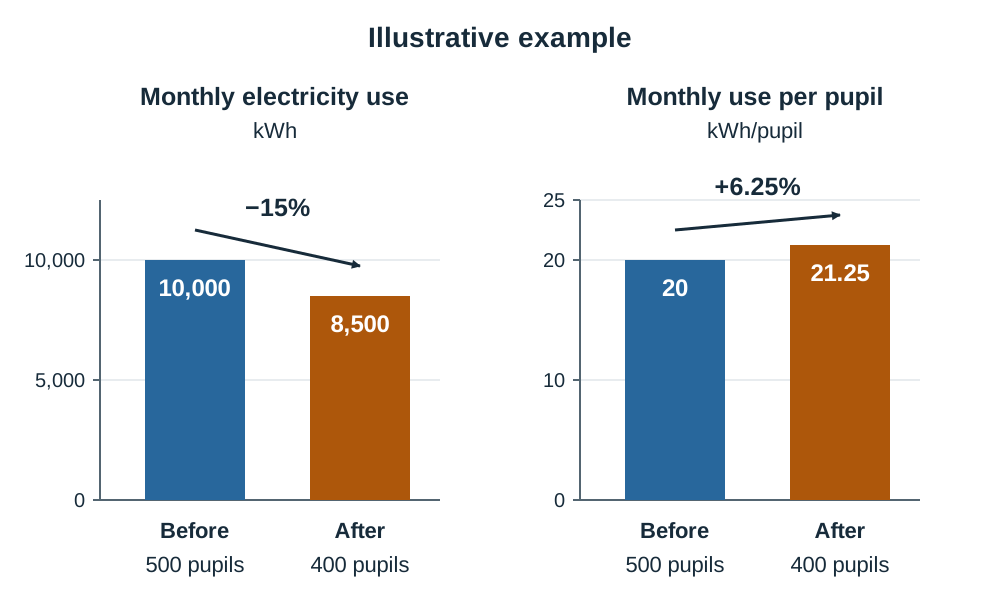
Similarly, distinguish between percentage points and relative percentage change. If active cycling to school increases from 20% of journeys to 30% of journeys, the increase is 10 percentage points, but the relative increase is:
Always interrogate confounding factors (alternative explanations). If electricity consumption drops during a classroom switch-off campaign, verify whether mild winter temperatures, boiler maintenance, school closures, or a newly installed LED retrofit were the true drivers of the reduction.
Real Named Irish Case Studies and the 2027 Action Project
Leaving Certificate responses require reference to genuine, named Irish initiatives rather than vague generalities. Ground your answers in established organisations and programmes:
- Green-Schools (An Taisce): Operating across primary and post-primary schools, this programme requires pupil committees to address thematic areas (Litter & Waste, Energy, Water, Travel, Biodiversity). Schools must establish documented baselines (bin audits, meter logs, hands-up travel surveys) before earning a Green Flag.
- Tidy Towns: A nationwide voluntary movement where local committees deliver biodiversity, circular economy, and climate initiatives. Annual published adjudication reports offer an independent, multi-year record of local progress and setbacks.
- SEAI Sustainable Energy Communities (SECs): A network supported by the Sustainable Energy Authority of Ireland where local communities complete an Energy Master Plan (EMP), establishing a documented baseline of local energy use to guide retrofit and renewable projects.
- Templederry Community Wind Farm, Co. Tipperary: A pioneering community-owned renewable energy initiative, demonstrating local ownership of energy generation and community revenue reinvestment rather than consumer conservation alone.
- Cloughjordan Ecovillage, Co. Tipperary: A planned sustainable community featuring district heating powered by renewable energy, low-carbon building materials, and a community-supported agriculture (CSA) farm.
- Local Authority Climate Action Plans: Every city and county council in Ireland has adopted a statutory five-year climate plan containing measurable local decarbonisation targets.
These analytical skills align directly with the SEC Action Project Brief for 2027 (Reducing Ireland's Greenhouse Gas Emissions). Section A of the coursework journal (Research to inform action, 350 words, 30 marks) requires students to research a group that has taken climate mitigation action, justify their choice, describe the action, analyse whether it was appropriate to achieve the aim, and evaluate its success using reliable sources.
Key terms
- Investigate
- To observe, study, or make a detailed and systematic examination, in order to establish facts and reach new conclusions.
- Mitigation
- Human interventions that reduce greenhouse gas emissions from sources or enhance greenhouse gas removal by sinks, tackling the causes of climate change.
- Adaptation
- Adjustments in ecological, social, or economic systems in response to actual or expected climatic stimuli and their effects, reducing vulnerability and moderating harm.
- Quantitative Evidence
- Empirical evidence expressed in numerical measurements, rates, or counts, demonstrating the scale and magnitude of an observed change.
- Qualitative Evidence
- Descriptive, contextual evidence collected via language, imagery, or observation, providing explanatory insight into attitudes, motives, and structural barriers.
- Primary Evidence
- First-hand data gathered directly by the student or investigator in the field, such as waste weigh-ins, hands-up surveys, or interviews.
- Secondary Evidence
- Data, reports, or research compiled and published by external individuals or organisations, including EPA inventories, SEAI datasets, or local authority plans.
- Triangulation
- The research practice of cross-checking findings across multiple independent sources or data collection methods to verify accuracy and expose bias.
- Collective Action
- Collaborative, organised efforts by groups, communities, or civil society to transform shared policies, infrastructure, or socio-economic systems, addressing root causes.
- Personal Behaviour
- Individual lifestyle choices and voluntary consumer habits that alter personal environmental footprints without necessarily changing systemic infrastructure.
- Root Cause
- The underlying institutional, economic, structural, or regulatory driver of an environmental problem, distinct from its visible immediate symptoms.
- Baseline Data
- Standardised measurements collected prior to an intervention to establish the starting benchmark against which subsequent change and effectiveness are calculated.
- Output
- The direct tangible product, event, or service delivered by an initiative, such as holding a workshop or installing segregated recycling bins.
- Outcome
- The measurable change in behaviour, resource use, or environmental conditions resulting from an action, such as a verified decrease in electricity consumption.
- Impact
- The enduring, systemic transformation of root causes, local policies, or socio-ecological systems, such as permanent amendments to municipal bylaws or public procurement contracts.
- Confounding Factor
- An external variable or unmeasured condition (such as weather variation, building retrofits, or timetable changes) that could explain an observed outcome independently of the action being tested.
Check yourself
What is the official curriculum definition of the command verb 'Investigate'?
To observe, study, or make a detailed and systematic examination, in order to establish facts and reach new conclusions.
Name five sources of evidence you could use to investigate a local action, and state one weakness of each.
News articles (often written at launch before outcomes exist); social media (curated and promotional, hiding failures); testimony (prone to social desirability bias); place-based visits (provide only a single snapshot in time); and records of previous initiatives (may suffer from gaps or changed measuring protocols).
Explain the difference between an output and an outcome using a school biodiversity garden as an example.
The output is the physical creation of the garden (e.g. planting 50 native shrubs and building bug hotels). The outcome is the verified ecological result (e.g. a measured 35% increase in pollinator species recorded during seasonal transect audits).
Classify each of the following as mitigation or adaptation: a school LED lighting retrofit; planting shade trees in a yard; a community wind farm; installing permeable paving in a car park.
School LED upgrade: mitigation; planting shade trees: adaptation; community wind farm: mitigation; permeable paving: adaptation.
You plan to interview the coordinator of a community garden and photograph the site. What three ethical and safety steps must you take first?
Obtain informed consent by explaining the purpose of the study and asking permission; follow school health and safety rules by agreeing the visit with a teacher and not going alone; and respect GDPR by keeping personal details anonymous and avoiding identifiable photographs of individuals.
A school canteen produced 90 kg of waste per week in September and 63 kg per week in December under identical pupil attendance. What is the percentage change?
((63 - 90) / 90) 100 = (-27 / 90) 100 = -30%. Waste fell by 30%.
State three of the six core features of 'effective action' highlighted in the specification.
Any three of the following: (1) is collective in nature, (2) addresses root causes rather than symptoms, (3) considers power and who holds it, (4) is based on solidarity with affected people, (5) is empowering and invites participation beyond the classroom, or (6) contributes to transforming global inequalities.