

Strand 2 (Learning Outcome 2.6) asks you to compare how an innovative community in Ireland and an innovative community from the Global South adapt to climate change through participatory problem-solving. In the Higher Level written paper (worth 300 marks or 60% of your grade), examiners expect you to evaluate local hazards, look closely at nature-based or engineered adaptations, judge how deeply residents actually participate, and weigh up differences in wealth and power using climate justice concepts. Don't mix this up with your Action Project (40% / 200 marks), which for 2027 focuses on cutting Ireland's emissions through climate mitigation.
Breaking Down the Learning Outcome
To tackle this question well, you need to understand exactly what the syllabus means by each phrase:
- Innovative community: A group of people who create or revive practical ways to handle a local threat. Innovation doesn't mean high-tech laboratories or expensive gadgets. Relearning traditional planting cycles or combining local volunteer work with coastal biology is genuine grassroots innovation.
- Participatory problem-solving: Local residents take the lead. They identify what is wrong, pick priorities together, and carry out the physical work, rather than waiting for an outside authority to hand down instructions.
- Global South: A political and economic grouping rather than a tidy line on a map. It refers to lower- and middle-income nations across Africa, Asia, Latin America, and Oceania. Most of these countries contributed very little to cumulative greenhouse gas emissions, yet their people deal with severe, frontline climate impacts.
- Compare: The official State Examinations Commission (SEC) action verb requires an account of similarities and differences, referring to both items throughout. Writing one page on Ireland followed by a separate page on Bangladesh is not a comparison; you must link them side by side in every paragraph.
The Higher Level paper is 300 marks, divided into Section A (60 marks), Section B (160 marks), and Section C (80 marks). A comparison of two communities needs several developed paragraphs, so learn both examples in enough detail to write a longer structured answer. A simple memory hook to keep your essays balanced is Hazard – Strategy – Participation – Justice.
Adaptation, Vulnerability, and Maladaptation
Before comparing communities, get the core terminology straight. Climate mitigation tackles the roots of the problem by cutting emissions or boosting carbon sinks, such as building wind farms or rewetting peat bogs. Climate adaptation, by contrast, means changing human habits, physical structures, and ecosystems to handle climate impacts that are already happening or locked in for the future.
A handy test is to ask yourself: would this project still be needed if global emissions dropped to zero tonight? Because past emissions have already heated the oceans and changed atmospheric patterns, storms will stay violent and sea levels will keep creeping up. Communities still need restored sand dunes and flood-proof crops. That ongoing protection is adaptation.
How much harm a community suffers comes down to exposure, vulnerability, and resilience. Exposure is simply whether people and buildings sit directly in harm's way, like cottages on an eroding sandy spit. Vulnerability is how badly they get hit, which depends on household income, physical health, home construction, and state emergency services. Resilience is the community's capacity to absorb the shock, clean up, and keep going without falling apart.
Adaptation measures fall into three main types. Hard engineered defences include concrete sea walls and rock revetments (a sloped rock or concrete facing built against the shore). Nature-based solutions protect, restore, or work with natural ecosystems, like replanting saltmarshes to break wave energy. Social and institutional measures involve early warning sirens, flood training, and revised zoning rules.
Be alert to maladaptation. This happens when a poorly thought-out project backfires. For example, building a rock sea wall can deflect wave energy down the shore, carving away the beach of an unprotected neighbouring village.
Evaluating Participatory Problem-Solving
The specification doesn't just ask what structures were built; it asks how the community worked together. When you study a project, use four practical checks to see whether it was genuinely participatory.
First, who spotted the problem and set the goals? Check whether local people raised the alarm themselves or whether an outside government department simply landed in the parish with a pre-packaged plan.
Second, who did the work on the ground? Real participatory problem-solving leans heavily on local volunteers, local materials, and local know-how rather than outsourcing everything to external contractors.
Third, who holds the reins once the project is finished? Sustainable adaptation needs a local committee, cooperative, or coastal group that keeps repairing structures and talking to residents month after month.
Finally, ask who was left out of the room. Notice whether women, smallholders, elderly people, and marginalised groups had an equal say, or whether traditional local leaders took all the decisions. An adaptation project can be an engineering success while completely failing on local democracy.
Irish Example: Sand Dune Restoration in the Maharees, Co. Kerry
Ireland's coastal climate pressures are clear: rising seas, heavier winter rainfall, and fierce Atlantic storms driving coastal erosion into soft coastlines.
The Maharees is a sandy tombolo—a narrow spit of land linking the Dingle Peninsula to a rocky headland in County Kerry. A small resident population lives on this low-lying sand bar, joined to the mainland by a single access road. During the destructive winter storms of 2013 and 2014, massive Atlantic swells stripped metres of sand off the protective foredunes, threatening homes, pasture, and the road.
Local residents refused to sit back. They set up the Maharees Conservation Association and chose a nature-based adaptation route rather than demanding a massive concrete wall.
Volunteers spend weekends planting sprigs of marram grass (Ammophila arenaria) into exposed dunes. Marram grass sends out deep, fibrous roots that knit loose sand grains together, while its stems trap windblown sand to rebuild the foredune naturally. The group put up chestnut pale fencing to catch moving sand, laid wooden boardwalks to keep walkers off delicate dune faces, and marked designated car parks to stop cars crushing vegetation.
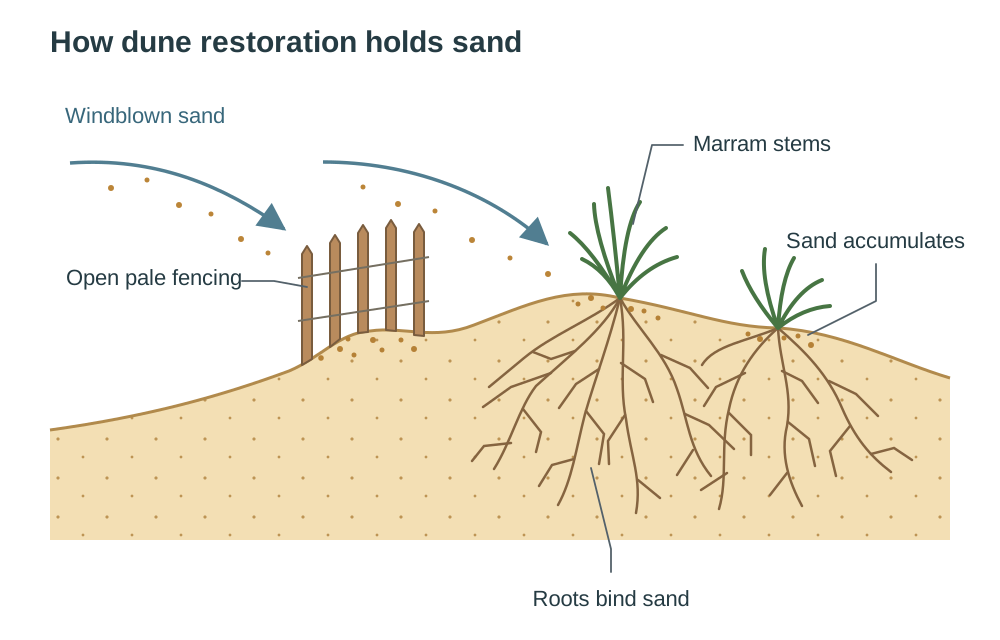
Crucially, the community brought in outside support on their own terms. They invited coastal geomorphologists from University College Cork and University of Galway to set up scientific beach-monitoring posts, and secured funding grants from Kerry County Council, the Office of Public Works (OPW), and the National Parks and Wildlife Service (NPWS).
Even so, this approach has clear limits. Grass roots cannot hold back an overwhelming storm surge if sea levels jump rapidly, and the system relies on unending volunteer hours and continued state grants.
Global South Example: Floating Gardens (Baira) in Southwest Bangladesh
In the delta districts of southwest Bangladesh, such as Gopalganj, Pirojpur, and Barisal, smallholders live along vast river channels. Climate change has intensified the monsoon rains and pushed higher tides up the Bay of Bengal, leaving crop fields waterlogged for five to eight months every year. Conventional crops drown, soils turn salty, and farm families face severe food shortages.
Rather than abandoning their land, farming communities revived and improved an indigenous agricultural practice called baira, or floating gardens.
Farmers harvest water hyacinth, an invasive freshwater weed that chokes local waterways during the monsoon. They layer the weeds on the water, weave in duckweed and crop stubble, and tread the mass down into thick, buoyant rafts up to two metres wide and twenty metres long.
Farmers then plant vegetables such as spinach, okra, gourds, and pumpkins into small starter balls made of compost, cow dung, and shredded coconut fibre placed across the raft surface. As the monsoon floodwaters rise and fall, the rafts float, keeping the crops safely above the dirty water.
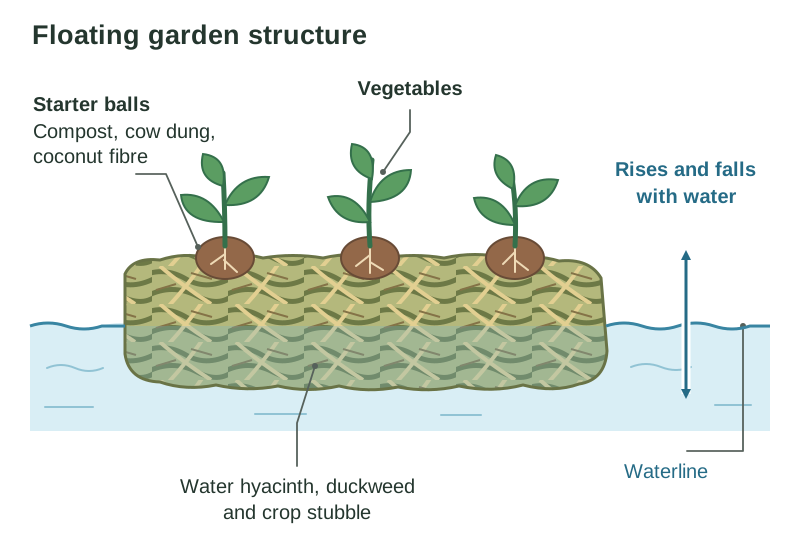
When the monsoon drains away, the rotting water hyacinth is shredded and worked into the soil as organic fertiliser, saving farmers from buying synthetic inputs. Village cooperatives and women's self-help groups run the seedling production, giving women their own income through seedling sales.
Just like the Maharees, baira has boundaries. The floating rafts can't stop a category 4 cyclone from ripping through villages, nor can they save mud homes on land. High river salinity during dry periods can also rot the hyacinth rafts early.
Comparative Analysis: Kerry versus Bangladesh
When answering an exam question, set your two examples side by side under clear comparative headings:
- Hazard: Both communities fight water-driven climate hazards. The Maharees defends against Atlantic wave energy, storm surges, and dune loss, whereas Bangladeshi villagers adapt to long-term freshwater flooding and saltwater intrusion.
- Strategy: Both chose nature-based solutions using local plant biology rather than concrete barriers. The Maharees uses marram grass roots to rebuild a coastal sand buffer; Bangladeshi farmers weave invasive water hyacinth into floating garden beds to keep crops above floodwaters.
- Knowledge and participation: Both rely on community labour and local committee meetings. The Maharees blends local volunteer effort with university beach monitoring and county council grants. In Bangladesh, communities rely on traditional farming knowledge passed down through generations, organised through village cooperatives and women's groups.
- Resources and state backing: This is the sharpest contrast. The Maharees draws on Irish state grants, local authority support, and university partnerships. Bangladeshi smallholders work with tiny NGO micro-grants and wild materials, depending almost entirely on their own unpaid manual labour.
- Limits: Both measures build real community resilience, but neither can stop catastrophic losses once an extreme climate threshold is crossed. Severe storm surges can wash away planted dunes, and major cyclones destroy floating rafts and village homes alike.
Climate Justice, Climate Debt, and Loss & Damage
Adaptation is never just a technical question. It is always about power, money, and fairness. Thinking about adaptation through a climate justice lens means asking hard questions about who caused the damage and who pays for the fix.
Distributive justice considers how resources and burdens get divided. Wealthy industrial countries built their modern economies on two centuries of heavy fossil fuel use. Ireland enjoys strong adaptive capacity, backed by tax revenues, engineering bodies, and social safety nets. Bangladesh, meanwhile, has tiny per-capita emissions, yet its farmers must invent ways to survive on floodwaters without national safety nets.
This gap underpins the idea of climate debt: wealthy countries consumed far more than their fair share of the global carbon budget and therefore owe financial and technological support to vulnerable nations. Ecological debt covers an even broader historical wrong, including centuries of resource stripping and colonial exploitation in the Global South.
Procedural justice requires that the people most affected have a real say in decisions. In southwest Bangladesh, where women manage household water, cooking, and child welfare, putting women in charge of seedling nurseries gives them direct authority over food security.
Finally, every adaptation strategy hits a wall when climate extremes overwhelm local efforts. When land vanishes permanently beneath the ocean or cyclones wipe out whole parishes, adaptation is no longer possible. That irreversible destruction is what the United Nations terms loss and damage, which requires direct compensation rather than simple advice.
Alternative Global South Example: Sand Dams in Kitui County, Kenya
If your class looked at drought instead of delta flooding, sand dams in semi-arid south-eastern Kenya make a strong Global South study.
In Kitui County, smallholder families depend on rain-fed farming. Climate change has made the two normal rainy seasons erratic, bringing severe droughts punctuated by violent downpours that strip topsoil from bare ground.
Working with local organisations like the Africa Sand Dam Foundation, communities build sand dams across seasonal, dry river channels. Groups of neighbours build a reinforced concrete wall across the gully. During flash floods, the wall stops heavy sand while water spills over. Over several wet seasons, sand piles up behind the wall until the trench fills completely.
Up to 40% of the volume of that sand deposit is water trapped between the grains. Because this clean water sits underground, the scorching sun cannot evaporate it, livestock cannot foul it, and mosquitoes cannot breed in it. Local residents dig shallow wells into the sand to draw clean water year-round.
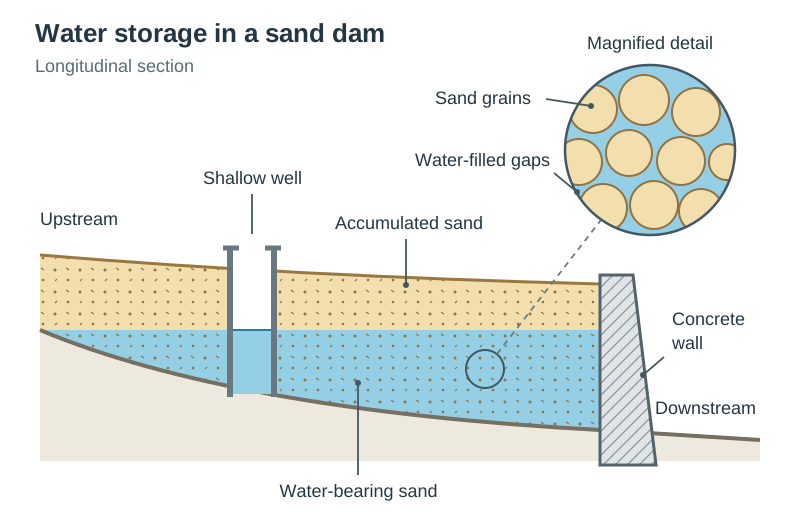
Village water committees, often led by women, mobilise labour and manage extraction rules. Having water close to home cuts walking times by several hours each day, letting girls attend school and giving women time to grow vegetables.
Yet sand dams cannot conjure water out of nothing. If the rains fail completely across multiple years, the sand stays dry.
Key terms
- Climate Adaptation
- Adjusting human practices, infrastructure, and ecosystems to moderate harm or take advantage of opportunities caused by actual or expected climate impacts.
- Climate Mitigation
- Interventions that cut greenhouse gas emissions at their source or expand carbon sinks to slow down global warming.
- Exposure
- The physical presence of people, homes, infrastructure, or ecosystems in locations that can be directly struck by climate hazards.
- Vulnerability
- The tendency of a community or system to be harmed by climate hazards, shaped by its sensitivity and lack of resources to cope.
- Resilience
- The capacity of a community or ecological system to absorb shocks, recover from disruptions, and adapt while maintaining its core functions.
- Nature-Based Solutions (NbS)
- Actions that protect, sustainably manage, and restore ecosystems to tackle societal challenges while benefiting human wellbeing and biodiversity.
- Maladaptation
- Adaptation actions that inadvertently increase vulnerability, damage natural ecosystems, or shift climate risks onto other communities.
- Participatory Problem-Solving
- A collective approach where local community members identify problems, decide actions democratically, and carry out work together.
- Climate Debt
- The moral and financial obligation owed by wealthy, high-emitting nations to low-emitting countries for using more than their fair share of the global carbon budget.
- Ecological Debt
- The historical debt accumulated by industrialised countries through resource extraction, environmental destruction, and colonial exploitation in the Global South.
- Loss and Damage
- Irreversible negative impacts of climate change that happen when climate effects push beyond what human adaptation or ecosystems can manage.
- Adaptive Capacity
- The combination of resources, institutions, wealth, and skills available to a community to prepare for and respond to climate impacts.
Check yourself
What is the key difference between climate adaptation and climate mitigation?
Mitigation tackles the causes of climate change by reducing emissions or expanding carbon sinks, while adaptation handles the consequences by altering human practices and environments to reduce harm.
Explain the difference between exposure and vulnerability using a coastal town.
Exposure means sitting physically in the path of a hazard, like houses built on a low-lying beach. Vulnerability is how badly those households get hurt, which depends on wealth, house structure, and access to emergency services.
How does marram grass help protect the Maharees coastline?
Its deep, fibrous root system binds loose sand grains together, while its surface shoots trap windblown sand, rebuilding foredunes that absorb Atlantic storm waves.
What materials are used to construct baira floating gardens in Bangladesh, and what climate threat do they address?
They are woven from water hyacinth, duckweed, and crop stubble. They address prolonged monsoon flooding by floating atop floodwaters, keeping crops dry and productive.
How does a sand dam in Kenya keep water clean and prevent it from evaporating during dry spells?
It traps coarse sand carried by seasonal flash floods, storing water in the pore spaces between sand grains underground, where the sun cannot evaporate it and mosquitoes cannot breed.
What does 'maladaptation' mean?
An adaptation action that backfires, accidentally increasing vulnerability to climate hazards, harming ecosystems, or shifting risks onto another group.
Why is the concept of climate debt important when comparing Irish and Global South adaptations?
It highlights that wealthy nations built their economies on fossil fuels and generated historical emissions, so they have a moral and financial duty to help low-emitting frontline communities adapt.