

A personal behaviour is something one person changes about their own life. Systemic change alters the rules, funding, or infrastructure so that everybody's default choice changes. This topic asks you to judge how far the first can go, and why the second is needed. Under Strand 2 Learning Outcome 4 of Leaving Certificate Climate Action and Sustainable Development, Higher Level students examine the impact and effectiveness of personal behaviours and compare them to collective actions that aim for wider systemic transformation through addressing root causes. Understanding these dynamics is central to the 300-mark written examination (60%) and to the coursework Action Project (40%), which for 2027 focuses on reducing Ireland's greenhouse gas emissions against our legally binding 2030 targets.
Personal Behaviour: Impact, Limitations, and the Rebound Effect
Personal environmental behaviours are the day-to-day choices people make to cut their direct ecological footprint. In Ireland, these lifestyle actions generally fall into five areas:
- Active and public travel: walking, cycling, or taking public buses and trains instead of driving a petrol or diesel car.
- Dietary adjustments: eating less beef and dairy, or choosing seasonal, plant-rich foods to lower agricultural methane and land pressure.
- Home energy conservation: lowering the thermostat, switching appliances off at the socket rather than leaving them on standby, and draught-proofing doors and windows.
- Waste diversion: composting food scraps, choosing reusable items, and sorting dry recyclables.
- Mindful consumption: wearing clothes for longer, avoiding fast fashion, and repairing household goods.
Quantifying personal impact
To understand personal action, you have to measure it against national totals. Take transport: a student who cycles a 10 km round trip to school on roughly 180 school days avoids about 1 800 km of car travel. Assuming an average petrol car emits 0.15 kg of carbon dioxide per kilometre, that saves about 270 kg (0.27 t) across the school year. Always state your assumptions like this; examiners reward clear units and logical working over memorised numbers.
Now put that saving in context. Ireland's total greenhouse gas emissions stand at roughly 55 to 60 million tonnes of equivalent () per year. According to the Environmental Protection Agency (EPA), emissions break down across sectors roughly as follows:
- Agriculture: roughly one third (methane from livestock, nitrous oxide from fertilisers)
- Transport: roughly one fifth (cars, freight, aviation)
- Energy industries: roughly one seventh (electricity generation)
- Residential heating: roughly one tenth (kerosene, gas, solid fuels)
- Manufacturing combustion and industrial processes: the remainder
The scale-up test
A single student's 0.27 tonnes looks vanishingly small against 55 million tonnes. What happens if everyone does it? Suppose every one of Ireland's 5.4 million people cuts 0.25 tonnes of per year through active travel:
$$ of national emissions.
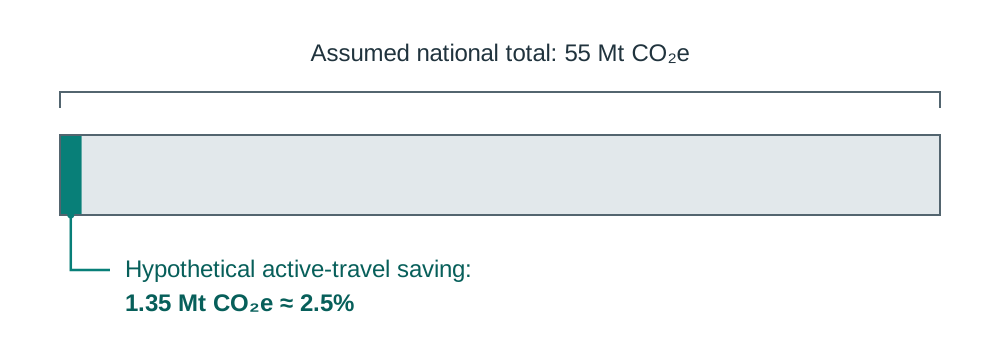
Even with universal, perfectly maintained behaviour change, the saving is about 2.5%. Ireland's legally binding target under the Climate Action and Low Carbon Development (Amendment) Act 2021 is a 51% cut by 2030 on 2018 levels. This calculation shows why personal action alone cannot reach national targets: the rest of the cut requires structural shifts in electricity, agriculture, public transport, and housing.
Hidden assumptions and the rebound effect
Personal behaviours rest on hidden privileges. Cycling assumes a person owns a working bicycle, has the physical health to ride it, and has access to safe, lit roads. Choosing active travel leaves the underlying root cause untouched: a transport system built around private cars.
The idea of an individual carbon footprint was heavily promoted in the mid-2000s by the oil company BP through an advertising campaign featuring a personal footprint calculator. Many analysts argue this was an effort to shift public scrutiny from fossil fuel extraction onto private individuals.
Personal savings can also trigger the rebound effect. This happens when money or energy saved through an eco-friendly habit is spent on another carbon-intensive activity. A household that saves €400 a year by dialling down the thermostat might use that money to book a weekend flight, cancelling out the emissions avoided.
Judging Effectiveness: The Six Tests
Strand 2 Learning Outcome 4 requires you to examine both the impact (how much carbon is saved) and the effectiveness (how well the action works in practice) of personal behaviour. Do not stop at calculating emissions. Test any personal behaviour against these six criteria:
- Scale: How large is the saving compared to Ireland's national total of roughly 55 million tonnes of ?
- Speed: How quickly does the reduction occur? (Personal behaviour changes can start tomorrow; building a light-rail line or retrofitting a million homes takes years.)
- Permanence: Does the saving last if someone loses motivation, changes jobs, or moves house? Individual habits can reverse overnight, whereas laws and built infrastructure stay in place.
- Scalability: Can everyone adopt this behaviour, or is it restricted to people with specific incomes, housing arrangements, or health?
- Equity: Who can afford to take this action, and who gets unfairly blamed if they cannot?
- Root causes: Does the behaviour alter the economic and political system producing the emissions, or merely manage the individual's slice of them?
Applying the six tests: dietary change
Consider cutting beef consumption to lower agricultural emissions:
- Speed: passes. A person can switch to plant-based meals immediately.
- Root cause: passes partially. Lower demand reduces incentives for high-emission livestock farming.
- Scale: weak. A single person's dietary shift saves a few hundred kilogrammes of emissions a year.
- Permanence: fails. The individual can drop the diet at any point because supermarkets still stock cheap processed meats.
- Scalability: fails. Nothing in European Union Common Agricultural Policy subsidies or Irish food pricing has changed to make plant-based eating the default for everyone.
Privilege, Capacity for Action, and Just Transition
A central rule of climate justice is that capacity for action is unequal. An individual's ability to live sustainably depends on their income, housing tenure, and location. Expecting everyone to adopt identical lifestyle habits ignores four structural barriers in Ireland:
- Upfront financial capital: Deep retrofitting a home with an air-to-water heat pump, solar PV panels, and external insulation costs tens of thousands of euro. Even with grants from the Sustainable Energy Authority of Ireland (SEAI), the required cash co-funding excludes lower-income families from energy efficiency.
- Housing tenure: Renters in private accommodation or social housing have no legal right to alter their building fabric. A tenant cannot install double glazing, insulate external walls, or replace an inefficient kerosene boiler, leaving them trapped in fuel poverty regardless of their personal values.
- Settlement patterns and rural infrastructure: In Dublin or Cork, where bus lanes, Luas tracks, and rail stations exist, going car-free is achievable. In rural Ireland, dispersed one-off housing and limited rural bus routes make running a car essential for reaching work, school, and groceries.
- Mobility and caring demands: Shift workers, parents with multiple caring responsibilities, and people living with physical disabilities often cannot walk or cycle several kilometres daily.
At the same time, wealthier households usually produce the highest total emissions: more flights, larger homes to heat, and greater overall consumption, even when they buy organic groceries or drive an electric vehicle. Those with the greatest financial power to act are often the heaviest emitters.
Connecting privilege to just transition
These same inequalities shape national transitions. If a carbon tax increases without alternatives in place, a rural tenant in a draughty house with no bus route pays more tax with no way to avoid it. A wealthier family simply upgrades their heating and switches cars. Effective collective action is therefore based on solidarity with the most exposed groups.
A just transition ensures that the move to a low-carbon economy protects vulnerable workers and communities rather than leaving them to bear the costs alone. When Bord na Móna ceased commercial peat harvesting in the Midlands, the State and the EU introduced a dedicated Just Transition Fund to retrain workers for deep retrofitting and peatland rehabilitation. Systemic climate action asks who pays as well as what gets cut.
Symptom vs Root Cause and Collective Action Strategies
Where personal behaviour manages surface symptoms, collective action brings people together to challenge decision-makers, reform laws, and transform institutions. To achieve systemic transformation, an action must target root causes of climate injustice such as continuous-growth capitalism, fossil fuel subsidies, and corporate lobbying.
Symptom or root cause? Pair them up
| Symptom-level action | Root-cause action on the same issue |
|---|---|
| A school litter clean-up | Campaigning for Extended Producer Responsibility (EPR) so that producers, not householders or councils, must pay for collecting and recycling the packaging they put on the market — with higher charges for packaging that is hard to recycle. |
| Bringing a reusable bottle | The Deposit Return Scheme (2024) placing a statutory refundable deposit on drinks containers nationwide |
| Turning down the thermostat | Demanding State-funded deep retrofits for social and low-income housing so the home retains heat |
| Choosing to cycle on busy roads | Lobbying local councils to build segregated, grade-separated cycle tracks that protect all ages |
| Switching to a green electricity tariff | Implementing legally binding carbon budgets under the 2021 Act to force the entire national grid to decarbonise |
Use this quick rule: if this individual stopped doing it tomorrow, would the wider system change? If not, it is a symptom-level action.
Named strategies for collective action
The CASD specification identifies seven explicit strategies used by social movements to achieve change:
- Lobbying: Meeting, writing to, or petitioning elected officials and planners to change legislation. Example: environmental coalitions submitting evidence on the national Climate Action Plan.
- Community organising: Mobilising local residents around shared goals and shared governance. Example: SEAI Sustainable Energy Communities where neighbours cooperate on community-wide energy audits and group retrofits.
- Trade union organising: Mobilising organised workforces to protect employment conditions during industrial change. Example: unions negotiating retargeted employment and pensions as peat harvesting ended in the Midlands.
- Legal action: Using the courts to compel governments or corporations to obey environmental law. Example: Climate Case Ireland (2020), where Friends of the Irish Environment challenged the 2017 National Mitigation Plan. The Supreme Court quashed the Plan because it was too vague and failed to specify how Ireland would meet the national transition objective under the Climate Action and Low Carbon Development Act 2015.
- Civil disobedience: Non-violently breaking specific regulations to draw urgent public and political attention to an emergency. Example: school strikes for climate and sit-down blockades of fossil fuel infrastructure.
- Boycott: Organising consumers to withhold purchases from a company until it changes damaging practices. Example: consumer boycotts targeting fast-fashion brands linked to worker exploitation and excessive waste.
- Creative arts expression: Using murals, theatre, poetry, or installations to alter public perception and build community solidarity around climate loss.
The six features of effective action
The specification sets out six features of effective action. Genuine collective action:
- Is collective in nature, bringing people together rather than acting in isolation.
- Aims to address root causes of climate and sustainability issues, rather than just managing symptoms.
- Considers power, analysing who holds decision-making authority in that context.
- Is based on solidarity with people affected by climate and sustainability issues.
- Is empowering and invites participation from people and communities beyond the school or classroom.
- Contributes to and addresses the transformation of global inequalities.
Comparing Personal Behaviour and Systemic Transformation
Personal behaviour and systemic change are not rival approaches; they reinforce each other in a continuous cycle.
- Individual adoption: People begin adopting sustainable habits, such as cycling, sorting waste, or eating plant-based foods.
- Cultural normalisation: These visible habits shift everyday social expectations and build civic awareness.
- Collective organising: Community groups and campaigns harness that public interest to lobby councils, run legal challenges, or organise boycotts.
- Structural policy and infrastructure: Decision-makers respond with statutory regulations, subsidies, and physical infrastructure, such as dedicated cycle corridors or container return schemes.
- The new default: Low-carbon choices become easy, affordable, and normal for people who could never have made them through individual effort alone.
Comparison grid
When exam questions ask you to compare personal and collective action, use these criteria as paragraph themes:
| Criterion | Personal behaviour | Collective action for systemic transformation |
|---|---|---|
| Who acts | An individual person or single household | Organised communities, trade unions, civic coalitions, or the courts |
| What changes | The individual's own consumption or carbon output | Laws, market regulations, infrastructure, and fiscal policy |
| Target of action | The symptom (my immediate emissions) | The root cause (the rules and institutions creating emissions) |
| Scale of effect | Kilogrammes or tonnes per year | Megatonnes; applies across entire populations and industries |
| Speed | Immediate to start | Slower to organise, but creates rapid society-wide changes once enacted |
| Durability | Can be reversed tomorrow if motivation drops | Locked in by legislation, court judgments, or physical concrete infrastructure |
| Accessibility | Restricted by income, housing tenure, health, and geography | Built to transform defaults so that low-income or vulnerable citizens benefit directly |
| Relationship to power | Leaves existing power dynamics untouched | Directly challenges institutions, governments, and corporations holding authority |
Sentence stems for comparative writing
To keep your writing integrated rather than splitting your answer into two disconnected essays, practice these comparative sentence structures:
- Whereas the personal behaviour of [Action A] manages only the individual's direct emissions, collective action through [Strategy B] confronts the root cause by...
- Both approaches reduce transport emissions, but they differ in durability: an individual cyclist can be forced back into a car by bad weather or poor health, while a segregated cycle track locked in by local planning permanently...
- The personal choice to install a heat pump is limited to affluent homeowners with capital, while collective campaigns for State retrofits transform the default for...
Applying Topic 2.4 to the 2027 Action Project
The coursework Action Project accounts for 40% (200 marks) of your Leaving Certificate CASD grade. The common brief for the 2027 examination sets the topic: Reducing Ireland's Greenhouse Gas Emissions, with a focus on any sector, against Ireland's legally binding target of a 51% reduction on 2018 levels by 2030.
Your project must be submitted as a digital Action Project Journal of at most 1,800 words across four prescribed sections. The journal is the sole assessed artefact: anything you do that is not written up in the journal receives zero marks. The journal must contain no more than 10 images, and videos are not permitted. In-text citations and the bibliography do not count towards the 1,800-word limit. Always verify the official submission date with your teacher.
Section-by-section breakdown
- Section A: Research to inform action (30 marks, ~350 words): Research the brief and choose an existing group that took action. Evaluate whether their work tackled a root cause or remained at symptom level, and explain how their methods informed your own ideas.
- Section B: Planning for and taking action (70 marks, ~900 words): Move beyond an isolated personal behaviour. Rather than asking classmates to turn off classroom lights, plan an action that engages your school management, community council, or local businesses to alter rules or equipment permanently. Describe your individual contribution clearly.
- Section C: Reflection and evaluation (60 marks, ~550 words): Reflect critically on what worked and what failed. A high-scoring reflection explores capacity for action: reflect honestly on who in your school or community was unable to participate due to lack of transport, money, or time, and explain how this deepened your understanding of climate justice.
- Section D: References and bibliography: List full reference details for every primary and secondary source consulted, including publications from the EPA and SEAI.
- Communication, innovation, and coherence (40 marks): These marks are assessed across the entire journal. They reward clear writing, well-chosen visuals, and consistent presentation rather than forming a separate written section.
Key terms
- Examine
- Action verb, as defined in the glossary of action verbs in the subject specification (Appendix 1): consider an argument or concept in a way that uncovers the assumptions and relationships of the issue.
- Compare
- Action verb, as defined in the glossary of action verbs in the subject specification (Appendix 1): give an account of the similarities and (or) differences between two (or more) items or situations, referring to both (all) of them throughout.
- Personal Behaviour
- An individual lifestyle decision or habit, such as active travel, home energy conservation, or dietary change, taken to lower direct environmental impact.
- Collective Action
- Coordinated activity undertaken by groups, communities, trade unions, or civic campaigns to challenge decision-makers and secure systemic reform.
- Systemic Transformation
- Fundamental structural change to legal, economic, political, and infrastructural systems that alters the default choices for the whole of society.
- Root Causes of Climate Injustice
- The underlying structural drivers of ecological breakdown—such as continuous-growth capitalism, fossil fuel dependence, and corporate influence—rather than immediate surface symptoms.
- Capacity for Action
- The practical ability an individual or group has to respond to climate change, determined by income, housing tenure, geographical location, health, and social power.
- Carbon Footprint
- The total greenhouse gas emissions caused directly and indirectly by an individual, organisation, or product, expressed in carbon dioxide equivalent (CO2e).
- Rebound Effect
- A phenomenon where financial or efficiency savings achieved by an environmental action are spent on other carbon-intensive activities, offsetting emissions reductions.
- Just Transition
- A framework ensuring that the shift to a low-carbon economy distributes costs and benefits equitably, protecting workers and vulnerable communities from bearing unfair burdens.
Check yourself
Ireland has a statutory target to cut emissions by 51% by 2030. Using figures, explain why universal individual behaviour change alone cannot deliver this target.
Multiplying an individual saving of 0.25 t CO2 across Ireland's 5.4 million people saves roughly 1.35 Mt CO2e per year. Against national emissions of around 55 Mt, that represents roughly 2.5%, proving that structural transformations in energy, transport, and agriculture are essential to achieve a 51% cut.
Give one personal behaviour, one root cause it leaves untouched, and one collective action that targets that root cause.
Personal behaviour: bringing a reusable water bottle. Root cause left untouched: corporate production and retail of single-use plastic bottles. Collective action targeting root cause: introducing the statutory Deposit Return Scheme (2024), placing a refundable deposit on all plastic bottles and aluminium cans nationwide.
List four of the six features of effective action set out in the subject specification.
Any four of: (1) is collective in nature; (2) aims to address root causes rather than symptoms; (3) considers who has power; (4) is based on solidarity with affected people; (5) is empowering and invites broader participation; (6) contributes to and addresses the transformation of global inequalities.
Why does housing tenure create an unequal capacity for action regarding residential energy upgrades?
Tenants in private or local authority rental housing lack legal permission to alter building structures (such as installing wall insulation or a heat pump) and have no financial incentive to fund permanent capital improvements on a landlord's asset, leaving them locked into energy-inefficient housing.
Outline the significance of Climate Case Ireland (2020) as an example of collective action.
Friends of the Irish Environment used legal action in the Supreme Court, which quashed the State's 2017 National Mitigation Plan for being too vague to show how Ireland would achieve its statutory national transition objective under the 2015 Act. It demonstrates citizens using the courts to hold the State accountable rather than individuals changing private consumption.
A commuter replaces 1 200 km of petrol car driving with cycling over one year. Assuming the car emitted 0.15 kg CO2 per km, calculate the mass of CO2 avoided.
1 200 km × 0.15 kg CO2/km = 180 kg CO2 (or 0.18 t CO2).