

Ireland needs more housing, warmer homes, and reliable electricity, but it also needs to halve emissions by 2030 and halt biodiversity loss. Sustainable development is the attempt to reconcile human progress with the ecological limits of our planet, meeting current needs without destroying the living conditions future generations will rely on. At Higher Level, you must be able to trace where this idea came from, contrast the weak and strong models of sustainability, evaluate the limits of Gross Domestic Product (GDP), and critique both conventional development and sustainable development itself.
The Meaning and Evolution of 'Development'
Before you can judge sustainable development, you need to know what people usually mean by 'development'. In post-war global politics, development was treated as synonymous with industrialisation, rising consumption, and economic growth, measured primarily by Gross Domestic Product (GDP)—the total monetary value of all finished goods and services produced within a country in a year.
In 1949, US President Harry Truman described much of the world as 'underdeveloped areas', framing Western industrial technology and capital investment as the universal solution. In 1960, economist W.W. Rostow formalised this into a linear model ('Stages of Economic Growth'), arguing that every society passes along the same five-stage path from traditional agrarian subsistence to high mass consumption.
This growth-centred paradigm faces several fundamental critiques:
- GDP measures the flow of money, not how well people live: Simon Kuznets, who helped design national income accounting, warned that GDP is not a measure of welfare. GDP counts transactions regardless of whether they cause harm or benefit. Clearing up an oil spill, rebuilding after storms, or prescribing antidepressants all increase GDP, while unpaid family care, community volunteering, and intact ecosystems register as zero economic value.
- The Irish GDP distortion: In 2015, Ireland's official GDP surged by 26% in a single year. This was caused by multinational corporations moving intellectual property and balance sheets on paper rather than any real change in domestic living standards. Because GDP is distorted by global accounting, the Central Statistics Office (CSO) devised *Modified Gross National Income (GNI)** to measure the actual size of the domestic economy.
- Externalisation of environmental damage: Conventional accounting treats resource depletion, toxic pollution, and emissions as external costs offloaded onto public healthcare, vulnerable communities, and unborn generations rather than costs paid by the producing business.
- Colonial extractivism and ecological debt: Dependency theorists point out that historical development in the Global North relied on extracting raw materials and agricultural commodities from colonised territories. This created an enduring ecological debt, where high-consuming nations exhausted global atmospheric and ecological space while leaving environmental degradation and poverty in the Global South.
Alternative Measures: The Human Development Index
If GDP is an incomplete measure, what else is used? The most widely accepted international alternative is the Human Development Index (HDI), created by the United Nations Development Programme (UNDP) in 1990 and designed by economists Mahbub ul Haq and Amartya Sen. The HDI scores countries between 0 and 1 using three dimensions:
- Health: measured by life expectancy at birth.
- Education: measured by expected and average years of schooling.
- Standard of living: measured by gross national income per person.
The HDI treats income as a means to a good life rather than the ultimate goal. However, high human development in countries like Ireland is currently achieved alongside high per capita carbon emissions and resource consumption, demonstrating that a high HDI score does not automatically make development sustainable.
The Three Pillars of Sustainable Development
Sustainable development rests on three interconnected dimensions (or pillars). A policy or development proposal is only sustainable if it holds up across all three:
- Environmental: protecting ecosystems, water, air, soil, and climate within natural carrying capacities (e.g. rewetting a raised bog so it stores carbon instead of releasing it).
- Social: meeting basic human needs equitably and ensuring democratic inclusion (e.g. targeting home retrofitting grants at low-income households experiencing energy poverty).
- Economic: providing long-term, viable livelihoods that do not depend on depleting the natural resource base (e.g. creating skilled, secure jobs in renewable energy installation).
Origins and Timelines of Sustainability
Long before international summits, communities managed resources within environmental limits through local traditions and customary laws. In Ireland, the historic tradition of meitheal—neighbours pooling their labour at harvest or for cutting turf—demonstrated community cooperation to meet shared needs. Similarly, the Haudenosaunee (Iroquois) 'seventh generation' philosophy requires community leaders to consider how every major decision will affect descendants living seven generations into the future.
Core Milestones to Know
You do not need to memorise dozens of dates. Focus on four pivotal milestones:
- 1962 – Silent Spring (Rachel Carson):* Documented the ecological damage caused by synthetic chemical pesticides such as DDT, sparking the modern global environmental movement.
- 1972 – The Limits to Growth (Club of Rome) and the UN Stockholm Conference:* MIT computer simulations showed that endless industrial and population growth would overshoot physical limits; Stockholm was the first major UN conference to focus directly on environmental degradation, establishing the United Nations Environment Programme (UNEP).
- 1987 – Our Common Future (The Brundtland Report):* Published by the UN World Commission on Environment and Development, this established the standard international definition of sustainable development.
- 2015 – The Sustainable Development Goals (SDGs) and the Paris Agreement: All 193 UN member states adopted 17 universal, integrated goals. Concurrently, the Paris Agreement established the collective long-term goal of holding global temperature rise well below 2°C and pursuing 1.5°C above pre-industrial levels, binding countries to submit and update Nationally Determined Contributions (NDCs).
Memory hook: warning (1962) → modelling (1972) → definition (1987) → goals (2015).
Other notable developments include Hans Carl von Carlowitz formulating 'sustained yield' forestry in Germany (1713), the 1980 World Conservation Strategy (which brought the term 'sustainable development' into mainstream international policy use), the 1992 Rio Earth Summit (which created Agenda 21, the UNFCCC, and the Convention on Biological Diversity), and the 2000 Millennium Development Goals (MDGs, which focused largely on developing nations and isolated environmental targets in Goal 7).
Sustainability versus Sustainable Development
Students frequently use these two terms interchangeably in exams, but they represent distinct concepts:
- Sustainability is the long-term destination: the capacity of natural and human systems to endure indefinitely without depleting resources faster than they regenerate or producing waste faster than it can be absorbed.
- Sustainable development is the process or pathway: the intentional actions, policies, and systemic changes societies use to improve human wellbeing while staying within those ecological limits.
Think of sustainability as the destination and sustainable development as the road we travel to get there.
Unpacking the Brundtland Framework: Needs, Limits, and Equity
The formal definition formulated in Our Common Future (1987) is the standard baseline used in international policy:
"Development that meets the needs of the present without compromising the ability of future generations to meet their own needs."
Rather than an open-ended slogan, the Brundtland Commission explicitly anchored this definition upon two interdependent concepts:
- The concept of needs: specifically the essential needs of the world's poor, which should receive overriding priority.
- The idea of limitations: the boundaries imposed by technology and social organisation on the environment's ability to meet present and future human needs.
From these foundations emerge two distinct ethical principles:
- Intergenerational equity: Fairness between present generations and future generations not yet born. It requires us to preserve ecological life-support systems, soils, and climate stability so future people inherit a viable planet.
- Intragenerational equity: Fairness among people alive today. It demands that conservation cannot come at the expense of human survival. A wealthy minority cannot consume the vast majority of resources while expecting poorer communities in the Global South to endure deprivation.
Carrying Capacity and Planetary Boundaries
Brundtland's 'limitations' are defined scientifically through two related concepts:
- Carrying capacity: The maximum population size, resource consumption, and waste generation that a given ecosystem can sustain indefinitely without undergoing degradation.
- Planetary boundaries: A scientific framework led by Johan Rockström (2009) identifying nine Earth-system processes (including climate change, freshwater use, land-system change, and biogeochemical flows of nitrogen and phosphorus) that define a safe operating space for humanity. Exceeding these boundaries risks triggering irreversible environmental changes.
Weak versus Strong Sustainability: Pillars and Models
To evaluate sustainable development critically, you must understand the distinction between two competing economic models.
First, consider the two types of assets societies rely on:
- Natural capital: The stock of physical and biological assets provided by nature, including freshwater, fertile soil, forests, mineral deposits, pollinating insects, and a stable climate.
- Manufactured capital: Human-made material assets, including buildings, machinery, transport infrastructure, factories, and technological systems.
The central debate is whether manufactured capital can substitute for depleted natural capital:
| Feature | Weak Sustainability | Strong Sustainability |
|---|---|---|
| Core Assumption | Natural capital and manufactured capital are interchangeable substitutes. | Natural capital and manufactured capital are non-substitutable complements. |
| Resource Rule | The total capital stock must not fall; depleting a natural asset is acceptable if the money funds manufactured assets of equal value. | Critical natural capital performs unique life-support functions that no human technology can replace. |
| Visual Model | Overlapping Venn diagram: Economy, Society, and Environment intersect equally; sustainability is the shared middle. | Nested systems model: The Economy is a subsystem of Society, which is entirely contained within the finite Biosphere. |
| Policy Example | Building higher concrete sea walls to manage rising tides while continuing high emissions. | Restoring coastal salt marshes and wetlands that absorb storm surges, store carbon, and regenerate naturally. |
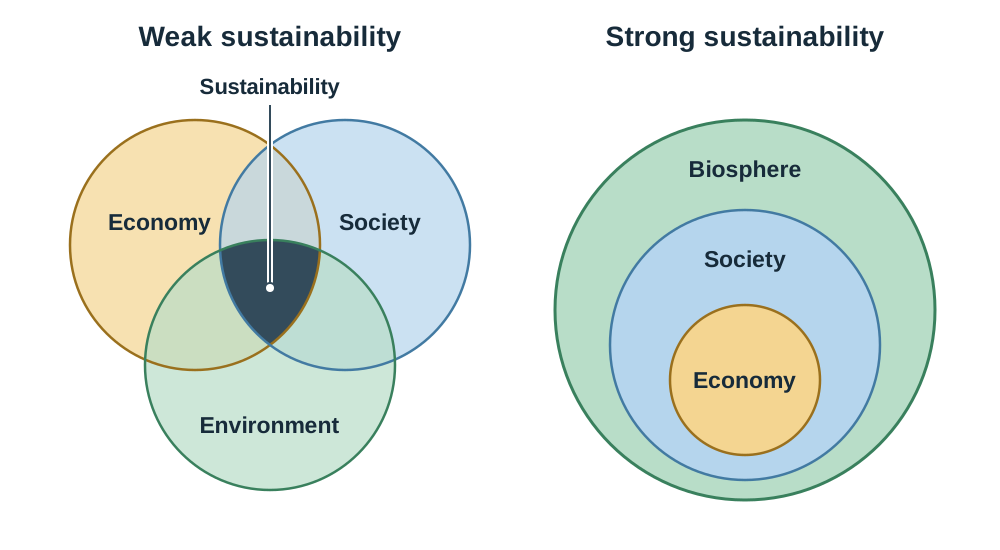
In practice, most governments work on weak sustainability assumptions, presuming technological efficiency and market mechanisms can offset environmental damage. Ecological science supports strong sustainability: human societies and economies collapse if critical biophysical limits are breached.
Mini Worked Example: Flood Management
Scenario: A local authority has a €10m budget to manage rising estuarine flood risks.
- Weak sustainability approach: Spend the funds building an engineered concrete flood wall. This treats human-made infrastructure as a direct substitute for natural flood plains.
- Strong sustainability approach: Spend the funds restoring 50 hectares of native coastal salt marsh and intertidal mudflats. The salt marsh dissipates wave energy, sequesters carbon, provides fish nursery grounds, and self-repairs over time—critical functions no concrete wall can duplicate.
Critiques of Sustainable Development
At Higher Level, you must be able to discuss the main criticisms of sustainable development:
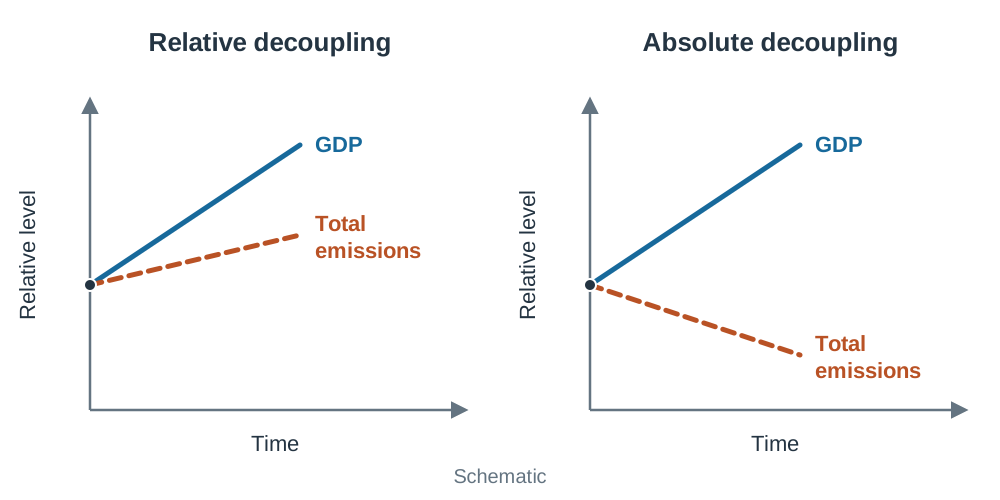
- The growth contradiction (an oxymoron?): The first critique is that 'sustainable growth' is a contradiction in terms, or oxymoron. Mainstream development pursues continuous GDP growth through 'green growth' and relative decoupling, where each euro of economic output produces fewer emissions. However, global data shows economies have failed to achieve sustained absolute decoupling, where total planetary emissions and material extraction fall in real terms while GDP continues to expand.
- Vagueness and greenwashing: The Brundtland definition never defines what counts as a genuine 'need' versus a luxury. Because it can be stretched to fit almost anything, fossil fuel companies, airlines, and industrial agribusinesses can rebrand business-as-usual operations as 'sustainable'—a practice known as greenwashing.
- Subordination of the ecological pillar: In political compromises, economic growth and short-term competitiveness regularly override social and environmental concerns. During Ireland's rapid 'Celtic Tiger' economic expansion, national greenhouse gas emissions soared, causing the state to miss international emissions targets.
- Anthropocentric worldview: Mainstream sustainable development is rooted in anthropocentrism, valuing ecosystems, rivers, and living species only for their economic utility to humans (treating them as 'services' or 'natural capital'). In contrast, ecocentrism recognises that all living organisms and natural systems possess intrinsic value regardless of human use.
- Shifting environmental burdens: A project may appear sustainable within a wealthy nation while displacing damage elsewhere. For example, expanding electric vehicles in Europe reduces domestic tailpipe emissions but drives destructive lithium and cobalt mining across ecosystems in the Global South.
(Note: Alternative economic frameworks—such as degrowth, doughnut economics, the bioeconomy, and the circular economy—are formally examined in Strand 3, but you can reference them here as conceptual critiques of conventional growth.)
Applying Sustainable Development: Irish Dilemmas and the Five-Step Tool
To achieve high marks in Section B and Section C of the written examination, you must ground your analysis in real-world Irish contexts.
Contemporary Irish Case Studies
- Data centres and the national grid: Ireland is a European hub for multinational cloud computing infrastructure. According to the Central Statistics Office, data centres consumed approximately 21% of all metered electricity in Ireland in 2023. Under weak sustainability, this is justified by corporate tax revenues, high-tech foreign direct investment, and employment. Under strong sustainability, this rapid growth strains grid capacity, consumes renewable energy needed to decarbonise domestic heating, and makes it harder to meet Ireland's legally binding target of a 51% cut in greenhouse gas emissions by 2030 relative to 2018 levels, set out in the Climate Action and Low Carbon Development (Amendment) Act 2021. That target is delivered through five-year carbon budgets and sectoral ceilings, meaning excess emissions in one sector squeeze the allowances for others.
- Bord na Móna and peatland rewetting: For decades, Bord na Móna harvested peat on an industrial scale across the Midlands to supply the ESB's peat-fired power stations at Shannonbridge (West Offaly Power) and Lanesborough (Lough Ree Power), both of which closed in 2020. Peat extraction provided rural jobs but depleted raised bogs and emitted greenhouse gases. Bord na Móna has since ended peat harvesting for energy, transitioning into bog rewetting, renewable energy generation, and commercial recycling. This represents an active, real-world transition from an extractive business model to restoring critical natural capital.
- Ireland's Well-being Framework: Launched by the Government in 2021 and reported on annually in Understanding Life in Ireland, this framework tracks national progress across health, community safety, environmental quality, mental wellbeing, and housing security alongside standard economic figures, directly addressing the critique that GDP alone cannot measure human development.
The Five-Step Proposal Evaluation Tool
When analysing an unfamiliar stimulus or development plan in the exam, use this sequence:
- Identify the core need: What specific human requirement does the proposal claim to serve (e.g. public housing, renewable electricity, regional employment)?
- Examine the three dimensions: What are the tangible environmental, social, and economic consequences, avoiding generic statements?
- Evaluate equity and timescale: Who benefits financially right now, who bears the local pollution or disruption, and how are unborn generations affected?
- Test the evidence: Are emissions, resource demands, and financial claims backed by verifiable baseline data, or does the proposal rely on greenwashing?
- Formulate a justified judgement: Conclude with a clear conditional statement: 'On balance this proposal is/is not sustainable development, because it satisfies [pillar] but fails [pillar], and it would only qualify if [named condition].'
Linking Sustainable Development to Your Action Project (40%)
In Section A of your Action Project Journal, you must analyse whether an action taken by another group was appropriate and evaluate its success. The weak versus strong sustainability distinction gives you the language to do this effectively: did that group treat the problem as something technology or money could offset, or did they protect non-substitutable natural limits? In Section C, applying these same dimensions allows you to reflect honestly on the systemic impact of your own action.
Key terms
- Sustainability
- The capacity of natural and human systems to endure indefinitely without depleting resources faster than they regenerate or exceeding the waste absorption capacity of ecosystems.
- Sustainable Development
- Development that meets the needs of the present without compromising the ability of future generations to meet their own needs, established by the Brundtland Commission in 1987.
- Brundtland Report
- The landmark 1987 publication 'Our Common Future' by the UN World Commission on Environment and Development, chaired by Gro Harlem Brundtland, which established the standard international definition of sustainable development.
- Gross Domestic Product (GDP)
- The total monetary value of all finished goods and services produced within a country over a year, widely criticised for treating environmental destruction and disaster recovery as positive economic activity.
- Modified Gross National Income (GNI*)
- An economic indicator designed by Ireland's Central Statistics Office that strips out multinational profit-shifting and intellectual property transactions to reflect the true domestic economy.
- Human Development Index (HDI)
- A composite index created by the UNDP measuring average national achievement across health (life expectancy), education (years of schooling), and decent living standards (gross national income per capita).
- Intergenerational Equity
- The moral principle of fairness between generations, obligating people living today to protect ecological systems and natural resources for generations not yet born.
- Intragenerational Equity
- The moral principle of fairness among people alive today, requiring equitable sharing of global resources and giving overriding priority to the essential needs of the world's poor.
- Natural Capital
- The stock of natural ecosystems, renewable and non-renewable resources, clean air, water, and fertile soils that provide essential life-support goods and services to humanity.
- Manufactured Capital
- Human-made material assets, tools, buildings, transport networks, and industrial machinery used in the production of goods and services.
- Weak Sustainability
- The economic model assuming that natural capital and manufactured capital are interchangeable substitutes, meaning that degrading natural assets is acceptable if offset by human-made wealth of equal value.
- Strong Sustainability
- The ecological model asserting that critical natural capital cannot be substituted by human-made technology, requiring economic and social activity to stay strictly inside biophysical boundaries.
- Critical Natural Capital
- Essential ecological assets and life-support processes—such as a stable climate, the ozone layer, fertile topsoil, and hydrological cycles—for which there are no human-made substitutes.
- Carrying Capacity
- The maximum load—in terms of resource extraction, consumption, and waste generation—that an ecosystem can support indefinitely without becoming degraded.
- Planetary Boundaries
- A framework developed by Johan Rockström and international scientists defining safe operating thresholds for nine key Earth-system processes that humanity must not exceed.
- Relative Decoupling
- A scenario where resource use or carbon emissions increase at a slower rate than economic growth (GDP).
- Absolute Decoupling
- A scenario where total resource consumption and greenhouse gas emissions decrease in real terms while economic growth (GDP) continues to expand.
- Greenwashing
- The practice of misleading consumers or the public by marketing an organisation, product, or policy as environmentally sound while its core activities cause ecological harm.
- Anthropocentrism
- A human-centred worldview that values nature and non-human life solely for its usefulness and resource utility to human beings.
- Ecocentrism
- A nature-centred worldview recognising that all species, ecological communities, and biophysical systems have intrinsic value, independent of their usefulness to humans.
- Ecological Debt
- The accumulated historical and ongoing debt owed by industrialised nations to developing countries due to colonial resource extraction and disproportionate exploitation of the global atmospheric commons.
Check yourself
What is the classic definition of sustainable development from the 1987 Brundtland Report?
Development that meets the needs of the present without compromising the ability of future generations to meet their own needs.
Which two specific concepts are explicitly contained within the Brundtland definition?
The concept of 'needs' (specifically the essential needs of the world's poor, which should receive overriding priority) and the idea of 'limitations' imposed by technology and social organisation on the environment.
What is the main difference between natural capital and manufactured capital?
Natural capital refers to natural assets such as clean water, fertile soil, forests, and climate stability, whereas manufactured capital refers to human-made physical assets such as roads, buildings, machinery, and technology.
How do weak sustainability and strong sustainability differ in their view of natural capital?
Weak sustainability assumes natural capital and manufactured capital can substitute for one another, whereas strong sustainability insists that critical natural capital performs unique life-support functions that cannot be replaced.
Why did the Central Statistics Office (CSO) develop Modified Gross National Income (GNI*) for Ireland?
To provide a realistic picture of the domestic economy by removing the major distortions caused by multinational profit-shifting and intellectual property re-domiciliation that artificially inflate Irish GDP.
What are the three dimensions measured by the Human Development Index (HDI)?
Health (life expectancy at birth), education (expected and mean years of schooling), and decent standard of living (gross national income per capita).