
When a chemical reaction happens, heat either comes out (making the surroundings warmer) or goes in (making the surroundings colder). Thermochemistry is about measuring and calculating that heat energy change at constant pressure. This topic covers exothermic and endothermic reactions, labelled energy profile diagrams, bond enthalpies, standard heats of reaction, formation, combustion, and neutralisation, alongside problem-solving using Hess's Law and Experimental Investigations (EIs) on enthalpy of neutralisation and heat of combustion of alcohols.
Enthalpy Changes and Energy Profile Diagrams
In chemistry, 'heat of reaction' and 'enthalpy change' mean the exact same thing; you will see both terms used on examination papers.
Enthalpy () is the total heat content of a chemical system at constant pressure. We cannot directly measure absolute enthalpy, but we can measure the enthalpy change () when a process occurs:
All thermochemical processes are governed by the Law of Conservation of Energy, which states that energy cannot be created or destroyed, only converted from one form to another.
Standard conditions for measuring enthalpy changes are a temperature of () and a standard pressure of ( or , with some modern syllabi specifying ). Do not confuse these standard conditions with standard temperature and pressure (s.t.p.) in gas calculations, which uses ().
Exothermic and Endothermic Reactions
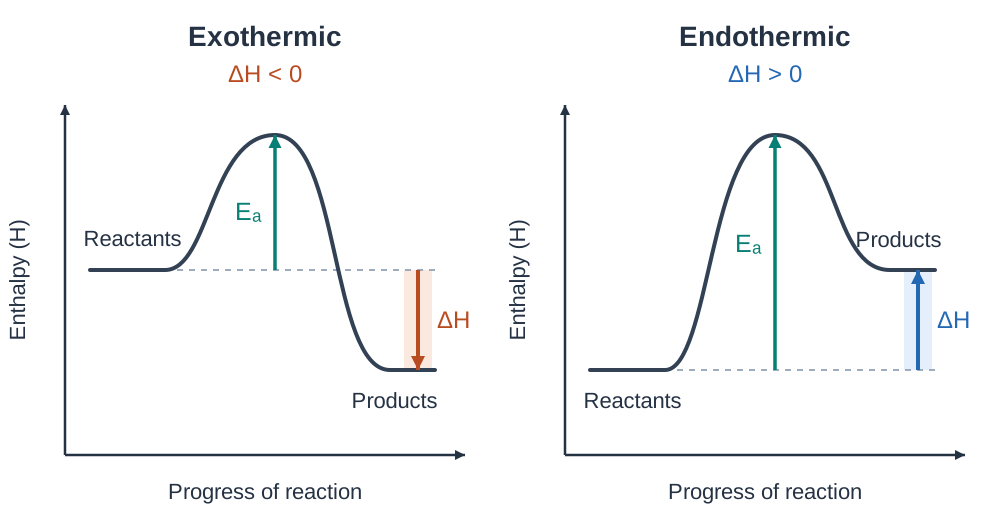
- In an exothermic reaction, heat is released to the surroundings, causing the surrounding temperature to rise. The products have less energy than the reactants, so is negative (). Examples include combustion of fuels, respiration, neutralisation of an acid by a base, and the rusting of iron.
- In an endothermic reaction, heat is absorbed from the surroundings, causing the surrounding temperature to drop. The products have more energy than the reactants, so is positive (). Examples include the thermal decomposition of limestone and photosynthesis.
- Physical changes also involve enthalpy changes: melting and vaporisation are endothermic because intermolecular forces must be overcome, while freezing and condensation release energy and are exothermic.
Energy Profile Diagrams
An energy profile diagram models the energy changes during a reaction:
- The vertical axis is labelled 'Enthalpy ()' and the horizontal axis is labelled 'Progress of reaction'.
- Activation energy () is the minimum energy that colliding particles must have for a reaction to occur. On the diagram, it is represented by a vertical arrow extending upwards from the reactant level to the peak of the curve.
- For an exothermic reaction, the reactant line sits higher than the product line. The curve rises from the reactants to the peak () and then falls to the product line. A vertical arrow pointing straight down from the reactant level to the product level is labelled (e.g. ). Never label the arrow as ; the downward direction already indicates the negative sign.
- For an endothermic reaction, the product line is higher than the reactant line. The vertical arrow points upwards from the reactant level to the product level and is labelled (positive value).
Bond Enthalpies and Reaction Energetics
Chemical reactions involve breaking bonds in the reactants and forming new bonds in the products:
- Breaking a bond always takes in energy, so bond breaking is endothermic.
- Forming a bond always gives out energy, so bond forming is exothermic.
Bond enthalpy is the average energy required to break one mole of a particular covalent bond and separate the neutral atoms from each other in the gaseous state.
Because published bond enthalpies are averaged across many different gaseous molecules, any value calculated from them is an approximation. For instance, calculating for the combustion of methane using bond enthalpies gives when water is formed as a gas. The experimental value is ; the difference arises from using average bond energies and because real combustion yields liquid water, releasing additional energy during condensation.
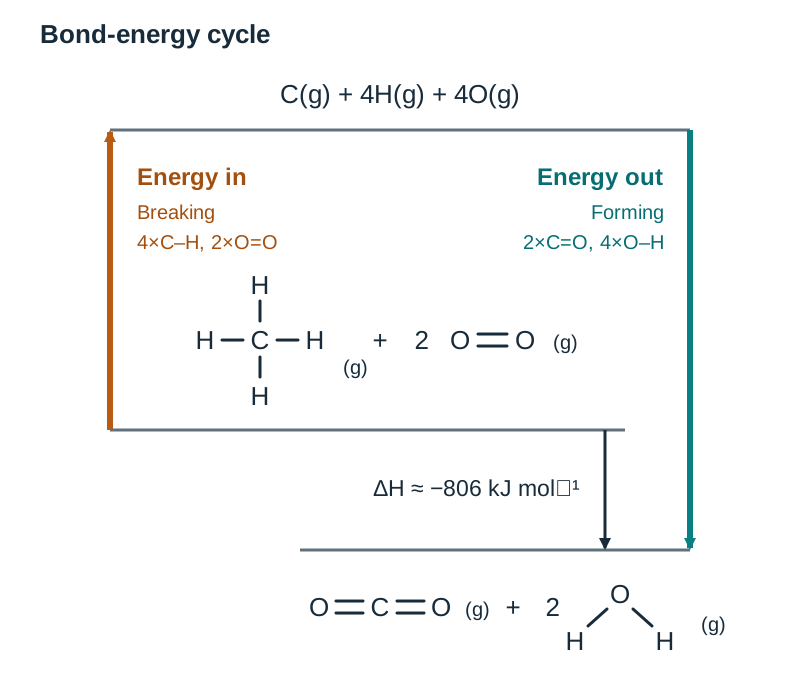
Calculating from Bond Enthalpies
Multiple bonds share more electron pairs, so bond strength increases across single, double, and triple bonds (e.g. is much stronger than ).
Standard Heats of Reaction, Formation, and Combustion
A thermochemical equation includes the balanced chemical equation, state symbols (, , , ), and the corresponding value.
Heat of Reaction
The heat of reaction () is the heat change that occurs when the numbers of moles of reactants in the balanced chemical equation react completely under specified conditions.
Heat of Formation
The heat of formation () of a compound is the heat change that occurs when one mole of a compound in its standard state is formed from its constituent elements in their standard states.
- The standard heat of formation of any pure element in its standard reference state is zero by definition (e.g. , , , all have ).
- The equation must form exactly one mole of the target compound, which frequently requires fractional coefficients for elemental reactants:
- A large negative indicates that the compound is thermodynamically stable relative to its elements.
Heat of Combustion
The heat of combustion () is the heat change that occurs when one mole of a substance is completely burned in excess oxygen.
- Heats of combustion are measured accurately in the laboratory using a bomb calorimeter. A known mass of fuel is placed in a steel container ('bomb') charged with excess oxygen under high pressure. The bomb is submerged in a known mass of water inside an insulated calorimeter. The sample is ignited electrically, and the resulting temperature rise of the water allows calculation of the heat produced.
Combustion Trends
- Alkanes: In the alkane homologous series, heat of combustion becomes more negative by roughly per additional unit, because each methylene unit provides more and bonds that oxidise into stable and bonds.
- Alkanes vs Alkenes vs Alkynes: For hydrocarbons with the same number of carbons (ethane, ethene, ethyne), alkanes release the most heat per mole because they have the highest hydrogen-to-carbon ratio. However, ethyne gives the hottest flame when burned in pure oxygen (oxyacetylene welding). Each mole of ethyne forms fewer product molecules, especially less water, so the heat released warms a smaller amount of gas to a higher temperature.
- Primary Alcohols vs Alkanes: Alcohols release less heat per mole than parent alkanes of the same chain length because the carbon attached to the group is already partially oxidised.
Balancing Complete Combustion Equations
For this course, practise hydrocarbons with no more than one double or triple bond and primary alcohols up to C6. Complete combustion produces carbon dioxide and water. Balance carbon first, hydrogen second and oxygen last; count the oxygen already present in an alcohol.
For ethanol, two carbons give 2CO₂ and six hydrogens give 3H₂O. Those products contain seven oxygen atoms. Ethanol supplies one, so three O₂ molecules supply the remaining six:
The same method works for a double or triple bond:
Across the primary alcohol series, the standard heat of combustion becomes more negative as the carbon chain gets longer: more fuel is oxidised per mole, releasing more energy. Compare values per mole, using the same standard-state convention.
Experimental Investigation (EI): Heat of Combustion of Alcohols
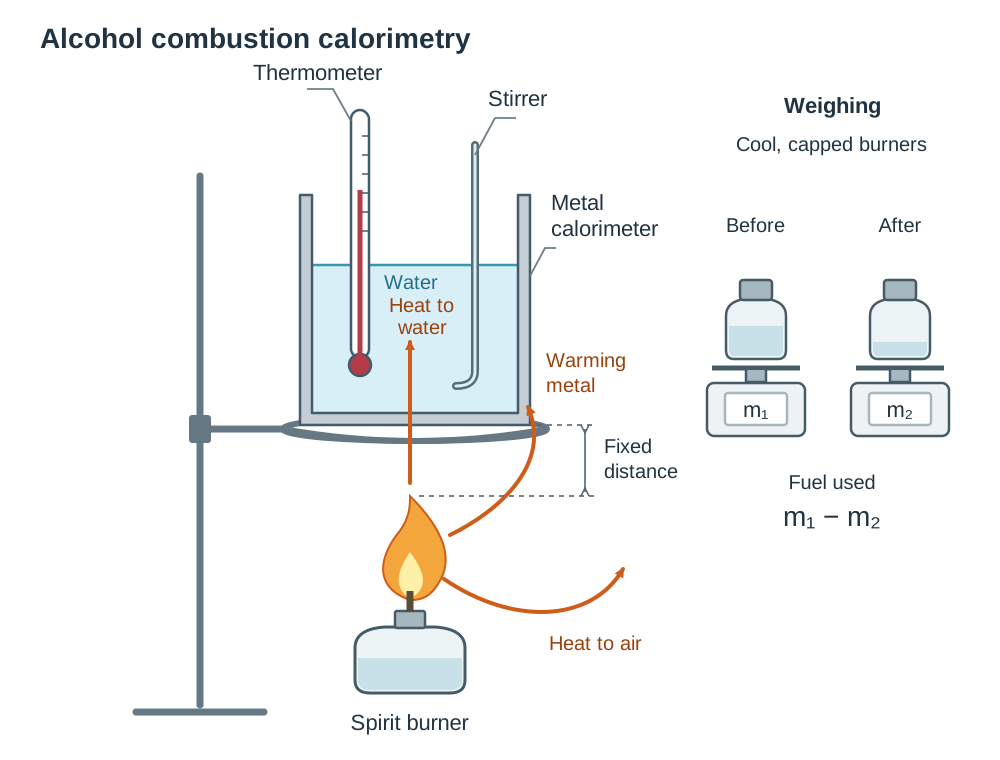
Use primary measurements to estimate the heat of combustion, then compare your result with a standard value. A spirit burner heats water in a metal calorimeter; the water's temperature rise tells you how much heat it received.
- Weigh the capped spirit burner containing the alcohol. Put a known mass of water in the metal calorimeter and record its initial temperature.
- Remove the cap, light the burner and gently stir the water. Keep the flame-to-calorimeter distance fixed.
- After a measurable temperature rise, extinguish the flame with the cap and record the highest water temperature. Let the capped burner cool before reweighing it.
- The decrease in burner mass gives the measured mass of fuel used. Repeat with the teacher-selected alcohols, keeping water mass, apparatus and distance the same. Wear eye protection and never refill a hot or lit burner.
Worked calculation — illustrative measurements: Burning 0.460 g of ethanol raises 100 g of water by 20.0 K. Use a molar mass of 46.0 g mol⁻¹ and water's specific heat capacity of 4.184 kJ kg⁻¹ K⁻¹.
- Heat received by the water: .
- Moles of ethanol: .
- Estimated heat of combustion: .
Compared with a supplied standard value of about −1367 kJ mol⁻¹, this result is much less negative. Explain the difference: heat escapes to the air and heats the metal can; incomplete combustion may produce soot; alcohol evaporation can make the measured mass loss larger than the mass actually burned. The simple calculation counts only heat gained by the water. Standard values also specify physical states and standard conditions, so compare like with like.
Hess's Law and Problem Solving
Hess's Law states that if a chemical reaction takes place in a number of stages, the sum of the heat changes in the separate stages is equal to the heat change if the reaction is carried out in one stage.
The total heat change depends only on the initial reactants and final products, not on the route taken. This is a direct consequence of the Law of Conservation of Energy.
Method 1: Equation Manipulation
- Write out the target balanced equation.
- Rearrange the given thermochemical equations so the required substances sit on the proper side:
- Reversing a reaction reverses the sign of .
- Multiplying or dividing an equation by a factor requires multiplying or dividing by .
- Add the manipulated equations together. Cancel a substance that occurs in the same physical state on both sides. If the amounts differ, cancel the smaller amount and keep the difference on the side with more: for example, 3O₂ on the left and O₂ on the right leaves 2O₂ on the left.
- Sum the adjusted values algebraically.
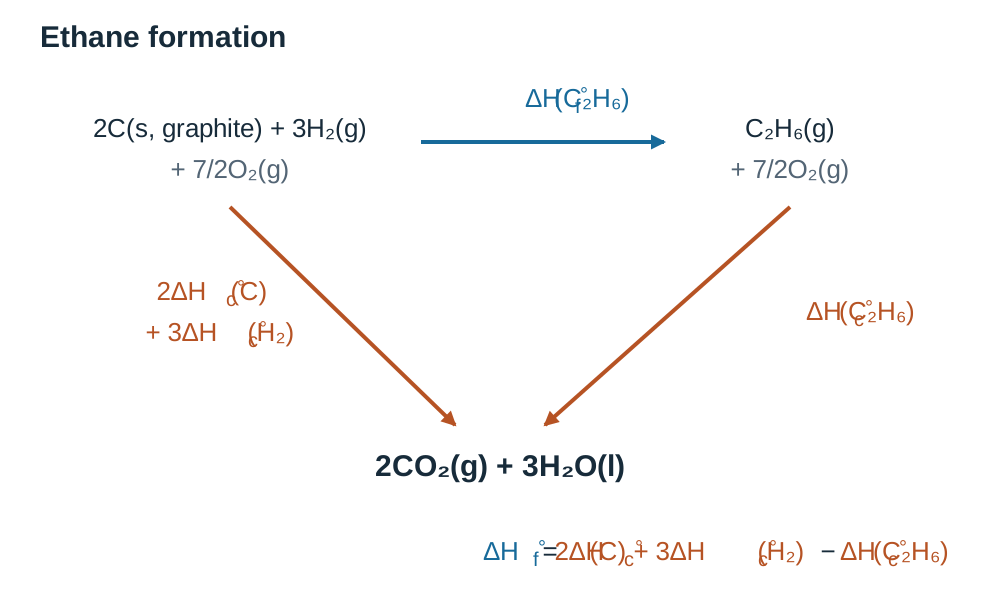
Energy Cycle for Ethane Formation
Instead of equations, Hess's Law can be represented as an energy cycle:
- Top-left: Reactants in standard states ().
- Top-right: Target compound (). The arrow between them represents .
- Bottom: Combustion products ().
- Downward arrow from elements to combustion products = . Downward arrow from ethane to combustion products = .
- By Hess's Law: , so .
Method 2: Heats of Formation Formula
When standard heats of formation are available for all compounds: Multiply each by its balancing coefficient and assign zero to uncombined elements in standard states.
Experimental Investigation (EI): Determination of Enthalpy of Neutralisation
The heat of neutralisation is the heat change that occurs when one mole of ions from an acid reacts with one mole of ions from a base to form one mole of water.
Purpose and Apparatus
To measure the enthalpy change when aqueous hydrochloric acid is neutralised by aqueous sodium hydroxide.
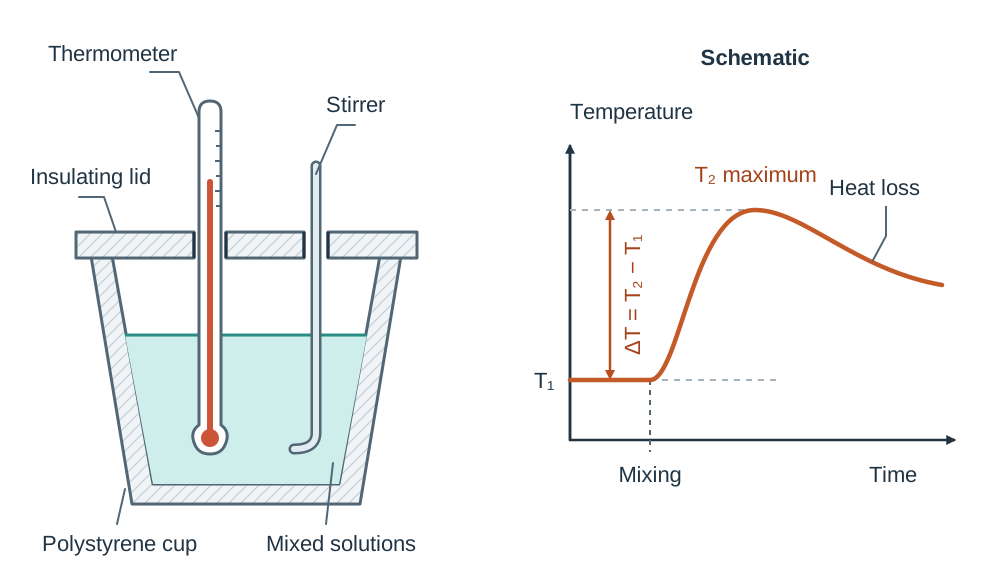
- Apparatus: Expanded polystyrene cup with an insulating lid (containing holes for thermometer and stirrer), two graduated cylinders (), and a thermometer reading to . A polystyrene cup is used because polystyrene is a poor conductor of heat (a good insulator) and absorbs very little heat itself, so less of the heat produced is lost than with a glass beaker.
Method
- Measure of and of using separate graduated cylinders.
- Record the temperature of both solutions. If they differ slightly, record their average as the initial temperature ().
- Pour the acid into the polystyrene cup, quickly add the base, replace the lid immediately, and stir continuously.
- Observe the thermometer and record the maximum temperature reached ().
- Calculate the temperature rise: .
Measurements and Observations
- The temperature rises because neutralisation is exothermic.
- After reaching the maximum, the temperature slowly falls because the reaction has finished and the warm solution loses heat to the cooler room.
- Record the highest temperature reached, before heat loss dominates.
Calculation and Assumptions
- Heat released: , where (assuming solution density is ) and (assuming the specific heat capacity of water).
- Calculate moles of water formed: .
- Enthalpy of neutralisation: .
Typical Result
For strong acid-strong base reactions, the accepted value is approximately . School results are usually slightly less negative (e.g. to ) due to unavoidable heat loss.
- Strong acids and bases are fully dissociated in water; the metal cations and acid anions are non-reacting spectator ions. The reaction in all strong acid-strong base combinations is identically .
- Weak acids (e.g. ethanoic acid) give less negative values (around ) because weak acids are only partially dissociated. Energy is absorbed to dissociate remaining molecules before they react.
Diprotic Acid Mole Trap
Sulfuric acid is diprotic: . One mole of supplies two moles of ions, forming two moles of water. You must divide by the moles of water formed, which is double the moles of .
Experimental Conditions and Errors
- Choice of concentration: Approximately solutions are chosen. If solutions are too dilute, is very small, leading to large percentage reading errors. If too concentrated, they are more corrosive, and the larger temperature rise makes the solution lose heat to the surroundings faster.
- Scale of volume: Doubling both volumes at the same concentration doubles the moles reacting and the total heat released, but it also doubles the mass of liquid being heated. Therefore, remains the same.
- Doubling concentration: Doubling concentrations with the same volume doubles the moles reacting in the same liquid mass, so roughly doubles.
- Apparatus selection: A burette measures volume more accurately than a graduated cylinder, but adding base from a burette is slow, leading to excessive heat loss during addition.
- Systematic errors: Heat lost to surroundings and heat absorbed by the cup and thermometer push all results in the same direction, making measured less negative. Repeating trials does not remove a systematic error; better insulation (lid, polystyrene cup) reduces it.
- Random errors: Meniscus judgement and reading the thermometer scatter unpredictably above and below the true value. These are minimised by using a thermometer and averaging concordant repeated trials.
Key terms
- Enthalpy ()
- The total heat content of a chemical system at constant pressure.
- Enthalpy Change ()
- The heat energy exchanged between a chemical system and its surroundings during a process occurring at constant pressure.
- Exothermic Reaction
- A chemical reaction that releases heat energy to its surroundings, characterised by a negative enthalpy change ().
- Endothermic Reaction
- A chemical reaction that absorbs heat energy from its surroundings, characterised by a positive enthalpy change ().
- Activation Energy ()
- The minimum energy that colliding particles must have for a chemical reaction to occur.
- Law of Conservation of Energy
- A fundamental scientific law stating that energy cannot be created or destroyed, but can only be converted from one form to another.
- Bond Enthalpy
- The average energy required to break one mole of a particular covalent bond and separate the neutral atoms from each other in the gaseous state.
- Heat of Reaction
- The heat change that occurs when the numbers of moles of reactants in the balanced chemical equation react completely under specified conditions.
- Heat of Formation
- The heat change that occurs when one mole of a compound in its standard state is formed from its constituent elements in their standard states.
- Heat of Combustion
- The heat change that occurs when one mole of a substance is completely burned in excess oxygen.
- Hess's Law
- A law stating that if a chemical reaction takes place in a number of stages, the sum of the heat changes in the separate stages is equal to the heat change if the reaction is carried out in one stage.
- Heat of Neutralisation
- The heat change that occurs when one mole of H⁺ ions from an acid reacts with one mole of OH⁻ ions from a base to form one mole of water.
- Standard Conditions
- A reference temperature of () and a standard pressure of ( or ) under which standard thermochemical measurements are recorded.
- Bomb Calorimeter
- A sealed steel reaction vessel surrounded by water used to determine accurate heats of combustion by burning samples in excess oxygen under pressure.
Check yourself
State the scientific law on which Hess's Law is directly based.
The Law of Conservation of Energy, which states that energy cannot be created or destroyed, only converted from one form to another.
In a polystyrene cup, of and of , both at , reach a maximum temperature of . Taking and density , calculate the enthalpy of neutralisation.
. Solution mass . Heat released . Moles of water formed . (2 significant figures, because the concentrations, 2.0 M, and the density, 1.0 g cm⁻³, are given to 2 significant figures).
Why does the temperature of the liquid in a neutralisation experiment fall after reaching its maximum?
The chemical reaction is complete, so no more heat is being generated. The warm solution then gradually loses heat energy to the cooler surroundings (air, cup, thermometer).
Why are approximately solutions chosen for the neutralisation experiment rather than or solutions?
Dilute solutions () produce a very small temperature rise, resulting in a large percentage reading error. Concentrated solutions () are hazardous/corrosive and cause rapid heat loss to surroundings.
What is the standard heat of formation of pure liquid bromine, Br₂(l), and why?
0 kJ mol⁻¹, because by definition the standard heat of formation of any pure chemical element in its standard reference state is zero.
Classify heat lost to the surroundings in the neutralisation experiment as a random or systematic error, and state whether repeated trials eliminate it.
It is a systematic error because it pushes all experimental results in the same direction (making ΔH consistently less negative). Repeating trials does not eliminate systematic errors; only improved thermal insulation can reduce it.