

Atomic structure is about what atoms are made of and how scientists' picture of the atom changed as new experiments were done: from solid balls, to a nucleus with electrons around it, to electrons in energy levels, to today's orbital model. For Leaving Certificate Higher Level Chemistry, this topic covers the evaluation of the nuclear, Bohr, and orbital models, subatomic particles, isotopes, calculating relative atomic mass, line emission spectra, flame tests, and writing electron configurations up to element 36 ().
Evolution of Atomic Models
Our picture of the atom evolved over time as new experimental evidence emerged. While earlier thinkers like John Dalton viewed atoms as solid indivisible spheres and J.J. Thomson proposed the plum pudding model (a sphere of positive charge with embedded electrons), the Leaving Certificate specification focuses on evaluating three major scientific models: the nuclear model, the Bohr model, and the orbital model. Every model rests on assumptions and has limitations.
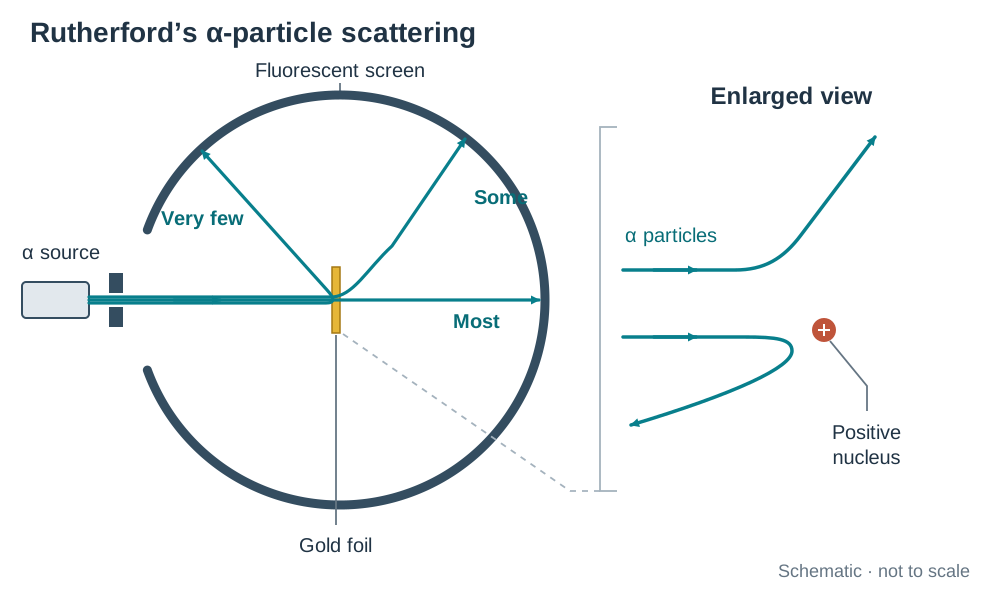
Rutherford's Nuclear Model (1911)
Ernest Rutherford tested Thomson's model by firing positively charged alpha particles () at a thin sheet of gold foil surrounded by a fluorescent screen.
- Observations and Conclusions:
- Most alpha particles passed straight through undeflected: Most of the atom is empty space.
- Some alpha particles were deflected at large angles: Positive charge is concentrated in a tiny, dense core that repels incoming positive alpha particles.
- A very small fraction (about 1 in 8,000) were deflected back towards the source: The nucleus is extraordinarily small and contains virtually all the mass of the atom.
- Assumptions: All the positive charge and nearly all the mass are concentrated in a tiny central nucleus. Electrons move around the nucleus in the surrounding empty space, governed by classical physics.
- Limitations: By the physics of the time, an electron moving around the nucleus should continuously give out energy as radiation and spiral into the nucleus, causing the atom to collapse. Real atoms are stable, and this model provides no arrangement for electrons and cannot explain line spectra.
Bohr Model (1913)
- Assumptions: Electrons move in fixed circular orbits called energy levels around the nucleus. Each level has a fixed, quantised amount of energy. An electron does not radiate energy while remaining in a given level. Energy is absorbed or emitted only when an electron transitions between levels ().
- Limitations: It works mathematically only for hydrogen (one-electron systems). It cannot account for multi-electron spectra or the existence of sublevels. Crucially, treating an electron as a particle on a fixed circular path violates the wave nature of electrons and the Heisenberg uncertainty principle.
Orbital Model (Current Model)
- Assumptions: The electron exhibits wave-particle duality. Because we cannot measure an electron's exact position and momentum simultaneously, we can only describe the probability of finding it in a given region of space. That region is an atomic orbital.
- Limitations: It provides probabilities rather than exact paths. The wave equations can only be solved exactly for hydrogen; multi-electron atoms require mathematical approximations. Like all models, it may be modified as new evidence emerges.
Why Older Models Are Still Used
Models are simplified representations of reality. The Bohr model is still useful because it explains the hydrogen spectrum simply and works well for drawing introductory dot-and-cross bonding diagrams. The orbital model is used whenever we need to account for sublevels, orbital shapes, and 3D molecular geometry.
Subatomic Particles, Isotopes, and Nuclidic Notation
An atom consists of three fundamental subatomic particles:
| Particle | Location | Relative Mass | Relative Charge |
|---|---|---|---|
| Proton () | Nucleus | 1 | |
| Neutron () | Nucleus | 1 | 0 |
| Electron () | Orbitals outside nucleus |
The atomic number () is the number of protons in the nucleus of an atom. In a neutral atom, it also equals the number of electrons. The mass number () is the total number of protons and neutrons in the nucleus of an atom of an element.
Nuclide Notation and Particle Counts
In standard nuclide notation, , the mass number is at the top and the atomic number is at the bottom:
- in a neutral atom. For positive ions (cations), subtract the charge value; for negative ions (anions), add the charge value.
| Species | Protons | Neutrons | Electrons |
|---|---|---|---|
| 17 | 20 | 17 | |
| 17 | 20 | 18 | |
| 12 | 12 | 10 | |
| 35 | 44 | 35 | |
| 35 | 46 | 35 |
Comparing nuclei: Bromine-79 and bromine-81 nuclei both contain 35 protons, but bromine-81 has 46 neutrons compared to 44 in bromine-79.
Isotopes and Relative Atomic Mass
Isotopes are atoms of the same element that have the same atomic number (same number of protons) but different mass numbers due to a different number of neutrons. Isotopes share identical chemical properties because they have the same electron configuration, but their physical properties (like density and diffusion rate) differ slightly.
Relative atomic mass () is the average mass of an atom of an element relative to of the mass of a carbon-12 atom, taking natural isotopic abundances into account. Note that mass number is always a whole number for a single isotope, whereas relative atomic mass is a weighted average over all naturally occurring isotopes, which is why chlorine is 35.5. Isotopic abundances are determined experimentally using a mass spectrometer.
Atomic Spectra and Flame Tests
Passing white light through a glass prism produces a continuous spectrum where colours blend smoothly. Passing light from an excited gas through a prism produces an atomic line emission spectrum: sharp coloured lines separated by dark regions.
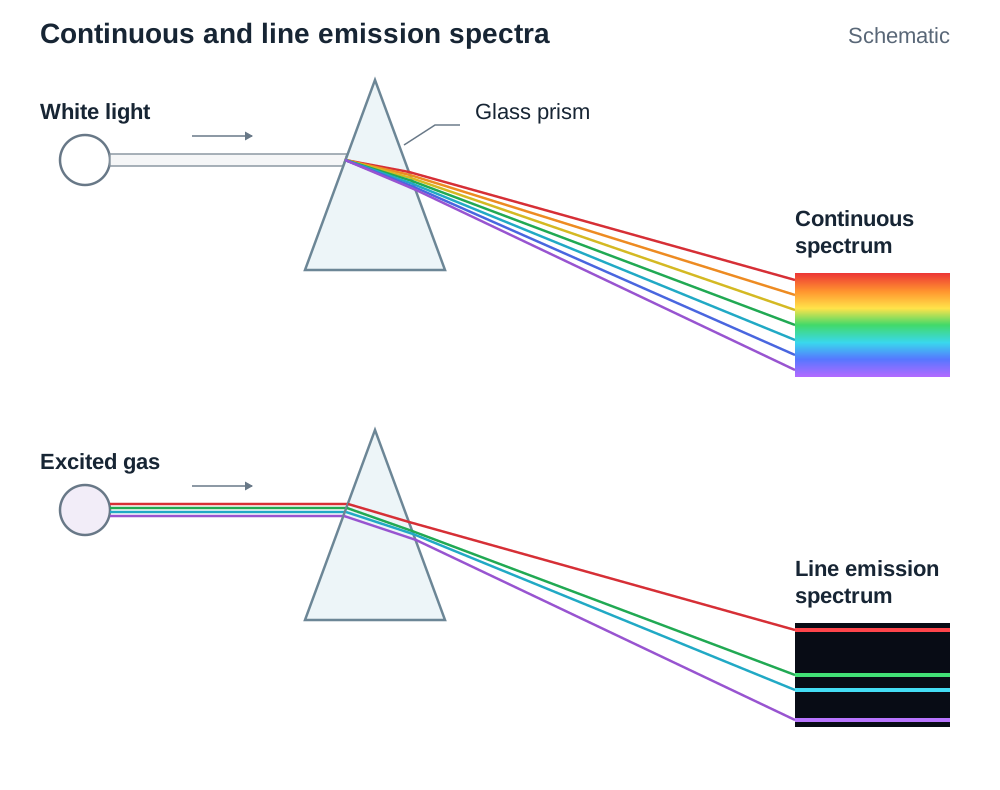
Origin of Emission Lines
- Ground state: Electrons normally occupy the lowest available energy levels, where the atom is at its most stable.
- Excitation: When supplied with heat or electrical energy, electrons absorb a specific quantum of energy and jump to higher energy levels (excited state).
- Falling back: The excited state is unstable, so the electron falls back to a lower energy level.
- Photon emission: In falling, the electron emits the lost energy as a single packet of light called a photon. The frequency of the emitted light depends on the energy difference:
where is the higher energy level, is the lower energy level, is Planck's constant (), and is the frequency in (or ).
Why Line Spectra Are Evidence for Energy Levels
- Electrons in an atom can only have certain fixed energies (energy levels).
- When an electron falls from a higher level to a lower level, the energy lost () can only take definite, allowed values.
- Because , each jump produces light of one definite frequency, showing up as a distinct sharp line.
- Each line corresponds to one specific electron transition. If electrons could have any arbitrary energy, atoms would emit a continuous rainbow instead of discrete lines.
In the hydrogen spectrum, electron transitions falling to give the ultraviolet Lyman series, transitions falling to give the Balmer series (all visible lines belong to this series), and transitions falling to give the infrared Paschen series.
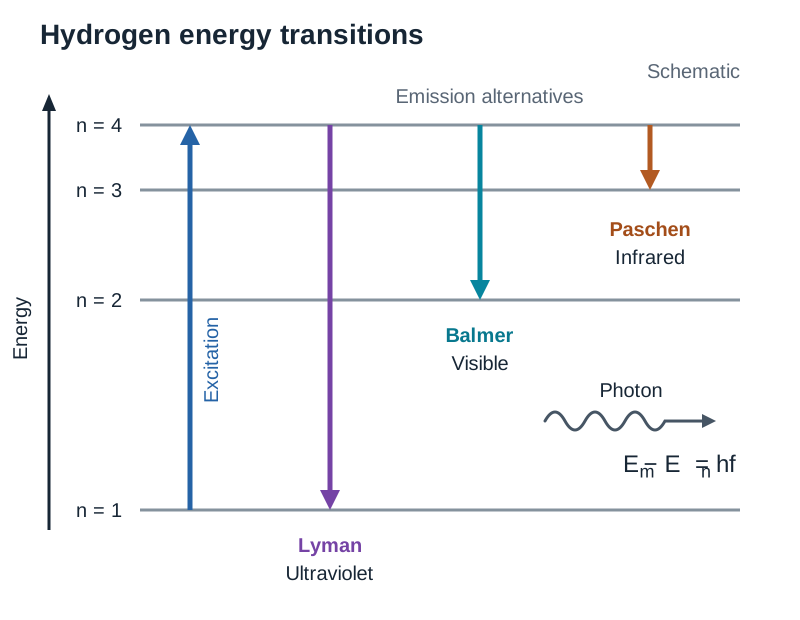
Identifying Elements
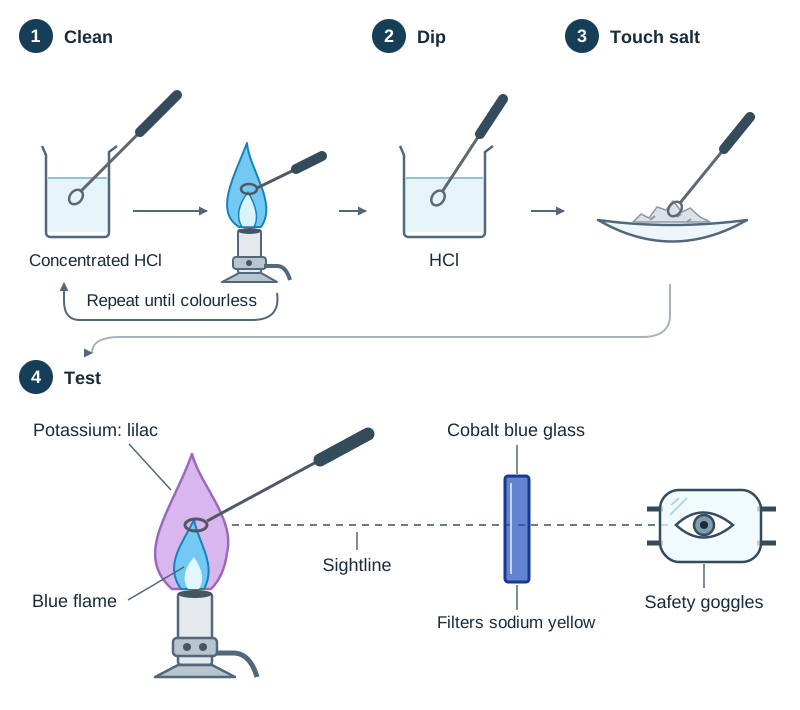
- Flame tests: Clean a nichrome or platinum wire in concentrated hydrochloric acid () and place it in a blue Bunsen flame until no colour appears. Dip the wire in acid, touch the test salt, and return it to the flame:
- Sodium (Na): yellow-orange
- Potassium (K): lilac
- Copper (Cu): blue-green
- Lithium (Li): crimson
- Barium (Ba): apple green
- Strontium (Sr): red / scarlet
Why flame colours appear: Heat excites electrons to higher levels; when they drop back, they emit photons of characteristic frequencies. Each metal has a unique set of energy levels, resulting in a distinctive flame colour.
Good practice and errors: Sodium is a pervasive contaminant whose intense yellow easily masks other colours. Always clean the wire until the flame is colourless. Potassium's lilac flame is faint; view it through cobalt blue glass to filter out yellow sodium light. Colours judged by eye can be confused (such as lithium crimson versus strontium red), so run known reference salts alongside unknowns. Concentrated is corrosive, so wear safety goggles.
- Line emission spectra: You need to be able to identify an element from its line emission spectrum for salts of sodium (Na), strontium (Sr), and copper (Cu). View the light through a spectroscope and compare the line positions with reference spectra. An element is identified only if every line in its reference spectrum matches the unknown sample.
Electronic Structure and Configurations
Electrons are arranged in main energy levels (), which are divided into sublevels (), which consist of individual atomic orbitals.
- Energy level: The fixed energy value that an electron in an atom may have ().
- Sublevel: A subdivision of a main energy level consisting of one or more orbitals of equal energy.
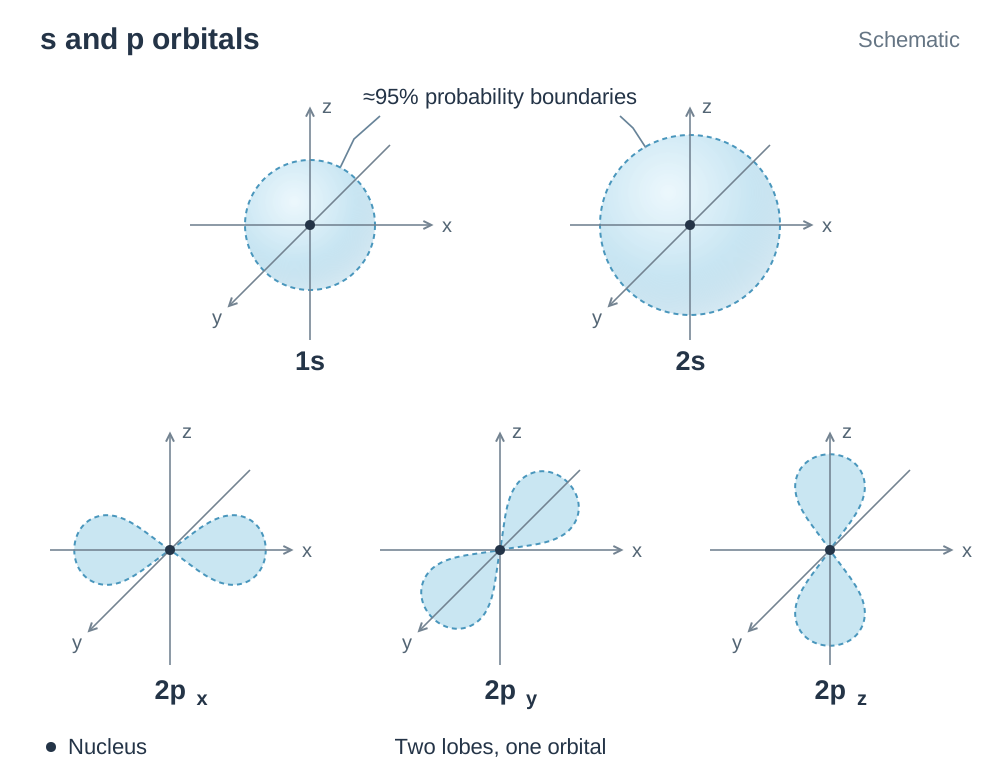
- Atomic orbital: A region in space around the nucleus of an atom where there is a high probability of finding an electron. When drawing an orbital, its boundary typically marks where the electron is found approximately 95% of the time.
Orbital Shapes and Drawings
- s orbitals: Sphere-shaped, centred on the nucleus. Draw a circle centred on a dot (the nucleus) with axes and label it . A orbital has the same shape but is larger.
- p orbitals: Dumbbell-shaped, consisting of two lobes on opposite sides of the nucleus along one Cartesian axis. Draw three mutually perpendicular dumbbells along axes labelled , and .
Rules for Electron Configurations
- Aufbau principle: When an atom is in its ground state, electrons occupy the lowest available energy orbitals first (). The sublevel fills before because it has lower energy when unoccupied.
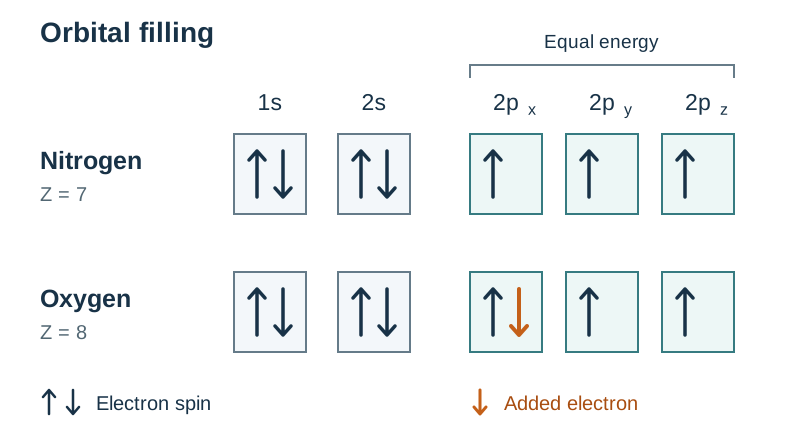
- Pauli exclusion principle: No more than two electrons can occupy an orbital, and if two electrons are present, they must have opposite (antiparallel) spins.
- Hund's rule of maximum multiplicity: When two or more degenerate (equal-energy) orbitals are available, electrons occupy them singly with parallel spins before pairing up in any one orbital.
For example, nitrogen () has three electrons, each occupying a separate orbital: . In oxygen (), the eighth electron pairs up: .
Ground-State Configurations up to
- Nitrogen ():
- Sodium ():
- Scandium ():
- Bromine ():
- Krypton ():
Stability Exceptions: Chromium and Copper
A half-full () or completely full () sublevel is especially stable. So in chromium and copper, one electron moves from into :
- Chromium (): (not )
- Copper (): (not )
Electron Configurations of Ions
Main-group elements gain or lose electrons to achieve a stable noble gas electron configuration (usually eight outer electrons, but two for ions like , which take the helium configuration ). Configurations of transition metal ions are excluded from the specification:
- Magnesium ion (, ):
- Chloride ion (, ):
Key terms
- Atomic Orbital
- A region in space around the nucleus of an atom where there is a high probability of finding an electron.
- Energy Level
- The fixed energy value that an electron in an atom may have.
- Ground State
- The state of an atom in which the electrons occupy the lowest available energy levels.
- Excited State
- The state of an atom in which electrons occupy higher energy levels than those occupied in the ground state.
- Isotopes
- Atoms of the same element that have the same atomic number but different mass numbers due to a different number of neutrons.
- Relative Atomic Mass
- The average mass of an atom of an element relative to 1/12th of the mass of a carbon-12 atom, taking natural isotopic abundances into account.
- Aufbau Principle
- A rule stating that when an atom is in its ground state, electrons occupy the lowest available energy orbitals first.
- Hund's Rule of Maximum Multiplicity
- A rule stating that when two or more degenerate (equal-energy) orbitals are available, electrons occupy them singly with parallel spins before pairing up in any one orbital.
- Pauli Exclusion Principle
- A rule stating that no more than two electrons can occupy an orbital, and if two electrons are present, they must have opposite spins.
- Heisenberg Uncertainty Principle
- A principle stating that it is impossible to measure simultaneously both the exact position and momentum (or velocity) of an electron.
Check yourself
How many protons, neutrons, and electrons are in a ion?
16 protons, 18 neutrons (34 - 16), and 18 electrons (16 + 2).
Describe the shape of a 2p orbital and name the three individual 2p orbitals.
Dumbbell-shaped, with two lobes on opposite sides of the nucleus along one axis; 2p_x, 2p_y, and 2p_z, arranged at right angles to each other.
Why does potassium's flame appear lilac, and why might you view it through cobalt blue glass?
Excited electrons drop between characteristic energy levels emitting lilac light; cobalt blue glass absorbs yellow light from sodium contamination that would otherwise mask the lilac colour.
Write the ground-state electron configuration of phosphorus (Z = 15) showing the individual 3p orbitals.
1s2 2s2 2p6 3s2 3p_x1 3p_y1 3p_z1 (following Hund's rule, electrons occupy equal-energy 3p orbitals singly before pairing).
Boron has two isotopes, boron-10 and boron-11, with a relative atomic mass of 10.8. What is the percentage abundance of each?
Boron-10 = 20% and boron-11 = 80% (10x + 11(100 - x) = 1080, which simplifies to 1100 - x = 1080, giving x = 20).