
Acids and bases react by transferring protons. These notes explain how to recognise acids and bases, identify conjugate pairs, and write the main acid-reaction equations. You will also learn why strength is different from concentration, how water forms ions, and how temperature affects neutral pH. The Arrhenius and Brønsted–Lowry models, amphoteric substances, and Ka and Kb values are explained along the way. Detailed pH calculations and titration curves are covered in companion topics.
Everyday Acid-Base Behaviour, Indicators, and Reactions
Acids and bases are familiar chemicals encountered daily at home and in industry. In the laboratory, we never taste or touch chemicals to identify them. Instead, we use indicators or instruments.
An acid-base indicator is a substance whose colour changes depending on the pH of the solution it is in. Litmus is the most common test strip, while universal indicator provides an estimated pH value. A calibrated pH meter or sensor provides a more precise, quantitative measurement.
| Indicator | Colour in Acid | Colour in Base |
|---|---|---|
| Litmus | red | blue |
| Methyl orange | red | yellow |
| Phenolphthalein | colourless | pink |
| Universal indicator | red, orange or yellow depending on pH | blue or purple depending on pH |
Universal indicator turns green in a neutral solution at (pH 7).
Everyday Neutralisation
Neutralisation occurs when an acid and a base react to form a salt and water, cancelling out each other's characteristic acidic and basic properties.
- Remedies for acid indigestion: The stomach produces dilute hydrochloric acid to digest food. Excess acid causes discomfort or heartburn. Antacids contain mild bases such as magnesium hydroxide or calcium carbonate to neutralise the excess acid:
- Use of lime in agriculture: Overly acidic soil limits crop nutrient uptake. Farmers spread agricultural lime (slaked lime, calcium hydroxide, or ground limestone, ) to neutralise soil acids and raise pH:
- Toothpaste: Plaque bacteria metabolise dietary sugars into organic acids that dissolve calcium hydroxyapatite in tooth enamel. Toothpaste is formulated to be mildly basic, neutralising oral acids on contact.
Standard Acid Reaction Patterns
You should be able to predict the products of, and write balanced equations (with state symbols) for, three reaction types:
Neutralisation (Acid + Base)
Acid + Reactive Metal
Acid + Carbonate or Hydrogencarbonate
The Arrhenius Theory and Its Limitations
In 1884, Svante Arrhenius proposed the first modern chemical model of acids and bases based on ionic dissociation in aqueous solutions:
- An Arrhenius acid is a substance that dissociates in water to produce hydrogen ions ().
- An Arrhenius base is a substance that dissociates in water to produce hydroxide ions ().
For example, nitric acid dissociates in water to release hydrogen ions:
Sodium hydroxide dissociates in water to release hydroxide ions:
Limitations of Arrhenius Theory
While Arrhenius theory explained simple neutralisations, it has two crucial limitations:
- Aqueous restriction: It requires water as the solvent. It fails to explain acid-base behaviour in non-aqueous solvents or in the gas phase, such as hydrogen chloride gas reacting directly with ammonia gas:
- Exclusion of non-hydroxide bases: Many substances neutralise acids and turn litmus blue without possessing hydroxide ions in their structure. For example, ammonia () and sodium carbonate () are effective bases, but Arrhenius cannot classify them directly because they contain no to release upon simple dissociation.
The Brønsted-Lowry Theory and Amphoteric Species
In 1923, Johannes Brønsted and Thomas Lowry independently established a broader, more functional model focused directly on proton transfer:
- A Brønsted-Lowry acid is a proton donor.
- A Brønsted-Lowry base is a proton acceptor.
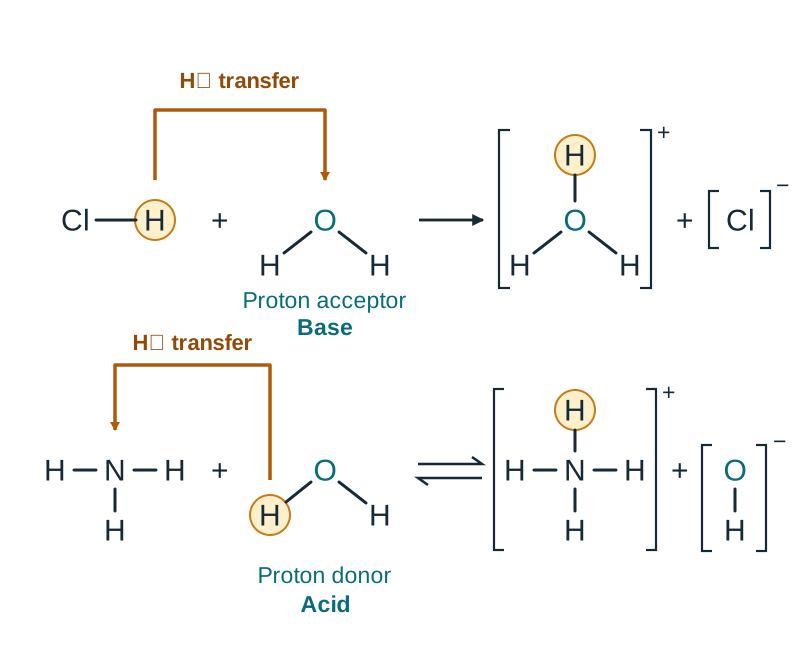
A proton is a hydrogen ion (). A bare proton cannot float freely in water; its dense positive charge binds directly to the lone pair of a water molecule to generate the hydronium ion ():
When hydrogen chloride dissolves in water, donates a proton to :
Here, acts as a Brønsted-Lowry acid and acts as a Brønsted-Lowry base.
When ammonia dissolves in water, accepts a proton from water:
Here, acts as a Brønsted-Lowry base, while donates a proton and acts as a Brønsted-Lowry acid.
Proton Donating Capacity: Monoprotic vs Diprotic
Acids are classified by how many protons one molecule can donate:
- A monoprotic acid can donate only one proton per molecule (e.g. , , ).
- A diprotic acid can donate two protons per molecule in stepwise dissociation (e.g. ).
Amphoteric Substances
A substance that can act as either a Brønsted-Lowry acid or a Brønsted-Lowry base, depending on what it reacts with, is described as amphoteric (or amphiprotic).
Water is the most common example: it accepts a proton from (acting as a base) and donates a proton to (acting as an acid). Other common amphoteric species include the hydrogencarbonate ion () and the dihydrogenphosphate ion ().
Comparing Arrhenius and Brønsted-Lowry Theories
A syllabus comparison requires examining both similarities and differences between the two models.
Similarities
- Both theories identify acidity with the hydrogen ion ().
- Both account for neutralisation reactions between standard acids and metal hydroxides.
- Every Arrhenius acid is also a Brønsted-Lowry acid.
Differences
| Feature | Arrhenius Theory | Brønsted-Lowry Theory |
|---|---|---|
| Acid definition | Dissociates in water to yield ions | Proton donor |
| Base definition | Dissociates in water to yield ions | Proton acceptor |
| Solvent restriction | Aqueous solutions only | Any solvent or none (gas phase) |
| Bases without | Cannot explain (e.g. , ) | Fully explained as proton acceptors |
| Conjugate pairs | Not part of the theory | Every acid has a matching conjugate base |
Justifying Why Brønsted-Lowry is More Extensive
Brønsted-Lowry theory is considered a more extensive model because it encompasses all Arrhenius acids and bases while removing its restrictions. Specifically, it explains:
- Acid-base reactions that take place outside water, such as gas-phase reactions: .
- The basic behaviour of substances that contain no hydroxide ions in their formula, such as or carbonate ions (), which act as bases simply by accepting a proton.
Conjugate Acid-Base Pairs
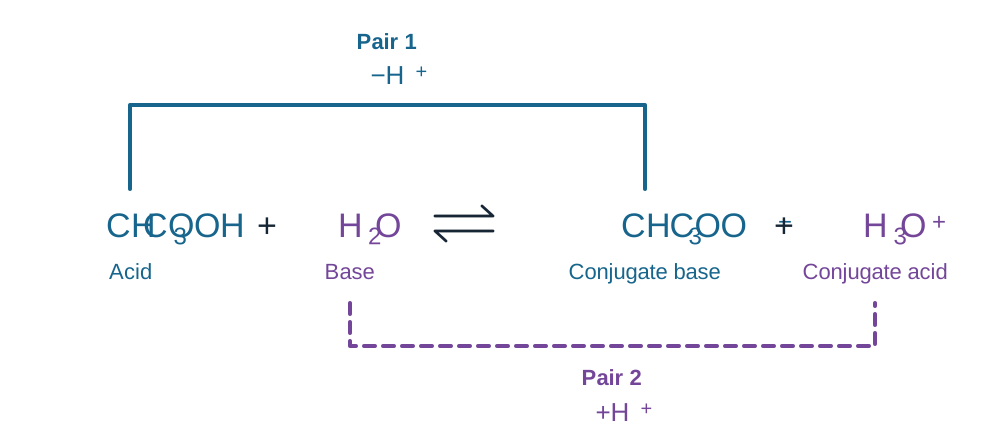
In every Brønsted-Lowry reaction, an acid becomes a base once it loses its proton, and a base becomes an acid once it gains one. These linked species are called conjugate acid-base pairs.
A conjugate acid-base pair consists of two chemical species that differ by exactly one proton ().
Consider the reversible dissociation of ethanoic acid in water:
- Pair 1: (acid) and (conjugate base)
- Pair 2: (conjugate acid) and (base)
Determining Conjugate Partners
- To find the conjugate base of any species: subtract one and decrease the overall electrical charge by one.
- To find the conjugate acid of any species: add one and increase the overall electrical charge by one.
For example:
- The conjugate acid of is .
- The conjugate base of is .
Conjugate Pair Relative Strengths
The stronger an acid, the weaker its conjugate base; the stronger a base, the weaker its conjugate acid.
- is a strong acid that readily gives away its proton. Its conjugate base, the chloride ion (), has virtually no tendency to act as a base in water.
- is a weak acid. Its conjugate base, the ethanoate ion (), is a weak base that accepts protons from water to a modest extent, reforming some undissociated acid.
Distinguishing Strong vs Weak and Concentrated vs Dilute
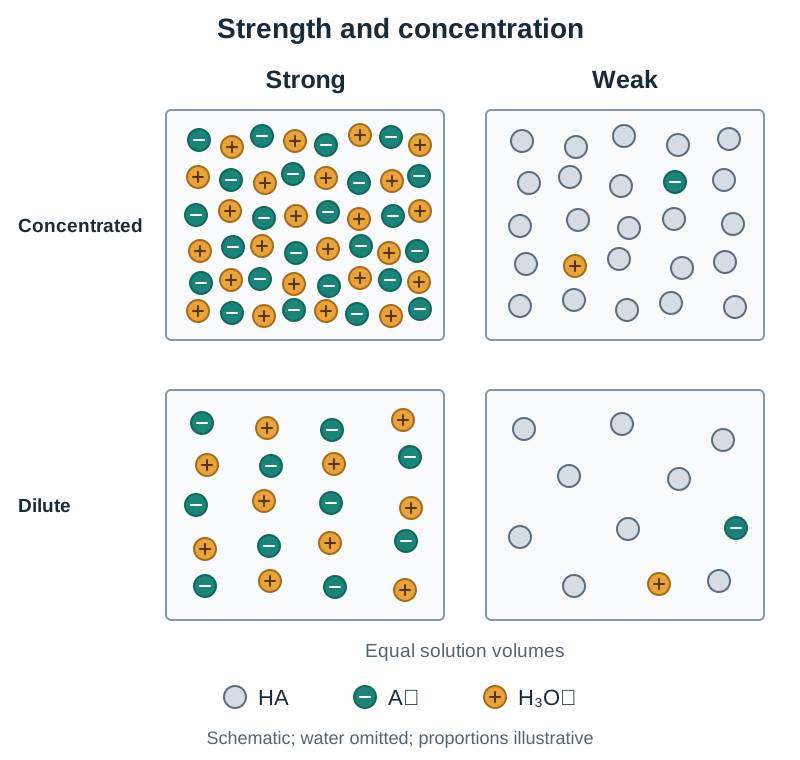
Students often confuse the chemical strength of an acid or base with its concentration. They describe completely different properties:
| Property | Strong / Weak | Concentrated / Dilute |
|---|---|---|
| Meaning | Degree of dissociation (ionisation in water) | Number of moles of solute dissolved per unit volume |
| Acid | A strong acid dissociates almost completely into ions in water (e.g. , , ). A weak acid dissociates only slightly in water (e.g. , ). | A concentrated acid contains a high number of moles of acid per litre. A dilute acid contains a low number of moles of acid per litre. |
| Base | A strong base dissociates almost completely into ions in water (e.g. , ). A weak base dissociates or ionises only slightly in water (e.g. ). | Concentration applies independently of whether the base is strong or weak. |
Consider two practical comparisons:
- is a dilute solution of a strong acid. There are very few moles of acid per litre of solution, but every single molecule is fully dissociated into ions.
- is a concentrated solution of a weak acid. There are many moles of acid dissolved per litre, yet only a small fraction (well under 1%, about 0.2%) of those molecules dissociates into and .
Dissociation Constants (Ka, Kb) and Comparing Strengths
Weak acids and weak bases do not dissociate completely. Instead, they set up dynamic chemical equilibria.
Weak Acid Dissociation Constant ()
For a generic weak monoprotic acid in water:
Because the concentration of liquid water remains virtually constant, it is combined into the equilibrium constant to define :
Weak Base Dissociation Constant ()
For a weak base such as ammonia () accepting a proton from water:
You may also see this written for an ionic base as . Products are always over reactants, with water omitted.
Comparing Degrees of Dissociation using and
The larger the numerical value of , the further the equilibrium lies to the right, the greater the degree of dissociation, and the stronger the acid. The same rule governs for bases.
- Comparing weak acids: Consider methanoic acid () and ethanoic acid (). Methanoic acid has a ten times greater than that of ethanoic acid. Therefore, in equimolar solutions, methanoic acid dissociates to a greater extent and is the stronger acid. However, because both constants are much smaller than 1, both remain classified as weak acids.
- Strong acids: Strong acids like dissociate virtually 100%. Their equilibrium lies almost entirely to the right, meaning their is exceptionally large and rarely quoted in tables.
- Weak vs strong bases: Ammonia has a of , indicating weak base dissociation. Sodium hydroxide () dissociates fully into ions in solution and has no meaningful value.
Self-Ionisation of Water and Deducing Kw
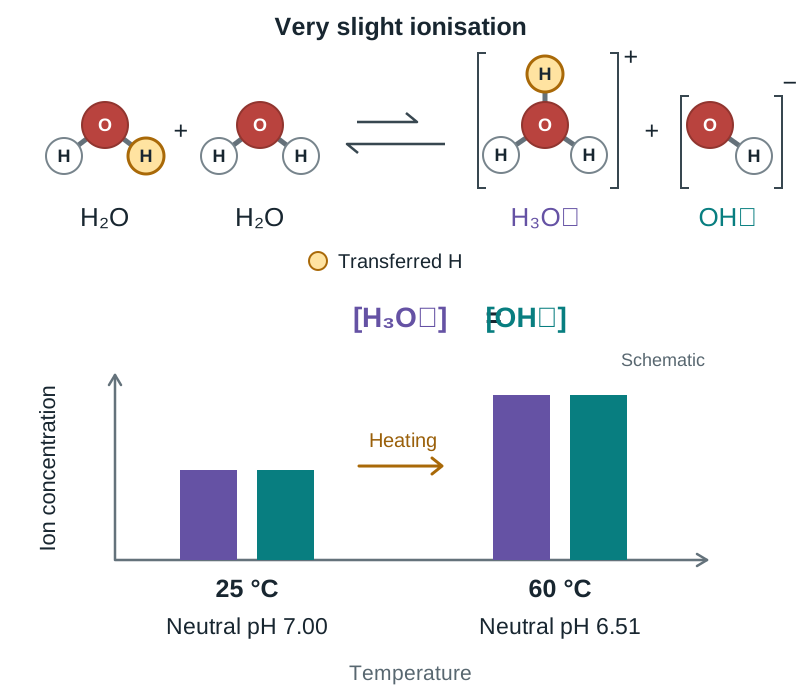
Pure water is not purely molecular. It undergoes self-ionisation to an extremely small degree:
Simplified:
Deducing the Mathematical Representation for
- Write the equilibrium constant () for the simplified self-ionisation:
- Because water self-ionises to such a tiny extent, the concentration of undissociated remains effectively constant (at approximately in pure water).
- Multiplying both sides by the constant :
- The left side is the product of two constants, giving a new constant called the ionic product of water ():
At , . This relationship holds in all dilute aqueous solutions, not just pure water. If increases, must decrease so that their product stays at at (for example, if is multiplied by 10, is divided by 10).
Temperature Dependence of and Chemical Neutrality
The forward reaction of water self-ionisation involves breaking covalent bonds, which absorbs energy. It is endothermic ().
According to Le Châtelier's principle, increasing temperature shifts the equilibrium in the endothermic forward direction to absorb added heat. This forward shift increases both and , causing to increase:
(or ). At , pH 7 is neutral, below 7 is acidic and above 7 is basic. Full pH calculations are in the pH note.
- At : (Neutral pH = 7.00)
- At : (Neutral pH = 6.51)
A solution is defined as neutral when . In pure water, each dissociation produces exactly one for every . Pure water is therefore strictly chemically neutral at all temperatures, even when its pH drops below 7 at elevated temperatures.
Key terms
- Arrhenius Acid
- A substance that dissociates in water to produce hydrogen ions (H⁺).
- Arrhenius Base
- A substance that dissociates in water to produce hydroxide ions (OH⁻).
- Brønsted-Lowry Acid
- A substance that donates a proton (H⁺).
- Brønsted-Lowry Base
- A substance that accepts a proton (H⁺).
- Conjugate Acid-Base Pair
- A pair of chemical species that differ from each other by exactly one proton (H⁺).
- Conjugate Acid
- The species formed when a Brønsted-Lowry base accepts a proton.
- Conjugate Base
- The species remaining after a Brønsted-Lowry acid donates a proton.
- Amphoteric (Amphiprotic)
- A substance capable of acting as either a Brønsted-Lowry acid or a Brønsted-Lowry base depending on what it reacts with.
- Hydronium Ion
- The hydrated proton (H₃O⁺) formed when a hydrogen ion binds datively to a water molecule.
- Ionic Product of Water (Kw)
- The product of the molar concentrations of hydrogen ions and hydroxide ions in water or an aqueous solution at a given temperature: Kw = [H⁺][OH⁻] = [H₃O⁺][OH⁻].
- Acid Dissociation Constant (Ka)
- The equilibrium constant for the dissociation of a weak acid in aqueous solution: Ka = [H⁺][A⁻]/[HA].
- Base Dissociation Constant (Kb)
- The equilibrium constant for the dissociation or ionisation of a weak base in aqueous solution.
- Strong Acid / Strong Base
- An acid or base that dissociates almost completely into ions in aqueous solution.
- Weak Acid / Weak Base
- An acid or base that dissociates or ionises only slightly into ions in aqueous solution.
- Degree of Dissociation
- The fraction or percentage of solute molecules that have broken down into ions in solution.
- Self-Ionisation
- The reaction in which two identical neutral molecules react to produce positive and negative ions, exemplified by water forming H₃O⁺ and OH⁻.
Check yourself
What is the formula of the conjugate base of the hydrogensulfate ion (HSO₄⁻)?
SO₄²⁻ (the sulfate ion, formed by removing one H⁺ from HSO₄⁻).
Can a hydrochloric acid solution be both strong and dilute? Explain.
Yes. It is strong because every dissolved HCl molecule fully dissociates into ions, and it is dilute if it has a low molar concentration (such as 0.001 mol l⁻¹).
Why does the value of Kw increase as the temperature of water rises?
The self-ionisation of water is endothermic (absorbs heat). By Le Châtelier's principle, raising the temperature shifts the equilibrium in the forward direction, increasing [H⁺] and [OH⁻] and thus raising Kw.
Why can Arrhenius theory not account for the basicity of ammonia (NH₃)?
Ammonia does not have hydroxide ions (OH⁻) in its chemical structure to dissociate directly in water, so Arrhenius theory cannot classify it as a base.
Acid X has a Ka of 1.5 × 10⁻³ and Acid Y has a Ka of 2.0 × 10⁻⁵. Which acid has a higher degree of dissociation in equimolar solution?
Acid X, because a larger Ka indicates that the dissociation equilibrium lies further to the right.