
Volumetric analysis is a quantitative laboratory technique where you measure the exact volume of one solution needed to react completely with another. In acid-base work, we use this method to determine an unknown concentration by titrating it against a reliably standardised solution. This topic covers the strict criteria for primary standards, how to prepare standard solutions, conversions across six common concentration units, correct glassware handling, indicator behaviour explained through Le Châtelier's principle, reading pH curves, and the student investigation on ethanoic acid in commercial vinegar.
Standard Solutions and Primary Standards
A standard solution is simply a solution of accurately known concentration. You can make one either by weighing out an exact mass of pure solid and dissolving it in a measured volume of water, or by finding its concentration through a titration against another reliable standard.
Not every chemical can be weighed out to make a standard solution directly. Many substances pick up moisture from the air, react with gases, or break down over time. That brings us to primary standards. A primary standard is a substance that can be obtained in a stable, pure, and soluble solid state, so you can weigh it accurately and dissolve it in water to make a solution of precisely known concentration.
To work as a primary standard, a compound needs to satisfy several conditions:
- High purity: It should be virtually 100% pure so that the mass on the balance belongs entirely to the target compound.
- Stability in air: It must not absorb water vapour or carbon dioxide from the atmosphere, nor should it lose water of crystallisation.
- High relative molecular mass (): A large molar mass means you weigh out a bigger mass for the same number of moles. That keeps your percentage weighing error very low.
- Good water solubility: It needs to dissolve readily and completely at room temperature.
- Fast and complete reaction: It must react instantaneously and according to a clean, known stoichiometric ratio without side reactions.
In our laboratory, anhydrous sodium carbonate (, ) is the main primary standard for acid-base work. We use it to standardise solutions of hydrochloric acid. In redox chemistry, ammonium iron(II) sulfate (Mohr's salt, ) serves as a primary standard to standardise potassium manganate(VII). Mohr's salt contains water of crystallisation, but unlike many hydrated crystals, it stays stable in air and does not lose that water on standing.
Common lab chemicals often fail these tests:
- Sodium hydroxide (): Solid pellets absorb moisture from the air so quickly that they dissolve in their own puddles. This property is called deliquescence. They also react with atmospheric carbon dioxide to form sodium carbonate. As a result, you can never weigh out pure .
- Hydrochloric acid (): Concentrated hydrochloric acid is a gas dissolved in water. It gives off hydrogen chloride gas fumes whenever the bottle opens, meaning its concentration drops over time.
- Sulfuric acid (): It is hygroscopic, meaning it constantly pulls water vapour out of the surrounding air into the liquid.
- Hydrated sodium carbonate (): Washing soda crystals are efflorescent. They lose water of crystallisation to the air, turning powdery and changing mass unpredictably.
- Potassium manganate(VII) (): It cannot be made completely pure, and in solution it gradually decomposes when exposed to light.
Preparing a Standard Solution in the Laboratory
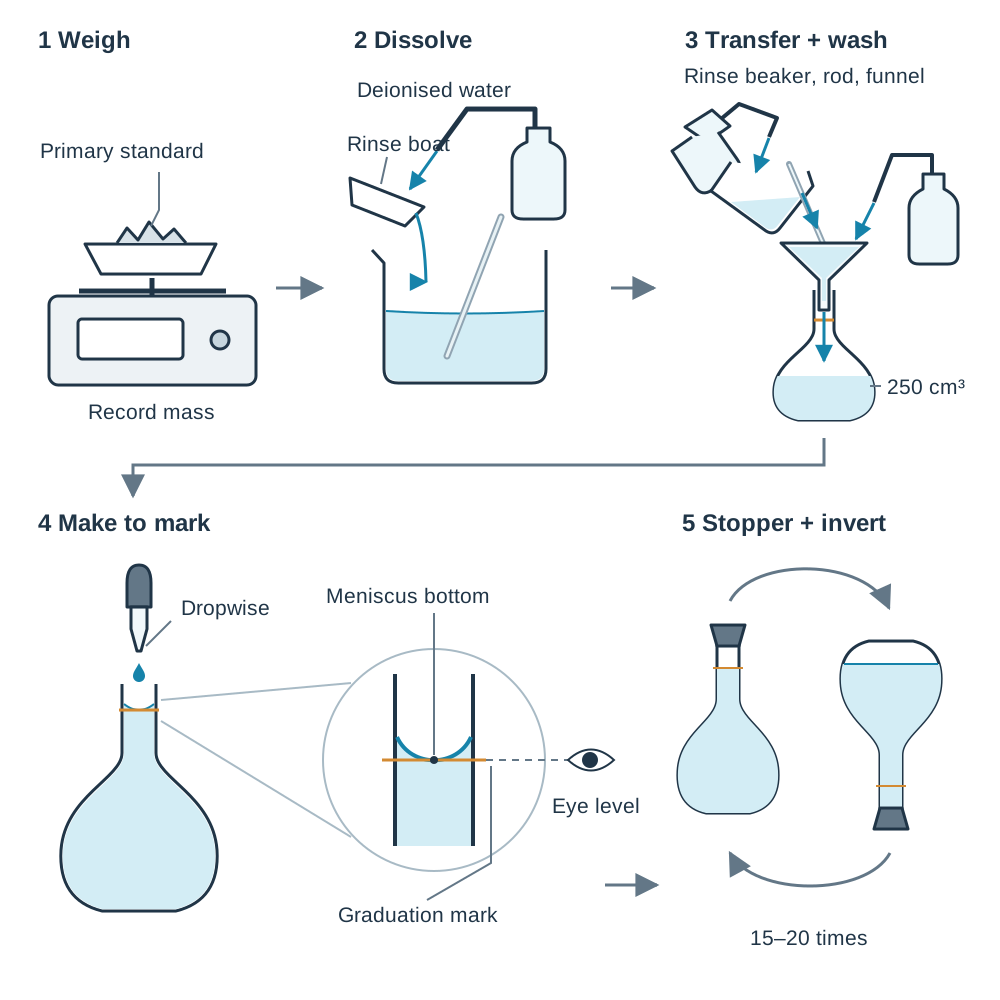
Making a standard solution is a fundamental laboratory technique. You will carry it out during practical work, and examiners regularly ask for the full step-by-step sequence in written questions. The standard method breaks down into five clear stages:
- Weighing the solid: Place a clean, dry weighing boat on an analytical balance reading to two or three decimal places. Tare the balance or record the mass of the empty boat, then add the dry primary standard (such as anhydrous ) until you reach the required mass. Record the exact final mass.
- Dissolving in a beaker: Tip the solid into a clean beaker containing around of deionised water. Use a wash bottle filled with deionised water to rinse the weighing boat thoroughly into the beaker, catching every lingering crystal. Stir the mixture with a clean glass rod until the solid dissolves completely.
- Transferring with washings: Pour the dissolved solution through a clean filter funnel into a volumetric flask, usually a flask. Do not stop there. Rinse the beaker, the stirring rod, and the funnel several times with deionised water from your wash bottle, letting all these washings run straight into the volumetric flask.
- Making to the mark: Add deionised water until the liquid level sits roughly a centimetre below the etched line on the neck. Put down the wash bottle and switch to a dropper or Pasteur pipette. Looking at eye level so you avoid parallax error, add water drop by drop until the bottom of the meniscus rests right on the graduation mark.
- Mixing thoroughly: Push the stopper firmly into the neck of the volumetric flask. Invert the flask and shake it back and forth at least fifteen to twenty times. If you skip this step, the solution near the bottom remains more concentrated than the liquid in the narrow neck.
Units of Concentration and Conversions
Concentration tells us how much solute is dissolved in a particular volume or mass of solution. The Leaving Certificate specification expects you to move comfortably between six different units:
- Molarity ( or ): The number of moles of solute in one litre () of solution.
- Mass concentration (): The mass in grams of solute in one litre of solution. You switch between molarity and mass concentration using the molar mass ():
- Percentage mass per volume (\% w/v): The mass in grams of solute dissolved in of solution. Because one litre contains ten units, converting from to is as simple as dividing by 10:
- Percentage mass per mass (\% w/w): The grams of solute in of the overall solution. This format is standard on commercial bottles of concentrated acids.
- Percentage volume per volume (\% v/v): The volume of liquid solute in present in of solution. You see this on bottles of alcoholic drinks, though remember that vinegar acidity is traditionally measured in .
- Parts per million (p.p.m.): For dilute aqueous solutions, (). We use p.p.m. for trace quantities, such as calcium and magnesium ions in hard water samples.
Practical Conversion Examples
Converting p.p.m. to A water sample contains of dissolved ions.
Converting \% (v/v) to using density A bottle of cider contains ethanol (, ). Pure ethanol has a density of .
- gives of pure ethanol in , which scales up to of ethanol in one litre.
- .
- .
Converting \% (w/w) to using density Bench hydrochloric acid is sold as with a measured density of ().
- of this acid solution has a mass of .
- .
- .
Dilutions and Volumetric Glassware Technique
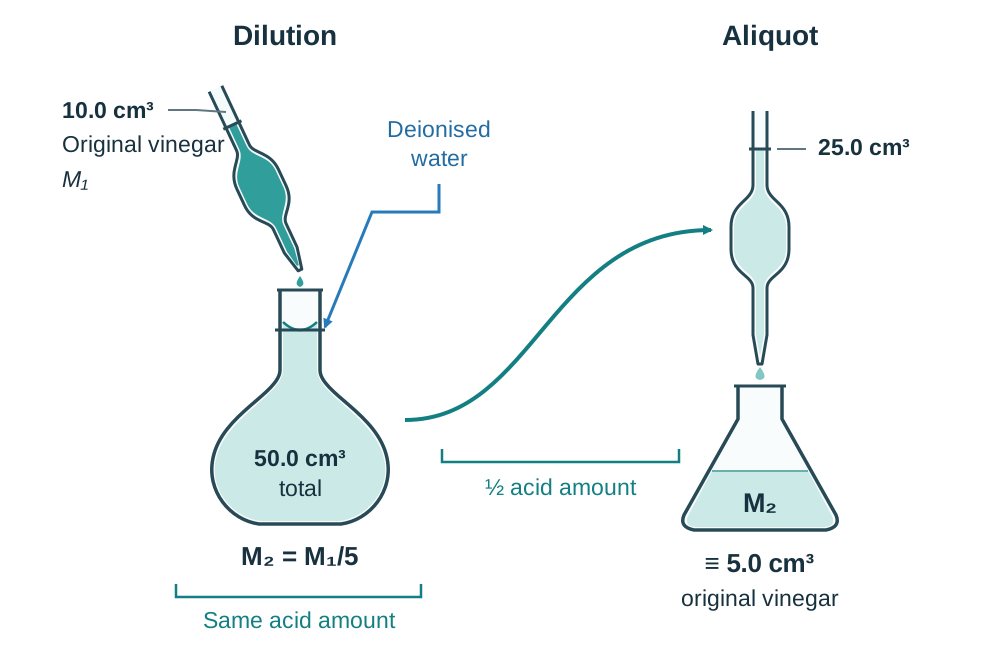
When you add pure water to a concentrated solution, you change its volume and concentration, but the number of dissolved moles stays unchanged:
The dilution factor tells you how many times more dilute your final solution is compared to the original sample:
If you dilute of commercial vinegar up to in a volumetric flask, your dilution factor is . Each portion you pipette into a conical flask holds the equivalent of of original vinegar. Always calculate this factor straight from the numbers given in the question; never guess that it is 10.
In a serial dilution, you dilute a sample through several repeated steps using the same ratio. For example, three consecutive dilutions give an overall dilution factor of .
How to Rinse Volumetric Glassware
| Piece of Glassware | Main Job | Correct Rinsing Protocol |
|---|---|---|
| Volumetric Flask | Prepares and holds an exact total volume of solution | Rinse with deionised water only. Leaving residual droplets of the solution inside would add extra solute and throw off the final concentration. |
| Pipette | Measures and delivers a fixed aliquot into the conical flask | Rinse with deionised water first, then with the solution it will contain. This washes out dirt without letting leftover water droplets dilute the measured sample. |
| Burette | Delivers variable, measured volumes of titrant | Rinse with deionised water first, then with the solution it will contain. Ensure the jet below the tap is filled with liquid. |
| Conical Flask | Holds the reacting mixture during titration | Rinse with deionised water only. Rinsing with the analyte would leave extra droplets of reactant behind, artificially inflating your titre. |
Essential Bench Rules
- Open the burette tap quickly to flush the tip before writing down your starting volume. An air bubble trapped in the jet will wash out during titration, which makes the burette reading higher than the volume actually added.
- Take the funnel out of the top of the burette straight after filling. A funnel left in place will drip extra drops of titrant down the wall while you are titrating.
- Read the bottom of the meniscus at eye level for all clear solutions.
- Let the pipette drain under gravity with the tip resting against the inner neck of the flask. Never blow out the last drop stuck in the tip; the glassmaker calibrated the pipette to leave that droplet behind.
- Use a wash bottle to rinse splashes on the inside walls of the conical flask down into the mixture as you titrate. Deionised water adds no extra moles of reactant, so it does not affect your result.
Indicators and Le Châtelier's Principle
An acid-base indicator is a weak acid or a weak base where the undissociated molecule has a completely different colour from its ionised conjugate form. An indicator changes colour over a characteristic range of roughly two pH units.
Weak Acid Indicators ()
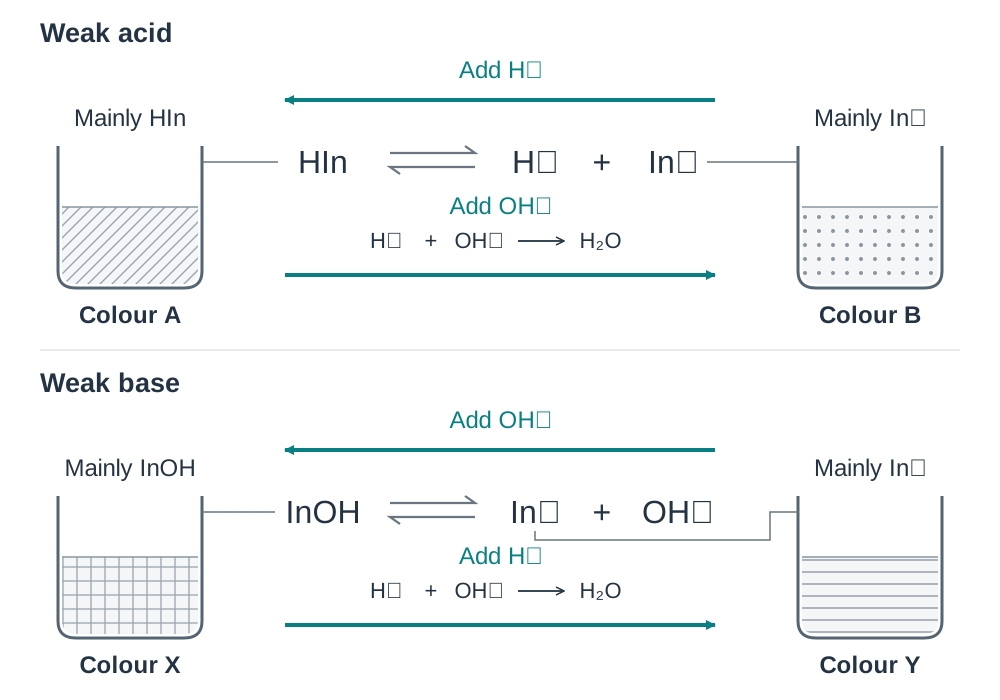
A weak acid indicator sets up a dynamic equilibrium in water:
When you place this indicator in an acidic solution, the high concentration of ions shifts the equilibrium position to the left according to Le Châtelier's principle. You see Colour A. If you add base, hydroxide ions react with to make water, removing from solution. The system responds by shifting to the right to replace the lost hydrogen ions, producing more and showing Colour B.
Weak Base Indicators ()
A weak base indicator sets up this equilibrium:
In a basic solution, the abundance of drives the position of equilibrium to the left, showing Colour X. In an acid, added combines with to produce neutral water molecules. The equilibrium shifts right to replenish the hydroxide ions, giving Colour Y.
Concept Example
Question: A student adds phenolphthalein to ethanoic acid in a conical flask, then runs sodium hydroxide in from a burette. Why does the solution start colourless and suddenly switch to pink? Explanation: Phenolphthalein is a weak acid indicator: , where is colourless and is pink. While acid is in excess, the plentiful ions keep the equilibrium shifted to the left, so the mixture stays colourless. Once all the acid reacts, the first excess drop of sodium hydroxide supplies ions that remove . The equilibrium shifts right to make , turning the solution permanently pink.
Investigating pH Titration Curves
A pH titration curve is a graph showing how the pH of the mixture changes as you add titrant from a burette. In class investigations, you generate this curve by gathering primary data with a calibrated digital pH probe.
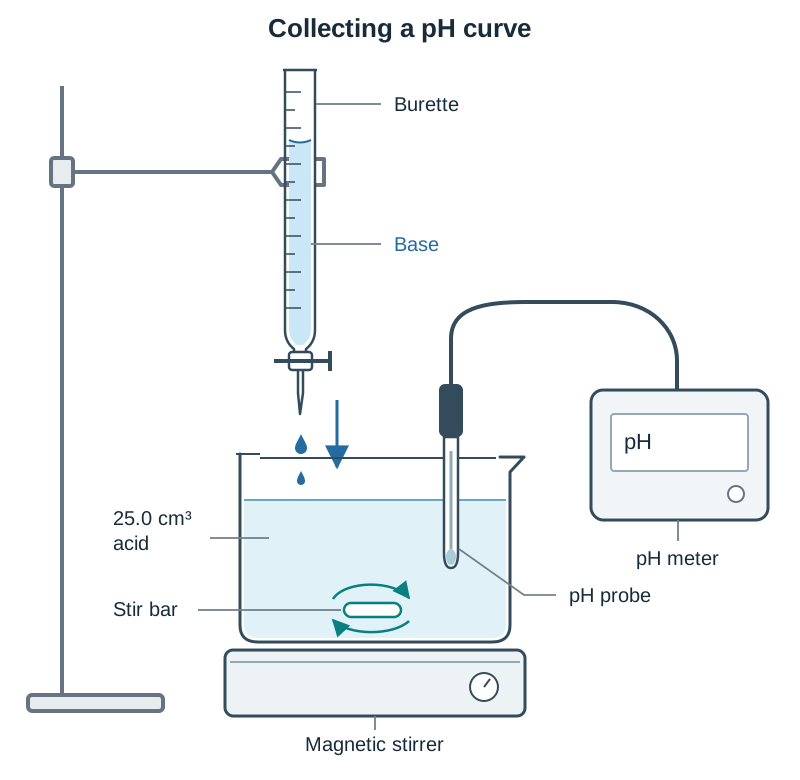
Generating a Primary pH Curve
- Calibrate your pH probe with two buffer solutions, usually pH 4 and pH 7.
- Pipette of acid into a clean beaker, lower the probe into the liquid, and mix gently with a magnetic stirrer.
- Run base in from the burette in portions, recording the pH reading each time.
- When you notice the pH climbing rapidly, slow down and add the base in small increments of .
- Keep adding base past the neutralisation point until the pH readings flatten out near the top.
- Plot pH on the vertical axis against the volume of base added in on the horizontal axis.
The equivalence point is the exact midpoint of the steep, near-vertical section of the curve. Reading straight down from this midpoint to the horizontal axis gives you the equivalence volume of titrant.
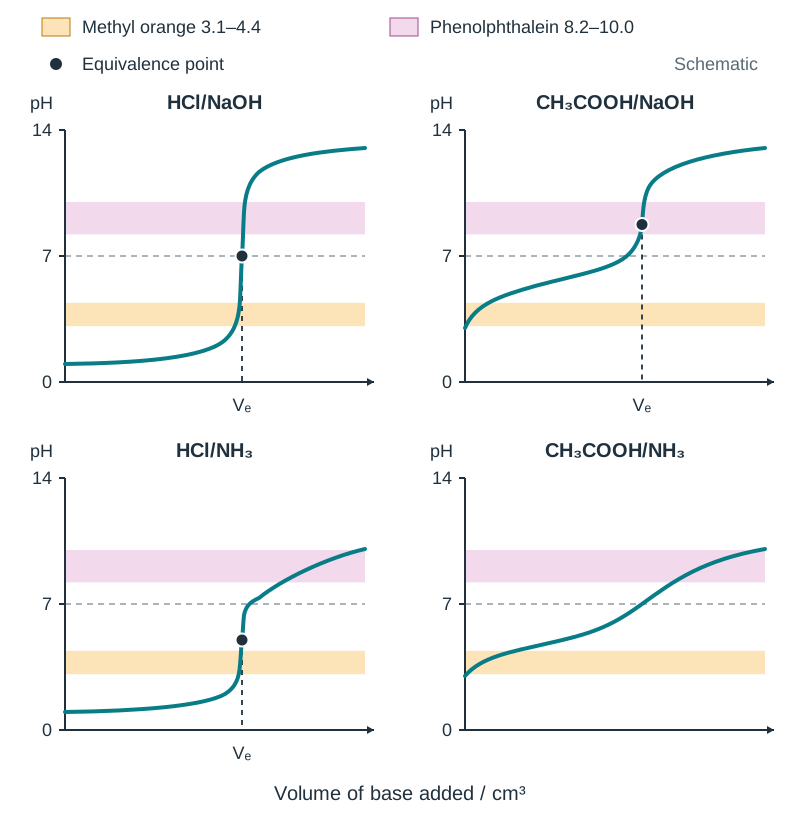
Four Curve Shapes You Need to Know
- Strong acid against strong base (e.g. titrated with ): The curve starts low around . It rises gradually, then jumps vertically between roughly and . The equivalence point sits right at . Both methyl orange (range ) and phenolphthalein (range ) fall inside this vertical jump, so either indicator works well.
- Weak acid against strong base (e.g. titrated with ): Starts higher, around . The vertical jump is shorter, extending from about to . The equivalence point lies on the alkaline side, typically between and , because the ethanoate salt formed hydrolyses in water:
Phenolphthalein is the right choice here because its colour-change band () fits on this vertical jump. Methyl orange would change colour much too early, before the reaction finishes.
- Strong acid against weak base (e.g. titrated with ): The steep section falls lower on the scale, between roughly and . The equivalence point sits in the acidic region, around . Methyl orange works reliably here because its colour-change range () lies along this steep section; phenolphthalein would not be suitable as its range lies entirely outside this vertical region.
- Weak acid against weak base (e.g. titrated with ): This curve has no sharp vertical step. It shows only a gentle inflection point. No chemical indicator can give a distinct colour change over such a sluggish rise, so indicators cannot be used. A digital pH meter can trace the curve, though identifying the exact equivalence volume remains difficult because the slope changes so gradually.
Investigation: Determining Ethanoic Acid in Vinegar (EI 4.1.5)
Commercial vinegar is an aqueous solution of ethanoic acid (). Finding its concentration using standardised sodium hydroxide is a required experimental investigation (marked with the superscript EI in the specification).
Because solid sodium hydroxide absorbs water and reacts with air, you cannot weigh it out as a primary standard. You must standardise it through a reliable experimental chain:
- Standardise a hydrochloric acid solution against primary standard anhydrous sodium carbonate using methyl orange.
- Titrate your sodium hydroxide against that freshly standardised hydrochloric acid.
- Use the newly standardised sodium hydroxide to titrate your vinegar.
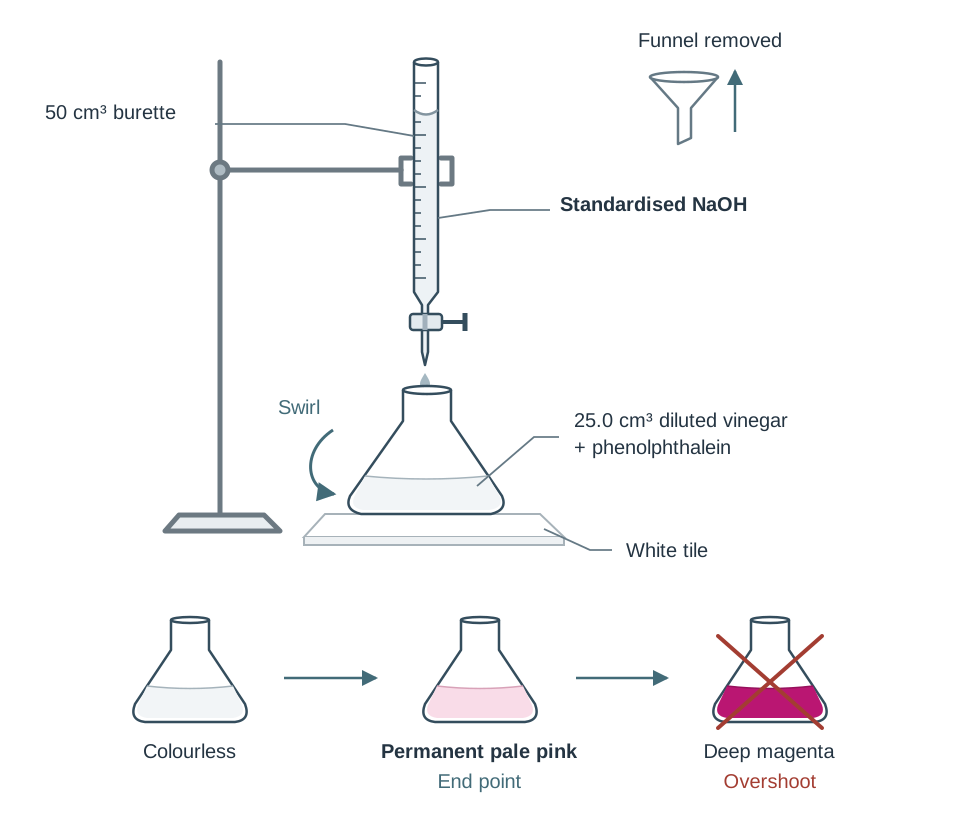
Practical Investigation Steps
- Objective: Find the concentration of ethanoic acid in commercial vinegar in both and .
- Key apparatus: pipette with safety filler, volumetric flask, burette, conical flask, white tile, wash bottle with deionised water.
- Why we dilute the vinegar: Neat commercial vinegar contains between 4% and 8% (w/v) ethanoic acid, roughly . If you titrated neat vinegar directly with , you would need only about of neat vinegar in the flask, which gives large percentage reading errors, or else well over of base from the burette. Diluting the vinegar tenfold lets you pipette a sensible sample and gives titres of roughly , which fit comfortably in a burette.
- Procedure:
- Pipette of commercial vinegar into a volumetric flask. Add deionised water to near the neck, then use a dropper to bring the bottom of the meniscus level with the line. Stopper the flask and invert it twenty times.
- Pipette of this diluted vinegar into a conical flask rinsed only with deionised water. Add two to three drops of phenolphthalein indicator.
- Fill the burette with your standardised (having rinsed it with deionised water and then ). Check that the tap jet has no trapped air bubble and take away the funnel.
- Place the conical flask on a white tile. Titrate while swirling continuously until one single drop turns the liquid from colourless to a permanent pale pink.
- Repeat until you get two concordant titres that agree within , then average them.
- Reaction equation:
Precautions and Common Experimental Errors
- White tile: Sits beneath the conical flask so you spot the very first faint, permanent pink colour against a bright background.
- Swirling: Keeps the solutions blending evenly so you do not mistake a brief pink splash for the real end point.
- Adding drop by drop near the end: Stops you overshooting the true neutralisation point.
- Pipette filler: Essential for safety; never pipette corrosive liquids by mouth.
- Overshooting the end point (deep magenta colour): You recorded too high a burette volume, which makes your calculated acid concentration artificially high.
- Rinsing the burette with deionised water only: Water droplets left on the walls dilute the . You will need a bigger volume of base to neutralise the acid, making your calculated vinegar concentration too high.
- Rinsing the pipette with deionised water only: Water droplets left inside dilute the vinegar sample. You deliver fewer moles of acid, the titre is too low, and your calculated concentration comes out too low.
Key terms
- Standard solution
- A solution whose concentration is accurately known.
- Primary standard
- A substance that can be obtained in a stable, pure, and soluble solid state so that it can be weighed out accurately and dissolved in water to give a solution of accurately known concentration.
- Equivalence point
- The point in a titration where the quantity of added titrant is chemically equivalent to the amount of analyte according to the reaction stoichiometry.
- End point
- The point in a titration at which the indicator changes colour. A suitable indicator makes the end point coincide with the equivalence point.
- Deliquescent
- The property of a substance that absorbs water vapour from the atmosphere until it completely dissolves to form an aqueous solution.
- Concordant titres
- Two or more titration volume readings that agree with each other within 0.10 cm³.
- Percentage mass per volume (% w/v)
- The mass of solute in grams dissolved per 100 cm³ of solution.
- Parts per million (p.p.m.)
- For dilute aqueous solutions, the concentration expressed as milligrams of solute per litre of solution (1 mg L⁻¹).
Check yourself
Why is solid sodium hydroxide completely unsuitable for use as a primary standard?
Sodium hydroxide is deliquescent: it absorbs water vapour from the air until it dissolves, and it reacts with atmospheric carbon dioxide to form sodium carbonate. A weighed sample is therefore never pure NaOH.
The burette is rinsed only with deionised water before being filled with sodium hydroxide. What effect does this error have on the calculated concentration of ethanoic acid in vinegar?
The water droplets left inside the burette dilute the sodium hydroxide solution. A larger volume of this dilute base is needed to neutralise the acid, giving a larger titre, so the calculated ethanoic acid concentration is too high.
What is the sharp end point colour change when standardised sodium hydroxide is run from a burette into diluted vinegar containing phenolphthalein?
The colour changes sharply from colourless to a permanent pale pink.
How many grams of anhydrous sodium carbonate (Na₂CO₃, Mr = 106.0 g mol⁻¹) are required to prepare 500.0 cm³ of a 0.0500 mol L⁻¹ standard solution?
Moles required = 0.5000 L × 0.0500 mol L⁻¹ = 0.0250 mol. Mass required = 0.0250 mol × 106.0 g mol⁻¹ = 2.65 g.
Why can chemical indicators not be used to find the equivalence point of a weak acid-weak base titration?
The pH changes only gradually near the equivalence point, so the pH curve has only a small, gradual inflection rather than a steep vertical section. No indicator changes colour over a narrow enough volume to give a sharp end point.