

The periodic table organises elements by increasing atomic number, grouping together elements with similar chemical properties and identical outer electron structures. Periodic trends in atomic size, ionisation energy, and electronegativity arise from changes in nuclear charge, electron shells, and inner-shell screening. Understanding these trends explains how the elements react, from reactive metals in Groups 1 and 2 to halogens and unreactive noble gases.
Historical Development and the Periodic Law
In 1869, Dmitri Mendeleev arranged the known elements in order of increasing atomic weight (relative atomic mass), placing elements with similar chemical behaviours into vertical columns.
Mendeleev made two crucial decisions that demonstrated the predictive power of his work:
- Gaps for undiscovered elements: He predicted that undiscovered elements would fill these gaps, and he predicted their properties. When gallium (1875) and germanium (1886) were discovered, their properties closely matched his predictions.
- Reversing pairs: He placed tellurium before iodine, despite tellurium having a higher atomic weight, to ensure both elements aligned with families sharing similar chemical properties.
The Periodic Laws
- Mendeleev's periodic law: When elements are arranged in order of increasing atomic weight (relative atomic mass), their properties recur at regular intervals.
- Modern periodic law: When elements are arranged in order of increasing atomic number, their properties recur at regular intervals.
In 1913, Henry Moseley used X-ray spectroscopy to establish that an element's fundamental identity is its atomic number (), which is the number of protons in its nucleus. Ordering elements strictly by increasing atomic number placed tellurium () before iodine () naturally, removing the need for arbitrary adjustments.
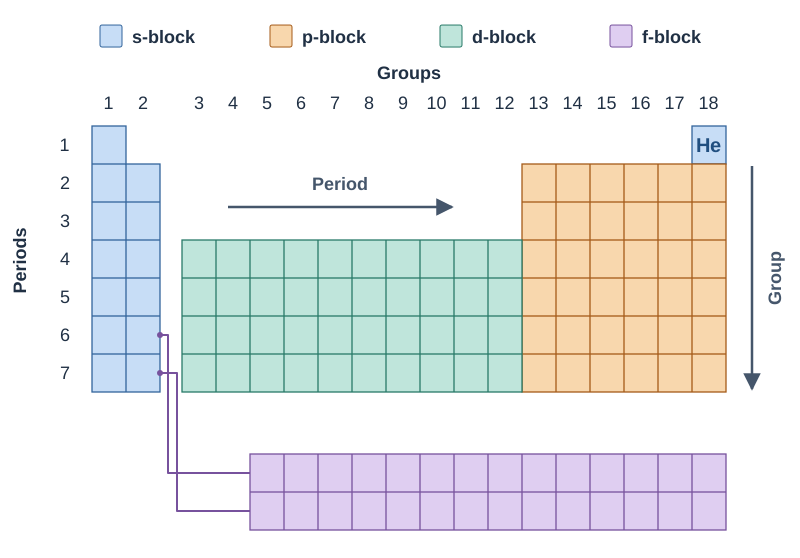
Structure of the Modern Periodic Table
- Periods: Horizontal rows numbered 1 to 7. The period number corresponds to the highest occupied principal energy level () in the ground state.
- Groups: Vertical columns numbered 1 to 18 (IUPAC). Elements in the same group have the same outer electron arrangement. In Groups 1 and 2, the number of outer electrons equals the group number. In Groups 13 to 18, it equals the group number minus 10 (e.g., chlorine in Group 17 has 7 outer electrons), except helium, which has 2.
- Blocks: The table divides into four blocks based on which sublevel receives the highest-energy electron: the s-block (Groups 1 and 2, plus He), the p-block (Groups 13 to 18), the d-block (transition metals), and the f-block (lanthanides and actinides).
Orbitals, Configurations, and Main-Group Ions
An atomic orbital is a region in space around the nucleus of an atom where there is a high probability (greater than 95%) of finding an electron. Orbitals have distinct geometries:
- An s orbital is spherical, centred on the nucleus. The lowest-energy orbital in any atom is the 1s orbital.
- A p orbital is dumbbell-shaped. There are three mutually perpendicular p orbitals in each p sublevel (), aligned along the x, y, and z axes.
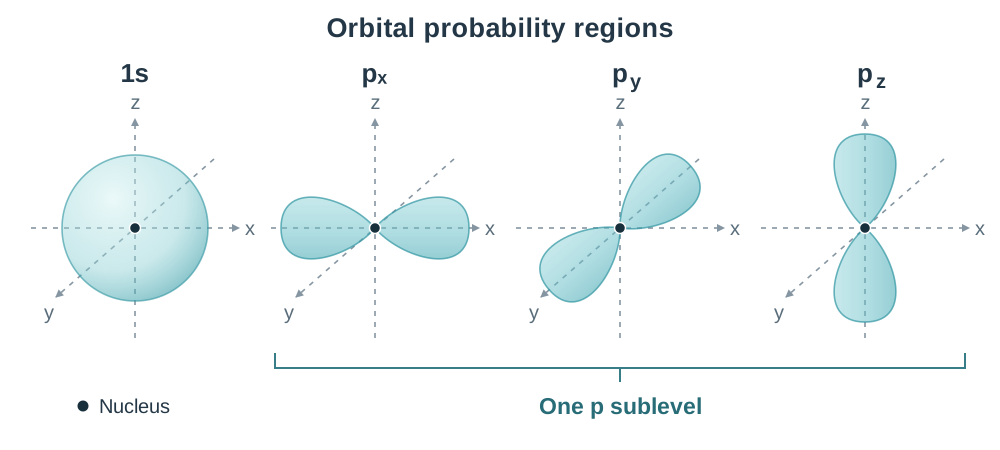
A sublevel is a group of orbitals of equal energy within a main energy level (for example, the 2p sublevel contains three orbitals, each holding up to two electrons).
Ground-State Electron Filling Rules
- Aufbau Principle: Electrons occupying an atom in its ground state fill the lowest available energy sublevels first before occupying higher levels (). Neutral atoms fill the 4s sublevel before 3d.
- Pauli Exclusion Principle: No more than two electrons can occupy any single atomic orbital, and they must have opposite spins (represented as ).
- Hund's Rule of Maximum Multiplicity: When orbitals of equal energy are available, electrons occupy them singly with parallel spins before pairing up.
Stability Exceptions (Z = 1 to 36)
- Chromium (): Has the configuration rather than . A half-filled 3d sublevel confers added stability.
- Copper (): Has the configuration rather than . A completely filled 3d sublevel confers added stability.
Stable Configurations and the Octet Rule
The octet rule states that when atoms bond, they tend to gain, lose, or share electrons so that each has eight electrons in its outer shell (achieving a stable noble gas configuration).
- Sodium loses one electron:
- Calcium loses two electrons:
- Oxygen gains two electrons:
- Bromine gains one electron:
Limitations of the octet rule include elements that achieve a stable duet like helium (hydrogen, lithium, beryllium), electron-deficient molecules such as boron in (which has only six valence electrons around boron), and transition metal compounds.
Isotopes and Relative Atomic Mass
Isotopes are atoms of the same element (same atomic number) that have different mass numbers, because they have different numbers of neutrons in their nuclei.
For example, naturally occurring bromine consists of bromine-79 and bromine-81. Both isotopes possess 35 protons and 35 electrons, but bromine-79 has 44 neutrons (), while bromine-81 has 46 neutrons (). Because they have identical electron configurations, isotopes show identical chemical behaviour.
Relative atomic mass () is the average of the mass numbers of the isotopes of an element, as they occur naturally, taking their abundances into account, expressed on a scale on which the mass of an atom of the carbon-12 isotope is exactly 12 units.
Relative atomic mass is a relative ratio and therefore has no units.
Periodic Trend: Atomic (Covalent) Radius
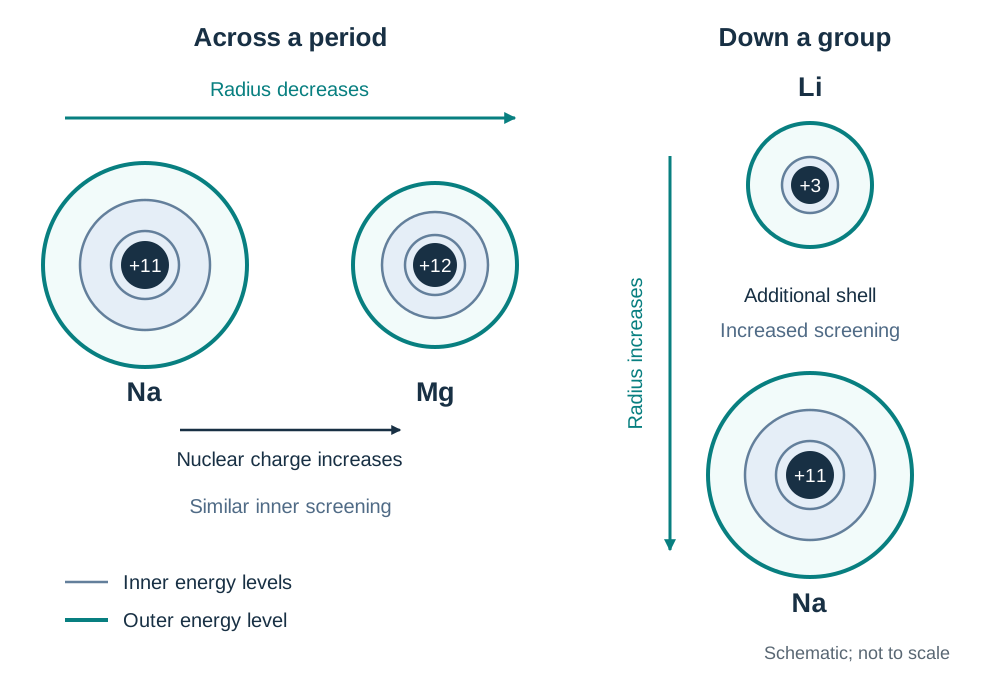
Inner electrons partly block the pull of the nucleus on outer electrons; this is called the screening effect (or shielding). The net positive pull that an outer electron actually feels is the effective nuclear charge.
Covalent radius is defined as half the distance between the centres of the nuclei of two identical atoms joined by a single covalent bond.
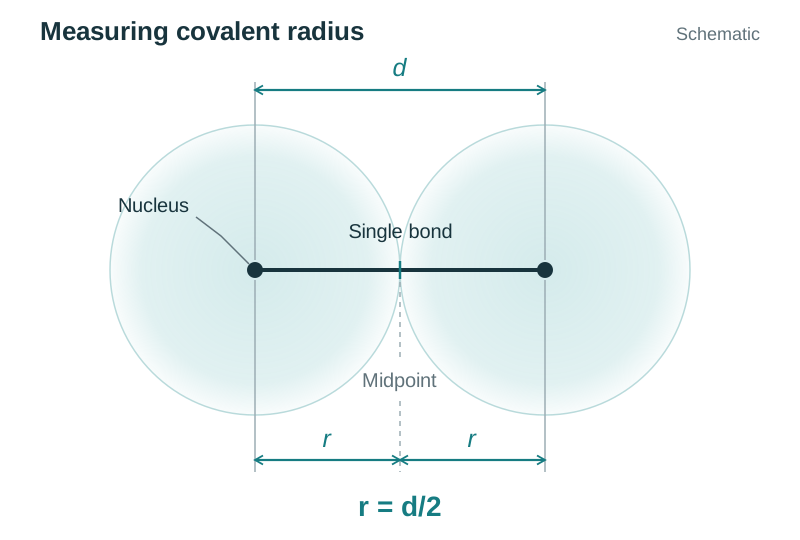
Trend Across a Period
Atomic radius decreases across every period from left to right:
- Each successive element gains an extra proton, increasing the positive nuclear charge.
- The incoming electron enters the same main energy level, so the screening effect from inner shells remains relatively constant.
- The higher effective nuclear charge draws the electron cloud closer to the nucleus.
Trend Down a Group
Atomic radius increases down every group from top to bottom:
- Each successive element has its outer electrons in an additional principal energy level.
- Extra inner filled shells provide an increased screening effect, shielding outer electrons from the nucleus.
- The greater distance and increased shielding outweigh the increase in nuclear charge, resulting in a larger atomic radius.
Noble gases (Group 18) are not assigned covalent radii because they exist as individual atoms and do not form single covalent bonds with identical atoms under normal conditions.
Periodic Trend: First and Successive Ionisation Energies
First ionisation energy is the minimum energy required to completely remove the most loosely bound electron from a neutral gaseous atom in its ground state:
The unit is . The atoms must be gaseous so that they are separate from each other, with no bonds or attractions to neighbouring atoms affecting the energy needed.
General Trends
- Across a period: First ionisation energy generally increases. Increasing nuclear charge and decreasing atomic radius pull outer electrons more firmly to the nucleus.
- Down a group: First ionisation energy decreases. Outer electrons occupy higher principal energy levels further from the nucleus and experience increased inner-shell screening, making them easier to remove.
Irregularities Across Periods 2 and 3
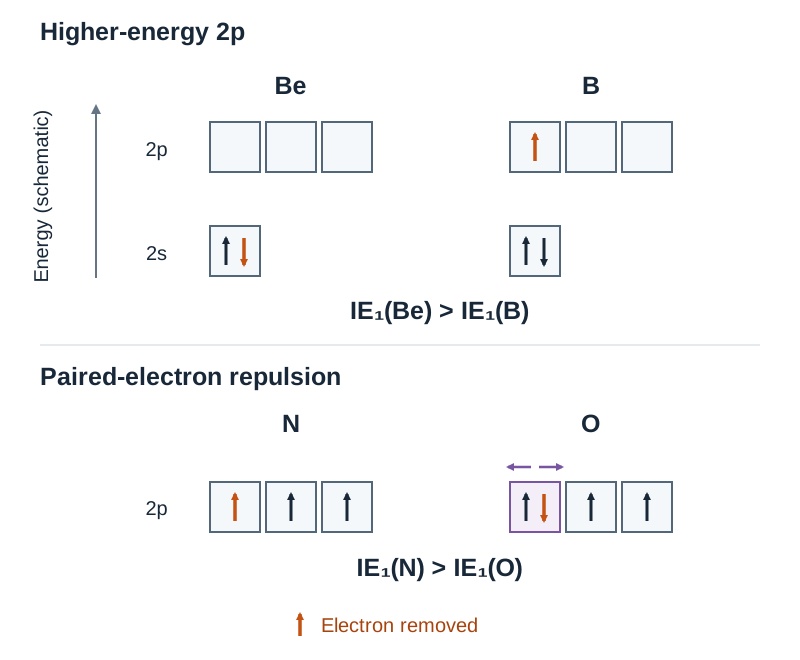
- Beryllium to Boron (and Mg to Al): Beryllium () has a higher first ionisation energy than boron (). Beryllium has a full 2s sublevel, which is a stable arrangement. Boron's valence electron sits in a higher-energy 2p sublevel, which is shielded by the 2s electrons and held less tightly.
- Nitrogen to Oxygen (and P to S): Nitrogen () has a higher first ionisation energy than oxygen (). Nitrogen has a half-filled 2p sublevel, which is a stable arrangement. In oxygen, two electrons must share the orbital; electrostatic repulsion between paired electrons in the same orbital raises their energy, making one electron easier to remove. Phosphorus and sulfur show the exact same pattern in Period 3.
Successive Ionisation Energies
Second ionisation energy is the energy required to remove an electron from a singly charged positive gaseous ion in its ground state:
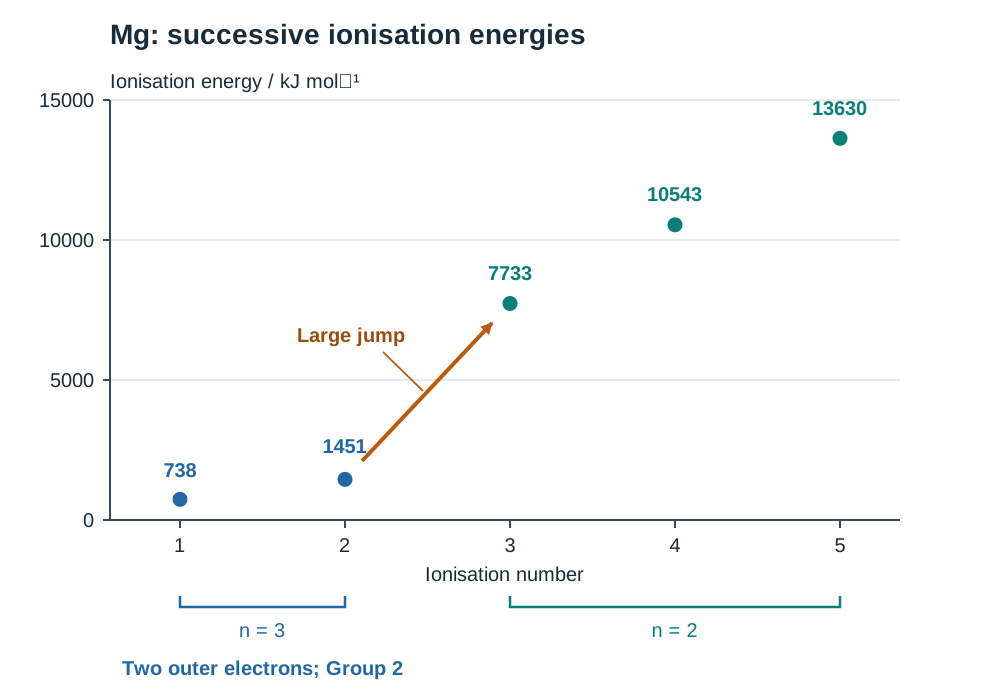
Removing successive electrons requires steadily more energy because each electron is pulled from an increasingly positive ion. A dramatic jump in ionisation energy occurs whenever an electron is removed from a full, inner principal energy level closer to the nucleus. These large jumps provide evidence that electrons are arranged in main energy levels (shells). Neon's first ionisation energy is very high because its 2p sublevel is completely full and its outer electrons experience a high effective nuclear charge, explaining its lack of chemical reactivity.
Periodic Trend: Electronegativity
Electronegativity is the relative attraction that an atom in a molecule has for the shared pair of electrons in a covalent bond.
Electronegativity is measured on the Pauling scale, on which fluorine has the highest value (4.0). Within the first 36 elements, potassium has the lowest value (0.8).
Trend Across a Period
Electronegativity increases across a period:
- Nuclear charge increases while screening from inner shells remains relatively constant.
- Atomic radius decreases, allowing the nucleus to exert a stronger pull on shared bonding electrons.
Trend Down a Group
Electronegativity decreases down a group:
- Atomic radius increases as new energy levels are added.
- Increased screening by inner shells diminishes the effective attraction between the nucleus and the shared pair of electrons.
Noble gases lack Pauling electronegativity values because their full outer shells make them chemically unreactive, so they do not routinely form covalent bonds.
Summary of Periodic Trends
| Property | Across a Period | Down a Group | Main Factors |
|---|---|---|---|
| Covalent Radius | Decreases | Increases | Nuclear charge vs number of shells & screening |
| First Ionisation Energy | Generally increases | Decreases | Nuclear charge & radius vs shielding & shell distance |
| Electronegativity | Increases | Decreases | Nuclear pull on bonded pair vs radius & shielding |
Comparative Group Chemistry: Groups 1, 2, 17, and 18
Group 1: Alkali Metals (Li, Na, K)
Alkali metals are soft, shiny metals with low densities (lithium, sodium, and potassium float on water) and excellent electrical conductivity. They have one outer electron (). Reactivity increases down the group as atomic radius expands, lowering ionisation energy.
- Reaction with oxygen: Form basic metal oxides, tarnishing quickly in air:
- Reaction with water: React vigorously to produce a metal hydroxide and hydrogen gas:
- Storage: Stored under paraffin oil to prevent reaction with atmospheric oxygen and water vapour.
Group 2: Alkaline Earth Metals (Be, Mg, Ca)
Alkaline earth metals are harder, denser solids with higher melting points than Group 1 metals. They conduct electricity well. They have two outer electrons (). Reactivity increases down the group.
- Reaction with oxygen: Burn to form basic oxides:
- Reaction with water: Beryllium does not react. Magnesium reacts extremely slowly with cold water, but reacts vigorously with steam to form magnesium oxide and hydrogen:
Calcium reacts steadily with cold water:
The solution turns cloudy because calcium hydroxide is only slightly soluble in water.
Group 17: Halogens (F₂, Cl₂, Br₂, I₂)
Halogens exist as diatomic non-metal molecules and are poor conductors of electricity in all states because they lack free electrons or ions. At room temperature, fluorine is a pale yellow gas, chlorine is a greenish-yellow gas, bromine is a dense red-brown liquid, and iodine is a purple-black solid (which sublimes into purple vapour when heated). Boiling points increase down the group because larger molecules have stronger van der Waals forces between them.
- Reactivity trend: Reactivity decreases down the group. Halogens react by attracting an incoming electron to complete an octet (). Smaller atoms with less screening exert a stronger pull on electrons.
- Displacement reactions: A more reactive halogen displaces a less reactive halide ion from solution:
The colourless solution turns orange-red as elemental bromine is formed.
Group 18: Noble Gases (He, Ne, Ar, Kr)
Noble gases are colourless, odourless, monatomic gases (they exist as single atoms) and poor conductors of heat and electricity. They are chemically unreactive due to their stable outer shells ( for helium; for all others). Boiling points increase down the group because larger atoms produce stronger van der Waals forces.
Key terms
- Atomic Number
- The number of protons in the nucleus of an atom of that element.
- Mendeleev's Periodic Law
- When elements are arranged in order of increasing atomic weight (relative atomic mass), their properties recur at regular intervals.
- Modern Periodic Law
- When elements are arranged in order of increasing atomic number, their properties recur at regular intervals.
- Atomic Orbital
- A region in space around the nucleus of an atom where there is a high probability (greater than 95%) of finding an electron.
- Sublevel
- A group of orbitals of equal energy within a main energy level.
- Octet Rule
- When atoms bond, they tend to gain, lose or share electrons so that each has eight electrons in its outer shell.
- Isotopes
- Atoms of the same element (same atomic number) that have different mass numbers, because they have different numbers of neutrons.
- Relative Atomic Mass
- The average of the mass numbers of the isotopes of an element, as they occur naturally, taking their abundances into account, expressed on a scale on which the mass of an atom of the carbon-12 isotope is exactly 12 units.
- Covalent Radius
- Half the distance between the centres of the nuclei of two identical atoms joined by a single covalent bond.
- Screening Effect
- The reduction in attraction between the positive nucleus and outer electrons caused by the presence of inner-shell electrons.
- Effective Nuclear Charge
- The net positive charge experienced by an outer electron, taking into account the screening effect of inner electrons.
- First Ionisation Energy
- The minimum energy required to completely remove the most loosely bound electron from a neutral gaseous atom in its ground state.
- Second Ionisation Energy
- The energy required to remove an electron from a singly charged positive gaseous ion in its ground state.
- Electronegativity
- The relative attraction that an atom in a molecule has for the shared pair of electrons in a covalent bond.
Check yourself
A sample of boron consists of 20% boron-10 and 80% boron-11. Calculate the relative atomic mass of this sample.
Ar = (10 × 20 + 11 × 80) ÷ 100 = (200 + 880) ÷ 100 = 1080 ÷ 100 = 10.8.
Write the ground-state electron configuration in s, p notation for the sulfide ion, S²⁻.
1s² 2s² 2p⁶ 3s² 3p⁶ (a sulfur atom has 16 electrons; gaining two electrons gives 18 electrons, achieving the stable electron configuration of argon).
Why does nitrogen have a higher first ionisation energy than oxygen?
Nitrogen (1s² 2s² 2p³) has a half-filled 2p sublevel, which is particularly stable. Oxygen (1s² 2s² 2p⁴) has two electrons paired in one 2p orbital; electrostatic repulsion between these paired electrons makes one easier to remove.
Using Pauling electronegativity values of H = 2.1 and Cl = 3.0, explain which atom in hydrogen chloride (HCl) carries the partial negative charge.
Chlorine carries the partial negative charge (δ⁻) because it has a higher electronegativity (3.0) than hydrogen (2.1), pulling the shared bonding electron pair closer to itself.
Describe what is observed when magnesium reacts with steam, and give the products of the reaction.
Magnesium burns with a bright white flame to form a white powder (magnesium oxide, MgO) and releases colourless hydrogen gas (H₂).