
Stoichiometry is how chemists use balanced chemical equations and the mole to work out how much of each substance reacts or is formed. Grounded in the laws of conservation of mass and energy, quantitative chemistry connects individual atoms, molecules, and ions to measurable laboratory quantities such as mass, gas volume, and solution concentration. This topic covers chemical equations, isotopic abundance, empirical and molecular formulae, gravimetric analysis, limiting reactants, reaction yields, gas behaviours at standard conditions, and methods for preparing and diluting chemical solutions.
Conservation of Mass, Energy, and Experimental Verification
Around 1774, Antoine Lavoisier heated tin in sealed glass vessels. The tin turned into a powder and gained mass, but the total mass of the sealed vessel remained completely unchanged. The mass gained by the metal equalled the mass of air consumed, which he later identified as oxygen. From meticulous measurements like these came the Law of Conservation of Mass: mass cannot be created or destroyed in a chemical reaction. The total mass of the reactants always equals the total mass of the products, meaning every atom present at the start must be accounted for at the end.
Closely linked is the Law of Conservation of Energy: energy cannot be created or destroyed, only transformed from one form into another. When methane burns in air, chemical potential energy stored within bonds transforms into thermal and radiant energy. The total quantity of energy before and after combustion is identical.
Chemistry distinguishes between the properties of matter and how matter changes:
- A physical property can be observed or measured without altering the chemical identity of the substance (e.g. colour, melting point, boiling point, density, and solubility).
- A chemical property describes how a substance reacts to form entirely new substances (e.g. flammability, reaction with acids, and corrosion).
- A physical change is a change where no new substance is formed, such as melting, boiling, or dissolving. The particles retain their chemical identity.
- A chemical change rearranges atoms through the breaking and forming of bonds to create one or more new substances. Signs of a chemical change include a distinct colour change, a gas being evolved, a solid precipitate forming, or heat and light being released or absorbed.
Experimental Investigation: Verifying Conservation of Mass
The specification designates this practical as an Experimental Investigation (EI). You verify the law using primary data you collect in the laboratory and justify the result using a particulate model.
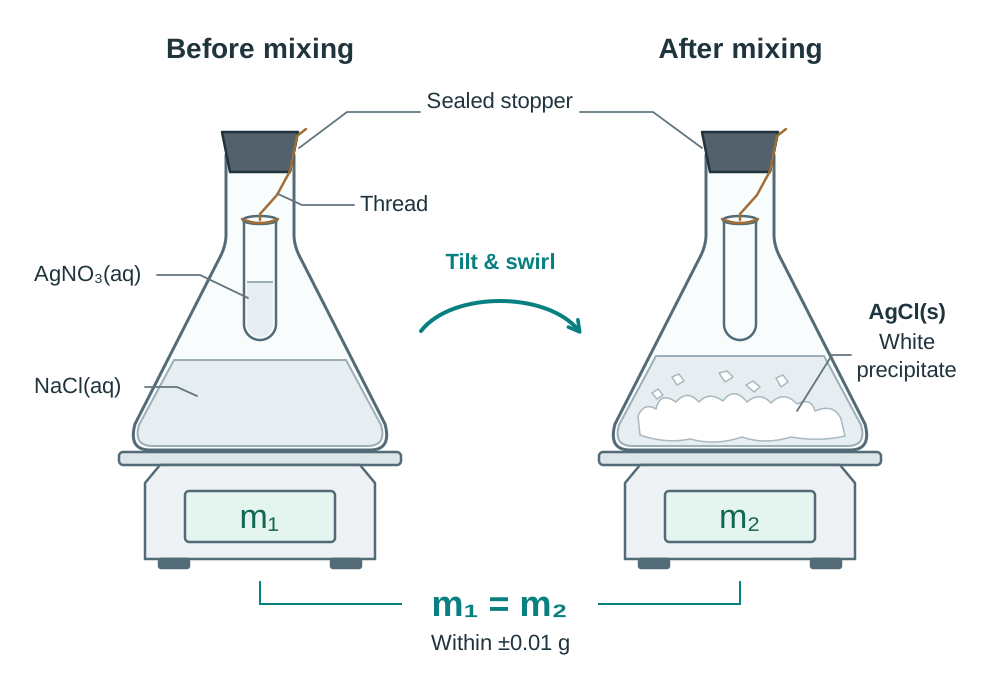
- Purpose: To verify, using primary data, that the total mass of substances before and after a chemical reaction is conserved in a closed system.
- Apparatus: Conical flask with a tight-fitting rubber stopper, small internal test tube (ignition tube), thin thread, electronic balance (reading to ), dilute sodium chloride solution (), and dilute silver nitrate solution ().
- Method:
- Pour approximately of dilute sodium chloride solution into the conical flask.
- Half-fill the small test tube with dilute silver nitrate solution and suspend it upright inside the flask using a thread trapped by the rubber stopper. Ensure the solutions do not mix.
- Place the entire assembled closed system on the balance and record its initial mass ().
- Tilt and swirl the flask gently so the two clear solutions mix thoroughly. A dense white precipitate of silver chloride forms immediately: $$
- Return the stoppered flask to the balance and record the final mass ().
- Result: Within the precision of the balance (), .
- Gas-Producing Alternative: React a small amount of marble chips with dilute HCl in a flask sealed with a balloon. Keep the quantities small so that pressure does not build up. The total mass of matter is unchanged, although the balance reading may dip very slightly as the inflating balloon is buoyed up by the surrounding air. When the balloon is removed, the reading drops clearly because the CO2 escapes.
- Model Explanation: Chemical reactions simply rearrange existing atoms into new combinations; atoms are neither created nor destroyed. The equation shows exactly 1 Ag, 1 N, 3 O, 1 Na, and 1 Cl atom on both sides of the arrow, so the total mass cannot change.
- Sources of Error: Balance calibration or zeroing faults, liquid spilling prematurely while lowering the inner tube, loose stoppers permitting gas or vapour exchange, condensation on external glassware, and draughts affecting sensitive balance pans.
Atomic Mass, Isotopes, and Balancing Chemical Equations
Most elements exist naturally as a mixture of isotopes: atoms of the same element containing identical numbers of protons but different numbers of neutrons, resulting in different masses.
Relative Atomic Mass and Isotopic Abundance
The relative atomic mass () is the average mass of an atom of the element, taking account of the natural abundance of its isotopes, relative to one-twelfth of the mass of a carbon-12 atom. Because is a relative ratio, has no units.
- Calculating : Chlorine consists of chlorine-35 and chlorine-37: $$
- Working backwards: Boron () contains only boron-10 and boron-11. Let be the percentage of boron-10; the percentage of boron-11 is : $20\%80\%$ boron-11.
The relative molecular mass () is the average mass of one molecule of a compound relative to one-twelfth of the mass of a carbon-12 atom. It is calculated by adding together the relative atomic masses of all atoms in the formula unit, and it also carries no units.
Balancing Chemical Equations
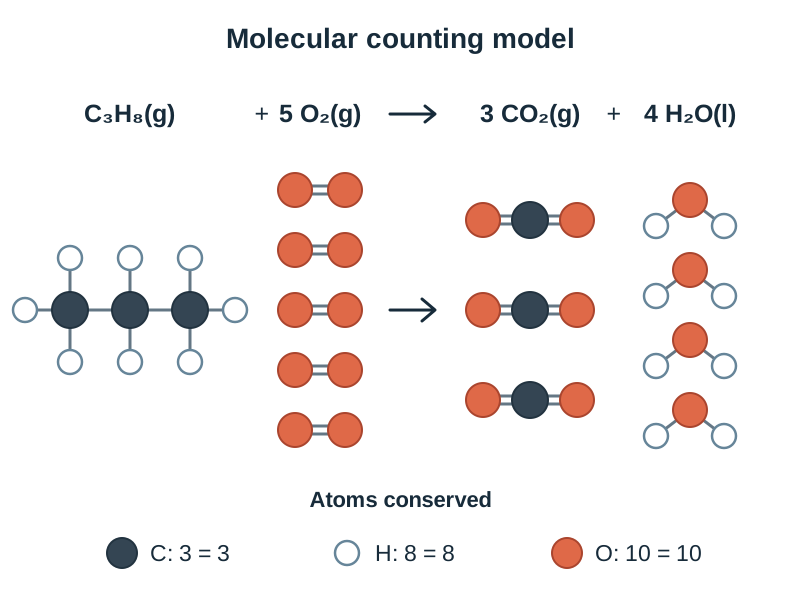
Because atoms are conserved, an equation must show equal numbers of each atomic species on both sides. Changing the chemical subscripts alters the identity of a substance; you may adjust only the stoichiometric coefficients (the numbers in front of formulae).
- Write the correct formula for each reactant and product.
- Balance elements appearing in only one substance on each side first. Leave free elements, oxygen, and hydrogen until last.
- Count every atom on both sides to verify equality.
- Include state symbols: solid, liquid, gas, and aqueous solution.
For the complete combustion of propane: $\text{CO}_2\text{H}_2\text{O}(3 \times 2) + (4 \times 1) = 10\text{O}_23.5\text{ O}_2$), multiply every coefficient in the equation by 2.
The Mole Concept, Molar Mass, and Density
Individual particles are far too small to count directly. Chemists count particles in large, fixed packages called moles, just as items are counted in dozens.
A mole is the amount of substance that contains elementary particles (atoms, molecules, ions, or formula units). This fundamental counting number is the Avogadro constant (). Historically, this value was chosen because exactly of carbon-12 contains one mole of carbon atoms.
The molar mass () is the mass of one mole of a substance expressed in grams per mole (). Molar mass has the exact same numerical value as the relative molecular mass () or relative atomic mass (), but unlike them, it carries units: water has , so its molar mass is .
To calculate moles from mass: $$
Density in Stoichiometric Calculations
Density is the mass per unit volume of a substance: $\text{g cm}^{-3}1\text{ g cm}^{-3} = 1\text{ g mL}^{-1}$). When reaction quantities are given as liquid volumes, convert volume to mass using density before calculating moles:
For example, to find the moles in of pure ethanol (, ): $$
Empirical Formulae, Molecular Formulae, and Gravimetric Analysis
A chemical formula reflects the fixed ratio of combining atoms governed by conservation principles.
Percentage Composition by Mass
To determine what fraction of a compound's mass is contributed by each element: $\text{NH}_4\text{NO}_3M_r = 80.0$
Empirical and Molecular Formulae
- An empirical formula shows the simplest whole-number ratio of atoms of each element in a compound.
- A molecular formula shows the actual number of atoms of each element present in one molecule of a compound.
To find an empirical formula:
- Convert percentages or masses into grams for each element.
- Divide each mass by the element's relative atomic mass () to find moles.
- Divide every mole value by the smallest calculated value.
- If fractional numbers remain, multiply by the smallest integer: multiply by 2 for values near , by 3 for values near or , and by 4 for values near or .
To determine the molecular formula, divide the relative molecular mass () by the empirical formula mass to obtain an integer multiplier : $$
Gravimetric Analysis
Gravimetric analysis determines chemical composition using precise mass measurements. A classic procedure involves heating copper metal in a crucible to form copper oxide. Heating, cooling in a desiccator, and reweighing are repeated until the mass no longer changes (heating to constant mass), confirming the reaction has finished.
Worked gravimetric example: A sample of of copper forms of oxide. Mass of combined oxygen .
- Moles of
- Moles of
- Mole ratio . The empirical formula is .
Gas Stoichiometry and Molar Volume
Avogadro's law states that equal volumes of gases, at the same temperature and pressure, contain equal numbers of molecules.
Deducing Molar Volume
Because gases behave similarly under moderate conditions, one mole of any gas occupies an identical volume at a specified temperature and pressure. Standard temperature and pressure (STP) is set at () and (). Using the ideal gas equation ( with , ): $20^\circ\text{C}293.15\text{ K}101.3\text{ kPa}24.0\text{ L}24,000\text{ cm}^3$). Always check the molar volume and conditions printed in the question or formula booklet.
For non-standard conditions, apply the ideal gas equation: $P\text{Pa}V\text{m}^31\text{ cm}^3 = 1 \times 10^{-6}\text{ m}^3nR = 8.314\text{ J K}^{-1}\text{ mol}^{-1}TT\text{(K)} = {}^\circ\text{C} + 273.15$).
Experiment: Determining the Relative Molecular Mass of a Volatile Liquid
- Purpose: To determine the relative molecular mass () of a volatile liquid (such as propanone) by vaporising it and applying .
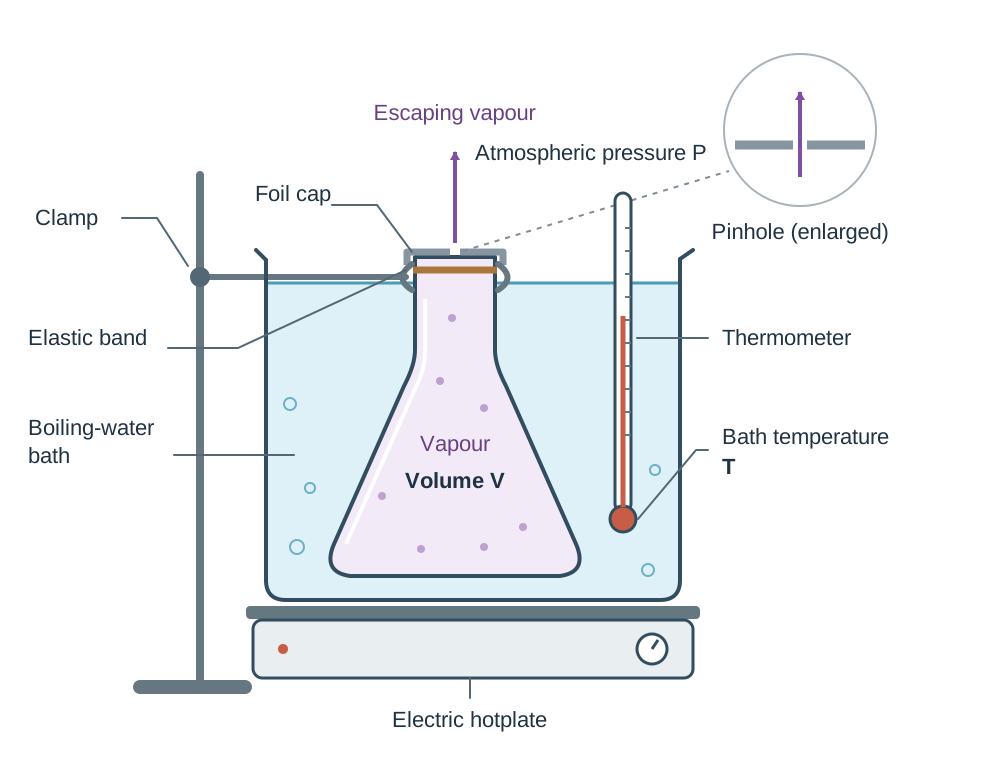
- Apparatus: Dry conical flask, aluminium foil cap with a small pinhole, rubber elastic band, large beaker of boiling water (water bath), electric hotplate, thermometer, barometer, and a balance reading to .
- Method:
- Weigh the clean, dry conical flask together with the aluminium cap and rubber band ().
- Add approximately of volatile liquid, secure the foil cap tightly with the band, and pierce a single pinhole in the centre.
- Immerse the flask as deeply as possible in a boiling water bath using a clamp. Heat until all liquid vanishes; the liquid vaporises and excess gas escapes through the pinhole, leaving the flask filled with vapour at atmospheric pressure.
- Record the temperature of the water bath (, which equals the vapour temperature) and barometric room pressure ().
- Remove the flask, cool to room temperature so the vapour condenses, dry the outside thoroughly, and reweigh (). The mass of condensed vapour is .
- Fill the flask completely with water and measure its total internal volume using a graduated cylinder ().
- Calculation: Find moles of vapour using , then calculate .
- Sources of Error: Liquid not completely vaporised, water droplets clinging to the outside of the flask during final weighing, parts of the neck projecting out of the bath causing premature condensation, or deviations from ideal gas behaviour.
- Safety: Volatile organic solvents are highly flammable; use an electric hotplate rather than an open Bunsen flame.
Limiting Reactants, Percentage Yield, and Purity
Chemical reactions rarely start with reactants mixed in exact stoichiometric ratios.
Limiting and Excess Reactants
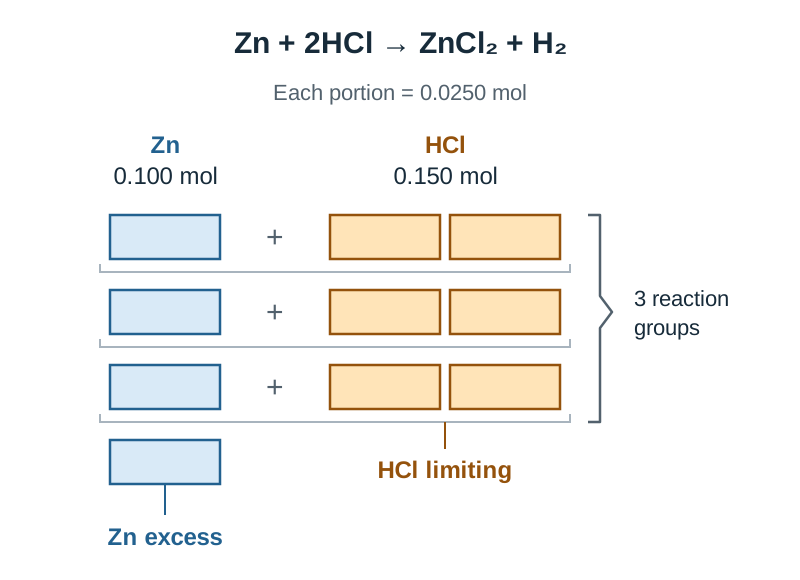
The limiting reactant is completely used up first. It stops the reaction and dictates the maximum amount of product formed. The reactant remaining when the reaction ceases is in excess.
To find the limiting reactant:
- Convert the starting quantity of each reactant into moles.
- Divide each mole quantity by its coefficient from the balanced equation.
- The reactant with the lowest quotient is the limiting reactant. Use only this substance to calculate theoretical product quantities.
Theoretical, Actual, and Percentage Yield
- Theoretical yield: The maximum amount of product calculated from the limiting reactant assuming completion without losses.
- Actual yield: The amount of pure product actually obtained in the experiment, measured as a mass, a gas volume, or a number of moles.
- Percentage yield: The ratio of actual yield to theoretical yield expressed as a percentage: $$ Both yields must be expressed in identical units (both in grams, or both in litres) before calculating the ratio.
Actual yields fall below due to:
- Reversible reactions reaching dynamic equilibrium before completion.
- Competing side reactions producing unwanted by-products.
- Mechanical losses during transfers, pouring, filtration, and recrystallisation.
- Impure starting materials.
If a product is not fully dried before weighing, trapped water or solvent adds extra mass, which artificially raises the apparent yield, sometimes exceeding .
Percentage Purity Calculations
When dealing with impure solid reagents, only the pure fraction participates in the chemical change: $2.00\text{ g}80.0\%1.60\text{ g } \text{CaC}_21.60\text{ g} / 64.0\text{ g mol}^{-1} = 0.0250\text{ mol}0.0250\text{ mol} \times 24.0\text{ L mol}^{-1} = 0.600\text{ L}$ at room temperature).
Chemical Solutions, Concentrations, and Dilutions
A solution consists of a solute dissolved in a solvent. The Leaving Certificate specification requires familiarity with solution classifications and concentration units.
Saturation States
- An unsaturated solution contains less dissolved solute than the maximum amount possible at that temperature; more solute will dissolve if added.
- A saturated solution contains the maximum quantity of solute that can dissolve at that specific temperature in the presence of undissolved solid.
- A supersaturated solution holds more dissolved solute than a saturated solution at that temperature. Prepared by slowly cooling an undisturbed hot saturated solution, it is unstable and crystallises rapidly upon mechanical agitation or the addition of a seed crystal.
Primary Standards and Standard Solutions
A standard solution is a solution whose concentration is accurately known. A primary standard is a substance pure and stable enough to produce a standard solution directly by dissolving a known mass in an exact volume of water. An ideal primary standard:
- is available in high purity (),
- is stable in air (does not absorb moisture or carbon dioxide),
- dissolves readily in deionised water, and
- possesses a high molar mass to minimise relative weighing errors.
Anhydrous sodium carbonate (, ) is a primary standard. Sodium hydroxide is unsuitable because it is deliquescent (absorbs atmospheric moisture) and reacts with atmospheric .
Preparing a Standard Solution
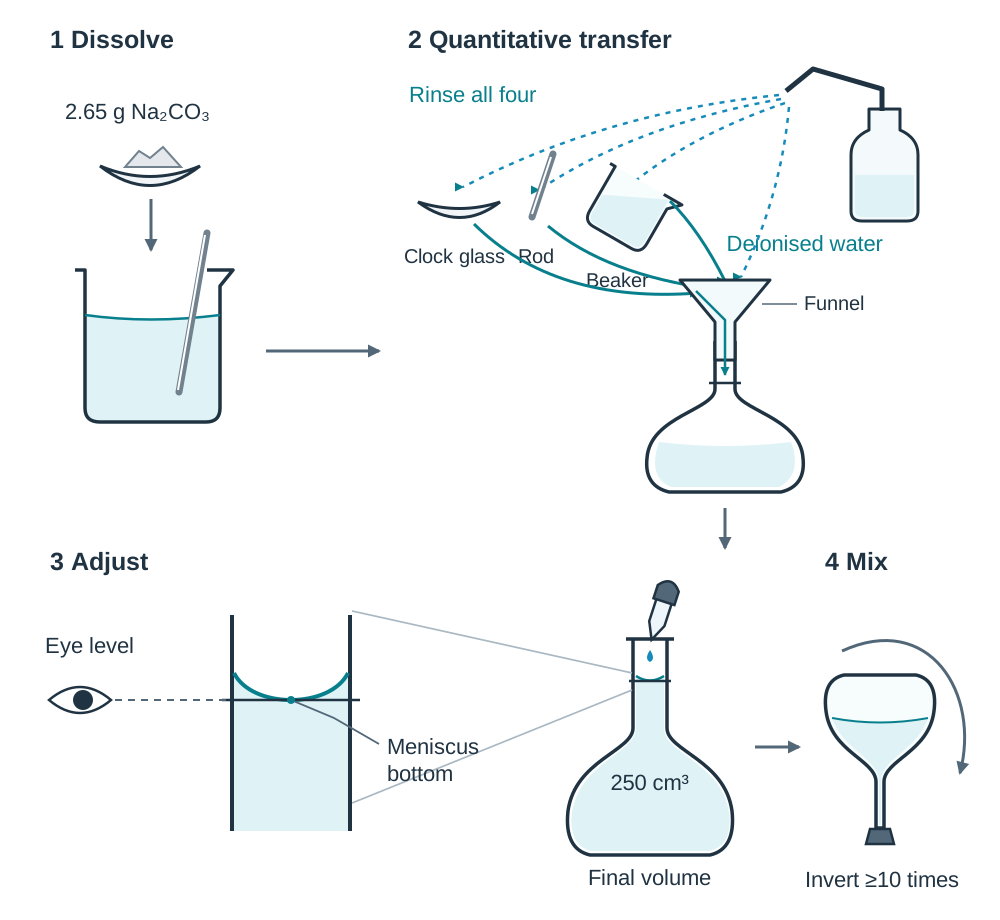
To prepare of sodium carbonate (; ):
- Weigh of anhydrous accurately on a clock glass using an analytical balance.
- Transfer the solid into a beaker and dissolve completely in approximately of deionised water.
- Pour the solution through a filter funnel into a volumetric flask. Thoroughly rinse the clock glass, stirring rod, beaker, and funnel with deionised water into the flask to prevent solute loss.
- Add deionised water until the liquid level nears the graduation mark. Use a dropper to bring the bottom of the meniscus exactly level with the mark at eye level.
- Stopper the flask and invert it at least ten times to produce a uniform concentration.
Units of Concentration and Unit Analysis
- Moles per litre (): Number of moles per of solution (also called molarity, ).
- Grams per litre (): Calculated using unit analysis: .
- Percentage weight per volume (): Grams of solute per of solution (). Multiplying by 10 gives .
- Percentage volume per volume (): Volume of liquid solute in per of solution.
- Percentage weight per weight (): Grams of solute per of total solution.
- Parts per million (): Parts of solute per million parts of solution by mass (). In dilute aqueous solutions, where , .
Quick check:
- Question: Express 0.250 mol L⁻¹ NaOH (M = 40.0 g mol⁻¹) in g L⁻¹ and in % w/v.
- Answer: 0.250 mol L⁻¹ × 40.0 g mol⁻¹ = 10.0 g L⁻¹ (the mol units cancel). 10.0 g per 1000 cm³ = 1.00 g per 100 cm³ = 1.00% w/v.
Dilution and Serial Dilution
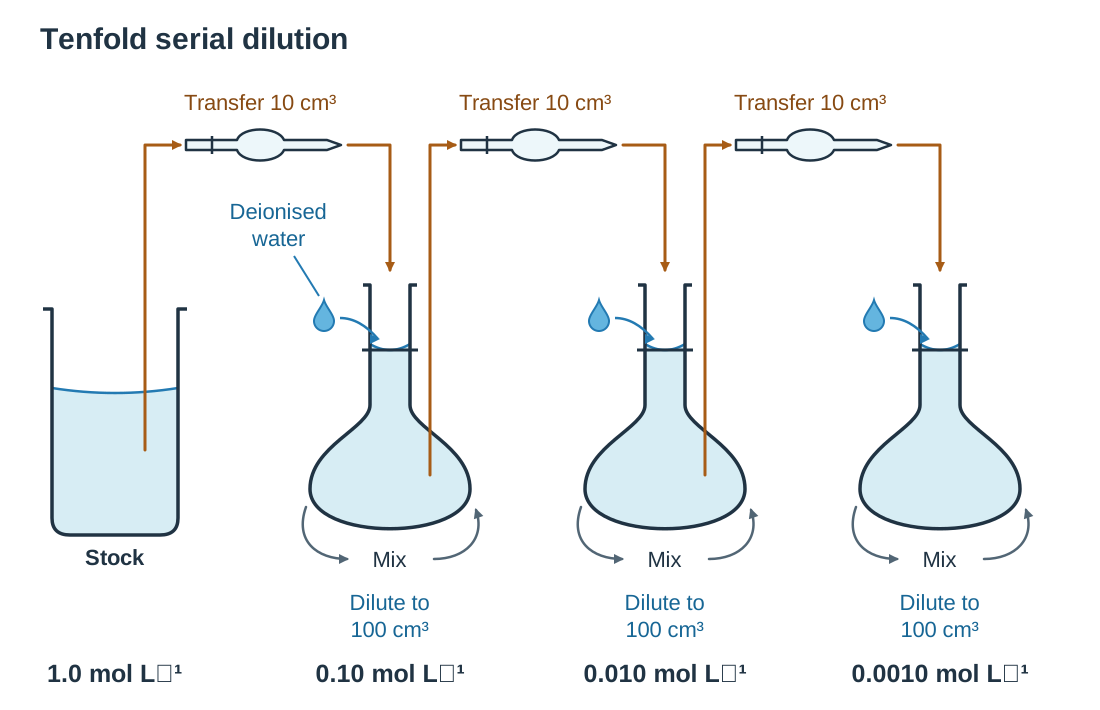
Diluting a solution adds solvent, which lowers concentration while keeping the moles of solute constant: $10\text{ cm}^3100\text{ cm}^31.0 \rightarrow 0.10 \rightarrow 0.010 \rightarrow 0.0010\text{ mol L}^{-1}$), allowing chemists to prepare accurate calibration ranges for instrumental analysis.
Key terms
- Law of Conservation of Mass
- The principle stating that mass cannot be created or destroyed during a chemical reaction; the total mass of the reactants is equal to the total mass of the products.
- Law of Conservation of Energy
- The principle stating that energy cannot be created or destroyed, only converted from one form to another.
- Relative Atomic Mass
- The average mass of an atom of an element, taking account of the natural abundance of its isotopes, relative to one-twelfth of the mass of a carbon-12 atom (dimensionless).
- Relative Molecular Mass
- The average mass of a molecule of a compound relative to one-twelfth of the mass of a carbon-12 atom, equal to the sum of the relative atomic masses in the formula (dimensionless).
- Mole
- The amount of substance that contains 6.022 x 10^23 elementary particles (atoms, molecules, ions, or formula units).
- Avogadro Constant
- The number of elementary entities contained in one mole of substance, equal to 6.022 x 10^23 mol^-1.
- Molar Mass
- The mass in grams of one mole of a substance, expressed in units of g mol^-1.
- Density
- The mass of a substance per unit volume, commonly expressed in g cm^-3 or g L^-1.
- Avogadro's Law
- Equal volumes of gases, measured at the same temperature and pressure, contain equal numbers of molecules.
- Molar Volume
- The volume occupied by one mole of any gas under specified conditions, equal to 22.4 L mol^-1 (22,400 cm^3 mol^-1) at standard temperature and pressure (STP).
- Standard Temperature and Pressure (STP)
- Standard conditions of temperature and pressure: 273.15 K (0 °C) and 101.3 kPa, at which one mole of gas occupies 22.4 L. Always use the conditions and molar volume given in the question or the Formulae and Tables booklet.
- Empirical Formula
- The chemical formula showing the simplest whole-number ratio of atoms of each element present in a compound.
- Molecular Formula
- The chemical formula showing the actual number of atoms of each element present in one molecule of a compound.
- Gravimetric Analysis
- A quantitative analytical technique based on the precise measurement of masses of substances.
- Limiting Reactant
- The reactant that is completely consumed first in a chemical reaction, thereby limiting the theoretical yield of products.
- Theoretical Yield
- The maximum quantity of product calculated to form from the limiting reactant assuming complete reaction without losses.
- Actual Yield
- The amount of pure product actually obtained when an experiment is carried out in the laboratory.
- Percentage Yield
- The ratio of the actual yield obtained to the theoretical yield predicted, expressed as a percentage: (actual yield / theoretical yield) x 100.
- Standard Solution
- A solution whose concentration is accurately known.
- Primary Standard
- A substance of high purity, stability, and high molar mass that dissolves readily in water to make a standard solution directly by accurate weighing.
- Saturated Solution
- A solution containing the maximum amount of dissolved solute possible at a given temperature, in equilibrium with undissolved solute.
- Parts Per Million (p.p.m.)
- A concentration unit representing parts of solute per million parts of solution by mass (1 p.p.m. = 1 mg kg^-1, or approximately 1 mg L^-1 for dilute aqueous solutions).
Check yourself
A sample of neon consists of 90.5% Ne-20 and 9.5% Ne-22. Calculate the relative atomic mass of neon to three significant figures.
Ar = [(90.5 x 20) + (9.5 x 22)] / 100 = (1810 + 209) / 100 = 2019 / 100 = 20.2.
State Avogadro's law.
Equal volumes of gases, measured at the same temperature and pressure, contain equal numbers of molecules.
How many total atoms are present in 4.40 g of carbon dioxide gas (CO2)? [M = 44.0 g mol^-1; Avogadro constant = 6.022 x 10^23 mol^-1]
Moles of CO2 = 4.40 g / 44.0 g mol^-1 = 0.100 mol. Number of molecules = 0.100 x 6.022 x 10^23 = 6.022 x 10^22 molecules. Each CO2 molecule contains 3 atoms (1 C, 2 O), so total atoms = 3 x 6.022 x 10^22 = 1.81 x 10^23 atoms.
What volume of 2.00 mol L^-1 HCl is required to prepare 250 cm³ of a 0.200 mol L^-1 HCl solution?
Using C1V1 = C2V2: (2.00 mol L^-1)(V1) = (0.200 mol L^-1)(250 cm³). V1 = 50.0 / 2.00 = 25.0 cm³.
Express a concentration of 12.0% v/v ethanol in cm³ of ethanol per litre of solution.
12.0% v/v means 12.0 cm³ of ethanol per 100 cm³ of solution. In 1000 cm³ (1 L), there are 12.0 x 10 = 120 cm³ of ethanol per litre.
Give three reasons why the actual yield of a product in an organic preparation is generally less than the theoretical yield.
Reversible reactions reach equilibrium before completion; competing side reactions form unwanted by-products; and mechanical losses occur during laboratory transfers, filtering, and drying.