
Redox reactions are chemical changes where electrons move from one substance to another. You encounter them every day when fuels burn, metals corrode, living cells respire, and batteries supply power. In Leaving Certificate Chemistry Higher Level, you will learn to track electron movement using oxidation numbers, balance complex ionic equations, compare how metals behave in the electrochemical series, build galvanic and electrolytic cells, and carry out precise quantitative redox titrations.
Redox Principles, Definitions, and Everyday Applications
At Leaving Certificate level, oxidation and reduction are defined by electron transfer and changes in oxidation state.
- Oxidation is the loss of electrons, corresponding to an increase in oxidation number.
- Reduction is the gain of electrons, corresponding to a decrease in oxidation number.
The mnemonic OIL RIG (Oxidation Is Loss, Reduction Is Gain) helps keep these definitions clear. Because free electrons cannot exist on their own in solution, oxidation and reduction always happen together. The electrons shed by one substance are immediately picked up by another.
- An oxidising agent brings about oxidation in another substance by accepting electrons. In doing so, it is reduced.
- A reducing agent brings about reduction in another substance by donating electrons. In doing so, it is oxidised.
Everyday Applications of Redox
- Combustion of fuels: When methane burns (), carbon is oxidised from to and oxygen is reduced from to , releasing large amounts of heat.
- Respiration: Living cells oxidise glucose () to transfer chemical energy into ATP, with oxygen acting as the final electron acceptor.
- Corrosion of iron (rusting): Rust forms when iron metal reacts with both oxygen and water to produce hydrated iron(III) oxide:
Iron is oxidised from to . Both oxygen and water are essential for rusting to happen; dissolved salts speed up the reaction. Corrosion can be prevented by coating the iron to keep out air and water (painting or greasing), by galvanising (coating iron in a protective layer of zinc), or by sacrificial protection (attaching blocks of a more reactive metal like zinc or magnesium, which corrode in place of the iron).
Rules for Assigning Oxidation Numbers
An oxidation number is the charge an atom appears to have when electrons in each covalent bond are treated as belonging entirely to the more electronegative atom.
The course's oxidation-number examples use compounds of the first 36 elements of the Periodic Table (hydrogen to krypton). Iodine (element 53) still appears in the iodine–thiosulfate titrations and the electrolysis of potassium iodide.
Use these priority rules to work out oxidation numbers. If two rules seem to clash, the rule higher up the list takes precedence:
- Uncombined elements: Any atom in an uncombined element has an oxidation number of (for example, , , , ).
- Monatomic ions: The oxidation number equals the charge on the ion (such as , , ).
- Neutral compounds: The sum of all oxidation numbers across the entire formula must equal .
- Polyatomic ions: The sum of oxidation numbers equals the charge on the ion (in , the sum is ).
- Group 1 and Group 2 metals: Group 1 elements are always and Group 2 elements are always in their compounds.
- Hydrogen: Almost always , except in metal hydrides (such as or ) where Rule 5 forces hydrogen to be .
- Oxygen: Almost always , except in peroxides (such as or ) where it is , and in oxygen difluoride () where fluorine forces oxygen to be .
- Halogens: Fluorine is always in all its compounds. Chlorine and bromine are unless bonded to a more electronegative element like oxygen (for example, in the chlorate ion, , chlorine is ).
Balancing Redox Equations (Higher Level)
At Higher Level, balancing complex ionic redox equations requires tracking changes in oxidation numbers so that both electrons and atoms are balanced.
Follow these five steps:
- Assign oxidation numbers to all atoms to find what is oxidised and what is reduced.
- Work out the change per formula unit: Calculate electrons lost per reducing species and electrons gained per oxidising species. Remember to multiply by any subscript (for example, contains two chromium atoms, so the total gain is doubled).
- Equalise electron transfer: Find the lowest common multiple between electrons lost and gained to set the molar ratio between the oxidising and reducing agents.
- Insert the coefficients in front of the reactants and their immediate products.
- Balance oxygens and hydrogens: In acidic solution, add water molecules () to balance oxygen atoms, then add hydrogen ions () to balance hydrogens. Finally, check that total atoms and net electrical charge match on both sides.
The Electrochemical Series and Metal Displacement
The electrochemical series is a list of metals arranged in order of their tendency to be oxidised (to lose electrons). The higher the metal sits in the series, the more easily it is oxidised:
Metals high up lose electrons readily to form positive ions, making them strong reducing agents. Metals lower down hold onto their electrons more tightly, and their ions are easily reduced to metal atoms.
Investigating Metal Displacement Reactions
In a displacement reaction, a more reactive metal higher up the series displaces the ion of a less reactive metal lower down from solution.
Experimental procedure:
- Clean small strips of magnesium, zinc, iron, and copper with sandpaper to remove surface oxide coatings.
- Place each metal into separate test tubes containing equal volumes of magnesium sulfate, zinc sulfate, iron(II) sulfate, and copper(II) sulfate solutions of identical concentration.
- Observe any metal deposited on the strip, colour changes in the solution, and any temperature rise.
Typical results:
- Iron in copper(II) sulfate: A reddish-brown coating of copper forms on the nail, and the blue solution gradually turns pale green as iron(II) ions enter solution:
- Copper in silver nitrate: Greyish-white needles of silver deposit on the copper wire, and the solution turns light blue as ions form:
A metal can only displace metals placed below it in the electrochemical series. Magnesium displaces zinc, iron, and copper; copper displaces none of them. In every displacement, the solid metal is oxidised (acting as the reducing agent) and the metal ion in solution is reduced (acting as the oxidising agent).
Galvanic Cells and Chemical Batteries
A galvanic cell (or voltaic cell) uses a spontaneous redox reaction to produce an electric current. By separating the oxidation and reduction half-reactions into two half-cells, electrons are forced to move through an external wire.
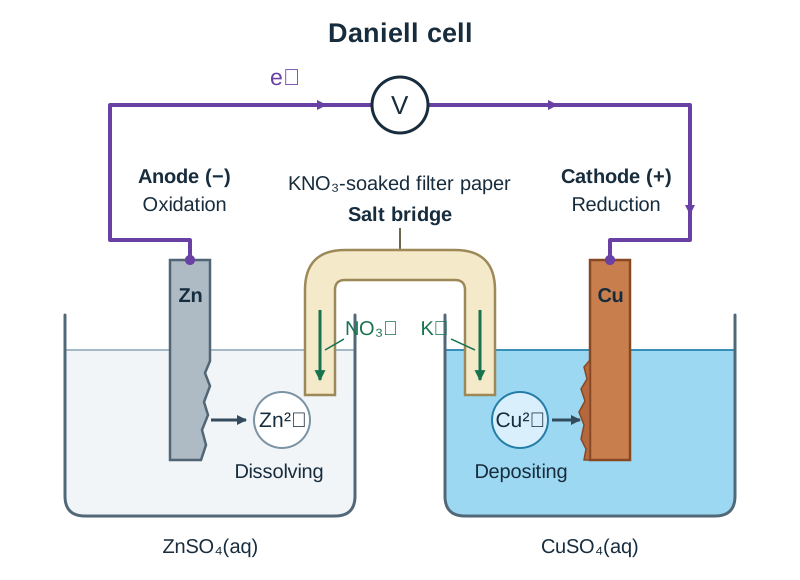
Parts of an Electrochemical Cell
- Anode: The electrode where oxidation occurs (An Ox). Electrons are released here, making this the negative terminal in a galvanic cell.
- Cathode: The electrode where reduction occurs (Red Cat). Electrons are accepted here, making this the positive terminal in a galvanic cell.
- Electrolyte: A liquid or solution containing mobile ions that conducts electricity, completing the internal circuit.
Creating a Simple Galvanic Cell
You can build a simple cell by inserting two different metal strips (like zinc and copper) into an electrolyte, such as dilute acid, salt water, or even a lemon, and connecting them to a voltmeter. Zinc oxidises more readily than copper, releasing electrons that flow through the wire to the copper strip. The further apart the two metals are in the electrochemical series, the higher the measured voltage. Magnesium paired with copper gives a notably larger voltage than zinc paired with copper, while two identical metal strips produce zero volts.
The Daniell Cell (Copper-Zinc System)
To sketch this cell:
- Left beaker: Zinc strip dipping into zinc sulfate solution. Label this anode (-), oxidation: . Over time, this electrode loses mass.
- Right beaker: Copper strip dipping into copper(II) sulfate solution. Label this cathode (+), reduction: . Over time, this electrode gains mass, and the blue solution fades.
- External wire: Connects the two electrodes through a voltmeter, with an arrow showing electrons flowing from zinc to copper.
- Salt bridge: A strip of filter paper soaked in potassium nitrate () dipping into both beakers. It allows mobile ions to migrate between solutions to prevent charge buildup. Electrons never travel through the salt bridge.
Primary vs Secondary Cells
- Primary cells: Non-rechargeable. The chemical reactions cannot easily be reversed. Once the reactants are consumed, the cell is flat and must be replaced (for example, standard zinc-carbon or alkaline batteries).
- Secondary cells: Rechargeable. Passing an external electric current through the cell in the reverse direction regenerates the original reactants (for example, lead-acid car batteries and lithium-ion batteries).
Electrolytic Cells and Electrolysis in Practice
Electrolysis is the use of electricity to bring about a chemical reaction. An electrolytic cell converts electrical energy into chemical energy by forcing a non-spontaneous redox reaction to occur.
An inert electrode (such as platinum or graphite) conducts electricity into and out of the electrolyte without chemically taking part in the reaction.
Comparison of Galvanic and Electrolytic Cells
| Feature | Galvanic Cell | Electrolytic Cell |
|---|---|---|
| Energy change | Chemical Electrical | Electrical Chemical |
| Reaction type | Spontaneous | Non-spontaneous (driven by power supply) |
| Anode sign | Negative () | Positive () |
| Cathode sign | Positive () | Negative () |
| Where oxidation occurs | Anode | Anode |
| Where reduction occurs | Cathode | Cathode |
| Classic example | Daniell cell | Electrolysis of |
Three Syllabus Electrolysis Systems
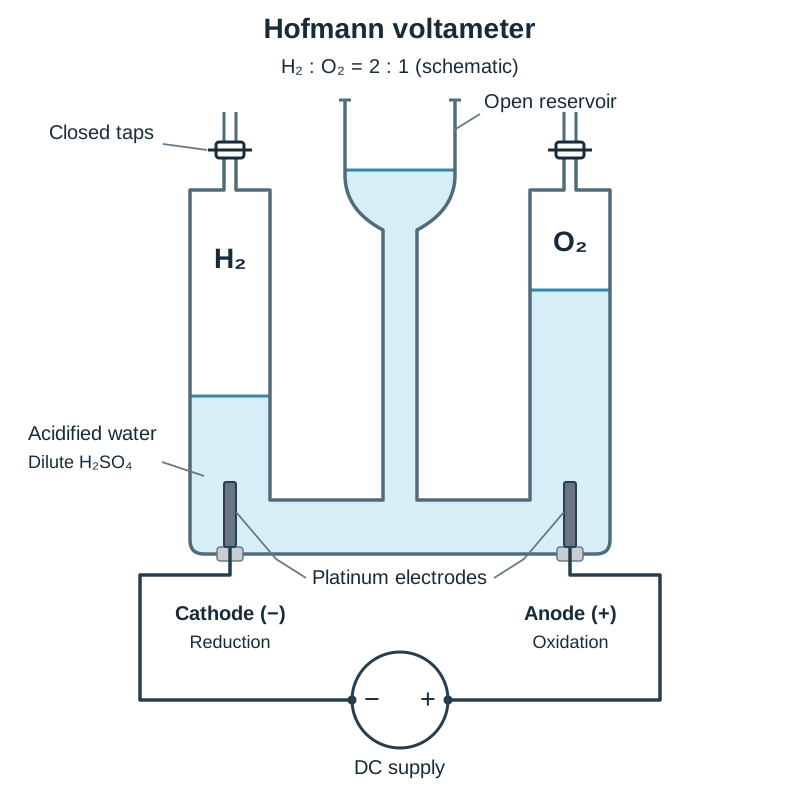
- Acidified Water (dilute ) in a Hofmann Voltameter:
- To sketch: Three connected vertical glass tubes with taps at the top and a central reservoir. Platinum electrodes are sealed into the bottom of the two outer limbs, wired to a DC power supply.
- Anode ():
- Cathode ():
- Observations and tests: Colourless gases collect in a volume ratio (). Hydrogen burns with a squeaky pop when tested with a lighted splint. Oxygen relights a glowing splint. In practice, slightly less oxygen is collected initially because oxygen is more soluble in water than hydrogen.
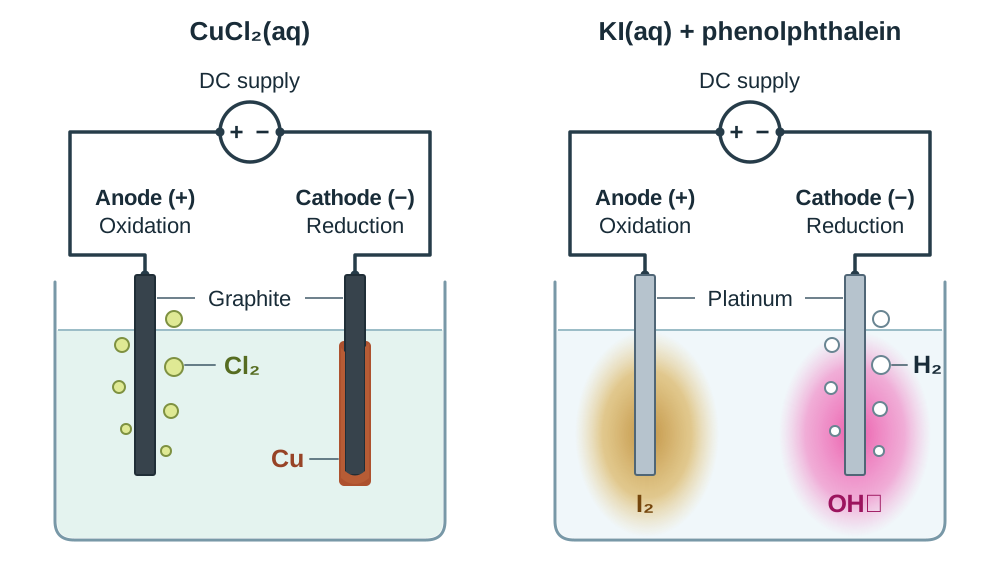
- Aqueous Copper(II) Chloride () with graphite electrodes:
- Anode (): . Pale yellow-green chlorine gas bubbles off; it turns damp blue litmus paper red and then bleaches it white.
- Cathode (): . A reddish-brown layer of copper coats the electrode.
- Aqueous Potassium Iodide () with phenolphthalein:
- Anode (): . A yellow-brown solution of iodine forms. Adding starch turns it blue-black.
- Cathode (): . Bubbles of hydrogen gas form, and the solution turns bright pink around the cathode as phenolphthalein detects the generated ions.
Modern Cells: Lithium-Ion and Hydrogen Fuel Cells
The Lithium-Ion Cell
A lithium-ion battery behaves as two different types of cell depending on its mode of use:
- When discharging: It acts as a galvanic cell, releasing stored chemical energy as an electric current to power a device.
- When charging: An external charger forces current backwards through the cell, making it act as an electrolytic cell to restore the initial chemicals.
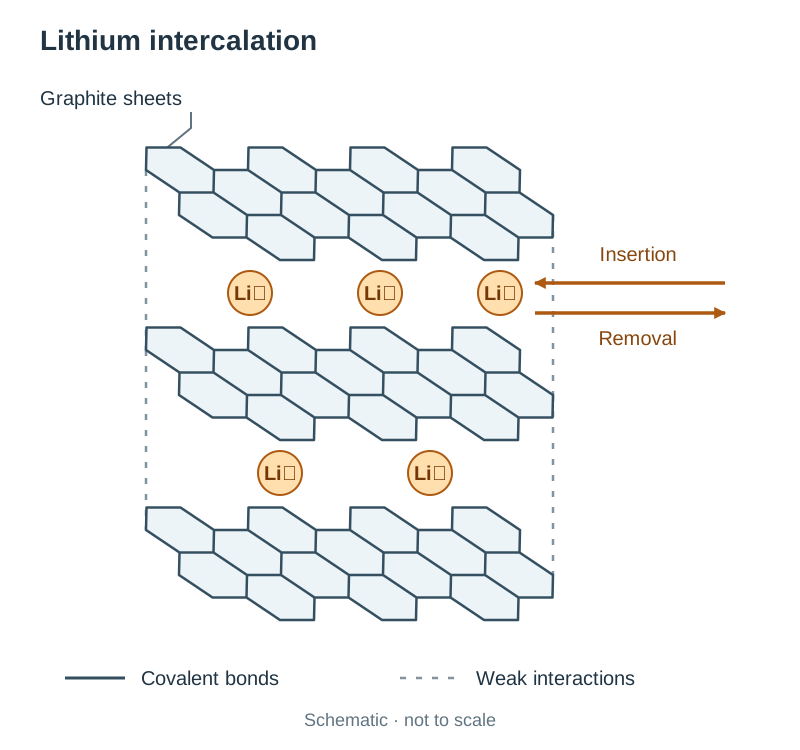
Graphite serves as the negative host electrode. It consists of flat hexagonal sheets of carbon atoms with delocalised electrons that conduct electricity. Weak forces hold the layers together, allowing lithium ions to slide reversibly between the sheets without breaking the covalent carbon bonds. This insertion process is called intercalation.
Life-cycle considerations:
- Mining: Extracting lithium and transition metals like cobalt and nickel consumes large amounts of water and causes habitat destruction.
- Use: Provides high energy density and hundreds of recharge cycles in phones, laptops, and electric cars.
- Disposal and recycling: Spent batteries cause fires and toxic leakage if sent to landfill. Recycling recovers valuable metals such as cobalt, nickel, and lithium for reuse in new cells.
Chemical Cells Compared with Fuel Cells
| Feature | Chemical Cell (Battery) | Fuel Cell |
|---|---|---|
| Supply of reactants | Stored internally inside the cell casing | Supplied continuously from external storage tanks |
| Lifetime | Runs flat when internal reactants are used up | Runs continuously as long as fuel and oxidiser are supplied |
| Products | Retained inside the cell container | Removed continuously as they form |
| Recharging | Must be discarded or plugged in to recharge | No recharging needed; just refuel the tank |
The Hydrogen Fuel Cell
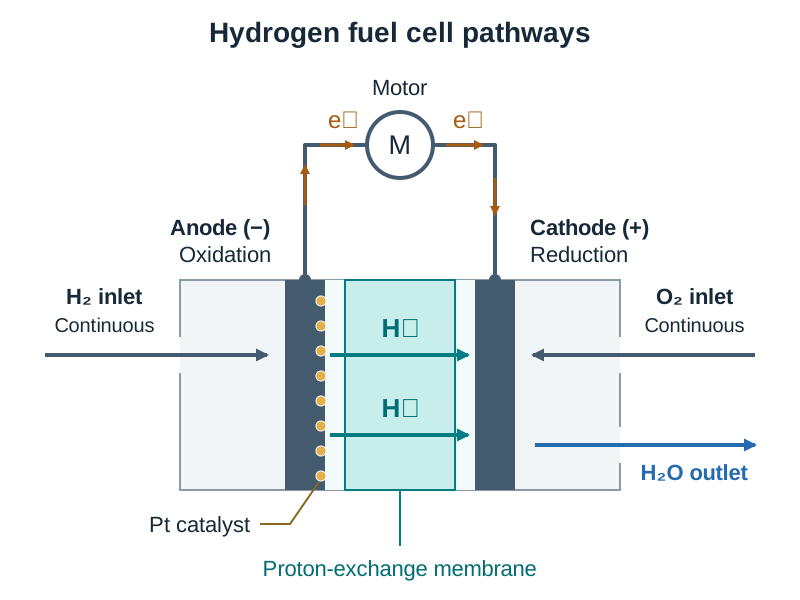
A hydrogen fuel cell is a galvanic cell that combines hydrogen fuel and oxygen directly:
- Anode (): Hydrogen gas is oxidised over a platinum catalyst: .
- Membrane: A specialised electrolyte sheet allows only ions to migrate through to the cathode while forcing electrons through the motor circuit.
- Cathode (): Oxygen gas is reduced, combining with protons and returning electrons: .
- Overall reaction: .
The only chemical exhaust is water. When the hydrogen is produced by splitting water using electricity from wind or solar power, it is called green hydrogen, creating an entirely carbon-neutral energy cycle.
Redox Volumetric Analysis: Iron Tablets and Iodine-Thiosulfate
Primary Standards and Standard Solutions
A primary standard is a substance that can be weighed out accurately and dissolved in water to make a solution of precisely known concentration. It must be:
- extremely pure
- completely stable in air (neither efflorescent nor hygroscopic)
- highly soluble in water
- of high molar mass to minimise percentage weighing errors
Potassium manganate(VII) is not a primary standard. It cannot be bought 100% pure, and it decomposes slowly in sunlight and reacts with traces of organic matter in water. It must be standardised against a primary standard solution of ammonium iron(II) sulfate (). Dilute sulfuric acid is added during preparation to stop air oxidising to .
Sodium thiosulfate is not a primary standard. Its crystals lose water of crystallisation to the air (effloresce), so its exact formula mass is variable. It is standardised against iodine released by reacting potassium iodate(V) (, a primary standard) with excess acidified potassium iodide:
Finding the Percentage of Iron in Iron Tablets
- Making the solution: Accurately weigh five iron tablets. Crush them with a pestle and mortar. Dissolve the powder in dilute sulfuric acid to prevent atmospheric oxygen oxidising to . (Any insoluble tablet binders leave a slight cloudiness, but this does not affect the dissolved .) Transfer quantitatively into a volumetric flask with rinsings. Add deionised water until near the mark, then use a dropper until the bottom of the meniscus touches the line at eye level. Stopper and invert repeatedly.
- Rinsing protocol:
- Pipette: Rinse with deionised water, then with the iron(II) tablet solution.
- Burette: Rinse with deionised water, then with the solution.
- Conical flask: Rinse with deionised water only. Never rinse with the iron solution, as that would add unmeasured .
- Titration: Pipette of tablet solution into the flask. Add roughly of dilute sulfuric acid to ensure complete reduction of manganese from to . If too little acid is added, manganese is reduced only to , precipitating brown manganese(IV) oxide () which ruins the endpoint. Do not use hydrochloric acid (manganate oxidises to toxic gas, giving a falsely high titre) or nitric acid (it is an oxidising agent itself).
- Reading and endpoint: is intensely coloured, so read the burette from the top of the meniscus. It is self-indicating: the endpoint is reached at the first permanent pale pink colour that lasts for 30 seconds.
Iodine-Thiosulfate Titrations
Iodine reacts quantitatively with sodium thiosulfate ():
Liberated iodine is titrated against standard sodium thiosulfate until the brown colour fades to a pale straw-yellow. Freshly prepared starch indicator is added at this moment, turning the mixture dark blue-black. Titrate dropwise until the blue-black colour completely disappears, leaving a sharp colourless endpoint.
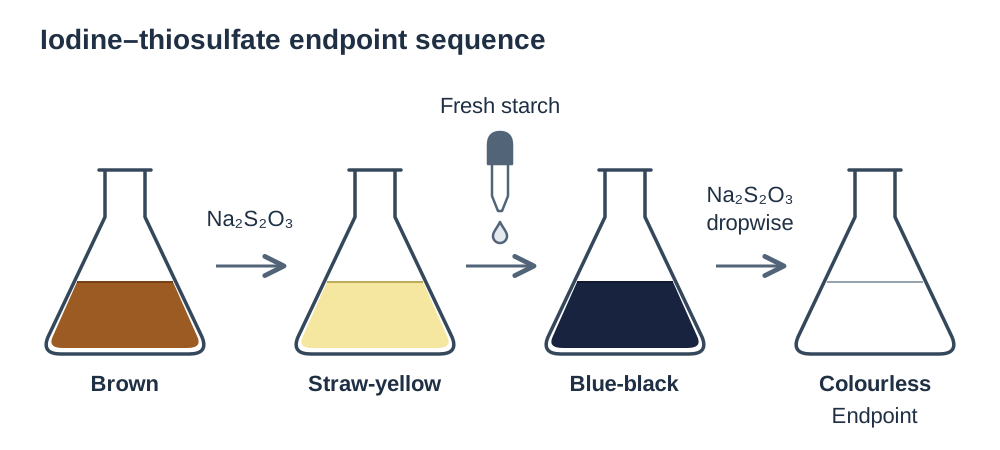
Timing precaution: Never add starch at the start. If added when iodine concentration is high, a large amount of the blue-black starch–iodine complex forms and releases its iodine only slowly. The colour then fades sluggishly instead of snapping colourless, leading you to overshoot the true endpoint.
Key terms
- Oxidation
- The loss of electrons by an atom, ion, or molecule, corresponding to an increase in oxidation number.
- Reduction
- The gain of electrons by an atom, ion, or molecule, corresponding to a decrease in oxidation number.
- Oxidising Agent
- A substance that brings about oxidation in another substance by accepting electrons, and is reduced in the process.
- Reducing Agent
- A substance that brings about reduction in another substance by donating electrons, and is oxidised in the process.
- Oxidation Number
- The charge an atom appears to have when electrons in each covalent bond are treated as belonging entirely to the more electronegative atom.
- Electrochemical Series
- A list of metals arranged in order of their tendency to be oxidised (to lose electrons).
- Galvanic Cell
- An electrochemical cell that produces electrical energy from a spontaneous redox reaction.
- Electrolytic Cell
- An electrochemical cell that uses external electrical energy to drive a non-spontaneous redox reaction.
- Electrolysis
- The use of electricity to bring about a chemical reaction.
- Inert Electrode
- An unreactive conductor (such as platinum or graphite) that carries electric current into or out of an electrolyte without reacting itself.
- Anode
- The electrode at which oxidation occurs.
- Cathode
- The electrode at which reduction occurs.
- Primary Standard
- A substance that is exceptionally pure, stable in air, water-soluble, has a high molar mass, and can be dissolved to make a solution of accurately known concentration.
- Self-Indicating
- A titration where one of the reacting solutions changes colour distinctly at the endpoint, removing the need for an added chemical indicator.
- Intercalation
- The reversible insertion of ions (such as lithium ions) between the layered sheets of a host material (such as graphite) without disrupting its covalent structure.
- Fuel Cell
- A galvanic cell that converts chemical energy directly into electrical energy using an externally and continuously supplied fuel and oxidising agent.
Check yourself
Balance this redox equation in acidic solution using oxidation numbers: MnO4(-) + Fe(2+) + H(+) -> Mn(2+) + Fe(3+) + H2O.
MnO4(-) + 5Fe(2+) + 8H(+) -> Mn(2+) + 5Fe(3+) + 4H2O. Manganese drops from +7 to +2 (gains 5e-), while iron rises from +2 to +3 (loses 1e-). This gives a 1:5 ratio. Four oxygens become 4H2O, requiring 8H(+). Both sides have a net charge of +17.
What is the oxidation number of sulfur in the thiosulfate ion, S2O3(2-)?
+2. The total charge is -2. Three oxygen atoms give 3(-2) = -6. Solving 2(S) - 6 = -2 gives 2(S) = +4, so each sulfur has an oxidation number of +2.
Why is slightly less than half as much oxygen as hydrogen collected initially during the electrolysis of acidified water?
Oxygen gas is more soluble in water than hydrogen gas, so a small amount of the generated oxygen dissolves in the electrolyte before collecting in the tube.
Why does iron metal displace copper from aqueous copper(II) sulfate, but copper metal cannot displace iron from iron(II) sulfate?
Iron sits higher than copper in the electrochemical series, meaning it has a greater tendency to be oxidised and donate electrons to copper(II) ions. Copper is less easily oxidised than iron.
Why is potassium manganate(VII) read from the top of the meniscus in a burette?
The solution is so intensely dark purple that the bottom of the meniscus cannot be seen clearly against the glass graduations.