
Organic reactions are the ways carbon compounds change into other compounds. In this topic, you will learn the five primary reaction types, how to follow and predict multi-step organic reaction schemes, two mechanisms that show how electrons move with curved arrows and fishhooks, and the core laboratory preparations: ethene synthesis, esterification, benzoic acid oxidation and recrystallisation, and soap making.
The Five Primary Organic Reaction Types
Every organic reaction on the Leaving Certificate course can be classified into one or more of five fundamental reaction types:
1. Addition Reactions
Two reactant molecules combine to form a single product. In an alkene, the weaker (pi) bond of the carbon-carbon double bond breaks, while the stronger (sigma) bond remains intact. Two incoming atoms or groups form new single covalent bonds to the carbons. During addition, the geometry around the reacting carbon atoms changes from planar () to tetrahedral ().
2. Substitution Reactions
An atom or group of atoms in a molecule is replaced by another atom or group of atoms. The saturation and tetrahedral geometry () of the carbon chain stay the same. Alkanes undergo substitution because they contain only strong, relatively unreactive, non-polar single bonds.
3. Elimination Reactions
A small molecule (such as water or hydrogen chloride) is removed from adjacent carbon atoms in a saturated molecule, forming an unsaturated double bond. Elimination is the reverse of addition. Heating ethanol over an aluminium oxide () catalyst removes water to form ethene, changing the carbon geometry from tetrahedral () back to planar ():
4. Redox Reactions
In organic chemistry, oxidation means gaining oxygen or losing hydrogen, while reduction means gaining hydrogen or losing oxygen. Aldehydes and ketones are reduced back to alcohols using hydrogen gas with a nickel catalyst ():
One reaction belonging to two types: adding hydrogen to ethene () is an addition reaction because two molecules form one product and the bond breaks, and it is also a reduction because the organic molecule gains hydrogen. If an exam question asks for the type(s), state both.
5. Acid-Base Reactions
These involve proton () transfer. Carboxylic acids react as typical weak acids with reactive metals, bases, and carbonates, forming salts called carboxylates:
- With magnesium: (bubbles of hydrogen gas; magnesium dissolves).
- With sodium hydroxide: (neutralisation).
- With sodium carbonate: (fizzing; carbon dioxide turns limewater milky).
Alcohols do not fizz with sodium carbonate. This simple test confirms that carboxylic acids are stronger acids than alcohols.
Hydrocarbon Structure, Bonding, and Reaction Schemes
Sigma and Pi Bonding in Hydrocarbons
A sigma () bond forms by the head-on overlap of atomic orbitals along the line between two nuclei. A pi () bond forms by the sideways overlap of p orbitals above and below the internuclear axis. Pi bonds are weaker and more exposed to attack than sigma bonds.
| Molecule | Bonds Between Carbons | Shape and Bond Angle | Reactivity |
|---|---|---|---|
| Ethane () | Single bond | Tetrahedral at each carbon () | Undergoes free-radical substitution; stable |
| Ethene () | One bond + one bond | Planar () | Undergoes ionic addition across exposed bond |
| Ethyne () | One bond + two bonds | Linear () | Readily undergoes addition |
| Benzene () | Six bonds in ring; six delocalised electrons | Planar regular hexagon () | Stable ring; resists addition to preserve delocalisation |
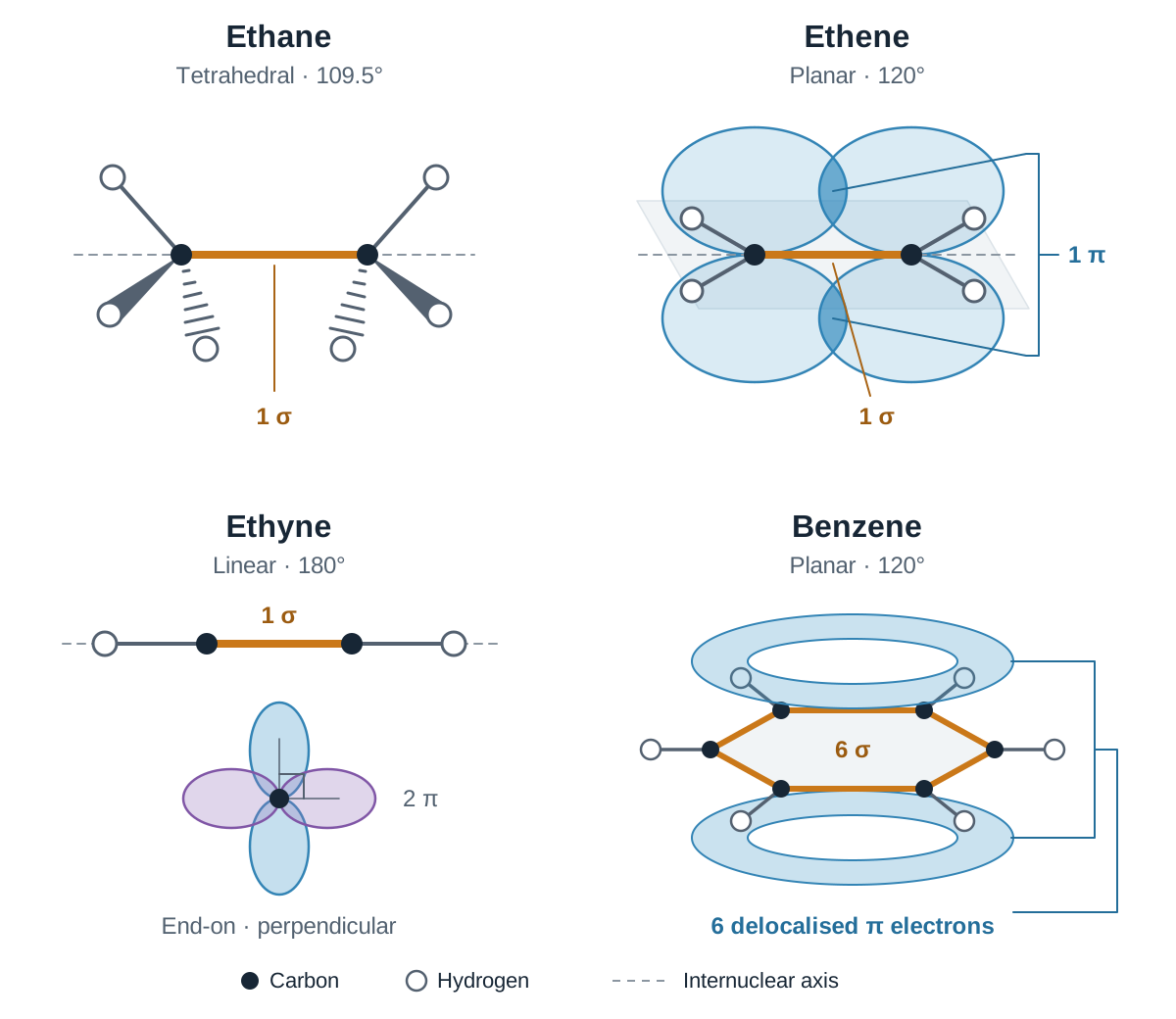
Because benzene's six electrons are delocalised around the entire ring, addition reactions would destroy the aromatic stability. Benzene therefore undergoes substitution rather than addition.
Tracing Synthetic Pathways and Geometry Changes
A reaction scheme is a visual map showing how functional groups interconvert. Tracking these pathways requires identifying the reaction type, naming the reagents, and describing geometry changes at each step.
- Step 1 (Ethane to Chloroethane): Free-radical substitution using and UV light. Geometry remains tetrahedral ().
- Step 2 (Chloroethane to Ethene): Elimination of using base and heat. A bond forms, shifting geometry from tetrahedral () to planar ().
- Step 3 (Ethene to 1,2-dichloroethane): Ionic addition of . The bond breaks, returning geometry to tetrahedral ().
- Step 4 (1,2-dichloroethane to Chloroethene): Thermal elimination of re-establishes a double bond and planar carbon geometry ().
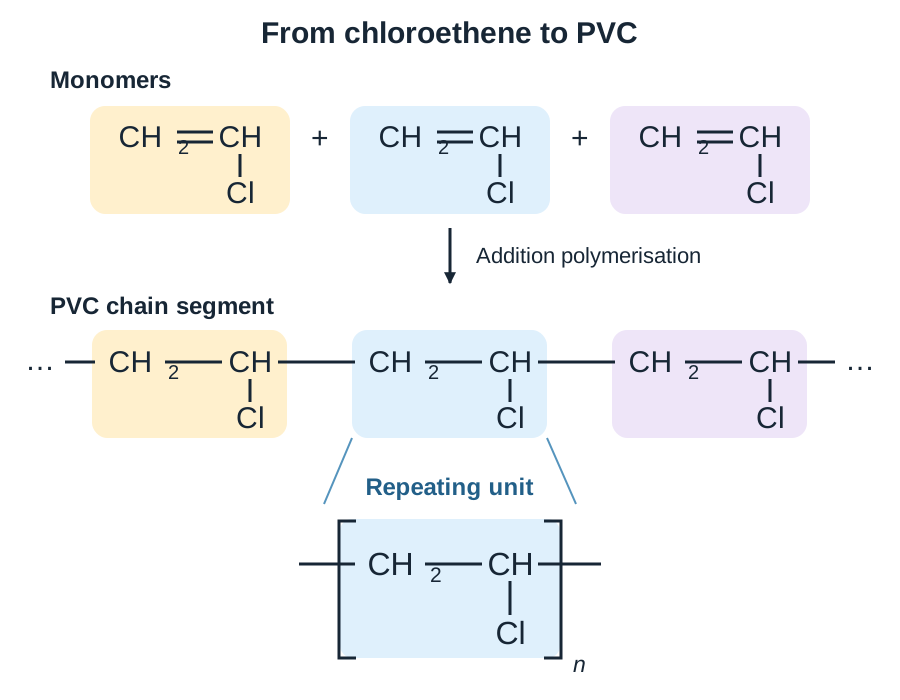
- Step 5 (Chloroethene to PVC): Addition polymerisation converts planar alkene monomers into a saturated chain of tetrahedral carbons ().
Why Some Reactions Are Not Possible
Exam questions frequently ask why a proposed conversion fails:
- Tertiary alcohols cannot be oxidised to carbonyls without breaking strong single bonds.
- Ketones cannot be oxidised by Fehling's solution because the carbonyl carbon has no attached hydrogen.
- Alkanes do not decolourise bromine water because they possess no weak bonds for addition.
Ionic Addition Mechanism to Ethene
Alkenes are electron-rich because of the exposed electron cloud above and below the carbon-carbon double bond. Electrophiles (electron-deficient species) are attracted to this region.
Addition of Chlorine () to Ethene
- Step 1 (Induced dipole and heterolytic fission): As the non-polar chlorine molecule approaches the electron-dense cloud of ethene, electron repulsion induces a temporary dipole (). The pair of electrons attacks the partially positive atom. The bond breaks by heterolytic fission, transferring both bonding electrons onto the atom to yield a chloride ion ().
- Step 2 (Carbocation formation): The electrons form a single covalent bond to the chlorine atom, leaving the other carbon with an electron deficit and a positive charge: a carbocation intermediate ().
- Step 3 (Nucleophilic attack): The chloride ion () uses a lone pair of electrons to attack the positively charged carbon, forming 1,2-dichloroethane ().
Addition of Hydrogen Chloride () to Ethene
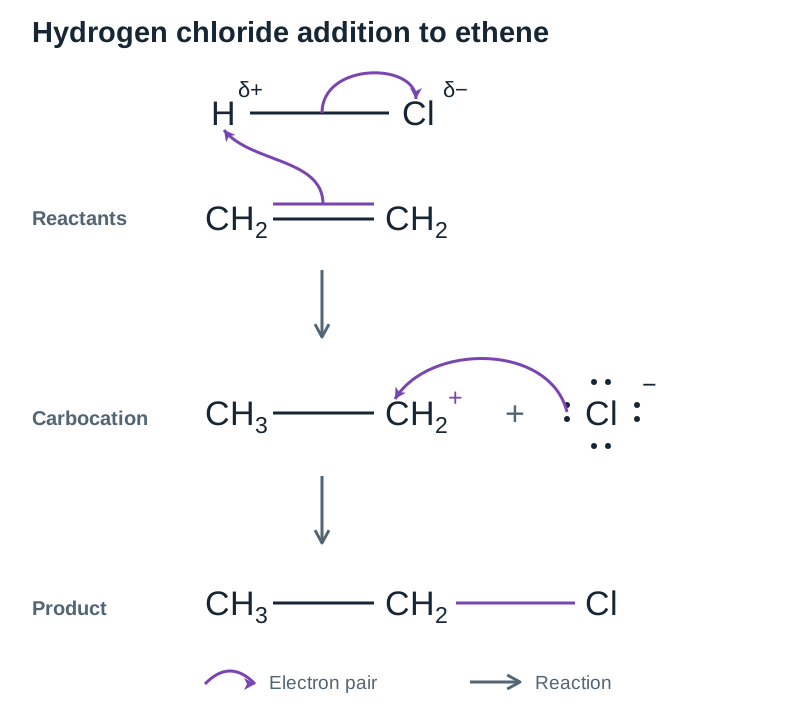
Hydrogen chloride has a permanent dipole (). The mechanism proceeds as follows:
- Draw ethene with a polar molecule beside it.
- Draw a curved arrow from the middle of the double bond to the atom.
- Draw a curved arrow from the bond to the atom.
- Draw the carbocation intermediate () and a chloride ion () with a lone pair.
- Draw a curved arrow from the lone pair on to the positively charged carbon atom ().
- Draw the product, chloroethane ().
Experimental Evidence for the Mechanism
When ethene gas is bubbled through bromine water containing dissolved sodium chloride, three separate products form: 1,2-dibromoethane, 1-bromo-2-chloroethane, and 2-bromoethanol. The formation of 1-bromo-2-chloroethane proves that the first step produces a positive intermediate (carbocation) that can be trapped by any nucleophile present: chloride ions give 1-bromo-2-chloroethane, and water molecules give 2-bromoethanol. The two halogen atoms therefore add in separate steps, confirming an ionic, two-step pathway.
Free-Radical Substitution Mechanisms of Methane and Ethane
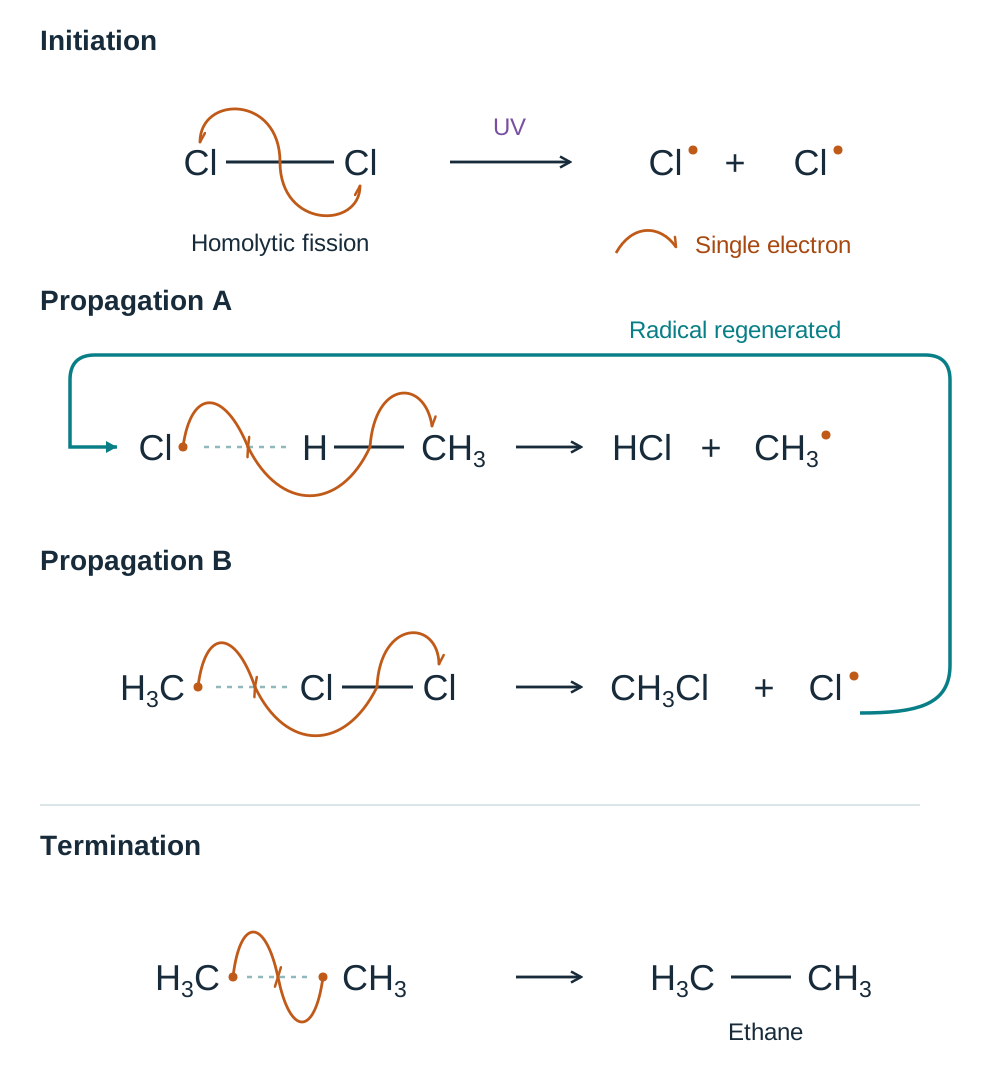
Alkanes react with halogens in the presence of ultraviolet (UV) light via a photochemical chain reaction involving free radicals. Single electrons moving during homolytic fission are represented by single-barbed fishhook arrows.
Chlorination of Methane ()
- 1. Initiation: Ultraviolet light supplies the energy needed to break the covalent bond evenly by homolytic fission, generating two reactive chlorine free radicals:
- 2. Propagation (Step A): A chlorine radical removes a hydrogen atom from methane, forming hydrogen chloride and a methyl radical:
- 3. Propagation (Step B): The methyl radical attacks an intact chlorine molecule, pulling off a chlorine atom to form chloromethane and regenerating a chlorine radical:
Regenerating sustains the chain reaction.
- 4. Termination: The chain stops whenever any two free radicals collide and pair their unpaired electrons to form a stable covalent bond:
Chlorination of Ethane ()
- Initiation:
- Propagation Step A: (ethyl radical)
- Propagation Step B: (chloroethane)
- Termination:
How to Draw Free-Radical Steps
- In initiation, draw two fishhook arrows pointing away from the centre of the bond: one to the left chlorine, one to the right chlorine.
- In propagation, draw one fishhook from the radical dot toward the incoming atom, and one fishhook from the breaking bond toward the radical.
Experimental Evidence
- Photochemical requirement: The reaction does not occur in the dark at room temperature, confirming light energy is required to split halogen molecules.
- Detection of alkane dimers: Small traces of ethane are detected during the chlorination of methane, and traces of butane during the chlorination of ethane. These dimers can only form when two alkyl radicals combine during termination.
- Promoters and inhibitors: Adding sources of free radicals (such as tetraethyl lead) accelerates the reaction, while radical scavengers (such as oxygen) slow it down.
Redox Pathways and the Acidity of Organic Compounds
Oxidation and Reduction Pathways
| Starting Material | Reagents and Conditions | Oxidation Product |
|---|---|---|
| Primary alcohol (e.g. ) | Acidified , alcohol in excess, distill off immediately | Aldehyde (e.g. ) |
| Primary alcohol / Aldehyde | Acidified , excess oxidant, heat under reflux | Carboxylic acid (e.g. ) |
| Secondary alcohol (e.g. propan-2-ol) | Acidified , heat under reflux | Ketone (e.g. propanone) |
| Tertiary alcohol (e.g. 2-methylpropan-2-ol) | Acidified , heat under reflux | No reaction (carbon bonded to has no hydrogen attached) |
For reduction, hydrogen gas with a nickel catalyst () reverses oxidation: it reduces aldehydes to primary alcohols and ketones to secondary alcohols.
Tests for Aldehydes and Ketones
- Fehling's solution: Contains deep-blue copper(II) ions. When heated with an aldehyde, the blue solution forms an insoluble brick-red precipitate of copper(I) oxide (). Ketones show no reaction.
- Acidified : Turns from purple to colourless when heated with an aldehyde. Ketones give no colour change.
Acidity: Carboxylic Acids versus Alcohols
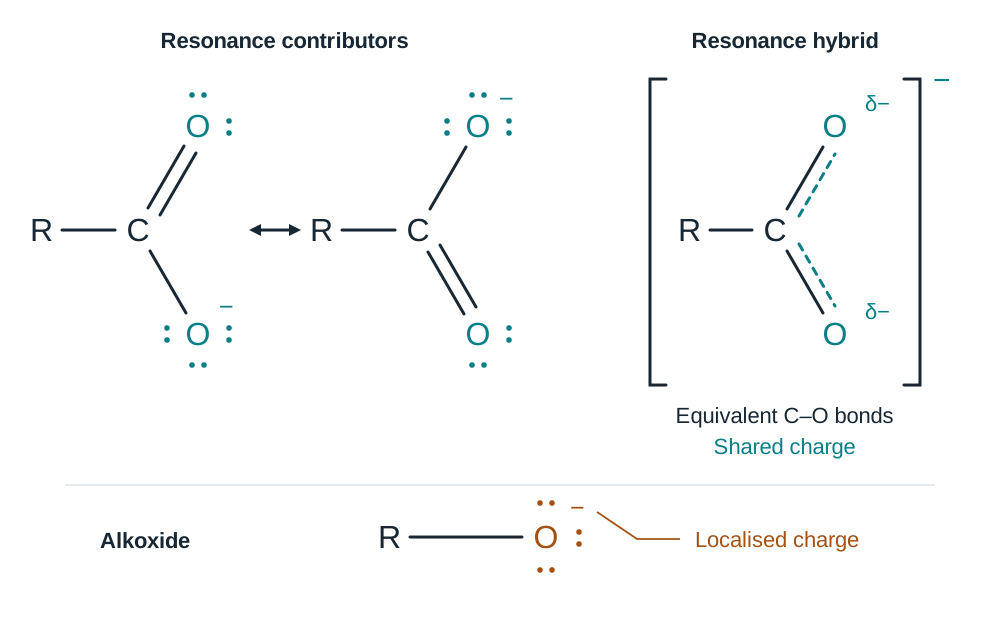
The O–H bond in both alcohols and carboxylic acids is polar, because oxygen is more electronegative than hydrogen. This lets the hydrogen leave as , so ethanol reacts slowly with sodium to give sodium ethoxide and hydrogen. The carboxylate ion is much more stable than the alkoxide ion, so carboxylic acids release far more readily.
Carboxylic acids are far more acidic than alcohols due to three key factors:
- Resonance stabilisation of the carboxylate ion: When a carboxylic acid loses a proton, the resulting carboxylate anion () spreads its negative charge evenly across both oxygen atoms by resonance. Both carbon-oxygen bonds become identical in length and stability is increased, favouring proton release.
- Lack of resonance in alkoxides: When an alcohol loses a proton, the negative charge on the alkoxide ion () is trapped entirely on one oxygen atom. Alkoxides have no resonance stabilisation.
- Inductive effect: In alkoxide ions, alkyl groups push electron density toward the oxygen atom (an electron-donating inductive effect), concentrating negative charge and making alcohols weaker acids than water. In contrast, electronegative substituents pull electron density away through sigma bonds (an electron-withdrawing inductive effect). For example, chloroethanoic acid () is stronger than ethanoic acid because the chlorine atom withdraws electrons and delocalises the negative charge of the carboxylate anion.
Organic Practical Preparations and Techniques
1. Preparation and Testing of Ethene
- Procedure: Ethanol soaked into glass wool is heated in a boiling tube alongside an aluminium oxide () catalyst. Ethanol vapour passes over the hot white catalyst and undergoes dehydration (an elimination reaction):
- Collection: Ethene gas is collected over water in test tubes. The first test tube is discarded because it contains mostly displaced air.
- Safety precaution: Remove the delivery tube from the water before turning off the Bunsen burner to prevent cold water sucking back into the hot boiling tube (avoiding glassware cracking).
- Tests for unsaturation:
- Bromine water: Changes from orange/red-brown to colourless.
- Acidified : Changes from purple to colourless.
- Combustion: Ethene burns with a luminous, smoky flame.
- Physical appearance: Colourless gas with a faint sweet odour.
2. Preparation of an Ester (Reflux and Isolation)
- Reaction: Ethanoic acid reacts with ethanol in the presence of concentrated sulfuric acid (catalyst and dehydrating agent):
- Why reflux?: The reaction is slow and reversible. Heating under reflux allows continuous boiling without loss of volatile reactants or products, giving the system time to reach equilibrium.
- Isolation steps:
- Rearrange the condenser for distillation and distil off the crude ester.
- Transfer distillate to a separating funnel. Shake with sodium carbonate solution to neutralise unreacted acid, regularly inverting and opening the tap to release generated gas.
- Allow layers to settle. Run off and discard the lower aqueous layer; keep the upper ester layer.
- Add an anhydrous drying agent (e.g. anhydrous or ) to remove water droplets.
- Redistil the dry liquid, collecting the fraction boiling near (the boiling point of ethyl ethanoate).
3. Synthesis and Purification of Benzoic Acid
- Oxidation under basic conditions: Phenylmethanol is boiled with alkaline in the presence of . The purple ion is reduced to brown manganese(IV) oxide ():
- Acidification and reduction: Concentrated protonates sodium benzoate into benzoic acid crystals. Sodium sulfite () is added dropwise to reduce insoluble brown into colourless, soluble ions, leaving white benzoic acid crystals.
- Recrystallisation: Crude crystals are dissolved in the minimum volume of boiling water. Insoluble impurities are removed by hot gravity filtration using fluted paper and heated glassware. The filtrate is cooled slowly and chilled on ice. Pure crystals are collected by cold suction filtration using a Büchner funnel.
- Purity and sources of error: Pure benzoic acid melts sharply at . Impurities lower the melting point and widen the melting range. Yield is lost by product remaining dissolved in the cold solvent, transfer losses between vessels, or adding excess solvent during recrystallisation.
4. Soap Preparation (Saponification)
- Base hydrolysis of an ester: Heating an ester with sodium hydroxide solution breaks it into a carboxylate salt and an alcohol. The sodium hydroxide is consumed as a reactant; it is not a catalyst.
- Soap synthesis from a triester: Heating a fat or oil (e.g. glyceryl tristearate, a fat found in animal fats such as tallow) with sodium hydroxide produces sodium stearate (soap) and propane-1,2,3-triol (glycerol):
- Stoichiometry consequences: Excess leaves corrosive alkali in the soap (detected by turning universal indicator deep purple). Limiting leaves unreacted oil, making the product greasy.
- Salting out: Adding saturated brine () precipitates the soap by decreasing its solubility in water.
- How soap cleans: Soap molecules are surfactants. They have a non-polar hydrocarbon tail that is hydrophobic (dissolves in grease) and an ionic carboxylate head () that is hydrophilic (attracted to water). The tails embed in grease while heads face outward into water, forming a spherical micelle that washes away.
Addition Polymers and Chemical Stability
A polymer is a very large molecule made by joining together many small molecules called monomers. An addition polymer forms when unsaturated alkene monomers join together by addition reactions across their double bonds, with no other product eliminated.
- Poly(ethene): Formed from ethene (). Used for plastic bags and squeeze bottles:
- Poly(chloroethene) (PVC): Formed from chloroethene (). Used for window frames, drainage pipes, and cable insulation:
- Poly(phenylethene) (Polystyrene): Formed from phenylethene (). Used for protective packaging and insulation:
Repeating Units
A repeating unit is the smallest structural section that repeats along the polymer chain. When drawing a repeating unit, convert the double bond to a single bond and show extension bonds passing through open brackets: for PVC, write .
Non-Biodegradability
Addition polymerisation converts reactive alkene bonds into long chains held together exclusively by strong, non-polar carbon-carbon and carbon-hydrogen single bonds. Microorganisms do not possess enzymes capable of breaking down these non-polar, chemically inert hydrocarbon chains, causing addition polymers to resist biodegradation.
Key terms
- Addition reaction
- A reaction in which two molecules combine to form a single molecule across an unsaturated double bond.
- Substitution reaction
- A chemical reaction in which an atom or group of atoms in a molecule is replaced by another atom or group of atoms.
- Elimination reaction
- A reaction in which a small molecule is removed from adjacent carbon atoms of a molecule to form a double bond.
- Free radical
- An atom or group of atoms with an unpaired electron.
- Homolytic fission
- The breaking of a covalent bond where each bonded atom retains one of the shared electrons, forming two free radicals.
- Heterolytic fission
- The breaking of a covalent bond where both bonding electrons end up on one atom, forming a cation and an anion.
- Reflux
- The process of continuous boiling and condensing of a reaction mixture in a vertical condenser to prevent the loss of volatile substances.
- Recrystallisation
- A purification technique in which an impure solid is dissolved in the minimum volume of hot solvent, filtered hot, and allowed to crystallise on cooling.
- Saponification
- The hydrolysis of an ester by heating with a strong base, forming the salt of the carboxylic acid and an alcohol.
- Inductive effect
- The shift of electron density along a chain of sigma bonds towards a more electronegative atom or group.
- Polymer
- A very large molecule made by joining many small molecules (monomers) together.
- Addition polymer
- A polymer formed when alkene monomers join by addition without eliminating any small molecule.
Check yourself
What two reaction types describe the conversion of ethene to ethane using hydrogen and nickel?
Addition (two reactant molecules combine into one across the double bond) and reduction (the organic molecule gains hydrogen).
Why does ethanoic acid react with sodium carbonate while ethanol does not?
Ethanoic acid is a stronger acid whose carboxylate anion is stabilised by resonance delocalisation across two oxygen atoms. Alcohols form alkoxide ions with no resonance stabilisation and do not react with carbonates.
What product detected during the chlorination of ethane confirms a free-radical mechanism?
Butane (C4H10), which forms during the termination stage when two ethyl radicals (C2H5•) collide and pair their single electrons.
What is the function of sodium sulfite in the preparation of benzoic acid?
Sodium sulfite acts as a reducing agent that converts the insoluble brown manganese(IV) oxide (MnO2) into soluble, colourless manganese(II) ions (Mn2+).
Why is benzene resistant to addition reactions that occur readily with ethene?
Benzene contains six delocalised pi electrons shared across the entire hexagonal ring. Addition would destroy this delocalised electron system and lose aromatic stability.