
Hydrocarbons are organic compounds composed of carbon and hydrogen only. They form the foundation of organic chemistry, serving as vital fuels and chemical feedstocks. This topic explores how hydrocarbons are classified into aliphatic families (alkanes, alkenes, alkynes) and aromatic systems (exemplified by benzene), their origin from fossil fuels, living matter, and synthesis, and their bonding mechanisms. Using end-on sigma () and sideways pi () orbital overlap alongside valence shell electron pair repulsion (VSEPR) theory, we explain molecular shapes, systematic IUPAC nomenclature up to , structural and geometric (cis-trans) isomerism, physical property trends governed by intermolecular forces, and the laboratory preparation and testing of ethene.
Classification, Sources, and Societal Impact of Hydrocarbons
A hydrocarbon is defined as a compound that contains carbon and hydrogen only. If a molecule contains any other element, such as oxygen, nitrogen, or chlorine, it is not a hydrocarbon.
Main Sources of Hydrocarbons
Hydrocarbons originate from three primary sources:
- Fossil fuels: Formed over millions of years from the remains of ancient plants and animals buried under high temperatures and pressures. These comprise natural gas (primarily methane), petroleum (crude oil), and coal.
- Living matter: Produced by the anaerobic decay of organic material by bacteria in wetlands, paddy fields, slurry pits, and the digestive systems of ruminant animals. Methane produced in farm digesters (biogas) can be collected and burned for heating. While burning biogas produces , capturing it prevents methane itself from escaping into the atmosphere, where it acts as a far more potent greenhouse gas.
- Synthesis: Hydrocarbons can be synthesised in industry or the laboratory from other organic precursors. For example, ethene is prepared by the dehydration of ethanol.
Industrial and Everyday Uses
Hydrocarbons are utilised throughout society: methane provides domestic and industrial heating; propane and butane supply liquefied petroleum gas (LPG) for portable heating and aerosol propellants; petrol is a mixture of liquid alkanes containing roughly 5 to 10 carbon atoms, including isomers of octane (); and alkenes like ethene and propene are essential feedstocks for the plastics industry.
Classification Families
Hydrocarbons are divided into two main categories:
- Aliphatic hydrocarbons: Organic compounds consisting of open chains of carbon atoms (straight or branched) and closed rings of carbon atoms that behave similarly in their chemical properties. Aliphatics are subdivided into:
- Alkanes: Saturated hydrocarbons containing single carbon-carbon bonds only (general formula for open chains). Alkanes can also form rings, such as cyclohexane (), where ring closure removes two hydrogen atoms.
- Alkenes: Unsaturated hydrocarbons containing at least one carbon-carbon double bond, (general formula for open chains with one double bond).
- Alkynes: Unsaturated hydrocarbons containing at least one carbon-carbon triple bond, (general formula for open chains with one triple bond).
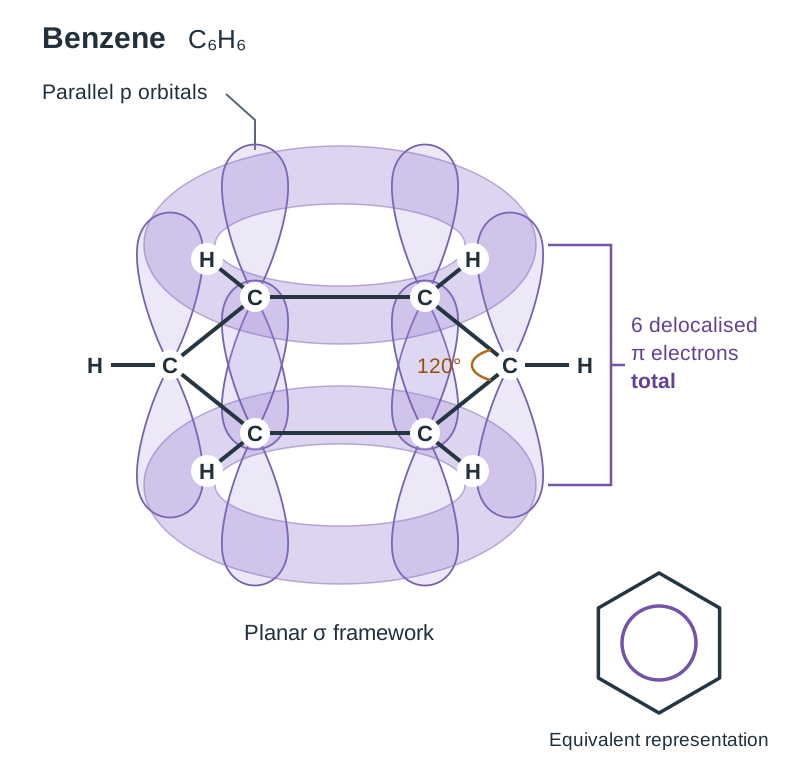
- Aromatic hydrocarbons: Organic compounds containing a benzene ring () with a planar hexagonal structure and a ring of six delocalised electrons. Benzene is unusually stable because of this delocalised pi system.
Environmental and Societal Impact
The extensive combustion of hydrocarbon fuels drives the enhanced greenhouse effect. When hydrocarbons burn, they release massive quantities of carbon dioxide: . Unburned methane also leaks into the atmosphere from gas extraction and agriculture. Elevated levels of greenhouse gases trap outgoing infrared radiation, leading to rising global temperatures, altered weather patterns, and ocean acidification as excess dissolves to form carbonic acid. Evaluating claims about hydrocarbon impacts requires consulting peer-reviewed data and recognising potential bias in media and industry reporting.
Carbon Bonding: Sigma, Pi, and Molecular Geometry
Carbon has four valence electrons and forms four covalent bonds in stable molecules. The shape around each carbon atom depends on how many groups of electrons point away from it. Each sigma bond (or lone pair) counts as one group, and these groups repel each other so they get as far apart as possible (VSEPR). The pi bond in a double or triple bond sits alongside the sigma bond, so it does not add another direction.
Sigma () and Pi () Bonds
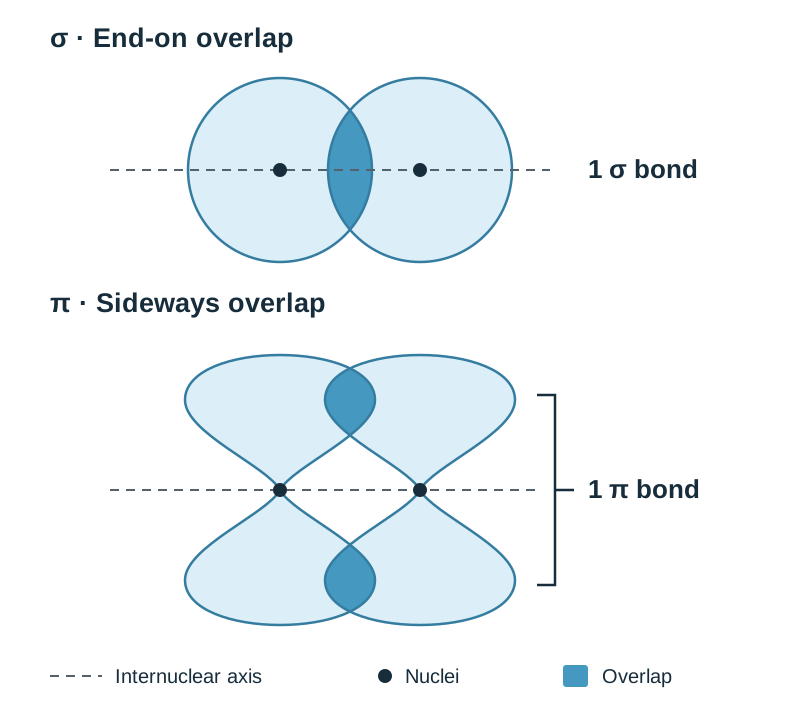
- Sigma () bond: Formed by the end-on overlap of atomic orbitals along the internuclear axis. The electron density is concentrated directly between the two nuclei. All single covalent bonds are sigma bonds, and they permit free rotation around the bond axis.
- Pi () bond: Formed by the sideways overlap of parallel orbitals above and below the internuclear axis. Sideways overlap is less effective than end-on overlap, meaning a pi bond is weaker and more easily broken than a sigma bond. A double bond consists of one bond and one bond; a triple bond consists of one bond and two bonds. The presence of a pi bond prevents free rotation, locking the atoms attached to the carbon atoms into a rigid geometry.
Shapes of Hydrocarbon Molecules
| Molecule | Formula | Carbon-Carbon Bonding | VSEPR Shape around Carbon | Bond Angle | Molecular Planarity |
|---|---|---|---|---|---|
| Ethane | Single bond () | Tetrahedral | 109.5° | Non-planar | |
| Ethene | Double bond () | Trigonal planar | 120° | Planar (all 6 atoms in one plane) | |
| Ethyne | Triple bond () | Linear | 180° | Linear (all 4 atoms along a line) | |
| Benzene | Delocalised ring ( per C) | Trigonal planar | 120° | Planar hexagonal ring |
- 4 sigma bonds → tetrahedral, 109.5° (ethane)
- 3 sigma bonds → trigonal planar, 120° (ethene, benzene)
- 2 sigma bonds → linear, 180° (ethyne)
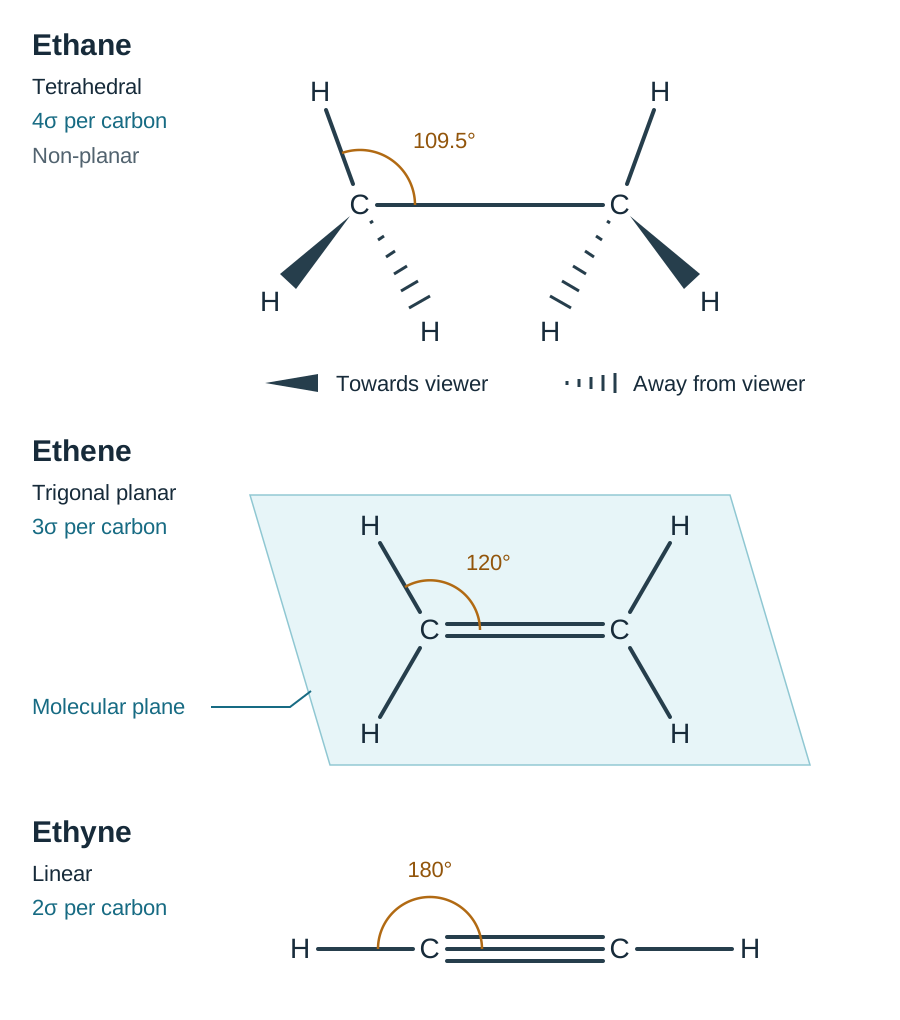
In molecules like propene (), two distinct geometries coexist: the methyl carbon () has four single bonds and a tetrahedral geometry (109.5°), while the two double-bonded carbons adopt a trigonal planar geometry (120°).
In benzene, each carbon forms three sigma bonds at 120° angles. The remaining orbital on each carbon overlaps sideways equally with its neighbours around the ring, creating a continuous cloud of six delocalised electrons above and below the ring. All six carbon-carbon bonds are identical, with lengths intermediate between single and double bonds.
Ethene: Preparation and Tests for Unsaturation
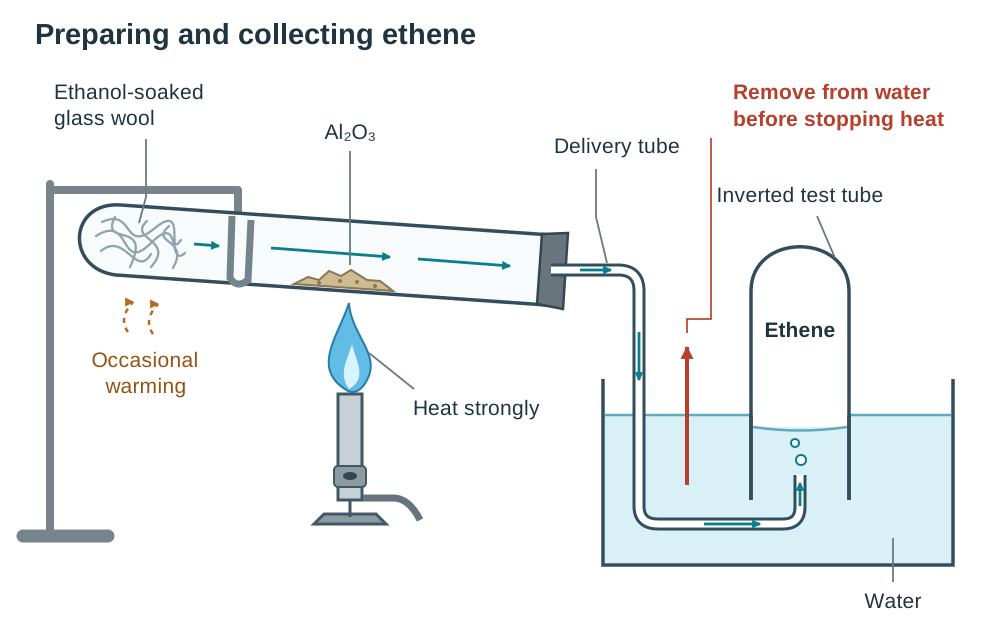
Ethene () is prepared in the laboratory by the dehydration of ethanol using an aluminium oxide () catalyst.
Reaction and Equation
Ethanol vapour passes over hot aluminium oxide, removing a molecule of water to produce ethene gas.
Apparatus and Procedure
- Glass wool soaked in ethanol is pushed to the closed end of a boiling tube clamped almost horizontally.
- Aluminium oxide powder is placed in the middle of the tube.
- A delivery tube leads from the rubber stopper of the boiling tube into a trough of water, where inverted test tubes filled with water collect the gas over water.
- The aluminium oxide is heated strongly with a Bunsen burner, while the glass wool is warmed only occasionally so that ethanol slowly vaporises across the hot catalyst.
- The first test tube of gas is discarded because it consists mostly of displaced air.
- Safety Precaution (Suck-Back): Before turning off the Bunsen burner, the delivery tube must be removed from the water trough. If heating stops while the tube is submerged, the gas inside contracts, drawing cold water back into the hot tube and causing the glass to shatter.
Physical Properties
Ethene is a colourless gas with a sweetish smell. It is only slightly soluble in water, allowing collection over water, and is less dense than air.
Chemical Properties and Tests
- Combustion: Ethene ignites to burn with a luminous, smoky yellow flame due to its higher carbon-to-hydrogen ratio compared to ethane: .
- Bromine water test: Shaking ethene with bromine water causes the colour to change rapidly from orange (red-brown) to colourless without needing light. Ethene undergoes an addition reaction across the double bond.
- Acidified potassium manganate(VII) test: Shaking ethene with dilute acidified results in a colour change from purple to colourless, as the double bond is oxidised and purple manganate(VII) ions are reduced to colourless .
Alkanes do not react with either reagent at room temperature; bromine water stays orange and potassium manganate(VII) stays purple. These two tests confirm that a hydrocarbon is unsaturated.
Combustion of Hydrocarbons
Combustion is the reaction of a fuel with oxygen to release heat. Hydrocarbons serve as our primary combustible fuels.
Complete vs Incomplete Combustion
- Complete combustion: Occurs when oxygen is plentiful. The carbon oxidises entirely to carbon dioxide and the hydrogen to water, producing a clean blue flame:
- Incomplete combustion: Occurs when the oxygen supply is limited. Carbon monoxide (), an odourless and highly toxic gas, or elemental carbon (soot) is produced alongside water, giving a yellow, smoky flame.
Balancing Complete Combustion Equations
A reliable method to balance hydrocarbon combustion:
- Balance carbon atoms by adjusting the coefficient of .
- Balance hydrogen atoms by adjusting the coefficient of .
- Balance oxygen atoms by adjusting the coefficient of .
- If the oxygen coefficient requires a half-integer (e.g. ), multiply the entire equation by 2.
For propane ():
For butane ():
Flame Characteristics
Alkanes burn with cleaner, less luminous flames because their carbon content is lower. Alkenes and alkynes have higher percentages of carbon by mass, so unburned carbon particles glow yellow in the flame and generate visible soot.
IUPAC Nomenclature and Structural Isomerism
The International Union of Pure and Applied Chemistry (IUPAC) specifies rules to name hydrocarbons up to :
IUPAC Naming Steps
- Find the longest continuous chain of carbon atoms. For alkenes or alkynes, the chain must contain the double or triple bond. Prefixes indicate chain length: meth-, eth-, prop-, but-, pent-, hex-.
- Number the carbon chain from the end that gives substituents (or the multiple bond) the lowest possible position numbers (locants). A double or triple bond takes priority over alkyl branches.
- Identify substituents: a one-carbon branch is methyl (), and a two-carbon branch is ethyl ().
- Use multiplicative prefixes (di-, tri-, tetra-) if multiple identical branches are present. Separate numbers with commas, and numbers from letters with hyphens (e.g. 2,3-dimethylbutane).
- List different substituents in alphabetical order (ethyl before methyl, ignoring di- and tri-).
Structural Isomerism
Structural isomers are compounds that have the same molecular formula but different structural formulas.
For alkanes:
- (2 isomers): butane and 2-methylpropane.
- (3 isomers): pentane, 2-methylbutane, and 2,2-dimethylpropane.
- (5 isomers): hexane, 2-methylpentane, 3-methylpentane, 2,2-dimethylbutane, and 2,3-dimethylbutane.
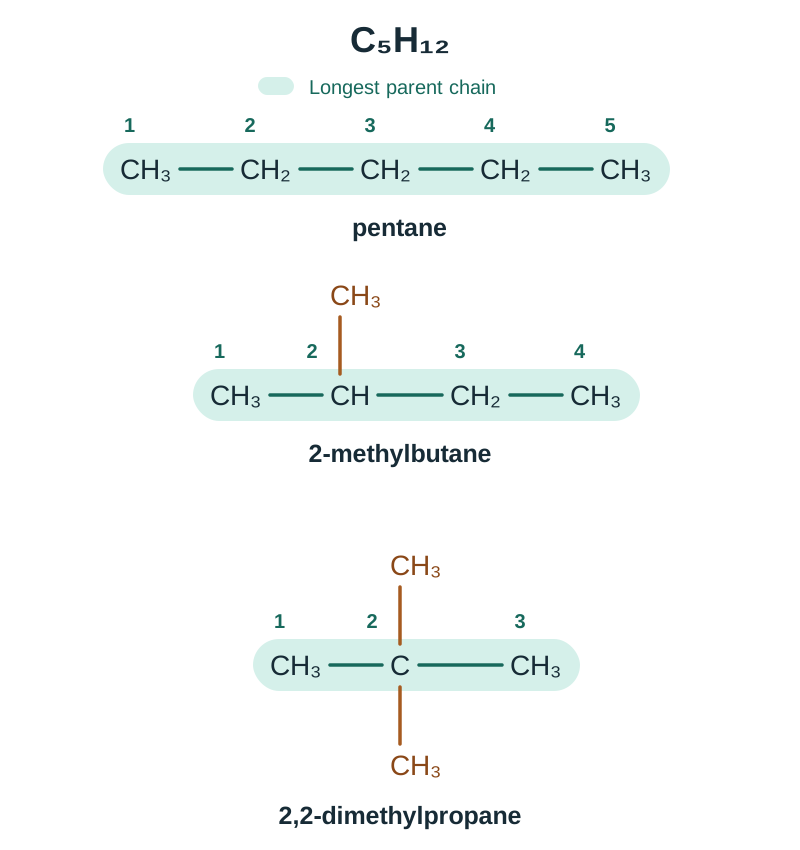
For alkenes, positional and branched isomers occur. For , three non-cyclic structural isomers exist:
- but-1-ene ()
- but-2-ene ()
- 2-methylpropene ()
Geometric (Cis-Trans) Isomerism and Physical Properties
Geometric isomerism is a form of stereoisomerism where molecules have the same molecular formula and connectivity of atoms, but differ in the spatial arrangement of groups across a rigid bond.
Conditions for Geometric Isomerism
Two criteria must be met simultaneously:
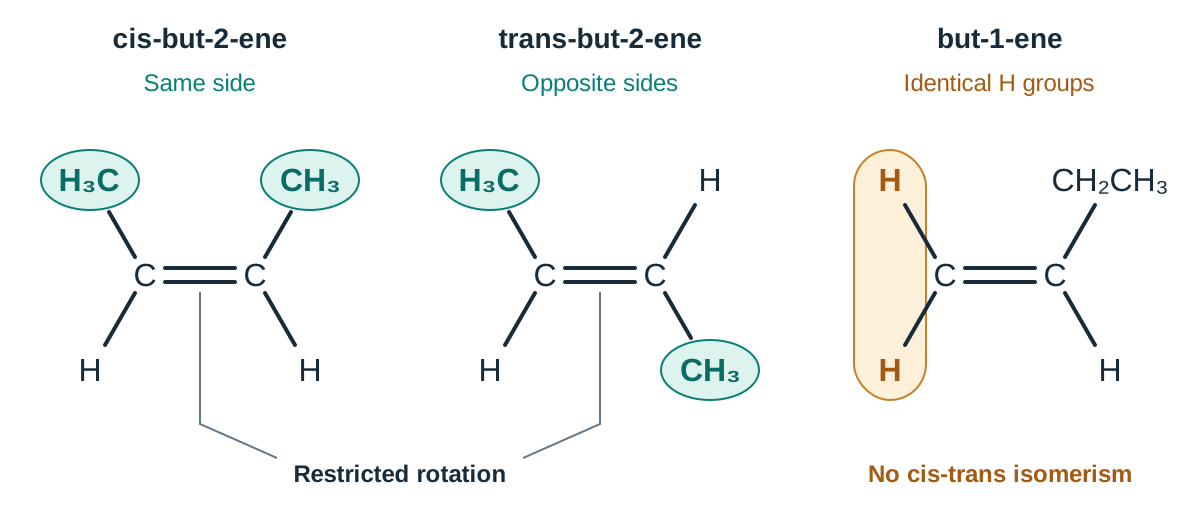
- Restricted rotation: Present in the carbon-carbon double bond () due to the sideways overlap of the pi bond.
- Two different groups on each carbon: Each carbon of the double bond must be attached to two non-identical groups.
In but-2-ene ():
- cis-but-2-ene: Both methyl groups are on the same side of the double bond.
- trans-but-2-ene: The methyl groups are on opposite sides across the double bond.
Conversely, but-1-ene () cannot exhibit cis-trans isomerism because carbon-1 is bonded to two identical hydrogen atoms.
Physical Properties and the Impact of Isomerism
The electronegativity difference between carbon () and hydrogen () is small (). Most hydrocarbons are non-polar overall, and the forces between their molecules are weak London dispersion forces.
- Chain length: As carbon chain length increases, the number of electrons per molecule increases, strengthening London dispersion forces. Consequently, straight-chain alkanes and alkenes with up to four carbons ( to for alkanes, to for alkenes) are gases at room temperature, while straight-chain and hydrocarbons are liquids.
- Branching in structural isomers: Straight-chain alkanes pack more closely with greater surface contact, giving stronger London dispersion forces and higher boiling points. Pentane boils at , whereas its branched isomer 2,2-dimethylpropane boils at .
- Symmetry and polarity in geometric isomers: In cis-but-2-ene, the slight bond dipoles reinforce each other on one side, making the molecule slightly polar. Weak permanent dipole-dipole attractions add to London dispersion forces, giving a boiling point of roughly . In trans-but-2-ene, the opposite arrangement creates symmetry where dipoles cancel. It is non-polar, possessing only London dispersion forces and a lower boiling point of roughly .
- Solubility: Hydrocarbons are insoluble in water because they are non-polar and cannot form hydrogen bonds with water molecules. Liquid hydrocarbons are less dense than water, so they form a separate layer on top. They dissolve readily in non-polar organic solvents such as cyclohexane.
Comparison of Alkanes and Alkenes
| Property | Alkanes | Alkenes |
|---|---|---|
| Carbon-carbon bonding | Single () bonds only | Contains () |
| Saturation | Saturated | Unsaturated |
| Open-chain general formula | ||
| Boiling point trend | Increases with chain length | Increases with chain length (comparable values) |
| Solubility | Insoluble in water; soluble in non-polar solvents | Insoluble in water; soluble in non-polar solvents |
| Combustion flame | Cleaner, non-luminous | Luminous, smoky |
| Chemical reactivity | Low (stable bonds, unreactive to tests) | High (undergoes addition across the reactive bond) |
Chemical Stability of Alkanes
Alkanes show relatively low chemical reactivity compared to alkenes due to two key factors:
- Strong sigma () bonding: All bonds in alkanes are single covalent sigma bonds, which are strong and hold electron density securely along the internuclear axis. Unlike alkenes, there are no exposed pi () bonds for incoming reagents to attack.
- Low polarity: The electronegativity difference between carbon () and hydrogen () is very small (). As a result, C–H and C–C bonds are virtually non-polar, offering no partial charges to attract polar or ionic reagents.
Because of this stability, alkanes do not react with common reagents at room temperature and do not decolourise bromine water or acidified potassium manganate(VII).
Key terms
- Hydrocarbon
- A compound that contains carbon and hydrogen only.
- Saturated hydrocarbon
- A hydrocarbon containing only single covalent bonds between carbon atoms.
- Unsaturated hydrocarbon
- A hydrocarbon that contains at least one carbon-carbon double or triple bond.
- Homologous series
- A series of compounds of similar chemical properties, showing gradations in physical properties, having a general formula for its members, each member differing from the previous member by a CH2 unit, and having a similar method of preparation.
- Aliphatic compound
- An organic compound consisting of open chains of carbon atoms and closed rings of carbon atoms that behave similarly in their chemical properties.
- Aromatic compound
- An organic compound containing a benzene ring with a planar structure and a delocalised ring of six pi electrons.
- Sigma (σ) bond
- A covalent bond formed by the direct, end-on overlap of atomic orbitals, with electron density concentrated symmetrically along the internuclear axis.
- Pi (π) bond
- A covalent bond formed by the sideways overlap of parallel p orbitals, with electron density located in lobes above and below the internuclear axis.
- Delocalised electrons
- Electrons that are shared between more than two atoms in a molecule or ion, rather than belonging to a single bond or atom.
- Structural isomers
- Compounds that have the same molecular formula but different structural formulas.
- Geometric (cis-trans) isomerism
- A form of stereoisomerism in unsaturated compounds where groups are attached differently in three-dimensional space across a bond with restricted rotation (cis: same side; trans: opposite sides).
- London dispersion forces
- Weak, temporary intermolecular attractions caused by instantaneous, fluctuating dipoles in electron clouds.
Check yourself
Write the balanced chemical equation for the complete combustion of butane (C₄H₁₀).
2C₄H₁₀ + 13O₂ → 8CO₂ + 10H₂O
Explain why cis-but-2-ene has a slightly higher boiling point than trans-but-2-ene.
cis-But-2-ene is slightly polar because its bond dipoles do not cancel, giving it weak permanent dipole-dipole attractions in addition to London dispersion forces. trans-But-2-ene is symmetrical and non-polar, possessing only London dispersion forces.
What colour change is observed when ethene is bubbled through (a) bromine water, and (b) acidified potassium manganate(VII)?
(a) Orange (red-brown) to colourless. (b) Purple to colourless.
Name the three non-cyclic structural isomers with molecular formula C₄H₈, and identify which one shows cis-trans isomerism.
but-1-ene, but-2-ene, and 2-methylpropene. Only but-2-ene shows cis-trans isomerism.
State the VSEPR shape and bond angle around each carbon atom in (a) ethane, and (b) ethyne.
(a) Ethane: tetrahedral, 109.5°. (b) Ethyne: linear, 180°.
Why is it necessary to remove the delivery tube from the water trough before turning off the Bunsen burner when preparing ethene?
To prevent suck-back of cold water into the hot boiling tube as the gas contracts, which would crack the glass.