

Gas Laws & Properties examines the physical behaviour of gases from microscopic particle motion to macroscopic properties. Direct experimental evidence from Brownian motion and diffusion underpins the kinetic theory of matter. The fundamental gas relationships discovered by Robert Boyle, Jacques Charles, and Amedeo Avogadro unite in the ideal gas equation (PV = nRT). This topic explores how to verify these laws with primary data, why real gases deviate from ideal behaviour, and how to measure the relative molecular mass of a volatile liquid in the laboratory.
Evidence for the Kinetic Theory of Matter
The kinetic theory of matter states that all matter consists of tiny particles in continuous, random motion. Because individual molecules are too small to observe directly under an optical microscope, we rely on effects we can see, such as Brownian motion and diffusion, as evidence that the particles are always moving.
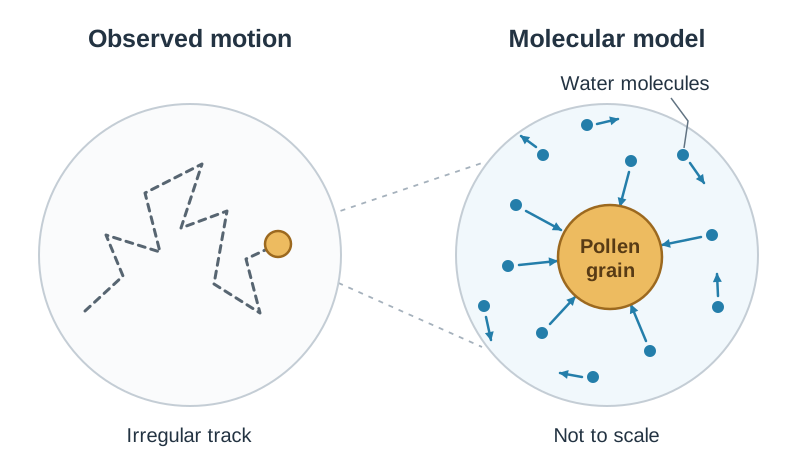
Brownian Motion
In 1827, botanist Robert Brown observed pollen grains suspended in water under a microscope. The pollen grains moved in a continuous, erratic, zig-zag path. This phenomenon occurs because unseen, rapidly moving water molecules constantly bombard the larger pollen grains unevenly from all directions. The same erratic motion is visible when illuminated smoke particles suspended in air are viewed under a microscope.
Diffusion of Gases
Diffusion is the spontaneous spreading out of particles from an area of higher concentration to an area of lower concentration until evenly distributed. Because it takes place without stirring or mechanical intervention, diffusion shows that gas particles possess their own kinetic energy.
Diffusion Demonstration: Ammonia and Hydrogen Chloride
This classic demonstration compares the diffusion rates of two volatile substances:
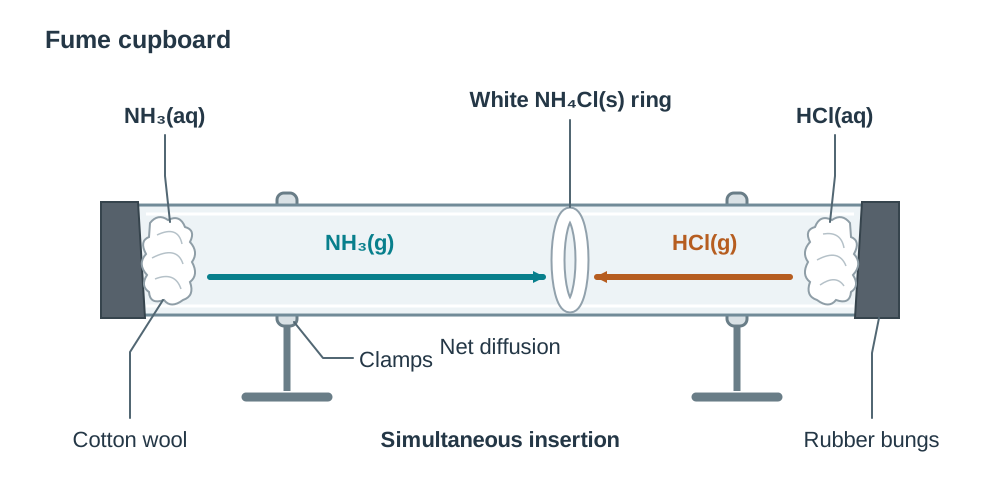
- Apparatus: A long, horizontal glass tube supported in clamps inside a fume cupboard. Concentrated ammonia solution () is placed on a cotton wool plug at one end, and concentrated hydrochloric acid () is placed on a cotton wool plug at the other end. Both plugs are inserted at the same time, and the tube ends are sealed with rubber bungs.
- Observation: As the two gases evaporate and diffuse along the tube, they meet and react to form a dense white ring of solid ammonium chloride:
- Explanation: The white ring forms noticeably closer to the hydrochloric acid end. Ammonia has a relative molecular mass () of , whereas hydrogen chloride has an of . Because lighter gas molecules have a higher average speed than heavier molecules at the same temperature, ammonia diffuses faster and travels farther along the tube in the same time.
The Fundamental Gas Laws and the Combined Gas Law
Gas pressure is caused by gas molecules colliding with the walls of their container. Pressure is defined as force per unit area and is measured in pascals (), where .
Boyle's Law
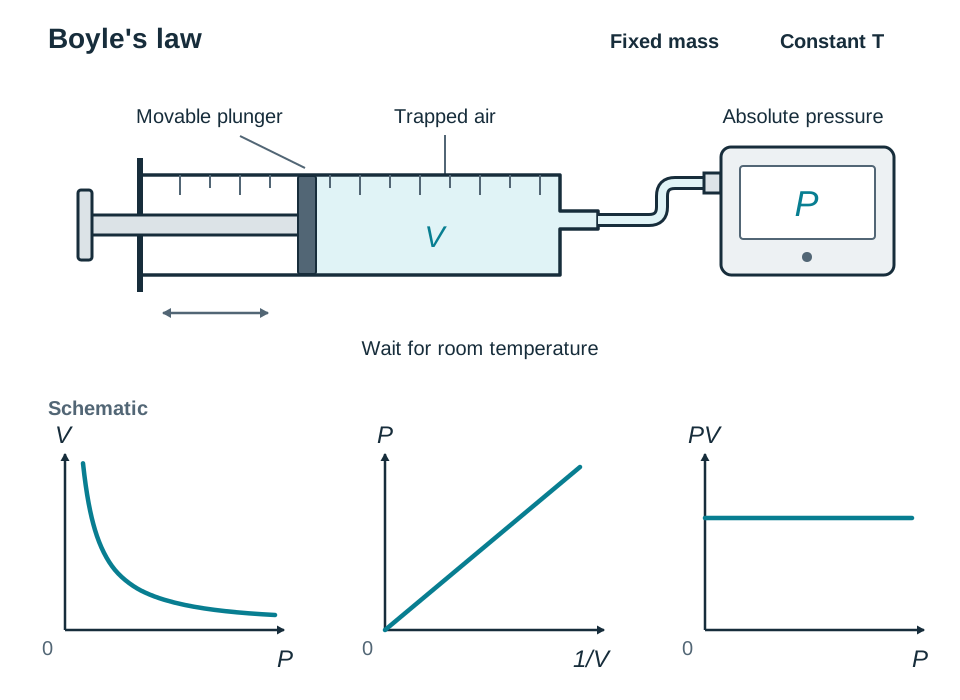
Boyle's Law states that at constant temperature, the volume of a fixed mass of gas is inversely proportional to its pressure.
Mathematically:
Kinetic explanation: Compressing a gas into half its volume crowds the particles into half the space. The molecules strike the container walls twice as often, doubling the pressure.
Graphs:
- A plot of against gives a curved hyperbola.
- A plot of against (or against ) gives a straight line through the origin.
- A plot of against gives a horizontal straight line, showing that the product remains constant.
Charles' Law
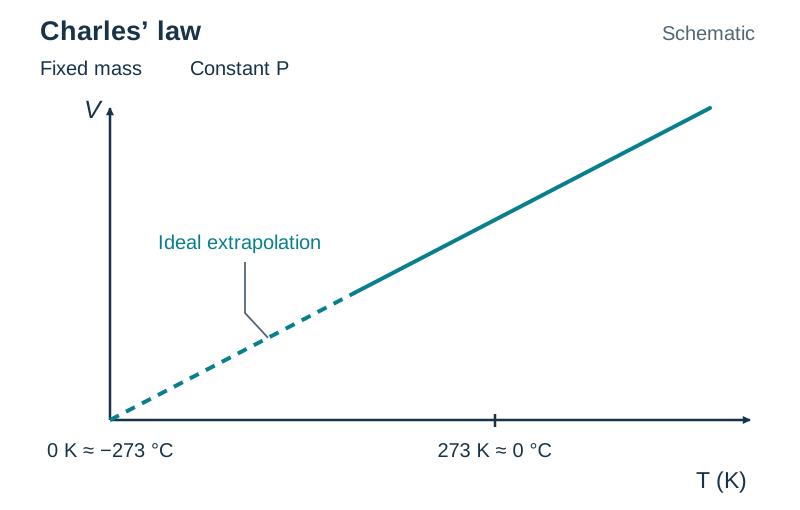
Charles' Law states that at constant pressure, the volume of a fixed mass of gas is directly proportional to its temperature measured on the Kelvin scale.
Mathematically:
The Kelvin scale measures absolute temperature (). Zero Kelvin (, rounded to ) is absolute zero, the temperature at which particles have minimum kinetic energy and an ideal gas would occupy zero volume.
Kinetic explanation: Heating increases the average kinetic energy and speed of the molecules, so they hit the walls harder and more frequently. For the pressure to stay constant, the gas must expand. In a larger volume, the molecules strike the walls less often, balancing the harder impacts.
Graph: A plot of against (in Kelvin) gives a straight line passing through the origin.
Pressure and Temperature at Constant Volume
At constant volume, the pressure of a fixed mass of gas is directly proportional to its temperature on the Kelvin scale:
Kinetic explanation: Heating makes the molecules move faster, so they hit the container walls more often and with greater force. Because the volume cannot change, the pressure rises.
The Combined Gas Law
Combining the three relationships for a fixed mass of gas gives:
This formula is used when a fixed mass of gas changes from an initial set of conditions () to a new set (). Temperature must always be in Kelvin. However, and can remain in non-SI units (such as or ), because identical units on both sides cancel.
Avogadro's Law and Molar Volume
Avogadro's Law states that equal volumes of gases contain equal numbers of molecules under the same conditions of temperature and pressure.
The volume occupied by one mole of any gas under specified conditions is its molar volume.
- At standard temperature and pressure (STP) ( and ), the molar volume of an ideal gas is ( or ).
Verifying Boyle's Law with Primary Data
To verify Boyle's law experimentally, trap a fixed mass of dry air in a sealed gas syringe connected to a digital pressure gauge at room temperature:
- Record the initial volume of trapped gas and the pressure.
- Depress the plunger to a smaller volume. Wait a moment for the gas to return to room temperature, then record the new volume and pressure.
- Repeat for at least five distinct volumes.
- Calculate for each reading and plot against . Calculate the product for each pair of values.
- Result: The plot of against is a straight line through the origin, and is approximately constant, confirming .
- Main sources of error: gas leaking past the syringe seal (mass does not stay fixed), rapid compression causing temporary temperature increases, and friction in the syringe barrel.
The Ideal Gas Equation and Molar Volume Deduction
Combining Boyle's, Charles', and Avogadro's laws yields the ideal gas equation:
Where:
- = pressure in pascals ()
- = volume in cubic metres ()
- = amount of gas in moles ()
- = universal gas constant ()
- = temperature on the Kelvin scale ()
SI Unit Conversions
Strict SI units are mandatory when using :
- Pressure (): Kilopascals () must be multiplied by to obtain ().
- Volume (): Cubic centimetres () must be multiplied by to obtain . Litres () must be multiplied by to obtain .
- Temperature (): Always convert degrees Celsius to Kelvin by adding .
Deducing the Molar Volume at STP
Rearranging the ideal gas equation to solve for volume gives:
Substitute the values for one mole of gas at STP (, , , and ):
Converting cubic metres to litres:
Notice that the identity of the gas never entered the calculation, so one mole of any ideal gas occupies 22.4 L at STP. This is what Avogadro's law predicts.
Finding Relative Molecular Mass ()
Because the amount in moles is given by mass divided by molar mass (), substituting into gives:
The numerical value of the molar mass in equals the dimensionless relative molecular mass ().
Ideal Gas Assumptions and Real Gas Deviations
An ideal gas is a theoretical gas that obeys all the gas laws and kinetic theory assumptions under all conditions of temperature and pressure.
The Five Assumptions of Kinetic Theory for Gases
- Gases consist of particles in continuous, rapid, random straight-line motion.
- The actual volume of the gas particles is negligible compared with the total volume of the container.
- There are no attractive or repulsive intermolecular forces between gas particles.
- Collisions between particles and with the container walls are perfectly elastic (no loss of kinetic energy).
- The average kinetic energy of the particles is directly proportional to the temperature on the Kelvin scale.
Why Real Gases Deviate from Ideality
In real gases, two assumptions fail:
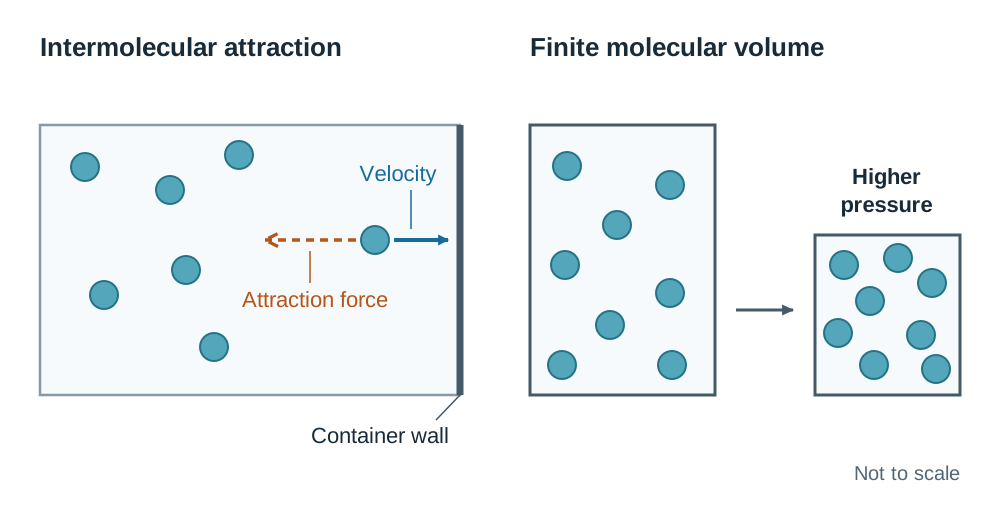
- Intermolecular forces exist: Gas molecules attract one another via intermolecular attractions (London dispersion forces, dipole-dipole attractions, or hydrogen bonding). These attractions pull approaching molecules inward, so they strike container walls with slightly less force than an ideal gas.
- Gas molecules occupy a finite volume: Real molecules take up space. At high pressures, molecules are crowded together, and the volume occupied by the particles themselves is no longer negligible compared to the total space.
| Property | Ideal Gas Model | Real Gas Reality |
|---|---|---|
| Intermolecular Forces | Zero | Attractive and repulsive forces exist |
| Molecular Volume | Zero (negligible) | Finite, non-negligible volume |
| Behaviour at Low Temperature | Remains a gas down to | Condenses to a liquid as attractions dominate |
| Behaviour at High Pressure | Compressible indefinitely | Resists compression due to molecular volume |
Conditions for Approaching Ideal Behaviour
Real gases behave most like an ideal gas at low pressure (particles are widely spaced, so their individual volume is negligible) and high temperature (particles have high kinetic energy, easily overcoming intermolecular attractions).
Comparing Real Gases
The degree of deviation depends on molecular size and the strength of intermolecular forces:
- Hydrogen () and helium (): Very small, non-polar particles with only weak London dispersion forces. They behave nearly ideally at room conditions.
- Ammonia () and water vapour (): Polar molecules capable of forming strong hydrogen bonds with one another. Strong intermolecular attractions cause them to deviate substantially from ideal behaviour.
Required Experiment: Relative Molecular Mass of a Volatile Liquid
The specification requires you to conduct an experiment to determine the relative molecular mass of a gas derived from a liquid (learning outcome 1.4.4). A volatile liquid has a low boiling point and vaporises readily at moderate temperatures (e.g. propanone or cyclohexane).
Practical Overview
- Purpose: To determine the relative molecular mass () of a volatile liquid using the ideal gas equation ().
- Key Assumption: The vaporised liquid behaves as an ideal gas.
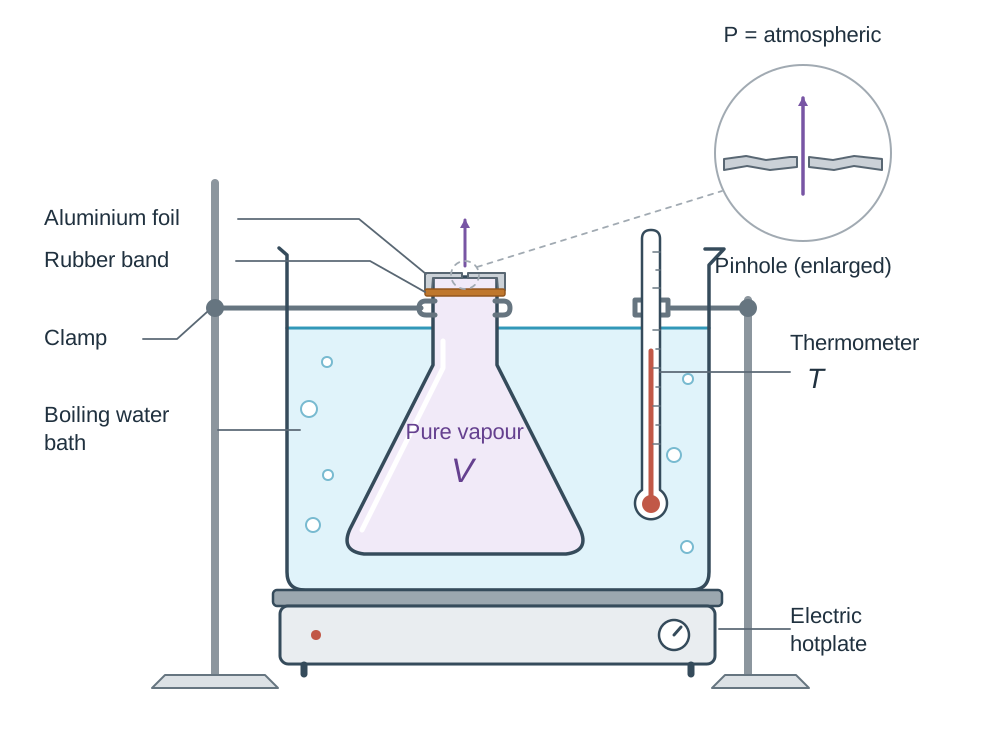
- Core Principle: Excess liquid is boiled away through a pinhole. At the moment boiling finishes, the flask contains pure vapour that completely fills its volume at the atmospheric pressure and boiling bath temperature. When cooled, this vapour condenses and its mass is determined by reweighing.
Apparatus Setup
A clean, dry conical flask is covered with a square of aluminium foil crimped tightly around the neck and secured with a rubber band. A tiny pinhole is pierced in the centre with a fine pin. The assembly is weighed on a precision balance.
- Diagram description: The covered conical flask is clamped and submerged up to its neck in a large beaker of water acting as a boiling water bath. The water bath is heated on an electric hotplate (never a naked flame, because volatile organic vapours are flammable). A thermometer is clamped into the water bath beside the flask to record the boiling temperature.
Method Steps
- Introduce approximately of volatile liquid into the flask, re-crimping the foil cap.
- Submerge the flask up to its neck in the boiling water bath on the electric hotplate in a well-ventilated room or fume cupboard.
- As the liquid boils, its expanding vapour flushes out all air through the pinhole. Excess vapour escapes until the internal pressure equals external atmospheric pressure.
- At the precise moment the last droplet of liquid vaporises, read and record the water bath temperature () using the thermometer.
- Read and record atmospheric pressure () from a laboratory barometer.
- Remove the flask, dry the outside glass thoroughly with a towel, and allow it to cool to room temperature. The trapped vapour condenses back into liquid.
- Reweigh the cooled flask, foil, band, and condensed liquid. Subtract the initial empty mass to find the mass () of trapped vapour.
- Determine the volume of the flask () by filling it to the brim with water and emptying the water into a graduated cylinder.
Sources of Experimental Error and Precautions
- Flask not dried thoroughly: Water on the outside of the flask adds extra mass, making too high and leading to an overestimate of .
- Removing the flask before complete vaporisation: Any unvaporised liquid remaining adds excess mass, causing a large overestimate of .
- Neck of flask above water level: If the neck protrudes too far above the bath, vapour in the cooler neck condenses prematurely, increasing the measured mass and .
- Non-ideal behaviour of vapour: The vapour is close to its boiling point, so intermolecular attractions mean it deviates slightly from ideal gas behaviour.
- Pinhole size: The pinhole must be tiny to allow internal and atmospheric pressure to equalise while preventing room air from diffusing into the flask.
Key terms
- Boyle's Law
- At constant temperature, the volume of a fixed mass of gas is inversely proportional to its pressure.
- Charles' Law
- At constant pressure, the volume of a fixed mass of gas is directly proportional to its temperature measured on the Kelvin scale.
- Avogadro's Law
- Equal volumes of gases contain equal numbers of molecules under the same conditions of temperature and pressure.
- Ideal Gas
- A theoretical gas that perfectly obeys all the gas laws and kinetic theory assumptions under all conditions of temperature and pressure.
- Diffusion
- The spontaneous spreading out of particles from an area of higher concentration to an area of lower concentration until evenly distributed.
- Brownian Motion
- The continuous, erratic, zig-zag movement of microscopic particles suspended in a fluid, caused by uneven collisions with surrounding molecules.
- Molar Volume
- The volume occupied by one mole of any gas under specified conditions, equal to 22.4 litres at standard temperature and pressure (STP).
- Absolute Zero
- The theoretical temperature (0 K or -273.15 °C) at which particles possess minimum kinetic energy and an ideal gas occupies zero volume.
Check yourself
Under what two conditions do real gases behave most like an ideal gas?
At low pressure and high temperature.
Why does the white ring in the diffusion tube form closer to the hydrochloric acid end than the ammonia end?
Ammonia (NH₃, Mr = 17) has a smaller molecular mass than hydrogen chloride (HCl, Mr = 36.5). Lighter molecules move with a higher average speed at the same temperature, so ammonia diffuses faster.
What is the volume occupied by 0.50 moles of carbon dioxide at STP (101.3 kPa and 273 K)?
11.2 litres (0.50 mol × 22.4 L mol⁻¹ = 11.2 L or 0.0112 m³).
Calculate the volume in cm³ occupied by 0.0100 mol of gas at 27 °C and 100 kPa (R = 8.31 J K⁻¹ mol⁻¹).
249 cm³. Working: T = 300 K, P = 1.00 × 10⁵ Pa; V = nRT/P = (0.0100 × 8.31 × 300) / (1.00 × 10⁵) = 2.49 × 10⁻⁴ m³ = 249 cm³.
Why does ammonia deviate more from ideal behaviour than hydrogen gas?
Ammonia is a polar molecule that forms strong hydrogen bonds, whereas hydrogen is non-polar and experiences only weak London dispersion forces.
In the volatile liquid experiment, how is the volume of the vaporised gas measured?
The conical flask is filled to the brim with water, and this volume of water is then measured using a graduated cylinder.