
Atoms join together (bond) so that each ends up with a stable electron arrangement, usually a full outer shell like a noble gas. They can achieve this by transferring electrons to form oppositely charged ions in ionic bonding, or by sharing pairs of electrons in covalent bonding. Chemical bonds do not sit in rigid boxes; instead, they lie along a continuous spectrum from pure covalent through polar covalent to predominantly ionic, governed by differences in electronegativity. The type of bonding and the resulting structure explain observable physical properties such as melting point, electrical conductivity, and solubility.
The Octet Rule, Valency, and Predicting Chemical Formulae
Atoms form chemical bonds to achieve stable electron configurations, usually obtaining eight electrons in their valence shell like the noble gases. The octet rule states that when bonding occurs, atoms tend to reach an electron arrangement with eight electrons in their outermost energy level.
The valency of an element is the combining power of an atom, reflecting the number of electrons an atom loses, gains, or shares when forming chemical bonds. For main-group elements, valency can be deduced directly from the group number in the periodic table:
- Group 1 metals have 1 valence electron, losing it to form cations (valency of 1).
- Group 2 metals have 2 valence electrons, losing them to form cations (valency of 2).
- Group 16 non-metals have 6 valence electrons, gaining or sharing 2 electrons (valency of 2).
- Group 17 non-metals have 7 valence electrons, gaining or sharing 1 electron (valency of 1).
Writing Formulae of Ionic Compounds
To write an ionic formula:
- Write the symbol and charge of each ion.
- Find the simplest ratio of ions so that the total positive charge cancels the total negative charge, giving an electrically neutral compound.
- Write the ratio using subscripts. When more than one of a polyatomic ion is required, enclose the polyatomic ion in brackets.
Common polyatomic ions to learn:
- Hydroxide:
- Nitrate:
- Hydrogencarbonate:
- Ammonium:
- Sulfate:
- Sulfite:
- Carbonate:
- Phosphate:
For example, aluminium forms and oxide is . Balancing gives and , so the formula is . Ammonium sulfate combines and , requiring two ammonium ions to balance one sulfate, written as .
Writing Formulae of Simple Covalent Compounds
In simple covalent molecules, each atom forms as many bonds as its valency. Carbon has a valency of 4 and chlorine has a valency of 1, so one carbon bonds to four chlorines: . Nitrogen has a valency of 3 and hydrogen has a valency of 1: .
Limitations in Predicting Bonding and the Octet Rule
While the octet rule is a helpful guide, it has definite limitations:
- Hydrogen achieves stability with 2 outer electrons, matching helium, rather than 8.
- Some stable molecules form with an incomplete octet: in boron trifluoride (), the central boron atom is stable surrounded by only six valence electrons.
- Period 3 elements can form an expanded octet: sulfur hexafluoride () accommodates twelve valence electrons around the sulfur atom.
- Transition metals show variable valency (such as iron forming or , and copper forming or ) because inner d-electrons participate in bonding.
Ionic Bonding, Crystal Lattices, and Ionic Lewis Diagrams
An ionic bond is the electrostatic attraction between oppositely charged ions formed by the transfer of one or more electrons from one atom to another. This transfer typically takes place between an electropositive metal atom that loses electrons and an electronegative non-metal atom that accepts them.
- A cation forms when a neutral metal atom loses valence electrons. For example, sodium ( or ) loses its outer electron to become ( or ), matching the stable electron configuration of neon.
- An anion forms when a non-metal atom gains electrons into its valence shell. Chlorine ( or ) gains one electron to form the chloride ion, ( or ), matching argon.
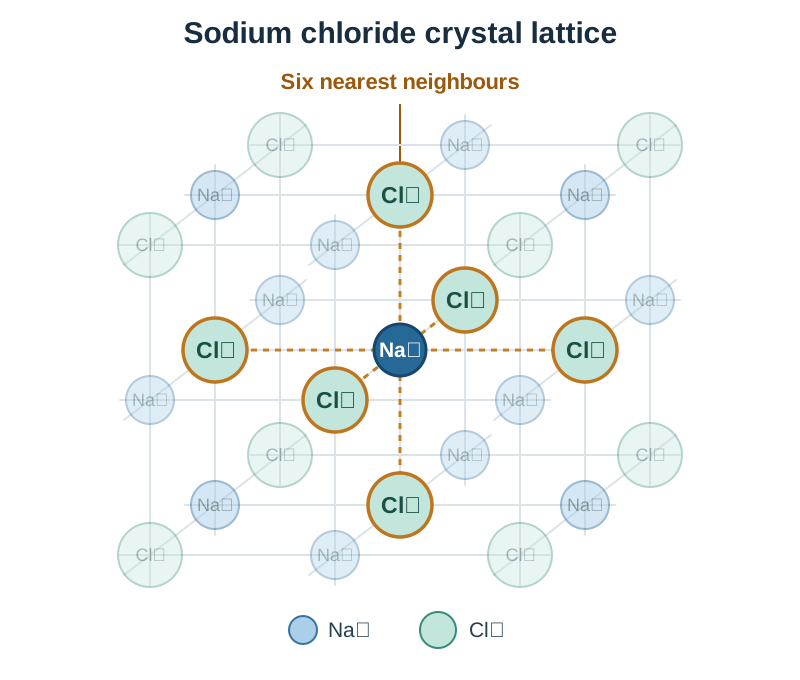
An ionic compound is not made of separate molecules. The formula only gives the ratio of ions: one for every . In solid sodium chloride, vast numbers of ions pack into a giant three-dimensional crystal lattice where each ion is surrounded by six ions, and each ion by six ions. This regular network maximises attractive electrostatic forces between opposite charges and minimises repulsion between like charges.
Drawing Dot-and-Cross Diagrams for Ionic Compounds
To draw a Lewis diagram for an ionic compound:
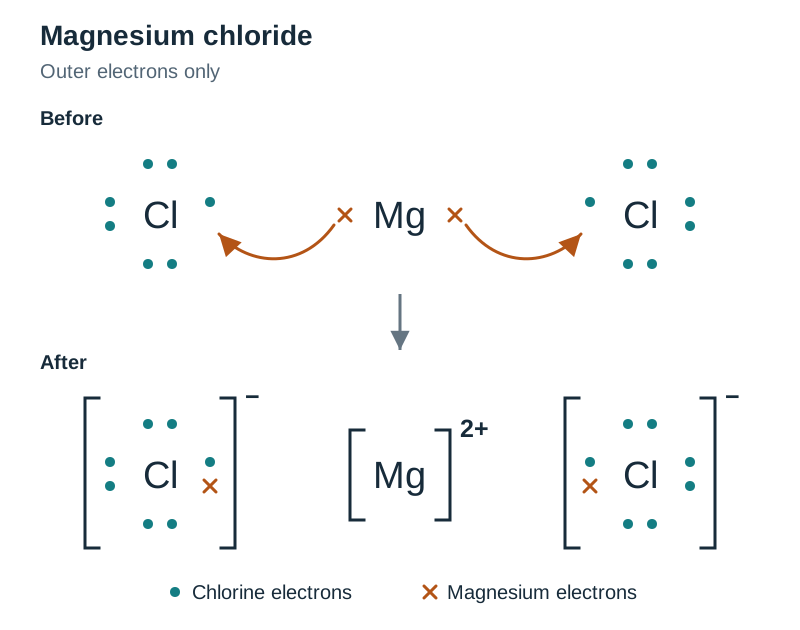
- Draw the metal cation with its lost valence electron gone (showing an empty outer shell).
- Draw the non-metal anion showing a complete outer shell of 8 electrons (using dots for its own valence electrons and crosses for the transferred electrons).
- Put square brackets around each ion and write the charge at the top right outside the bracket.
For sodium chloride, show alongside with 7 dots and 1 cross inside the brackets. For magnesium chloride, show one ion accompanied by two separate ions, each with 8 outer electrons.
Covalent Bonding and Lewis Diagrams
When two non-metal atoms bond, both atoms attract electrons strongly, so neither gives up electrons to the other. Instead, they share electrons to reach noble-gas configurations. A covalent bond is formed when two atoms share one or more pairs of electrons.
Drawing Dot-and-Cross Diagrams for Covalent Molecules
To draw a covalent Lewis diagram (showing outer-shell electrons only):
- Place the atomic symbols next to each other.
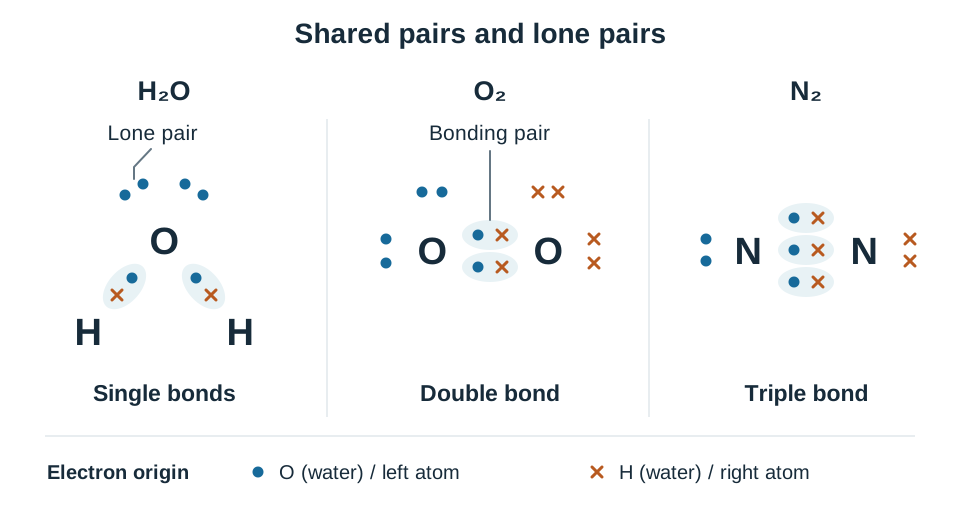
- Place shared pairs of electrons—each consisting of one dot and one cross—in the overlap between the atoms. A shared pair is called a bonding pair.
- Distribute remaining valence electrons on each atom in pairs. Unshared pairs are called lone pairs.
- Verify that each atom is surrounded by 8 outer electrons (or 2 for hydrogen).
Examples:
- Methane (): The central carbon atom shares four electron pairs with four hydrogen atoms, giving 4 bonding pairs and 0 lone pairs around carbon.
- Ammonia (): The central nitrogen shares three electron pairs with three hydrogen atoms and retains 1 lone pair, giving 4 electron pairs in total.
- Water (): The central oxygen shares two electron pairs with two hydrogen atoms and retains 2 lone pairs.
- Oxygen (): The two oxygen atoms share two pairs of electrons (four electrons in total) between them, forming a double bond. Each oxygen atom retains 2 lone pairs.
- Nitrogen (): The two nitrogen atoms share three pairs of electrons (six electrons in total) between them, forming a triple bond. Each nitrogen atom retains 1 lone pair.
- Carbon dioxide (): The central carbon forms two double bonds by sharing two electron pairs with each oxygen atom. Carbon has no lone pairs; each oxygen has 2 lone pairs.
Orbital Overlap: Sigma (σ) and Pi (π) Bonds
Covalent bonds form when half-filled atomic orbitals overlap. The geometry of the overlap determines whether the bond is a sigma () or a pi () bond.
Sigma () Bonds
A sigma bond is formed by the head-on overlap of two atomic orbitals along the internuclear axis joining the nuclei. A sigma bond is stronger than a pi bond because the shared electrons are concentrated directly between the two nuclei, where both nuclei attract them strongly. Sigma bonds form by:
- The overlap of two s orbitals (as in ).
- The overlap of an s orbital with a p orbital (as in ).
- The coaxial, end-on overlap of two p orbitals (as in ).
Pi () Bonds
A pi bond is formed by the sideways overlap of two parallel p orbitals, concentrating electron density in lobes above and below the internuclear axis. Sideways overlap provides less effective orbital overlap than head-on overlap, making a pi bond weaker and more easily broken than a sigma bond. A pi bond cannot exist on its own; it forms only after a sigma bond has joined the two atoms.
| Bond Type | Orbital Composition | Examples |
|---|---|---|
| Single bond | bond | , in methane |
| Double bond | bond and bond | , in ethene |
| Triple bond | bond and bonds | , in ethyne |
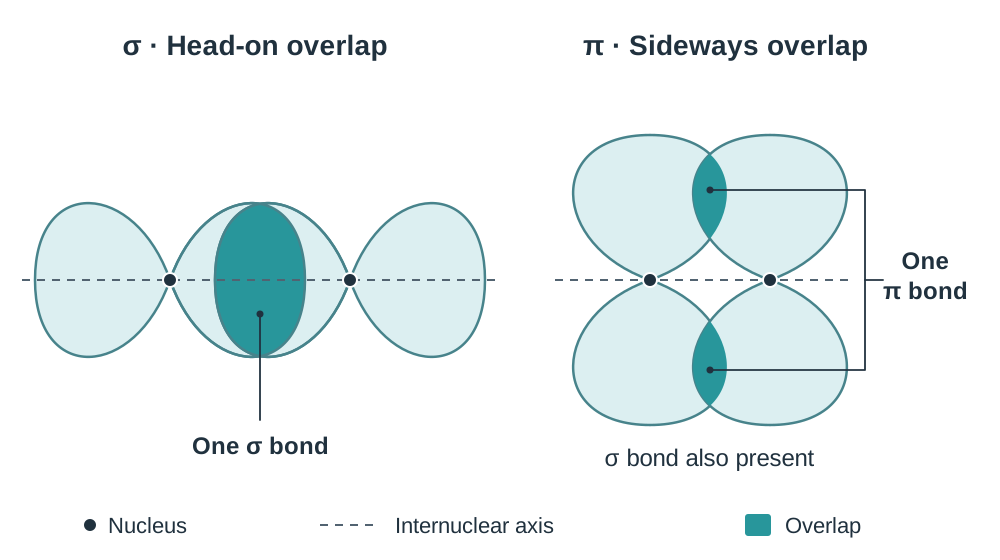
Counting all bonds: ethene () has and bonds (four , plus one and one in ); ethyne () has and bonds (two , plus one and two in ).
Delocalised Bonding
In some structures, electrons are not held between two specific nuclei but are shared across three or more bonded atoms. These are called delocalised electrons. In benzene (), each of the six carbon atoms supplies a p orbital that overlaps sideways across the entire six-carbon ring, creating a delocalised cloud of pi electrons. This delocalisation gives the ring exceptional chemical stability and makes all carbon-carbon bond lengths identical. Delocalised electrons also stabilise polyatomic ions such as nitrate () and carbonate ().
Electronegativity and the Bonding Continuum
Electronegativity is the relative attraction that an atom in a molecule has for the shared pair of electrons in a covalent bond. Electronegativity values are given on the Pauling scale. This is a relative scale, so the values have no units. Fluorine has the highest value (3.98), while alkali metals such as caesium have the lowest values (about 0.8). Always take values from the official examination data booklet rather than memory.
Periodic Trends in Electronegativity
- Across a period (left to right): Electronegativity increases. The nuclear charge increases while the number of inner screening shells remains constant. As a result, the atomic radius decreases and the positive nucleus exerts a stronger pull on shared bonding electrons.
- Down a group (top to bottom): Electronegativity decreases. Each successive element adds a new principal energy level, increasing the atomic radius. The shielding effect of inner filled shells outweighs the increased nuclear charge, weakening the pull on shared bonding electrons.
The Bonding Continuum
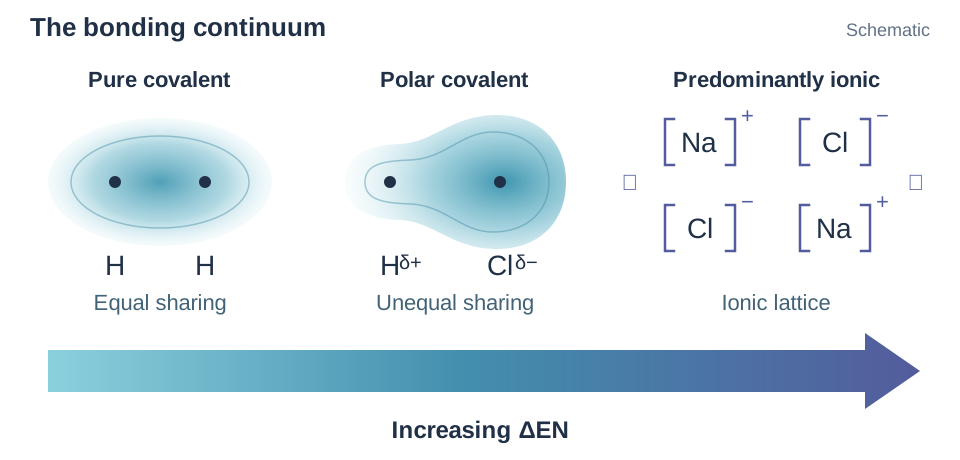
Bonds do not fall into rigid compartments; they lie along a continuous spectrum determined by the electronegativity difference () between the bonded atoms. The values below serve as a useful textbook guide rather than sharp borders:
- Non-polar covalent ( less than about 0.4): Electrons are shared equally or almost equally.
- Pure covalent means , with identical sharing between identical atoms (e.g. , ).
- The bond () has such a small difference that electrons are shared almost equally, making hydrocarbons essentially non-polar.
- Polar covalent (): Electrons are shared unequally. The more electronegative atom pulls electron density toward itself, acquiring a partial negative charge (), leaving the other atom with a partial positive charge (). In hydrogen chloride (), chlorine pulls electron density from hydrogen: .
- Predominantly ionic (): The more electronegative atom attracts the bonding electrons so strongly that electron transfer occurs, producing oppositely charged ions held by electrostatic attractions (e.g. in , ).
Limitation of the Electronegativity Guide
The cut-offs are only an empirical guide because bond character changes gradually. Hydrogen fluoride () has (), which exceeds 1.7. By the numerical cut-off alone, would be predicted as ionic. However, is a gas at room temperature and exists as discrete polar covalent molecules, not an ionic lattice. Predictions from electronegativity differences must always be checked against the observed physical properties of the substance.
Physical Properties Explained by Bonding Type
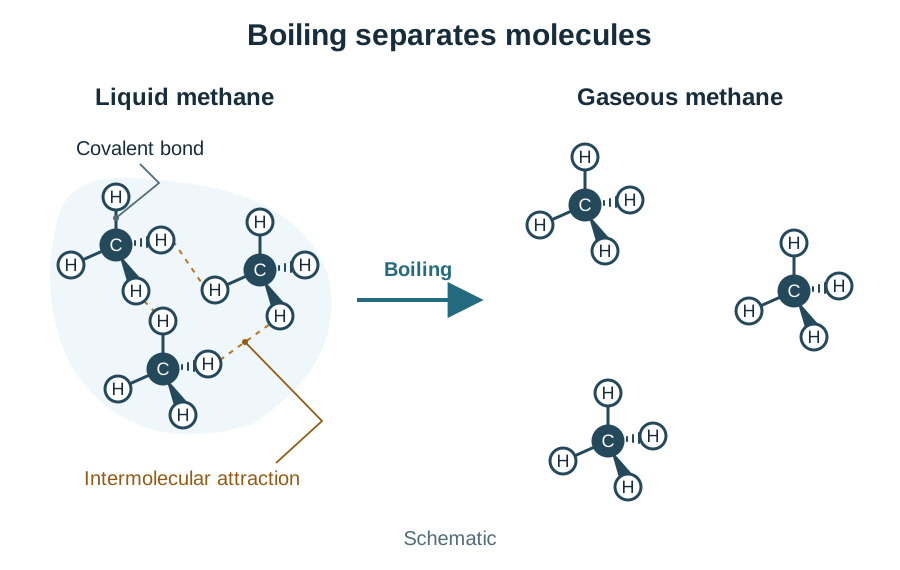
The properties you can observe (melting point, conductivity, solubility) depend on what particles the substance is made of and how strongly those particles are held together. Intramolecular bonds are the covalent bonds holding atoms together within a molecule. Intermolecular forces are the much weaker attractions between separate molecules.
| Physical Property | Giant Ionic Substances (e.g. , ) | Simple Molecular Covalent Substances (e.g. , ) |
|---|---|---|
| State at Room Temperature | Hard, crystalline solids | Gases, liquids, or soft volatile solids |
| Melting & Boiling Points | High (often ); huge energy is required to break strong ionic bonds throughout the lattice | Low to moderate; melting or boiling overcomes weak intermolecular forces, leaving intramolecular covalent bonds intact |
| Electrical Conductivity (Solid) | Non-conductors; ions are locked in fixed lattice positions and cannot move | Non-conductors; molecules are neutral with no mobile ions or free electrons |
| Electrical Conductivity (Liquid/Solution) | Good conductors; melting or dissolving breaks the lattice, freeing ions to move and carry electric current | Non-conductors; neutral molecules remain intact (except polar molecules like that react with water to form ions) |
| Solubility in Water | Many are soluble because polar water molecules attract ions (ion-dipole attraction) and pull them out of the lattice; some are insoluble (e.g. , ) | Follows 'like dissolves like': polar molecules generally dissolve; non-polar molecules are insoluble in water |
Model Answers for Explaining Physical Properties
- Why does sodium chloride have a high melting point? Sodium chloride consists of a giant 3D crystal lattice of and ions. Strong electrostatic forces of attraction hold these oppositely charged ions together. A very large amount of thermal energy is needed to break these strong bonds throughout the lattice.
- Why does methane have a low boiling point? Methane consists of discrete molecules. The covalent bonds holding carbon and hydrogen together inside each molecule are strong, but the intermolecular forces between separate molecules are very weak. Little thermal energy is needed to overcome these weak intermolecular forces, and the intramolecular covalent bonds are not broken on boiling.
Identifying Ions in Salts and Solutions (Experimental Investigation)
Every ion gives a characteristic test result, such as a flame colour, a coloured or white precipitate (an insoluble solid forming in a solution), or a gas. Matching your observation to these tests allows you to identify cations and anions in an unknown salt.
Flame Tests for Cations
- Clean a nichrome or platinum wire by dipping it into concentrated hydrochloric acid and heating it in a blue Bunsen flame until it imparts no colour.
- Dip the clean wire back into the acid, then into the solid salt.
- Hold the wire in the hot outer edge of a non-luminous (blue) flame and observe the colour.
| Cation | Flame Colour |
|---|---|
| Lithium () | Crimson red |
| Sodium () | Yellow-orange |
| Potassium () | Lilac (view through cobalt blue glass to mask sodium contamination) |
| Barium () | Yellow-green (apple green) |
| Strontium () | Scarlet red |
| Copper () | Blue-green |
Anion Tests in Aqueous Solution
Always prepare solutions of the unknown salt using deionised water:
- Chloride (): Add dilute nitric acid (), followed by silver nitrate solution (). A white precipitate of silver chloride forms, which dissolves upon adding dilute ammonia solution.
(Nitric acid is added first to destroy carbonate ions, which would otherwise form an interfering silver carbonate precipitate.)
- Sulfate (): Add barium chloride solution (). A white precipitate of barium sulfate forms that does not dissolve in dilute hydrochloric acid.
- Sulfite (): Add barium chloride solution (). A white precipitate of barium sulfite forms that does dissolve upon adding dilute hydrochloric acid, releasing sulfur dioxide gas.
- Carbonate () and Hydrogencarbonate (): Add dilute hydrochloric acid. Vigorous effervescence occurs. Bubble the gas through limewater; it turns cloudy, confirming carbon dioxide gas.
Limewater reaction:
- Distinguishing Carbonate from Hydrogencarbonate: Add magnesium sulfate solution () to fresh cold solutions of each salt.
- Carbonate gives an immediate white precipitate in the cold:
- Hydrogencarbonate gives no precipitate in the cold, but forms a white precipitate upon boiling/heating, as hydrogencarbonate decomposes to carbonate:
- Nitrate () - Brown Ring Test: Add freshly prepared iron(II) sulfate solution (). Incline the test tube and slowly pour concentrated sulfuric acid () down the inside wall so it settles as a dense layer at the bottom. A brown ring forms at the junction of the two liquid layers.
- Phosphate (): Add ammonium molybdate reagent acidified with concentrated nitric acid and warm gently. A bright yellow precipitate forms.
Analytical Limitations and Real-World Relevance
Each qualitative chemical test works only above a certain minimum concentration of the ion. A negative test indicates that the ion is absent or present below the analytical detection limit; it does not prove zero concentration.
These ion tests have direct real-world importance in water treatment and environmental protection. Chlorides, sulfates, nitrates, and phosphates are routinely monitored in drinking water and rivers. Excess nitrates and phosphates from agricultural run-off lead to eutrophication. Water hardness is caused by dissolved calcium and magnesium ions; hydrogencarbonate ions are linked to hardness because calcium and magnesium hydrogencarbonates cause temporary hardness.
Key terms
- Octet Rule
- The principle stating that when bonding occurs, atoms tend to reach an electron arrangement with eight electrons in their outermost energy level.
- Valency
- The combining power of an atom, reflecting the number of electrons an atom loses, gains, or shares when forming chemical bonds.
- Ionic Bond
- The electrostatic attraction between oppositely charged ions formed by the transfer of one or more electrons from one atom to another.
- Cation
- A positively charged ion formed when a neutral atom or group of atoms loses one or more electrons.
- Anion
- A negatively charged ion formed when a neutral atom or group of atoms gains one or more electrons.
- Crystal Lattice
- A regular, repeating three-dimensional arrangement of ions or atoms held together in a crystalline solid.
- Covalent Bond
- A chemical bond formed when two atoms share one or more pairs of electrons between their nuclei.
- Bonding Pair
- A pair of valence electrons shared between two bonded atoms in a covalent bond.
- Lone Pair
- A pair of valence electrons on an atom that is not involved in chemical bonding.
- Sigma (σ) Bond
- A covalent bond formed by the direct, head-on overlap of two atomic orbitals along the internuclear axis.
- Pi (π) Bond
- A covalent bond formed by the sideways overlap of two parallel p orbitals above and below the internuclear axis.
- Delocalised Electrons
- Electrons that are not confined to a single bond between two specific atoms, but are spread across three or more bonded atoms.
- Electronegativity
- The relative attraction that an atom in a molecule has for the shared pair of electrons in a covalent bond.
- Polar Covalent Bond
- A covalent bond in which the shared electron pair is drawn closer to the more electronegative atom, generating partial positive (δ+) and partial negative (δ-) charges.
- Intramolecular Bond
- A covalent bond that holds atoms together within a molecule.
- Intermolecular Force
- An attractive force that acts between separate molecules.
- Precipitate
- An insoluble solid that emerges from a liquid solution during a chemical reaction.
Check yourself
Write the chemical formula for iron(III) sulfate.
Iron(III) is Fe³⁺ and sulfate is SO₄²⁻. Balancing positive and negative charges requires two Fe³⁺ (+6) and three SO₄²⁻ (−6), giving Fe₂(SO₄)₃.
Describe how to draw the Lewis dot-and-cross diagram for carbon dioxide (CO₂).
Place the C atom between two O atoms. Draw two shared pairs of electrons (two dots and two crosses) in each C=O overlap, giving two double bonds and 8 electrons around carbon. Place two lone pairs of electrons on each oxygen atom.
Distinguish between a sigma (σ) bond and a pi (π) bond in terms of orbital overlap and relative strength.
A sigma bond forms by the direct head-on overlap of atomic orbitals along the internuclear axis and is stronger. A pi bond forms by the sideways overlap of parallel p orbitals above and below the internuclear axis, providing less overlap, which makes it weaker.
Why does hydrogen fluoride (HF) not form an ionic solid at room temperature despite having an electronegativity difference of 1.78?
The 1.7 cut-off is an approximate guide along a bonding continuum rather than an absolute rule. HF forms polar covalent molecules with strong intermolecular hydrogen bonding instead of an ionic crystal lattice.
How can you distinguish between a sulfate and a sulfite ion in aqueous solution using barium chloride?
Add barium chloride solution to both solutions; both form a white precipitate (BaSO₄ and BaSO₃). Add dilute hydrochloric acid: the barium sulfite precipitate dissolves in dilute hydrochloric acid; barium sulfate does not.