
Chemical kinetics investigates how quickly reactants turn into products, what controls that speed, and what takes place between particles when bonds break and form. By definition, the rate of reaction is the change in concentration per unit time of any one reactant or product. For particles to react, they have to bump into each other with enough energy to overcome the activation energy barrier, and they must hit each other in the correct alignment. We can adjust the reaction rate by changing concentration, pressure in gases, surface area, temperature, or by adding a catalyst. Catalysts offer an alternative pathway with a lower activation energy while emerging chemically unchanged. They work either by forming unstable intermediates or by adsorbing reactants onto their surface, though their performance can drop if their active sites get saturated or permanently poisoned.
Defining and Tracking Rates of Reaction
Some reactions finish in the blink of an eye. If you mix aqueous solutions of silver nitrate and sodium chloride, a white precipitate of silver chloride forms instantly because the ions are already free in the water and react as soon as they meet. Other reactions creep along slowly. An iron nail can take months to rust, and limestone weathers over centuries. In these slower systems, strong covalent bonds must break first, or the reaction has to clear high energy hurdles over several steps.
Definition of rate of reaction
In Leaving Certificate chemistry, the rate of reaction is defined as the change in concentration per unit time of any one reactant or product.
The usual unit for rate is (moles per litre per second). In our school laboratory, tracking concentration directly from second to second can be tricky, so we usually measure convenient physical changes instead. We might track the volume of gas produced over time (in ) or watch the mass of the flask drop on a balance (in ).
Common Laboratory Tracking Methods
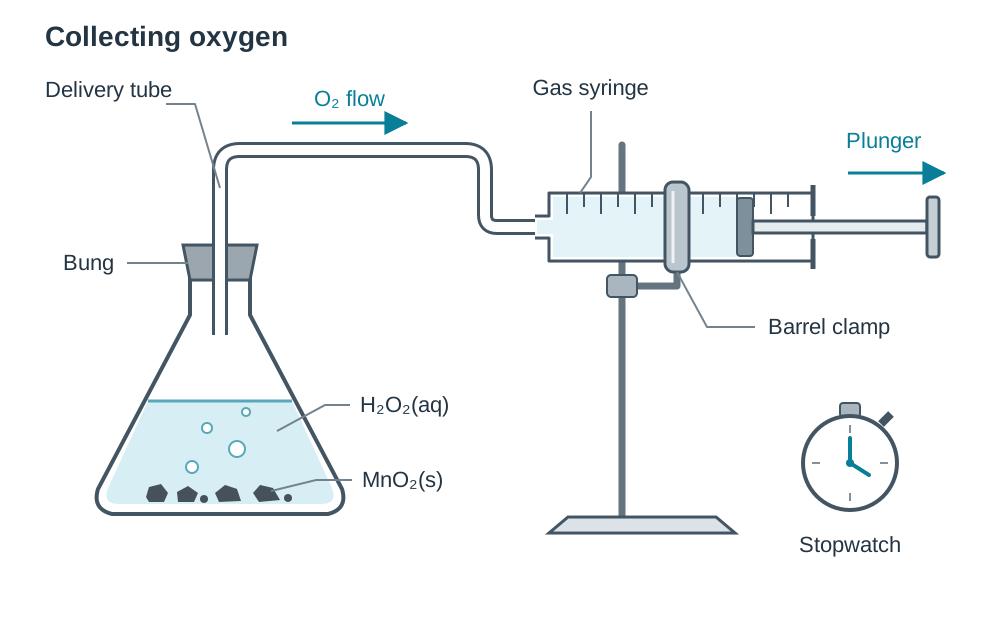
- Gas collection: We collect a gaseous product in a gas syringe or by bubbling it into an inverted graduated cylinder filled with water. Reacting marble chips with hydrochloric acid gives carbon dioxide, while decomposing hydrogen peroxide over manganese(IV) oxide generates oxygen.
- Mass loss: When a dense gas like carbon dioxide escapes, we can place the conical flask straight onto a top-pan balance and log the mass drop at regular intervals. A loose plug of cotton wool in the flask neck lets the gas vent freely while catching any acid spray that might escape.
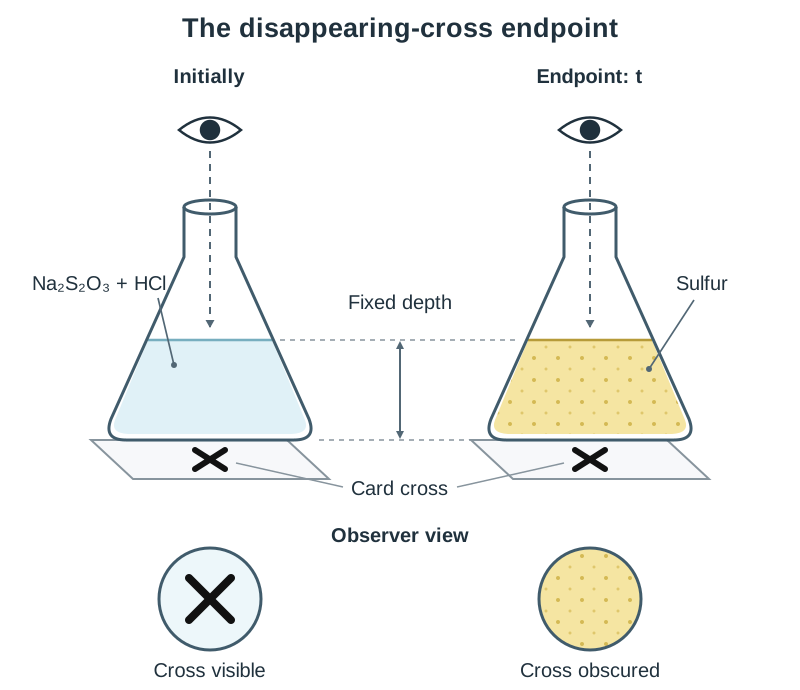
- Disappearing cross (turbidity): If a reaction precipitates an insoluble solid, we can time how long the mixture takes to turn opaque. Reacting sodium thiosulfate with dilute hydrochloric acid deposits solid yellow sulfur. By looking down through the liquid at a black cross drawn on paper beneath the flask, we record the exact time the cross disappears from view.
Analysing and Plotting Rate Graphs
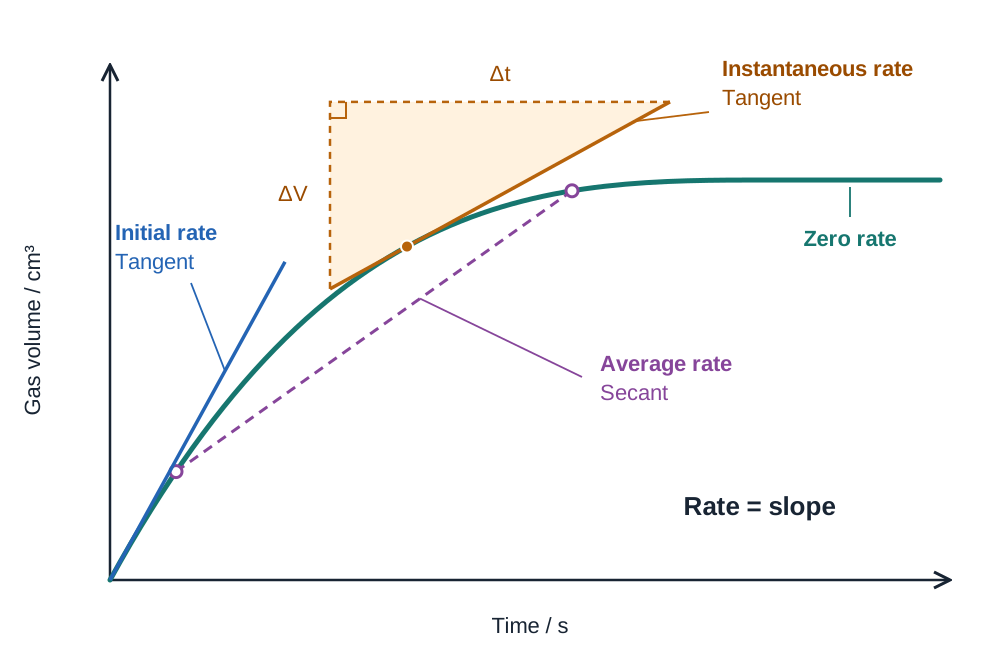
When you plot experimental data like the volume of gas collected against time, the graph always follows a characteristic curve made of three distinct phases:
- A steep initial slope at the start. Reactant concentrations are at their peak, so particles collide most frequently.
- A curve that gradually flattens out. As reactants get used up, collisions happen less often and the reaction slows down.
- A completely flat horizontal plateau. One of the reactants has run out entirely, the reaction has finished, and the rate drops to zero.
Practical Rules for Graph Drawing
Examiners look for good graph habits:
- Put the independent variable, time, on the horizontal axis (-axis) and your measured quantity, such as volume of gas or mass loss, on the vertical axis (-axis).
- Label each axis clearly with the quantity and its unit, such as "Time / " and "Volume of / ".
- Choose a scale that spreads your points across more than half the grid in both directions, using sensible steps like 1, 2, 5, or 10 units per large square.
- Mark each data point with a neat, sharp pencil cross. Draw a smooth, single line of best fit rather than joining the points like a dot-to-dot puzzle.
- If one reading is clearly an outlier, circle it, leave it off your best-fit line, and do not distort the curve to reach it.
Three Ways to Calculate Rate from Graphs
- Average rate: This measures the speed over a set interval of time. Divide the total change in your measured quantity by the elapsed time:
- Instantaneous rate: This gives the exact rate at one specific second. Place a clear plastic ruler on the curve at the chosen time and draw a straight tangent line touching the curve at that single point. Form a large right-angled triangle along the tangent, read off the coordinates, and work out the slope:
- Initial rate: This is the reaction speed right at the start (). Draw your tangent line where the curve leaves the vertical axis at time zero and calculate its slope.
Collision Theory, Factors Affecting Rate, and Syllabus Limitations
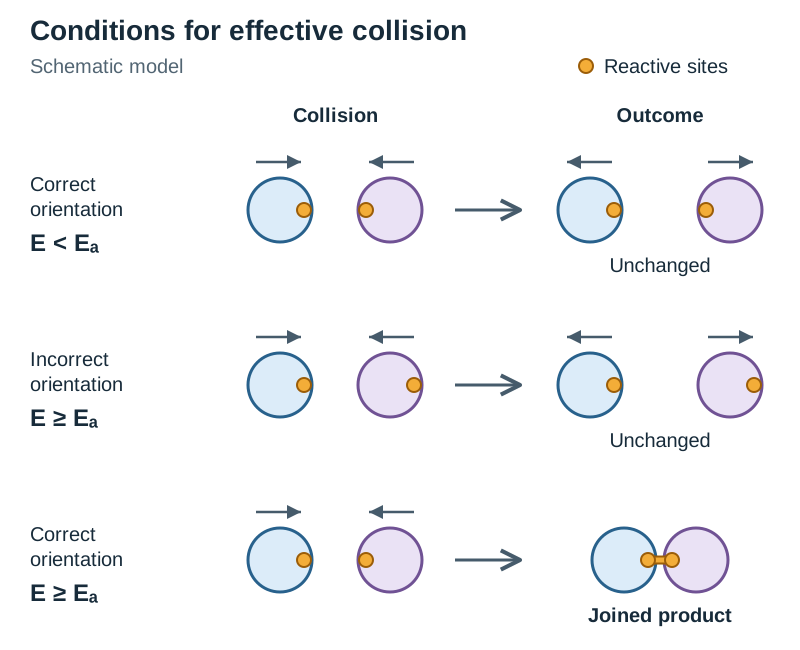
Collision theory tells us that reactant particles must physically strike each other for a reaction to happen. Even so, most collisions in a container produce nothing; the particles bounce straight off each other without reacting. For a collision to actually make products (an effective collision), it has to meet two strict requirements:
- Activation energy (): The colliding particles must carry a minimum combined kinetic energy equal to or greater than the activation energy barrier. This provides the punch needed to break existing chemical bonds.
- Correct collision orientation: The particles must strike each other at the right angle so the reacting atoms come directly into contact.
Factors That Control Reaction Rates
- Concentration: Adding more dissolved particles into each cubic centimetre crowds them closer together. This produces more collisions every second, which leads to more effective collisions per second.
- Pressure (in gases): Compressing a gas into a smaller container increases the number of gas molecules per unit volume. Just like raising the concentration of a solution, this boosts the collision frequency and speeds up the reaction.
- Surface area (solids): In a solid lump, only particles on the outside can collide with attacking molecules. Breaking the solid into tiny chips or grinding it into a powder exposes vastly more atoms, driving up collision frequency. This explains why combustible dusts, like flour in a mill or coal dust in a mine, can ignite explosively if a spark appears in a confined space.
- Temperature: Heating a mixture makes particles move a little faster, which slightly raises how often they collide. But the main reason heating speeds up a reaction so dramatically is that a far greater fraction of particles now possess kinetic energy equal to or greater than the activation energy (). For many everyday reactions, raising the temperature by just roughly doubles the rate.
- Catalyst: Adding a catalyst creates a completely different reaction pathway that has a lower activation energy.
Syllabus Limitations of Collision Theory and Rate Models
Leaving Certificate Higher Level students must know the limitations of these simple models:
- Concentration does not always alter the rate: Many reactions take place through several consecutive steps. The overall reaction speed is dictated by the slowest step in that sequence, called the rate-determining step. If a reactant only joins in during a later, faster step, altering its concentration will not change the overall rate at all. Similarly, once every active site on a solid catalyst or enzyme is already busy (saturation), pouring in more reactant cannot speed things up.
- Orientation requirement: Even when particles collide with violent kinetic energy well above , they will simply bounce apart if their reactive bonds are pointing the wrong way.
- Catalyst poisoning: Certain unwanted substances bond permanently to the active sites on a solid catalyst (catalyst poisoning). This shuts out reactant molecules and permanently kills the catalyst's activity.
Comparing Energy Profiles: Catalysed and Uncatalysed Reactions
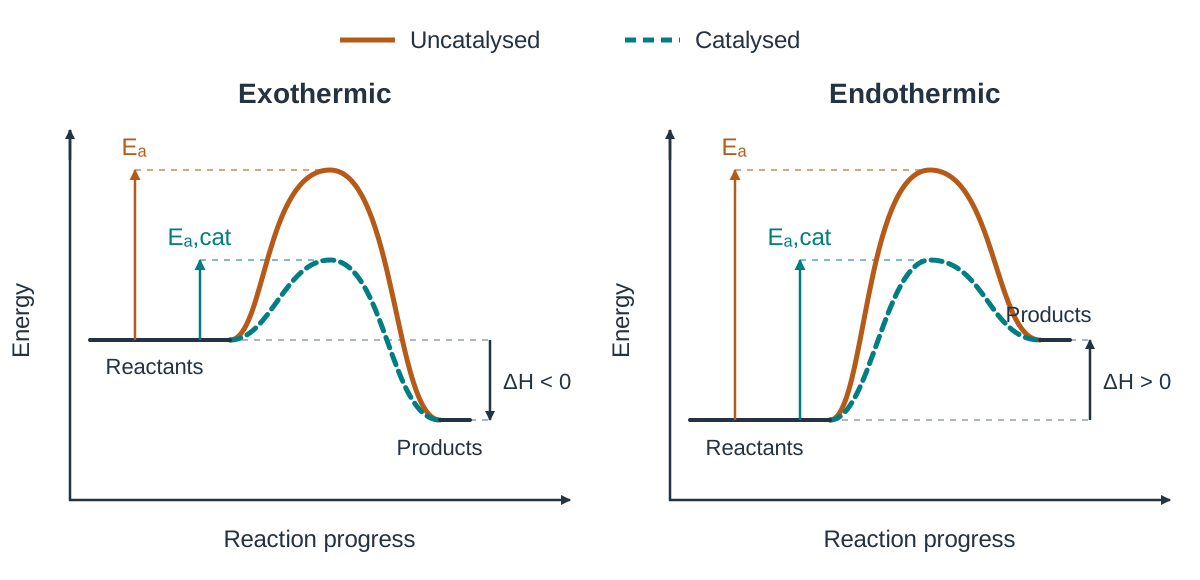
A catalyst is a substance that alters the rate of a chemical reaction without being consumed in the process. It works by opening an alternative pathway with a lower activation energy (). Because the catalyst is not used up, a tiny amount can convert huge quantities of reactant. Crucially, a catalyst does not alter the overall enthalpy change () of the reaction.
Rules for Sketching Energy Profile Diagrams
When sketching energy diagrams for exams:
- Put "Reaction progress" on the horizontal axis and "Energy" on the vertical axis.
- Draw flat horizontal lines for the reactant energy level and the product energy level.
- Draw a tall hump from the reactants to show the uncatalysed activation energy ().
- Draw a second, lower curve for the catalysed pathway () that starts at the exact same reactant line and lands on the exact same product line.
- Label as the vertical gap between the reactant and product levels. This gap must remain identical whether a catalyst is present or not.
Exothermic Reactions
In an exothermic reaction, the reactants sit on a higher energy shelf than the products. The curve climbs up to clear the activation energy barrier () and then drops down below the starting level. The difference between reactants and products is negative (). The catalysed curve follows the same start and finish levels, but passes over a noticeably lower peak.
Endothermic Reactions
In an endothermic reaction, reactants sit on a lower shelf than products because the system takes in heat from the surroundings (). The curve climbs over a high activation barrier before settling onto the higher product shelf. The catalysed pathway begins and ends at the identical plateaus, but clears a lower barrier.
Reactions with an Intermediate Compound
When a catalyst forms an intermediate compound, the single high energy peak is replaced by a two-humped curve. Each hump is lower than the original uncatalysed barrier, and between them sits a shallow dip that represents the temporary intermediate compound.
Catalytic Mechanisms: Homogeneous, Heterogeneous, and Biological
We divide catalysis into two main types based on whether the catalyst and reactants share the same physical state.
Homogeneous Catalysis and Intermediate Formation
In homogeneous catalysis, the catalyst and the reactants exist in the exact same physical phase, such as all being dissolved in water. The catalyst reacts chemically with one reactant to make an unstable intermediate compound. This intermediate then reacts with another substance to yield the products and regenerate the original catalyst.
An example is the decomposition of aqueous hydrogen peroxide using dissolved iodide ions () as a catalyst:
The iodate(I) ion () acts as the short-lived intermediate. Notice that iodide enters in step 1 and reappears unchanged in step 2.
A visual demonstration of this mechanism occurs when hydrogen peroxide oxidises potassium sodium tartrate in the presence of cobalt(II) chloride. The solution starts pink, turns dark green as an unstable intermediate complex forms, and then returns to its original pink colour once the reaction finishes and the cobalt(II) ions are regenerated.
Heterogeneous Catalysis and Surface Adsorption
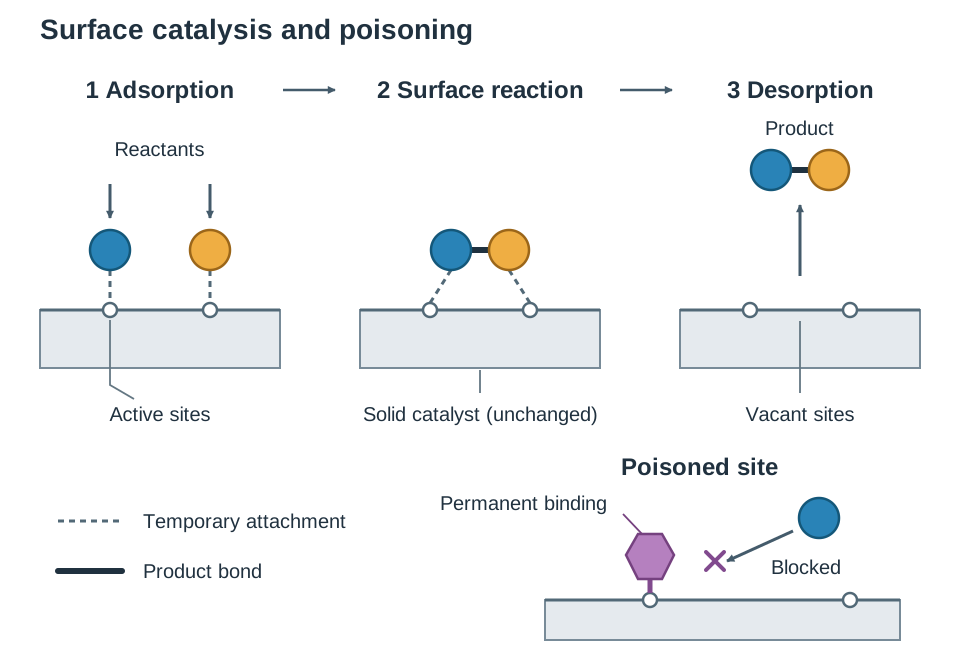
In heterogeneous catalysis, the catalyst and the reactants are in different phases. The most common setup involves gaseous reactants passing over a solid transition metal catalyst. The process takes place in three stages:
- Adsorption: Reactant molecules form temporary bonds onto active sites on the solid catalyst surface. This draws the molecules together, holds them in a favourable alignment, and stretches or weakens their internal bonds.
- Reaction on the surface: The weakened reactant molecules react with one another on the surface, clearing a much lower activation energy barrier than in the gas phase.
- Desorption: The new product molecules release their hold on the surface and diffuse away, freeing up the active sites for new reactant molecules.
Common practical examples include:
- Finely divided iron used in the Haber process to make ammonia:
- Vanadium(V) oxide () in the Contact process to produce sulfur trioxide:
- Platinum, palladium, and rhodium in motor vehicle catalytic converters:
Lead compounds from old leaded petrol bind permanently to platinum active sites, poisoning the catalyst converter and destroying its ability to clean exhaust fumes. That is why unleaded petrol is required by law.
Biological Catalysis: Enzymes
An enzyme is a biological catalyst made of protein. Each enzyme folds into a precise three-dimensional shape that features an active site tailor-made to fit one specific substrate molecule.
For example, catalase, found in liver and potato tissue, breaks down harmful hydrogen peroxide into water and oxygen. Dropping raw liver into hydrogen peroxide produces instant, violent foaming.
Enzymes differ from mineral catalysts in two critical ways:
- They have an optimum operating temperature, usually around in humans. Heating an enzyme above this temperature causes it to denature. Thermal vibrations shake the protein chain apart and warp the active site so the substrate no longer fits.
- They require a specific optimum pH. Shifting the pH alters charges on the amino acid chains, destroying the shape of the active site and halting catalysis.
Laboratory Investigations: Measuring and Tracking Reaction Rates
The Leaving Certificate specification highlights several practical investigations that let you generate primary data and follow reaction rates in the laboratory.
Decomposition of Hydrogen Peroxide
We can follow the breakdown of hydrogen peroxide by collecting oxygen gas over time:
Apparatus and Method:
- Pour of hydrogen peroxide into a conical flask and note its temperature.
- Weigh out of manganese(IV) oxide powder or granules.
- Add the solid to the flask, quickly push in the stopper connected to a gas syringe (or an inverted graduated cylinder filled with water), and start your stopwatch.
- Read the total volume of oxygen collected every 15 or 30 seconds until the gas volume stops increasing.
- Repeat the trial using of manganese(IV) oxide in a different particle size, keeping the volume, concentration, and starting temperature of the peroxide identical.
Observations and Sources of Error:
- The curve rises sharply at first and levels off to a horizontal plateau. The powdered catalyst gives a noticeably steeper initial slope than coarse granules because its larger surface area exposes more active sites. Both forms generate the exact same final volume of oxygen because the starting mass of peroxide is identical.
- A small burst of gas can escape during the delay between tipping in the powder and inserting the rubber bung. You can avoid this by suspending the solid in a tiny vial inside the flask on a thread and shaking it to start the reaction without opening the flask.
- Because this decomposition is exothermic, the flask warms up slightly, which can speed up the rate towards the middle of the run.
Sodium Thiosulfate and Hydrochloric Acid
To study how concentration affects speed, place the reaction flask over a paper card marked with a bold black cross. Add acid to the sodium thiosulfate solution, start the timer, and look straight down through the liquid until the precipitated sulfur obscures the cross completely. Because the flask dimensions and depth of solution remain fixed, a constant mass of sulfur is needed to obscure the cross each time. This means the reaction rate is proportional to .
Plotting against sodium thiosulfate concentration produces a straight line that passes through the origin. This proves that the rate of reaction is directly proportional to the concentration of sodium thiosulfate.
Safety reminder: Sulfur dioxide is a sharp, choking gas that can trigger asthma attacks. Keep the lab well ventilated, dispose of mixtures into a sodium carbonate stop-bath right away, and wear eye protection throughout.
Key terms
- Rate of reaction
- The change in concentration per unit time of any one reactant or product.
- Activation energy
- The minimum energy that colliding particles must have in order to react.
- Effective collision
- A collision between reactant particles that produces a chemical reaction, requiring energy equal to or greater than the activation energy and the correct collision orientation.
- Instantaneous rate
- The rate of reaction at one specific moment in time, determined from the slope of the tangent drawn to the curve at that time.
- Initial rate
- The rate at the very start of the reaction (t = 0 s), found from the slope of the tangent to the curve at the point where it meets the vertical axis.
- Average rate
- The total change in a measured quantity over a stated time interval divided by the elapsed time.
- Catalyst
- A substance that alters the rate of a chemical reaction without being consumed in the reaction.
- Homogeneous catalysis
- Catalysis in which the reactants and the catalyst are in the same physical phase.
- Heterogeneous catalysis
- Catalysis in which the reactants and the catalyst are in different physical phases.
- Adsorption
- The temporary binding of reactant molecules to active sites on the surface of a solid catalyst.
- Desorption
- The detachment of product molecules from active sites on a solid catalyst surface into the surrounding fluid phase.
- Catalyst poisoning
- The permanent binding of a foreign substance to the active sites of a catalyst, blocking reactants and destroying its catalytic activity.
- Enzyme
- A biological catalyst, composed of protein, that speeds up specific biochemical reactions in living cells.
- Rate-determining step
- The slowest step in a multi-step reaction mechanism that dictates the overall rate of the reaction.
Check yourself
Define rate of reaction.
The change in concentration per unit time of any one reactant or product.
What two conditions must be met for a collision to be an effective collision?
The colliding particles must have energy equal to or greater than the activation energy () and they must collide with the correct collision orientation.
Why does a 10 °C temperature increase roughly double the rate of many reactions, even though collision frequency rises by only a small percentage?
Raising the temperature significantly increases the fraction of colliding particles that possess kinetic energy equal to or greater than the activation energy ().
What is meant by the rate-determining step of a reaction?
The slowest step in a multi-step reaction mechanism, which governs the overall rate of the reaction.
Describe the three stages of the surface adsorption mechanism in heterogeneous catalysis.
1. Adsorption: Reactant molecules form temporary weak bonds to active sites on the catalyst surface, weakening their internal bonds. 2. Reaction on surface: Adjacent weakened molecules react with a lower activation energy. 3. Desorption: Product molecules detach from active sites and diffuse away.
Give one named example of an enzyme, identify the reaction it catalyses, and explain why heating it above 40 °C causes the reaction rate to fall.
Catalase catalyses the decomposition of hydrogen peroxide into water and oxygen. Heating it above its optimum temperature causes the protein to denature, permanently changing the shape of the active site so that the substrate no longer fits.