

Every adult has to decide where to put spare cash, when to borrow, and who to trust with their money. This topic provides the core questions to ask before making those decisions, along with the Irish and European rules designed to protect you. At Higher Level, making informed financial decisions requires matching choices to personal time horizons, risk tolerance, and capacity for loss. This note covers the differences between saving, investing, and borrowing; the mechanics and barriers to switching providers; how fintech is reshaping the provision of financial services; how credit histories are tracked on the Central Credit Register; the regulatory architecture of Ireland and the EU, including the dangers of under-regulation; practical fraud protection under FraudSMART; and the distinctions between Central Bank Digital Currencies (CBDCs), stablecoins, and crypto assets.
Saving, Investing, and Borrowing: Definitions and Core Products
Before comparing financial products, you need to understand which broad activity suits your needs.
Core Definitions and Named Irish Products
- Saving means putting money aside into a capital-secure account where the amount lodged is not at risk of capital loss, in return for a modest rate of interest. Typical Irish products include a commercial bank or credit union deposit account or regular saver account, a credit union share account, and State Savings products offered through An Post (such as Savings Certificates and Prize Bonds).
- Investing means using money to purchase an asset in the hope that it will generate income or grow in value over time, while accepting the risk that the capital invested can fall as well as rise. Common Irish products include ordinary shares in a public limited company (plc), corporate or government bonds, collective investment funds or Exchange Traded Funds (ETFs), investment property, and a pension fund.
- Borrowing means obtaining funds from an external lender now with a legal commitment to repay the principal alongside interest and charges over an agreed period. Irish credit options include a credit union loan, a bank personal loan, a residential mortgage, a credit card, an overdraft, hire purchase (HP), and Buy Now Pay Later (BNPL) arrangements.
A simple rule guides these choices: save for short-term, definite spending needs; invest for long-term wealth where you can ride out market falls; and borrow only when the immediate benefit of the purchase outweighs the total cost of credit.
Core Factors in Financial Decision-Making
Whether an individual is saving surplus earnings, deploying investment capital, or applying for credit, six fundamental factors must be evaluated.
The Six Factors
- Inflation: Inflation is the sustained increase in general price levels, eroding the purchasing power of money over time. If a deposit pays 1.5% interest while inflation runs at 3.5%, the real purchasing power of that money drops by roughly 2% each year. Returns must exceed inflation after tax to deliver genuine wealth creation.
- Interest Rates: The percentage reward earned on savings or the percentage charge paid on borrowings. High interest rates reward savers but increase monthly repayments on variable mortgages and commercial debt. Low rates make borrowing cheaper but depress deposit returns.
- Risk versus Return: Potential financial returns are directly linked to capital risk. Safe havens like government bonds or deposit accounts offer modest yields, whereas equities and commercial property offer higher upside alongside real risk of capital loss.
- Taxes and Charges: Deductions reduce net returns. In Ireland, deposit interest is subject to Deposit Interest Retention Tax (DIRT) at 33%, deducted at source. Profits realised on selling an investment are subject to Capital Gains Tax (CGT) at 33%, after an annual personal exemption on the first €1,270 of gains. Ongoing fund management charges, transaction fees, and broker commissions also eat into net yields.
- Time Horizon: Commitments divide into short term (under 1 year, demanding liquid, capital-secure accounts), medium term (1 to 5 years), and long term (over 5 years, allowing an investor time to recover from cyclical market downturns).
- Return on Investment (ROI): While return on investment for a company compares net profit with capital employed, personal ROI measures the net yield on your own money:
The Compounding Effect
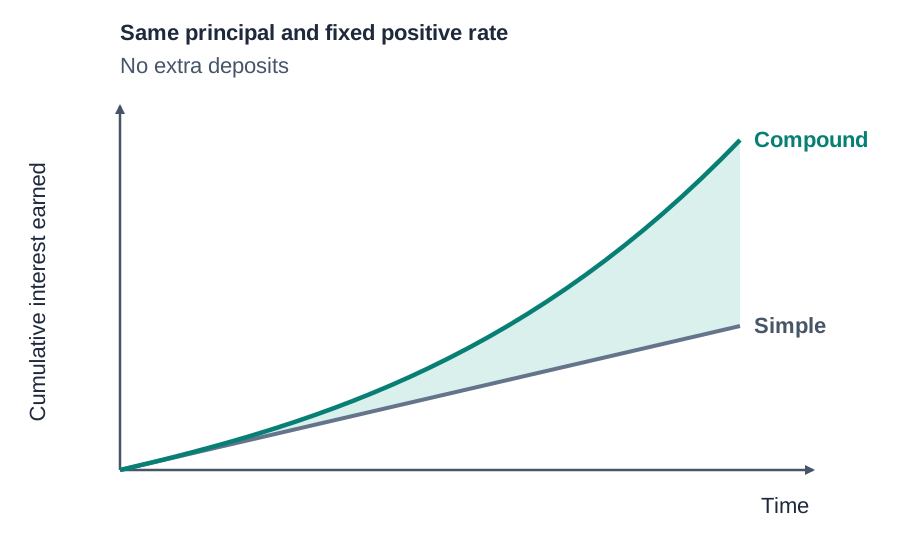
Compound interest means earning interest on your accumulated interest as well as your initial principal. For example, save €2,000 at 3% for three years and leave the interest in the account:
- Year 1: €2,000 × 1.03 = €2,060.00
- Year 2: €2,060 × 1.03 = €2,121.80
- Year 3: €2,121.80 × 1.03 = €2,185.45
Total interest earned is €185.45, compared to €180.00 under simple interest where interest is withdrawn each year. Over multi-decade horizons, such as inside a pension fund, compounding creates substantial growth.
Evaluating Credit: APR and Total Cost of Credit
When borrowing, looking only at the monthly repayment is misleading. The Annual Percentage Rate (APR) shows the complete annual cost of credit, combining interest rates and mandatory administration fees. Comparing the total cost of credit (the total sum repaid minus the original principal borrowed) prevents borrowers from falling for long loan terms that look affordable each month but carry high total interest.
- Loan A: €5,000 over 3 years at €155 monthly. Total repaid = 36 × €155 = €5,580. Cost of credit = €580.
- Loan B: €5,000 over 5 years at €105 monthly. Total repaid = 60 × €105 = €6,300. Cost of credit = €1,300.
Loan B appears €50 cheaper each month, but it costs €720 more in total interest.
Consumer Risk Management and Reliable Financial Sources
Managing financial exposure requires distinguishing between psychological comfort and objective reality.
Risk Tolerance versus Capacity for Loss
- Risk tolerance is a person's emotional and psychological willingness to endure uncertainty, volatility, and temporary paper losses without panicking.
- Capacity for loss is a person's objective financial ability to absorb capital losses without jeopardising essential living needs such as rent, utility bills, or debt repayments.
For example, an eighteen-year-old student might have high risk tolerance and wish to speculate on volatile cryptocurrency tokens, but their capacity for loss is practically zero if that money is needed to pay next month's student accommodation rent.
Identifying Consumer Risks
Consumers of financial products face several distinct types of risk. A useful memory aid is the acronym MICRO:
- Market Risk: Asset valuations collapse due to broader economic downturns or poor market sentiment.
- Inflation Risk: Cash returns fail to keep pace with the rising cost of living, eroding real purchasing power.
- Credit Risk: A commercial borrower, bond issuer, or financial institution defaults on its interest or principal obligations.
- Regulatory Risk: Changes in tax laws, pension rules, or government regulations reduce the net return or restrict access to a financial product.
- Operational Risk: Financial loss arising from technical errors, core banking outages, administrative mistakes, or external cyber fraud.
Consumers also encounter liquidity risk (being unable to sell an asset quickly for cash without accepting a substantial loss) and currency risk (foreign exchange fluctuations eroding the euro value of overseas investments).
Risk Management through Diversification
Diversification means spreading money across different asset classes (deposits, bonds, equities, property) as well as across different industries and geographical regions, so that a loss in one asset does not wipe out the entire fund. It is the practical expression of not putting all your eggs in one basket. A saver putting €20,000 entirely into one plc's shares takes on extreme company-specific risk; splitting that sum between a credit union deposit, State Savings, and a global index fund spreads the risk.
Judging Reliable Sources of Financial Information
Under learning outcome 4.2.2 and unifying research skills, consumers must evaluate the credibility of financial advice by applying four checks:
- Is the provider authorised? Check the Central Bank of Ireland's Register of Authorised Firms. Unregistered firms offer no access to state compensation funds or statutory dispute schemes.
- Is the source independent or sales-focused? An independent financial advisor looks across the wider market, whereas a tied agent is contracted to sell products from one specific institution. A commercial bank's marketing material explains its own products, but it is not impartial guidance.
- Is it a statutory or public-interest source? Reliable, free guidance in Ireland comes from the Competition and Consumer Protection Commission (CCPC) (offering independent product comparison tables), the Central Bank of Ireland, Revenue (taxation rules), the Pensions Authority, and the Money Advice and Budgeting Service (MABS) for individuals struggling with debt.
- Is the information current, and is anyone being paid to share it? Tax thresholds, DIRT rates, and mortgage lending criteria change. Social-media 'finfluencers' and unsolicited online promotions must be treated with caution, as they frequently involve paid sponsorships or unregulated schemes.
Switching Financial Providers and the Central Credit Register
Failing to review existing financial products costs consumers significant sums over time. Financial institutions frequently offer competitive introductory rates to attract new applicants while charging existing, disengaged customers higher discretionary margins.
Benefits of Switching
- Lower Borrowing Costs: Refinancing an existing mortgage or personal loan to a provider with a lower APR can yield substantial savings over a long repayment term.
- Higher Deposit Yields: Moving surplus cash from traditional clearing banks to competitive online platforms or credit unions secures better net interest rates.
- Reduced Administrative Costs: Moving current accounts can eliminate ongoing monthly maintenance fees and foreign exchange transaction charges.
Barriers to Switching
Switching is not always practical or cost-effective. Consumers must evaluate the barriers:
- Break fees / early redemption charges: Fixed-rate mortgages and fixed loans often penalise borrowers who exit before the term ends, potentially wiping out any interest rate benefit.
- Upfront professional costs: Switching a mortgage requires paying for independent property valuations, solicitor fees, and potential clawbacks of previously received cash-back promotions.
- Eligibility hurdles and negative equity: New lenders assess applicants afresh. A damaged credit record, reduced household income, or negative equity (owing more on a mortgage than the current market value of the property) will lead to refusal.
- Consumer inertia and administrative delays: Gathering documentation, payslips, and bank statements causes friction that prevents consumers from completing the process.
When switching a standard current account, consumers are supported by the Central Bank's switching code, which requires the old and new banks to transfer all direct debits and standing orders within a set timeframe.
The Central Credit Register (CCR)
A credit rating reflects a borrower's creditworthiness: the probability that they will repay debt on schedule. Under the Credit Reporting Act 2013, the Central Credit Register (CCR), owned and operated by the Central Bank of Ireland, compiles single credit records for individuals and businesses.
| Statutory Rule | CCR Requirement |
|---|---|
| Reporting Threshold | Lenders must submit monthly repayment data on all credit agreements of €500 or more (including credit cards, personal loans, mortgages, overdrafts, and hire purchase). |
| Mandatory Inquiry | Lenders must check the CCR before approving credit applications of €2,000 or more. |
| Data Retention | Loan records and repayment histories remain on the register for 5 years after the credit agreement is fully closed. |
The CCR does not issue a numerical credit score (such as a US FICO score), nor does it approve or decline loans. It simply supplies a factual statement of repayment behaviour. Each lender applies its own internal underwriting standards to decide whether to grant credit.
Consequences of a Poor Credit Rating
- Outright refusal of credit on future loan or mortgage applications.
- Higher interest rates, as lenders attach risk premiums to compensate for uncertainty.
- Demands for a guarantor or additional asset security before any facility is approved.
- Reduced credit limits or shorter repayment windows.
- Reliance on high-cost moneylenders, where legal APRs can significantly exceed credit union rates.
- Knock-on screening difficulties, such as failed credit checks for mobile phone contracts or private rental leases.
To rebuild a credit profile, an individual should clear arrears, ensure all future repayments are automated by direct debit, avoid multiple credit applications in short succession, keep credit card balances well below credit limits, and request a free personal CCR report from the Central Bank of Ireland to correct any factual errors.
Fintech: Impact on Provision, Benefits, and Challenges
Fintech (financial technology) refers to the integration of specialised software, cloud infrastructure, and mobile applications to deliver and automate financial services for consumers and enterprises. Alongside international digital banks like Revolut and N26, Ireland has produced globally significant fintech enterprises, such as the payments infrastructure firm Stripe (founded by Irish entrepreneurs), CurrencyFair, and Fire.com.
How Technology Has Changed the Provision of Financial Products
Technology has restructured the supply side of financial services:
- Shrinking physical branch networks: Traditional banks have closed rural and suburban branches and scaled back counter services because daily transactions have shifted to mobile apps. This reduces operating costs for providers but removes in-person customer service.
- Lower barrier to entry for app-only challenger firms: Neobanks operate without costly real estate or physical security networks, allowing them to enter markets rapidly and compete on international payment fees and foreign exchange margins.
- Automated underwriting and robo-advice: Algorithms assess credit applications and score risk in seconds rather than days. Robo-advisory platforms build investment portfolios through automated questionnaires, removing human financial advisors from basic retail products.
- Open banking infrastructure: EU regulations require banks to share consumer account data securely with authorised third-party providers (with customer consent), allowing budgeting apps to aggregate financial data from multiple institutions.
- Heightened operational vulnerabilities: Financial providers face new threats, including sophisticated ransomware attacks, cloud system outages, and compliance obligations under data protection and digital resilience laws.
Benefits of Fintech for Consumers
- 24/7 Accessibility: Account holders can check balances, freeze lost cards, and transfer funds instantly at any time without visiting a physical branch.
- Lower Transaction Fees: Digital competitors often remove standard account maintenance fees and offer cheaper foreign exchange rates for overseas travel.
- Improved Financial Tracking: Mobile applications automatically categorise consumer outgoings into categories like groceries, utilities, and entertainment, improving personal budgeting.
- Streamlined Onboarding: Account setup takes minutes using smartphone cameras for passport verification and facial biometrics, improving access for younger or mobile populations.
- Convenient Payment Integration: Mobile wallets like Apple Pay and Google Pay allow contactless smartphone payments without needing physical plastic cards.
Challenges of Fintech for Consumers
- Risk of Digital Exclusion: Cashless platforms and app-only models disadvantage individuals who lack smartphones, reliable rural broadband, or digital literacy skills.
- Automated Customer Support: When fraudulent transactions occur or accounts are mistakenly frozen by anti-money-laundering algorithms, resolving the issue via automated chatbots without human staff can prove slow and frustrating.
- Impulse Spending and Overborrowing: Frictionless payment journeys and embedded Buy Now Pay Later (BNPL) plugins encourage spontaneous overspending among younger demographics.
- Cybersecurity and Data Privacy Risks: Digital finance accounts face constant threats from credential phishing, malware, and data breaches.
- System Outages: Unexpected app downtime leaves users temporarily unable to purchase everyday necessities or access savings.
Financial Regulation in Ireland and the EU
Financial regulation establishes the statutory operating framework, supervisory rules, and consumer protections necessary to maintain economic stability.
Regulatory Bodies in Ireland and the EU
For exam answers, focus primarily on the Central Bank of Ireland and the CCPC domestically, and the European Central Bank (ECB) across the eurozone, with the European supervisory authorities providing supporting context:
- Central Bank of Ireland: Regulates, licenses, and supervises credit institutions, credit unions, insurance businesses, and investment firms in Ireland. It enforces the statutory Consumer Protection Code (which governs how firms must treat customers), sets statutory mortgage measures (lending limits), and ensures firms hold adequate capital reserves.
- Competition and Consumer Protection Commission (CCPC): Promotes market competition and provides independent financial information, price comparisons, and educational tools to consumers.
- European Central Bank (ECB): Sets monetary policy and official interest rates for the eurozone, while directly supervising significant commercial banks through the Single Supervisory Mechanism (SSM).
- European Banking Authority (EBA): Establishes the single rulebook for commercial banks across the EU and oversees regular stress-testing of banking balance sheets.
- European Securities and Markets Authority (ESMA): Promotes orderly securities markets, regulates credit rating agencies, and enforces transparency rules for retail investment products.
- European Insurance and Occupational Pensions Authority (EIOPA): Oversees EU insurance markets and occupational pension funds to protect policyholders and pension contributors.
Statutory Compensation Schemes
- Deposit Guarantee Scheme (DGS): Administered by the Central Bank of Ireland, it protects qualifying retail deposits up to €100,000 per depositor per credit institution in the event of bank, building society, or credit union insolvency.
- Investor Compensation Scheme (ICS): Compensates retail clients for 90% of lost funds, up to a maximum payout of €20,000, if an authorised investment firm becomes insolvent or commits fraud. Crucially, the ICS never covers losses caused by ordinary market price movements.
Resolving Disputes: The Statutory Complaints Route
When a consumer is treated unfairly by a financial institution, a specific escalation path must be followed:
- Submit a formal complaint to the financial provider first. Under the Central Bank's Consumer Protection Code, regulated firms are legally obliged to investigate complaints, adhere to strict communication timelines, and issue a written final response.
- Escalate to the Financial Services and Pensions Ombudsman (FSPO). If the dispute is not resolved satisfactorily, the consumer can bring their case to the FSPO. The FSPO is a statutory, independent, and free body with legal powers to investigate complaints against banks, insurers, credit unions, and pension providers. It can direct a firm to correct errors and award binding financial compensation.
- The role of the Central Bank: Note that while the Central Bank of Ireland supervises firms and imposes structural fines, it does not investigate or adjudicate individual consumer disputes; that function rests entirely with the FSPO.
Consequences of Under-Regulation
Under-regulation occurs when rules are too weak, poorly designed, or inadequately enforced. A balanced evaluation should consider its serious fallout:
- Widespread Product Mis-selling: Unchecked institutions push inappropriate products on consumers, such as inappropriately shifting customers off tracker mortgages or mis-selling Payment Protection Insurance (PPI).
- Excessive Risk-Taking by Lenders: Without statutory caps on lending, commercial banks compete recklessly for market share by relaxing underwriting standards, fuelling unsustainable asset and property bubbles.
- Bank Failures and Taxpayer Bailouts: Insolvent institutions collapse, forcing state interventions. The Irish banking collapse after 2008 required billions in taxpayer bailouts, resulting in deep austerity, reduced public services, and prolonged national debt.
- Direct Consumer Losses: Depositors and retail investors face total loss of capital without functioning compensation frameworks or legal avenues for redress.
- Systemic Loss of Confidence: When trust breaks down, depositors withdraw cash and investors hold back capital. This credit freeze starves businesses of working capital and slows the wider economy.
- Predatory Practices and Fraud: Weak oversight allows unlicensed moneylenders, fraudulent investment syndicates, and unregulated crypto platforms to exploit retail consumers without threat of prosecution.
Evaluative judgement: While regulatory compliance imposes real costs on firms and can make credit harder to access, the evidence from the 2008 banking crisis demonstrates that the economic and human costs of under-regulation are far more severe.
Managing Risk Across Four Syllabus-Prescribed Products
The specification explicitly identifies four product categories where consumers must actively manage their financial risk.
1. Pensions
- Associated Risks: Underfunding contributions; fund management fees eroding capital; inflation diminishing future purchasing power; sharp market declines immediately prior to planned retirement.
- Risk Management: Begin regular contributions early to exploit compounding; monitor annual management charges (AMCs); use diversification across mixed asset funds; and gradually transition from volatile equities into government bonds and cash as retirement nears.
2. Mortgages
- Associated Risks: Sudden interest rate hikes on variable-rate loans; household income shocks caused by illness or redundancy; and falling property values leading to negative equity.
- Risk Management: Comply with the Central Bank of Ireland's mortgage measures (lending limits). Under these statutory rules, a first-time buyer may generally borrow up to 4 times gross annual income, whereas a second or subsequent buyer is restricted to 3.5 times gross income. Both categories generally require a minimum cash deposit of 10% of the purchase price (though lenders hold limited discretion for annual exemptions). Borrowers should stress-test repayments against potential interest rate increases, weigh fixed-rate contracts for budgetary certainty, and secure mandatory mortgage protection life insurance.
3. Credit-Based Products (Credit Cards, Overdrafts, and BNPL)
- Associated Risks: Compounding APR charges; penalty fees on missed payments; and falling into persistent debt by paying only minimum required balances.
- Risk Management: Clear the full credit card balance each month within the interest-free grace window; treat overdrafts as short-term emergency facilities rather than ongoing income; avoid using credit facilities to fund recurring household groceries; and review transparent APR comparisons on the CCPC website.
4. Crypto-Finance
- Associated Risks: Extreme market price volatility; unbacked assets; hacking of private digital keys; collapse of unregulated trading platforms; and absence of statutory deposit insurance.
- Risk Management: Commit only disposable capital that the individual can afford to lose entirely; trade exclusively through platforms authorised under the EU's Markets in Crypto-Assets (MiCA) regulation; use secure offline hardware wallets; and reject any scheme advertising guaranteed double-digit yields.
Protecting Yourself from Financial Fraud
Financial fraud relies on social engineering, deception, and manufactured panic to manipulate consumers into transferring funds or releasing security credentials.
Common Fraud Types
- Phishing, Smishing, and Vishing: Deceptive emails (phishing), text messages (smishing), or phone calls (vishing) impersonating banks, postal carriers, or state bodies like Revenue. They demand urgent intervention to verify an account or reroute a parcel, steering victims to bogus websites designed to steal login credentials.
- Identity Theft: Illegally acquiring an individual's personal data (such as PPS numbers, dates of birth, and utility bills) to take out bank loans, secure credit cards, or order goods under their name.
- Investment Fraud: Bogus investment schemes promising guaranteed, high-yield returns, often featuring fake celebrity endorsements and professional-looking digital trading dashboards.
- Invoice Redirection Fraud: Criminals hack commercial email systems to alter the recipient IBAN details on pending invoices, causing payments to be wired straight into fraud accounts.
- Money Mule Operations: Criminal gangs recruit individuals, frequently targeting second- and third-level students, to receive illicit funds into their personal bank accounts and quickly withdraw or transfer them for a cash commission.
Acting as a money mule is a serious criminal offence under the Criminal Justice (Money Laundering and Terrorist Financing) Act 2010. A conviction can result in a criminal record, custodial prison sentences, immediate closure of bank accounts, and severe long-term difficulties in ever securing a bank account, car loan, student finance, or mortgage.
Prevention: FraudSMART Guidance
FraudSMART, the national fraud-awareness campaign run by the Banking & Payments Federation Ireland (BPFI), advises consumers to Stop, Think, Check. The Central Bank of Ireland and the CCPC also publish their own fraud warnings and consumer guidance:
- Stop: Pause before responding. Do not react to false deadlines or threats of account suspension. Legitimate banks and state agencies never demand immediate funds transfers or password disclosures.
- Think: Evaluate the contact. Look out for generic greetings, unusual email domains, awkward phrasing, and unexpected requests for one-time passcodes (OTPs).
- Check: Verify the communication independently. Phone the institution directly using the telephone number printed on the back of your official debit card or listed on an authentic paper statement. Check whether investment firms appear on the Central Bank's Register of Authorised Firms.
If you suspect fraud, phone your bank immediately using the number on the back of your card, request that all compromised cards and apps be cancelled, report the incident to your local Garda station, and notify your mobile network operator if a smishing attempt is involved.
Central Bank Digital Currencies (CBDCs), Stablecoins, and Crypto Assets
The digitisation of money has created three distinct classes of digital assets that must not be confused.
| Feature | Central Bank Digital Currency (CBDC) | Stablecoin | Crypto Asset (e.g. Bitcoin) |
|---|---|---|---|
| Issued By | A sovereign central bank (e.g. the European Central Bank designing a digital euro). | A private commercial firm or consortium. | No issuing body; governed by decentralised blockchain protocols. |
| Legal Tender | Designed to serve as official legal tender, alongside cash. | No legal tender status. | No legal tender status. |
| Stability | Guaranteed parity with physical cash (€1 digital euro = €1 cash). Completely stable. | Pegged to a sovereign currency (e.g. US Dollar) or commodity. | Highly volatile; pricing is driven entirely by speculative market trading. |
| Backing & Liability | Direct claim on the central bank balance sheet. | Reliability depends entirely on the private issuer's reserve assets and redemption credibility. | Unbacked; no single identifiable entity is liable for performance or capital return. |
Impact of a Digital Euro on Consumers
- Advantages: Offers a state-guaranteed, risk-free electronic equivalent to banknotes; ensures universal digital payment acceptance throughout the eurozone; promotes financial inclusion for unbanked individuals; and supports offline functionality for payments when internet or power networks fail.
- Disadvantages: Introduces privacy concerns regarding state visibility over personal spending habits; a limit on how much digital euro one person may hold is likely, to stop large sums being moved out of commercial bank deposits; and creates reliance on smartphones and digital devices to complete basic transactions.
Impact of a Digital Euro on Commercial Enterprises
- Advantages: Lowers merchant card-processing fees compared to private multinational credit card networks; provides instantaneous payment settlement, improving cash flow; and reduces the security risks and time spent counting cash associated with physical notes and coins.
- Disadvantages: Businesses face upfront investment costs for compatible Point-of-Sale (POS) card terminals, software updates, and employee training. Furthermore, if consumers shift personal savings out of commercial bank deposits into digital euros, commercial banks may face higher funding costs, potentially reducing the supply and raising the interest rates of business loans.
Analysing Financial News and Connecting to the Investigative Study (AAC)
Higher Level students must apply financial principles to news stories and media commentary. This analysis feeds into both the 60% written paper and the 40% Business Alive Investigative Study.
How the Paper Words It: Action Verbs Guide
Make sure your answer matches the specification's official glossary definitions:
- Outline: State the main points only, restricting details to essential facts.
- Explain: Give a detailed account, clearly setting out reasons, causes, or mechanics.
- Describe: Provide a detailed account of the main features using examples or diagrams.
- Examine: Look closely at arguments, data, or situations to uncover relationships, causes, and assumptions.
- Investigate: Carry out a systematic review of facts to establish evidence and reach supported conclusions.
- Discuss: Offer a considered, balanced review presenting a range of arguments supported by evidence.
- Evaluate: Examine the evidence, make a reasoned judgement, and explicitly highlight limitations.
Maintaining an Investigative Folder
Students should maintain an investigative folder across the two years of senior cycle, compiling media clippings, regulatory warnings from the Central Bank, ECB interest rate reports, and fintech news. This folder provides authentic primary and secondary source evidence that can be drawn on during the coursework brief.
Structured News Story Analysis
When examining a financial news item, follow four steps:
- Event Summary: Identify the core development (e.g. an ECB policy rate revision, a banking app outage, or new mortgage rule changes).
- Underlying Concept: Connect the news to core syllabus principles (such as real returns, total cost of credit, creditworthiness, or systemic under-regulation).
- Multi-Stakeholder Impact: Analyse how the event affects diverse groups: savers, mortgage borrowers, commercial enterprises, and the State.
- Supported Judgement: Reach a balanced conclusion on how the event influences personal financial strategy or commercial risk management.
Key terms
- Saving
- Putting money aside into a capital-secure account with no capital risk, earning a modest interest return.
- Investing
- Deploying capital into assets like shares, property, or funds hoping for income or growth, accepting that capital can fall as well as rise.
- Borrowing
- Obtaining money from an external lender with a legal obligation to repay the principal along with interest and charges over time.
- Annual Percentage Rate (APR)
- The total cost of credit expressed as an annual percentage of the loan balance, incorporating interest rates and mandatory fees.
- Total Cost of Credit
- The actual financial cost of a loan, calculated as the total sum repaid minus the original principal borrowed.
- Deposit Interest Retention Tax (DIRT)
- A statutory tax deducted at source by Irish financial institutions on savings interest earned, currently set at 33%.
- Risk Tolerance
- A consumer's emotional and psychological willingness to accept investment volatility and potential capital drops.
- Capacity for Loss
- A person's objective financial ability to absorb investment losses without compromising essential living needs or solvency.
- Diversification
- Spreading financial capital across different asset types, industries, and regions to reduce exposure to any single risk.
- Central Credit Register (CCR)
- The statutory Irish database operated by the Central Bank that logs loan agreements of €500 or more, retaining records for 5 years post-repayment.
- Negative Equity
- A situation where the outstanding loan balance on a mortgage exceeds the current open-market value of the property.
- Fintech
- The integration of software, mobile apps, and cloud technology to automate and deliver financial products and services.
- Central Bank Digital Currency (CBDC)
- An electronic form of central bank sovereign cash that gives consumers the option to use central bank money digitally, complementing banknotes and coins.
- Stablecoin
- A private digital token pegged to a sovereign currency or commodity whose stability depends on the private issuer's reserve assets.
- Crypto Asset
- A decentralised digital asset secured by cryptography that has no central bank backing and no single identifiable entity liable for its value.
- Consumer Protection Code
- A statutory set of binding rules enforced by the Central Bank of Ireland dictating how regulated financial firms must treat consumers.
- Deposit Guarantee Scheme (DGS)
- An Irish safety net protecting qualifying bank and credit union retail deposits up to €100,000 per person per institution.
- Investor Compensation Scheme (ICS)
- A scheme paying 90% of lost funds, up to €20,000, if an authorised investment firm becomes insolvent, but excluding normal market price drops.
- Financial Services and Pensions Ombudsman (FSPO)
- An independent statutory body that investigates and resolves individual consumer complaints against regulated financial and pension providers.
- Money Mule
- An individual who transfers illegally acquired money on behalf of others, an offence under the Criminal Justice (Money Laundering and Terrorist Financing) Act 2010.
Check yourself
What is the difference between risk tolerance and capacity for loss?
Risk tolerance is a person's psychological willingness to take investment risk and endure volatility, whereas capacity for loss is their objective financial ability to withstand capital losses without compromising basic living needs.
Under the Credit Reporting Act 2013, what is the reporting threshold for loans on the Central Credit Register, and when must lenders inspect it?
Lenders must report all credit agreements of €500 or more, and they are legally required to inspect the register before approving credit of €2,000 or more.
What protection is provided by the Irish Deposit Guarantee Scheme if an authorised bank fails?
It guarantees eligible retail bank and credit union deposits up to €100,000 per person per credit institution.
What is the advice promoted by the banking campaign FraudSMART?
Stop, Think, Check.
Under the Central Bank's mortgage measures, what are the standard loan-to-income borrowing limits for first-time buyers and second-time buyers?
First-time buyers can borrow up to 4 times gross annual income; second and subsequent buyers can borrow up to 3.5 times gross annual income.
What legislation makes acting as a money mule a criminal offence in Ireland?
The Criminal Justice (Money Laundering and Terrorist Financing) Act 2010.
State three potential consequences of under-regulation in the financial services industry.
Mis-selling of financial products to consumers, excessive risk-taking leading to bank failures and taxpayer bailouts, and direct loss of consumer savings without compensation.
Which independent statutory body investigates individual consumer complaints against banks and insurers after the firm's internal process has finished?
The Financial Services and Pensions Ombudsman (FSPO).