

Being an informed consumer requires knowing your statutory rights under Irish and European legislation, understanding your consumer responsibilities, and recognising how purchasing decisions ripple through the economy and the environment. This topic covers the core statutory protections established by the Consumer Rights Act 2022, the Consumer Protection Act 2007, and the General Data Protection Regulation (GDPR). It explores legal remedies for faulty goods, services, and digital content, cross-border shopping protections, consumer responsibilities, the circular and shadow economies, the disruptive positive and negative impacts of digital technology on consumer behaviour, and practical dispute resolution routes including the Small Claims Procedure.
Statutory Consumer Rights: Consumer Rights Act 2022
A consumer is an individual buying goods, services, or digital content mainly for personal use rather than for a trade, business, or profession. When buying from a commercial trader, the Consumer Rights Act 2022 automatically writes mandatory statutory conditions into the contract of sale. A trader cannot exclude or limit these terms through small print or store notices.
Core Rights Regarding Goods
Goods sold to consumers must meet four essential legal standards:
- Satisfactory quality: Goods must be of acceptable standard, usable, safe, and of a standard that a reasonable person would regard as satisfactory, taking into account the price, description, and nature of the product. In older law and business-to-business sales under the Sale of Goods and Supply of Services Act 1980, this was known as merchantable quality.
- Fit for purpose: Goods must carry out their ordinary everyday purpose, as well as any specific purpose the consumer made known to the seller before purchasing. For example, if a customer asks a retailer for paint suitable for exterior masonry, the supplied paint must withstand outdoor weather.
- Match the description: Goods must correspond to any description given in an advertisement, on the packaging, in a showroom sample, or by a sales assistant.
- Durability: Goods must remain functional and hold their quality over a reasonable period of normal use. A €1,000 television that breaks down under normal use after six months breaches this statutory requirement.
Rights Regarding Services and Digital Content
- Services: A service provider must possess the necessary skill, deliver the service with reasonable care and diligence, ensure materials used are of satisfactory quality, and complete the work within an agreed or reasonable timeframe at a fair or agreed price.
- Digital content and digital services: Downloaded or streamed items (such as computer software, mobile apps, video games, streaming media, and cloud storage) must match their description, be fit for purpose, and receive necessary software and security updates to keep them functioning.
Unfair Terms in Consumer Contracts
Under the Consumer Rights Act 2022, terms in a consumer contract must be clear, transparent, and written in plain language. An unfair contract term is any clause that causes a significant imbalance in the rights and obligations of the parties to the detriment of the consumer. Any term attempting to exclude statutory consumer remedies for faulty goods is blacklisted and legally void. For instance, a contract stating 'fees are non-refundable under any circumstances' is unenforceable.
Consumer Responsibilities
Statutory rights work alongside clear responsibilities. An informed consumer must:
- Inspect goods prior to purchase where practicable.
- Read user instructions, care guidelines, and safety warnings.
- Use products correctly and avoid damage caused by personal misuse.
- Retain proof of purchase, such as a paper till receipt, electronic invoice, or bank statement.
- Report a fault to the shop as soon as you notice it. Continuing to use a faulty item or delaying for months weakens a claim.
When There Is No Right to Redress
A consumer has no legal claim under consumer legislation when:
- They simply change their mind about an item bought in a physical shop.
- They caused the fault through accidental damage, neglect, or failing to follow instructions.
- The fault was pointed out before purchase (such as a jacket marked 'reduced: missing button').
- An examination before purchase ought to have revealed an obvious defect.
- The purchase was made for commercial or business use.
Buying from a Private Seller
Consumer legislation protects transactions between a consumer and a commercial trader. When buying from another private individual (such as through an online classified ad or a car bought from a neighbour), statutory consumer rights do not apply. The transaction is governed by the legal principle of caveat emptor ('let the buyer beware'). The buyer must inspect the goods carefully, because their only protection is that the item must match any specific factual description given by the seller.
Remedies and the Hierarchy of Redress
When a purchase breaches statutory standards, the consumer is entitled to legal redress. This remedy must be provided by the retailer who sold the item, because the contract of sale exists exclusively between the consumer and the retailer. The shop cannot tell the consumer to contact the manufacturer.
The Five-Step Goods Chain
To recall remedies easily, memorise this sequence: Fault inside 30 days → reject for full refund. After 30 days → repair or replacement first. Repair or replacement fails → price reduction or end contract. Up to 12 months → trader must prove fault was not present at delivery. Up to six years → consumer can sue for breach of contract.
Hierarchy of Redress for Faulty Goods
- Short-term right to cancel (first 30 days): If faulty goods fail any statutory standard within 30 days of delivery or possession, the consumer has the legal right to reject the item and obtain a full 100% refund. The retailer cannot force the customer to accept a repair or credit note.
- Repair or replacement (after 30 days): Outside the initial 30 days, the retailer can offer a repair or a replacement. This must be completed free of charge, within a reasonable time, and without significant inconvenience to the consumer. The consumer can express a preference, but the trader can choose the alternative if the preferred remedy is impossible or disproportionately expensive.
- Price reduction or final termination: If a repair or replacement is not completed within a reasonable time, causes major inconvenience, fails to resolve the fault, or is refused by the retailer, the consumer can demand a proportional price reduction or end the contract for a refund. After 30 days, immediate cancellation is not permitted for an entirely minor fault, such as a slight paint smudge.
Remedies for Services and Digital Content
For services and digital content, there is no 30-day right to reject. The initial remedy is requiring the trader to remedy the defect—re-performing the service with due skill or supplying an updated, working file—free of charge. If that fails or is refused, the consumer can seek a price reduction or end the contract.
Guarantee vs Statutory Rights
- A guarantee (or commercial warranty) is a voluntary promise, usually provided by a manufacturer, to repair or replace a product within a stated timeframe (such as one or two years).
- Statutory rights are legal protections granted by the Consumer Rights Act 2022. They are automatic, non-negotiable, and owed by the retailer.
- A guarantee is always in addition to statutory rights, never a substitute for them. When a guarantee expires, statutory rights continue under the six-year statute of limitations.
Cooling-Off, Cross-Border Shopping, and Resolving Disputes
Cancellation Rights (Cooling-Off Period)
A cooling-off period lets consumers cancel a contract without giving any reason. It applies to change-of-mind situations for remote purchases, not in-store transactions:
- Distance sales: Purchases completed online, over the phone, or via catalogue carry an automatic 14-day cooling-off period starting from the date the consumer receives the goods.
- Doorstep sales: Contracts signed during an uninvited visit by a trader to a consumer's home carry an extended 30-day cancellation period for contracts valued over €50.
- Exceptions: Custom-made or personalised items, perishable foods, unsealed audio/software recordings, and digital downloads once downloading has started with express agreement.
Buying Outside the EU
When an Irish consumer buys from a trader outside the EU (such as in Great Britain, the United States, or China), standard EU protections change:
- There is no automatic 14-day statutory cooling-off period.
- Irish import VAT applies regardless of parcel value, and customs duty applies to shipments valued over €150. Delivery couriers regularly charge handling fees.
- Returning faulty goods overseas can be very expensive, and enforcing statutory rights through foreign courts is practically impossible.
- If goods fail to arrive or are counterfeit, the consumer's best practical remedy is requesting a chargeback via their payment card provider.
Step-by-Step Dispute Resolution
- Direct written complaint: Contact the retailer in writing (letter or email) detailing the fault, enclosing proof of purchase, and stating the desired remedy with a reasonable deadline (e.g. 10 working days). A written record provides essential evidence if formal action becomes necessary.
- Sector-specific complaint bodies: For financial services, complain to the Financial Services and Pensions Ombudsman (FSPO). For telecoms and postal services, contact ComReg. For energy disputes, approach the Commission for Regulation of Utilities (CRU).
- European Consumer Centre (ECC) Ireland: Provides free cross-border advice and mediation when dealing with a trader based in another EU member state, Iceland, or Norway.
- Small Claims Procedure: An informal, inexpensive legal avenue operating within the District Court for consumer claims up to €2,000. The application costs a non-refundable €25 fee and does not require a solicitor.
- Competition and Consumer Protection Commission (CCPC): Ireland's statutory agency enforcing consumer and competition law. The CCPC inspects businesses, prosecutes unlawful trading, and publishes a Consumer Protection List naming non-compliant firms, but it does not resolve individual private compensation claims.
Commercial Practices and Consumer Protection Act 2007
The Consumer Protection Act 2007 outlaws unfair commercial practices that impair a consumer's ability to make an informed choice.
Prohibited Commercial Practices
- Misleading commercial practices: Giving false information or omitting material facts regarding product specifications, pricing, origin, or availability. For example, a retailer advertising a 'sale' price must ensure the item was genuinely sold at the higher previous price for a sustained period, rather than artificially inflating the price for a few days to advertise a fake markdown.
- Aggressive commercial practices: Using harassment, coercion, or undue influence to restrict a buyer's freedom of choice, such as taking advantage of an elderly consumer's vulnerability or refusing to leave a consumer's property.
- Banned practices: Commercial tactics illegal in all circumstances, including establishing pyramid schemes, advertising false health cures, demanding payment for unsolicited goods, and running competitions where the headline prize is not awarded.
Advertising Standards and Digital Marketing
The Advertising Standards Authority of Ireland (ASAI) regulates marketing communications across print, television, and online media. Under fair commercial practice rules, digital influencers and brands must clearly label sponsored content, paid collaborations, or gifted items using unambiguous identifiers such as #Ad or #Sponsored. Omitting these disclosures misleads consumers and breaches statutory standards.
Ethical Consumption, Circular Economy, and Shadow Economy
Every consumer euro spent creates environmental, social, and economic consequences.
Ethical and Green Choices in Practice
Consumers influence corporate behaviour by supporting ethical production standards:
- Buying certified goods: Choosing items carrying verified certifications, such as Fairtrade (guaranteeing fair prices and safe labour conditions without child labour), the EU Ecolabel, the EU energy label (rating home appliances from A to G), or Bord Bia's Origin Green for sustainably sourced Irish food.
- Buying local: Purchasing locally made products cuts down freight emissions ('food miles') and supports regional employment.
- Combating greenwashing: Greenwashing is the practice of making false, exaggerated, or unsubstantiated environmental claims to look eco-friendly. Consumers inspect third-party accreditations rather than vague marketing terms like 'all-natural'.
The Circular Economy
The official Leaving Certificate specification defines the circular economy as: "A model of production and consumption which extends the life cycle of products, reduces waste, and creates further value."
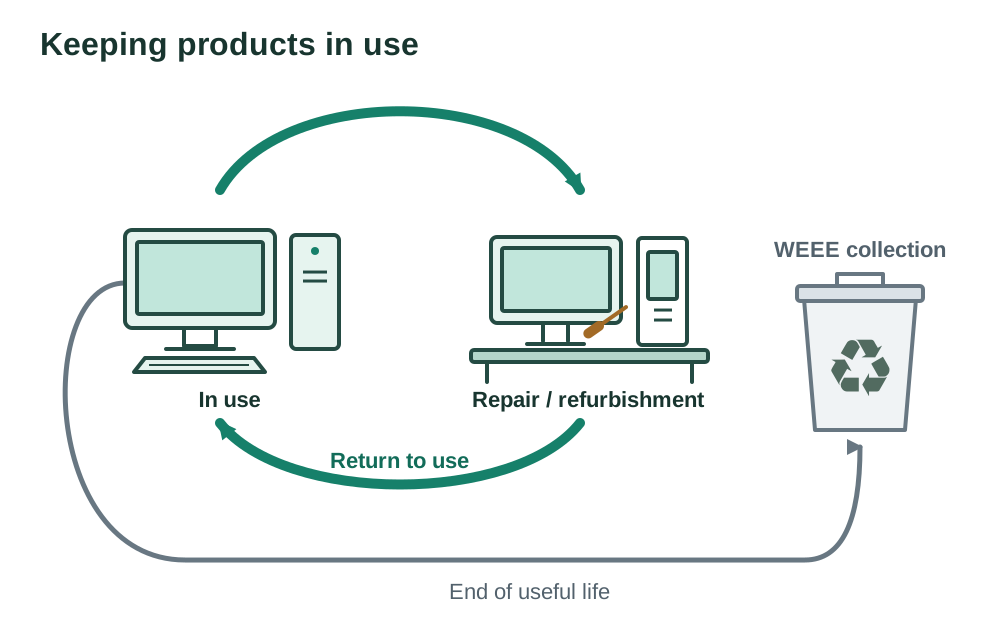
Consumers actively drive the circular economy through concrete actions across the product life cycle:
- Design and purchasing: Opting for durable, modular goods designed for repair over cheap single-use items.
- Maintenance and reuse: Using repair cafes, buying refurbished electronics, or renting clothes and tools via the sharing economy.
- End-of-life recovery: Returning drinks containers via Ireland's Re-turn deposit return scheme (where a deposit is refunded when cans and plastic bottles are returned to a reverse vending machine), bringing old appliances to WEEE recycling depots, and using textile collection points.
The Shadow Economy
The official Leaving Certificate specification defines the shadow economy as: "Business and economic transactions that are deemed illegal in a jurisdiction because the goods or services being traded or exchanged are unlawful or the transaction itself is not in line with legislation or government reporting requirements."
Everyday examples include paying tradespeople cash in hand without an invoice, purchasing counterfeit branded goods, or buying untaxed fuel and smuggled cigarettes.
Consequences Across Stakeholders
- For the consumer: Cash purchases leave no written receipt or contract, blocking access to the Small Claims Procedure if work is defective. Unregistered workers rarely hold public liability insurance, leaving homeowners liable if accidents occur, and counterfeit products often violate safety regulations.
- For the legitimate business: Tax-compliant firms face unfair price competition from rogue operators who evade taxes, PRSI, and safety standards, resulting in lost sales, squeezed profit margins, and job cuts.
- For the economy and workers: The State loses vital tax revenues needed to fund healthcare, education, and transport. Workers employed off the books build up no PRSI record, leaving them with no entitlement to sick pay, jobseeker benefits, or the State pension.
Digital Transformation and Consumer Behaviour
Advances in digital technology have completely disrupted how consumers evaluate, purchase, and interact with businesses.
Positive Impacts of Digital Technology
- Unrestricted access and wider choice: Consumers can purchase from global businesses 24 hours a day, overcoming local geographic boundaries.
- Rapid price comparison: Online comparison portals and apps allow consumers to evaluate utility tariffs, insurance premiums, and retail goods in seconds, promoting market competition.
- Pre-purchase research: Access to user reviews, product breakdown videos, and technical specifications allows buyers to assess quality prior to purchase.
- Convenience and lower pricing: Online retailers avoid physical storefront overheads, often passing cost savings directly to consumers through lower prices delivered to their doors.
- Streamlined dispute tracking: Complaints handled via customer portals or email create an immediate paper trail that can serve as formal evidence if a dispute escalates.
Negative Impacts of Digital Technology
- Targeted profiling: Algorithms track browsing history and search data to deliver personalised advertisements, encouraging impulsive and unneeded spending.
- Frictionless spending and debt: One-click purchasing and buy-now-pay-later schemes remove the immediate pain of paying, making it easier for vulnerable consumers to accumulate debt.
- Dark patterns and drip pricing: Websites use countdown timers to manufacture artificial urgency, pre-ticked add-on boxes, and 'drip pricing' (adding unexpected administrative or handling fees on the final payment screen).
- Fake reviews and bogus traders: Fabricated product reviews mislead shoppers, while fraudulent storefronts take money for items that never arrive.
- Digital exclusion: Consumers without high-speed internet, smartphones, or digital literacy—frequently older citizens—are excluded from web-only discounts and digital utility tariffs.
European Regulation and Data Protection (GDPR)
Personal data is protected across the European Union by the General Data Protection Regulation (GDPR). The GDPR is an EU Regulation, meaning it is directly applicable in every member state without needing domestic transposition. Ireland's Data Protection Act 2018 gives further effect to the Regulation in specific domestic areas and provides the statutory framework for the Data Protection Commission (DPC).
Key Roles Under Data Protection Legislation
- Data Subject: The living individual whose personal details are collected and processed (e.g. the customer).
- Data Controller: The enterprise or organisation that determines the purposes and methods for processing personal data (e.g. an online shopping website).
- Data Processor: A separate party processing data on behalf of and under the instructions of the controller (e.g. a cloud storage service or payroll contractor).
Core Data Protection Principles
- Lawfulness, fairness, and transparency: Personal details must be gathered honestly with clear, accessible privacy notices.
- Purpose limitation: Data collected for one explicit purpose (such as dispatching a parcel) cannot be repurposed for unrelated uses (such as selling to marketing brokers).
- Data minimisation: Traders must only request personal information strictly required to perform the service.
- Security and breach notification: Controllers must use strong technical safeguards. Any significant data breach posing a risk to individuals must be reported to the DPC within 72 hours of becoming aware of it.
Enforceable Rights of the Data Subject
Consumers have clear rights under GDPR:
- Right of access: Request a complete copy of all personal records held about them, which must be provided free within one calendar month.
- Right to rectification: Demand prompt correction of inaccurate or incomplete personal records.
- Right to erasure ('right to be forgotten'): Require a business to delete their records where there is no overriding legal reason to keep them.
- Right to object: Prevent the use of personal details for direct marketing and commercial profiling.
- Right to data portability: Obtain personal details in a structured, commonly used electronic format to transfer to a competitor.
Enforcement and Financial Penalties
The Data Protection Commission (DPC) investigates privacy complaints, conducts audits, and can impose administrative fines of up to €20 million or 4% of annual worldwide turnover, whichever is greater.
Analysing Consumer Stories in the News and Media
Your exam paper can present a short news story about consumers and ask you to evaluate it, and the same analytical skill is required when working on your Investigative Study. To structure your evaluation effectively, use this four-step framework:
- Identify the core consumer issue: Clarify whether the story relates to a breach of statutory rights, deceptive pricing, an ethical problem, cross-border delivery complications, data privacy violations, or shadow economy trading.
- Name the governing legislation and regulatory body: Cite the exact legal Act or watchdog (e.g. Consumer Rights Act 2022, Consumer Protection Act 2007, GDPR, CCPC, DPC, or FSPO).
- Assess the evidence and identify limitations: State whether the report relies on primary research (such as customer interviews) or secondary data (such as industry press releases). Look for potential bias, unrepresentative samples, or hidden commercial agendas.
- Deliver a reasoned evaluative judgement: State a clear conclusion on what actions consumers, businesses, or state authorities should take, outlining practical obstacles such as enforcement difficulties.
Key terms
- Consumer
- An individual who purchases goods, services, or digital content mainly for personal use rather than for a trade, business, or profession.
- Consumer Rights Act 2022
- The Irish legislation establishing statutory consumer rights and legal remedies for physical goods, digital content, and services, in effect from 29 November 2022.
- Satisfactory Quality
- A statutory standard under the Consumer Rights Act 2022 requiring goods to be of acceptable quality, safe, usable, and durable considering the price and description.
- Fit for Purpose
- The legal requirement that a product or service must perform its normal everyday function or any specific purpose explicitly communicated to the trader.
- Durability
- A statutory condition requiring that goods must maintain their required quality and functionality over a reasonable period of normal use.
- Short-Term Right to Cancel
- A statutory remedy allowing consumers to reject faulty goods within 30 days of delivery and receive a full 100% refund from the retailer.
- Caveat Emptor
- A common-law principle meaning 'let the buyer beware', which applies to private transactions where consumer statutory rights do not protect the buyer.
- Cooling-Off Period
- A statutory cancellation window permitting consumers to cancel distance contracts (14 days) or uninvited doorstep sales (30 days) without giving any reason.
- Consumer Protection Act 2007
- The Irish legislation prohibiting unfair, misleading, aggressive, and blacklisted commercial sales and advertising practices.
- Competition and Consumer Protection Commission (CCPC)
- The statutory body responsible for enforcing Irish consumer and competition law, informing consumers, and policing business compliance.
- Small Claims Procedure
- An accessible, informal legal route within the District Court that resolves consumer disputes up to €2,000 for a €25 application fee without requiring a solicitor.
- European Consumer Centre (ECC) Ireland
- The body providing Irish consumers with dispute resolution and mediation assistance when shopping with traders in the EU, Iceland, or Norway.
- Chargeback
- A payment reversal process initiated through a card provider to recover funds when a trader fails to supply goods, delivers faulty items, or commits fraud.
- Circular Economy
- A model of production and consumption which extends the life cycle of products, reduces waste, and creates further value.
- Shadow Economy
- Business and economic transactions that are deemed illegal in a jurisdiction because the goods or services being traded or exchanged are unlawful or the transaction itself is not in line with legislation or government reporting requirements.
- Greenwashing
- The practice of making exaggerated, deceptive, or unsubstantiated environmental claims about a company's products or business practices.
- General Data Protection Regulation (GDPR)
- The directly applicable EU Regulation that establishes uniform legal standards to protect personal data and grant privacy rights across all EU member states.
- Data Controller
- The organisation or business that decides why and how personal data will be collected, stored, and processed.
- Data Processor
- A third-party organisation that manages and processes personal data strictly following instructions given by a data controller.
- Data Protection Commission (DPC)
- Ireland's independent supervisory agency responsible for monitoring and enforcing data protection legislation and issuing administrative fines.
Check yourself
What are the financial claim threshold and application fee for the Irish Small Claims Procedure?
A maximum claim value of €2,000 and a non-refundable application fee of €25.
Under the Consumer Rights Act 2022, what remedy applies if a product develops a defect within the first 30 days?
The short-term right to cancel the contract and receive a full 100% refund.
What legal principle governs purchases made from private individuals, and what does it mean?
Caveat emptor, which means 'let the buyer beware'—the buyer has no statutory consumer rights and must inspect the goods carefully themselves.
Explain what is meant by the circular economy and give one example of how a consumer contributes to it.
It is a model of production and consumption which extends the life cycle of products, reduces waste, and creates further value; consumers contribute by returning plastic bottles and cans to reverse vending machines in the Re-turn deposit return scheme.
State one negative consequence of the shadow economy for legitimate businesses and one for the government.
Legitimate businesses face unfair price competition from tax-evading operators, while the government loses tax revenue needed to fund public services and infrastructure.
How does an EU Regulation such as GDPR differ in application from an EU Directive?
An EU Regulation takes direct legal effect in every member state immediately, whereas an EU Directive sets out objectives that each member state must pass into national legislation.
Which body regulates deceptive advertising and pricing, and which body regulates personal data breaches in Ireland?
The Competition and Consumer Protection Commission (CCPC) regulates deceptive commercial practices; the Data Protection Commission (DPC) regulates personal data privacy.