

How the Irish Government Fosters Enterprise
The Irish government cannot direct private commercial operations, but it creates a positive climate for business through financial, regulatory, and infrastructural supports.
Methods of Government Support
- Low taxation: Ireland maintains a competitive 12.5% corporation tax rate on trading profits, allowing firms to reinvest earnings into expansion. Start-up tax exemptions reduce initial tax burdens for new ventures. The Employment and Investment Incentive (EII) provides personal income-tax relief to investors funding small Irish companies, simplifying early-stage capital raising.
- State agency grants, mentoring, and advice:
- Local Enterprise Offices (LEOs): Located in every local authority area, LEOs act as first-stop shops for micro-enterprises (fewer than 10 employees). They provide Priming Grants, Business Expansion Grants, Trading Online Vouchers, mentoring, and "Start Your Own Business" courses.
- Enterprise Ireland: Backs Irish-owned manufacturing and internationally traded services firms (typically with 10 or more employees) aiming to scale and export. It provides Innovation Vouchers, funding under the High Potential Start-Up (HPSU) programme, and market intelligence through global overseas offices.
- Access to finance: Microfinance Ireland offers commercial loans to micro-enterprises unable to secure traditional bank funding. The Strategic Banking Corporation of Ireland (SBCI) works through commercial lenders to provide low-cost loans for working capital and green transitions.
- National infrastructure investment: Capital funding through the National Development Plan improves road networks, water facilities, and energy capacity. The National Broadband Plan delivers high-speed fibre broadband to regional and rural communities, enabling businesses outside major cities to conduct digital trade.
- Education and workforce training: Subsidised higher education provides a skilled pipeline of graduates in science, engineering, and digital business. State bodies like SOLAS, local Education and Training Boards (ETBs), and Skillnet Ireland design apprenticeships and upskilling courses tailored to private-sector skills requirements.
- Minimising administrative red tape: Digital compliance tools, including the CRO online portal (CORE) for annual corporate filings and the Revenue Commissioners' Revenue Online Service (ROS) for commercial tax returns, reduce administrative overheads for small firms.
Irish Government Policy and Business Lobbying
A government policy is a set of strategic objectives and agreed statements of guidance adopted by Cabinet as a basis for executive decision-making. In contrast, legislation consists of formal statutory Acts passed by the Oireachtas that are legally binding and enforceable in court.
When developing policy, the government normally identifies a problem, consults with industry stakeholders, agrees on an official strategy, implements supports or regulations, and evaluates outcomes.
Three Policies Across Distinct CSO Economic Sectors
- CSO Sector: Industry (Manufacturing) — White Paper on Enterprise Policy 2022–2030: Targets sustainable job growth, digital transformation, decarbonisation of manufacturing, and export diversification among indigenous firms. Enterprise Ireland delivers capital grants and digital advisory programmes under this policy.
- CSO Sector: Water Supply, Sewerage, and Waste Management — National Waste Policy 2020–2025: Establishes a circular economy model by setting targets to halve food waste by 2030, introducing deposit-return systems, and mandating eco-design. This policy pushes industrial packagers to reduce virgin plastics and rewards firms reusing production by-products.
- CSO Sector: Agriculture, Forestry, and Fishing — Food Vision 2030: Outlines a strategy for the agri-food industry to become a world leader in sustainable food systems. It focuses on reducing biogenic methane emissions, protecting biodiversity, and developing premium organic export markets.
How Businesses Influence National Policy
Businesses do not passively accept government decisions; they inform and influence policy development:
- Business interest groups:
- IBEC (Irish Business and Employers Confederation) is the primary representative body for large employers, lobbying ministers on commercial costs, taxation, and infrastructure.
- ISME (Irish Small and Medium Enterprises Association) and the SFA (Small Firms Association) advocate for independent small businesses.
- Chambers Ireland represents regional chambers of commerce, promoting local commercial infrastructure and town-centre vitality.
- The IFA (Irish Farmers' Association) represents commercial farming and agri-business interests.
- Pre-Budget submissions: Every summer, employer bodies submit proposals to the Department of Finance outlining tax adjustments, capital spending priorities, and payroll cost protections.
- Public consultations: Government departments publish draft policy papers and invite formal written submissions from enterprises and industry federations.
- Formal social dialogue: Bodies participate in state advisory structures such as the Labour Employer Economic Forum (LEEF) and the National Economic Dialogue.
- Lobbying and transparency: Under the Regulation of Lobbying Act 2015, businesses with more than 10 employees, representative and advocacy bodies, and professional lobbyists who lobby designated public officials (e.g. Ministers, TDs, senior civil servants) must register with the Standards in Public Office Commission (SIPO) and file returns three times a year on the public Register of Lobbying. This guarantees transparency regarding outside influence on legislative decisions.
The European Union: Legal Instruments and Business Impact
Ireland's membership of the European Union provides domestic firms with tariff-free access to a Single Market of approximately 450 million consumers, alongside the free movement of goods, services, capital, and labour.
Key EU Decision-Makers
- European Commission: The executive institution. It proposes new European legislation, oversees implementation, manages the EU budget, and ensures member states uphold European treaties.
- Council of the European Union: Composed of national ministers from each member state. It examines, amends, and adopts EU legislation alongside the European Parliament.
- European Parliament: Directly elected by EU citizens. MEPs debate, amend, and pass EU laws, share budgetary authority, and supervise the Commission.
- European Central Bank (ECB): Manages the monetary policy of the eurozone, setting benchmark interest rates to preserve price stability.
How Ireland Responds to EU Legal Instruments
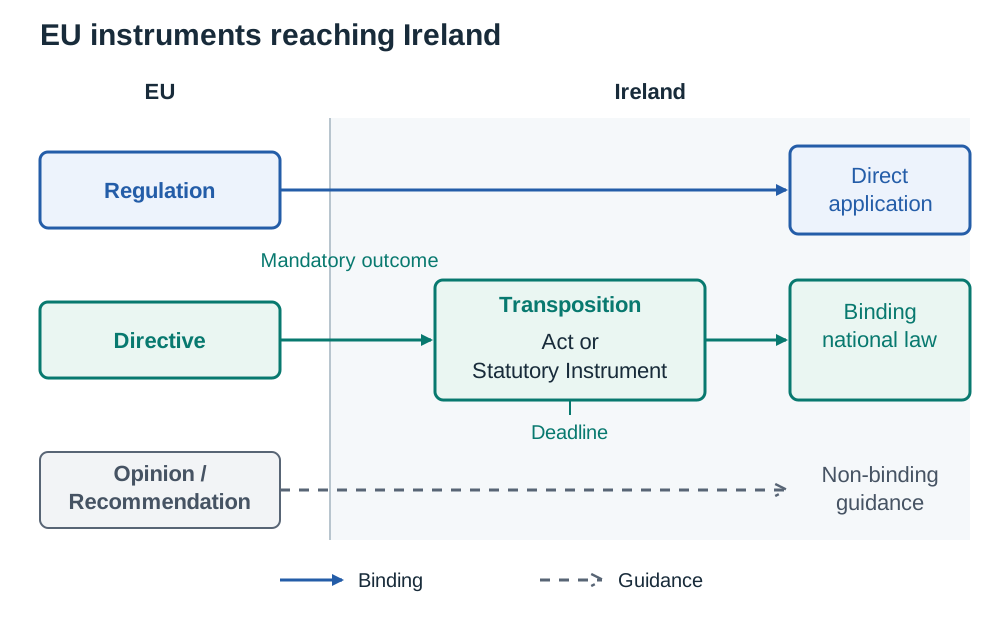
- EU Regulation: A legislative act that applies directly in full across all member states from its designated application date. The Oireachtas does not need to pass domestic transposing laws, and Irish law cannot contradict it. Ireland may introduce secondary legislation to assign local enforcement (e.g. appointing a supervisory authority).
- EU Directive: A legislative act that sets mandatory outcomes for all member states, but leaves the choice of form and method to national authorities. Ireland must transpose the directive into domestic law by passing an Act of the Oireachtas or a Statutory Instrument before a specified deadline. Failure to transpose in time results in European Commission infringement proceedings and potential fines from the Court of Justice of the European Union (CJEU).
- Opinion / Recommendation: Non-binding guidance that allows EU institutions to express a view. The Irish government may consider it, but faces no legal obligation to act.
Evaluating an EU Regulation: GDPR
General Data Protection Regulation (Regulation (EU) 2016/679)
- Purpose: To give EU citizens control over their personal data and harmonise data privacy laws across the Single Market.
- Implementation in Ireland: Enforced by the Data Protection Commission (DPC). Because major digital multinationals locate their European headquarters in Ireland, the DPC acts as the lead supervisory authority under GDPR's one-stop-shop mechanism for firms like Meta and Google.
- Positive effects: Increases customer trust when transacting online and establishes uniform data standards across Europe.
- Negative effects: Significant administrative compliance costs, including hiring Data Protection Officers and upgrading IT security, which disproportionately burden SMEs. Non-compliance risks fines up to €20 million or 4% of global annual turnover.
- Ethics and technology: Encourages ethical, transparent handling of customer data and pushes firms to invest in secure digital systems.
- Judgement: GDPR has delivered a net benefit to Irish enterprise. While initial compliance was expensive for small firms, strong regulatory trust underpins Ireland's digital export economy.
Evaluating an EU Directive: Work-Life Balance Directive
Work-Life Balance Directive (EU) 2019/1158
- Purpose: To increase labour-market participation among women, improve family-related leave, and facilitate flexible work arrangements.
- Implementation in Ireland: Transposed by the Oireachtas through the Work Life Balance and Miscellaneous Provisions Act 2023. It provides employees with statutory rights to request remote or flexible working and leave for medical care purposes, supported by a WRC Code of Practice.
- Positive effects: Enhances employee retention, boosts workforce wellbeing, and broadens talent recruitment in a tight labour market.
- Negative effects: Increases rota planning challenges and administrative overheads for small retail, hospitality, and manufacturing businesses that require on-site physical presence.
- Ethics and technology: Supports fair, family-friendly treatment of employees, and remote-working rights rely on digital collaboration tools.
- Judgement: Overall, the directive benefits the economy. In an environment of full employment, structured flexible working practices help firms attract and keep skilled workers without inflating basic pay rates.