

Every business depends on groups of people who also depend on it — owners, investors, staff, customers, suppliers, neighbours and the State. In this topic you will learn who they are and why they matter, how their needs change as a business grows, why they clash, how those clashes are prevented and settled in Ireland, and how a manager decides whose views to prioritise.
Stakeholder Roles: Internal vs External
A stakeholder is any individual, group, or organisation that has an interest in a business and is affected by its decisions, actions, and performance. In Senior Cycle Business, we classify stakeholders as internal or external based on their structural relationship to the organisation.
The Internal vs External Distinction
- Internal stakeholders operate directly within the business structure and take part in daily work or governance. They include business owners, managers, and employees.
- External stakeholders sit outside the firm's direct employment and governance structures, but they influence or feel the impact of its commercial activity. They include consumers, suppliers, government agencies, and the local community.
Where an investor fits depends on whether they provide equity or debt capital. A shareholder holds an equity stake and voting rights, making them an internal stakeholder. A commercial bank provides loan capital from outside the business, making it an external financial stakeholder.
The Key Stakeholders in Business
The specification names seven groups you must be able to discuss — owners, investors, employees, consumers, suppliers, the local community, and government. This list is not closed: in a case study you can also identify managers, trade unions, lenders, interest groups, or competitors if the text supports it.
| Stakeholder | What They Contribute | What They Expect | Business Importance |
|---|---|---|---|
| Business owners and entrepreneurs | Risk capital, vision, strategic direction, and time. | Operating profit, long-term capital growth, and managerial control. | Without their personal and financial risk-taking, the enterprise cannot exist. |
| Investors (shareholders and lenders) | Equity funding, commercial loan capital, and specialist guidance. | Dividends, capital appreciation, prompt loan interest, and debt repayment. | Provide the vital capital needed to launch, scale, or automate operations beyond retained earnings. |
| Employees and management | Labour, technical skills, operational leadership, and innovation. | Fair wages, safe conditions, job security, and promotion paths. | High staff productivity and service quality directly dictate business efficiency and customer retention. |
| Consumers | Sales revenue, repeat custom, and product feedback. | High product quality, honest pricing, consumer safety, and after-sales care. | Consumers are the only source of sales revenue, and that revenue is what pays wages, suppliers and loans; without customer demand no business survives. |
| Suppliers | Raw materials, component parts, inventory, and trade credit. | Prompt invoice payment, regular orders, and fair contract terms. | High-quality, punctual component deliveries keep factory lines running and prevent stockouts. |
| Local community | Local labour pool, commercial goodwill, and neighbourly support. | Local employment, civic sponsorship, and minimal noise, traffic, or pollution. | Community goodwill smooths planning applications and strengthens brand loyalty. |
| Government and State agencies | Transport infrastructure, enterprise grants, and legal protection. | Compliance with Irish law, timely payment of taxes (VAT, Corporation Tax), and job creation. | Sets the statutory operating environment; regulators can halt non-compliant operations. |
Who Speaks for Stakeholders: Representative Bodies
Stakeholders rarely negotiate alone. They often organise into representative bodies or interest groups, which significantly increases their bargaining power.
Key Employee and Employer Bodies
- Trade union: An organisation that represents employees collectively in negotiations on pay, conditions, and job security. A prominent Irish example is SIPTU (Services, Industrial, Professional and Technical Union).
- Shop steward: An employee elected by fellow trade union members in a workplace to represent them in day-to-day dealings with management, serving as the usual first point of contact in a dispute.
- ICTU (Irish Congress of Trade Unions): The single umbrella body for trade unions in Ireland, representing workers' interests at national policy and tripartite level.
- IBEC (Irish Business and Employers Confederation): The national umbrella body representing employers and business interests across all sectors in Ireland.
State, Consumer, and Regulatory Bodies
- CCPC (Competition and Consumer Protection Commission): The State agency that enforces consumer rights and competition law, ensuring open markets and investigating unfair practices.
- Revenue Commissioners: The State agency responsible for collecting taxes and duties (including VAT, PAYE, and Corporation Tax) with the authority to conduct compliance audits.
- EPA (Environmental Protection Agency): The statutory body that licenses, monitors, and inspects commercial activities to control emissions, waste management, and industrial pollution.
- Local Enterprise Office (LEO) and Enterprise Ireland: State development agencies providing grant funding, mentoring, and capability training to micro-enterprises and export-oriented firms respectively.
Always write the full title when introducing a body in an exam answer, followed by its abbreviation. Generic phrases like 'the union group' or 'the consumer watchdog' do not earn marks where an exact body is required.
Interdependence and the Business Lifecycle
Stakeholders do not work in isolation; they are bound together by interdependence. Interdependence occurs when one group becomes dependent on another for the supply of necessary goods and services, meaning neither can achieve its goals alone.
For example, Broderick's, a Dublin bakery, supplies its products to Aldi Ireland. Broderick's gains guaranteed sales volume and shelf space it could not reach alone, while Aldi gains a reliable supply of an Irish-made product it can promote to customers — a win-win.
Patterns of Stakeholder Interaction
- Cooperative relationship: Parties work collaboratively towards shared goals, creating a mutual win-win outcome. Both sides understand that cooperating increases the total value created.
- Competitive relationship: Stakeholders pursue opposing objectives or contest scarce resources, where one party's financial or operational gain directly imposes a disadvantage on the other (a win-lose outcome).
- Dynamic relationship: A relationship that shifts between cooperation and competition as commercial circumstances alter. A supermarket and a dairy processor may collaborate to develop low-carbon carton packaging, yet clash competitively over farm-gate milk prices when inflation rises.
Stakeholder Needs vs Wants Across the Lifecycle
A need is something a stakeholder must have for the relationship to survive; a want is something they desire and will push for when conditions allow. At start-up, an employee needs to be paid on time and have a safe workplace, but wants share options or bonus schemes. A supplier needs invoices settled within agreed credit windows, but wants exclusive long-term supply deals.
| Lifecycle Stage | What the Business Needs | What Employees Want | What Investors and Suppliers Want |
|---|---|---|---|
| Start-up stage | Seed capital, grant aid from LEO, committed staff, basic trade credit. | Job security, prompt payment of wages, clear initial employment contracts. | Investors want proof of concept and low burn rate; suppliers want cash on delivery (COD). |
| Growth stage | Bank expansion loans, skilled staff recruitment, volume raw materials. | Structured career paths, wage increases, training opportunities. | Investors want market share expansion; suppliers want accurate long-range order forecasts. |
| Maturity stage | Operational efficiency, brand defence, supply chain reliability. | Pay parity, corporate wellness programmes, flexible working arrangements. | Shareholders want steady dividends; suppliers want predictable, repeat bulk purchase contracts. |
| Decline or restructuring stage | Turnaround capital, cost reduction, debt rescheduling. | Job protection, redundancy packages above the statutory minimum, retraining support. | Lenders enforce debt covenants; suppliers shorten credit windows to protect cash flow. |
Corporate Social Responsibility to Stakeholders
Corporate social responsibility (CSR) means a business voluntarily going beyond its basic legal obligations to act ethically and sustainably towards the people, communities, and environments affected by its operations. In the Leaving Certificate syllabus, CSR reflects the cross-cutting lens of ethics and sustainability.
| Stakeholder | Social Responsibility Owed | What It Looks Like in Practice |
|---|---|---|
| Employees | Fair pay, safe working conditions, corporate wellness, and equal opportunities. | Paying the Living Wage, providing mental health supports, and respecting statutory breaks. |
| Consumers | Safe, high-quality goods, transparent pricing, and honest marketing. | Clear nutritional labelling, prompt recalls of faulty batches, and honest warranty terms. |
| Investors | Honest financial reporting, prudent capital management, and ethical oversight. | Presenting true and fair audited accounts without hidden off-balance-sheet debts. |
| Suppliers | Honouring agreed terms, fair commercial treatment, and prompt invoice settlement. | Settling 30-day invoices strictly on time instead of delaying payment to 90 days. |
| Local community | Minimising environmental disruption, civic investment, and local hiring. | Fitting air scrubbers to factory chimneys and sponsoring parish sports facilities. |
| Government | Strict compliance with statutory regulations and transparent tax returns. | Accurate, on-time declarations of VAT, PAYE and Corporation Tax, and not using aggressive tax avoidance schemes that are legal but shift profits away from the communities the business operates in. |
Acting with corporate social responsibility is not an unproductive overhead. It enhances enterprise reputation, attracts skilled applicants, builds customer loyalty, and reduces the risk of planning objections or regulatory fines.
Stakeholder Conflicts and Avoidance Strategies
Stakeholder conflict occurs when two or more groups pursue incompatible objectives. These disputes arise naturally because each group views commercial decisions through its own priorities.
Typical Stakeholder Clashes
- Owners vs Employees: Owners may want to limit payroll costs to maximise profit margins, whereas employees seek wage increases to protect purchasing power.
- Management vs Consumers: A manufacturer might alter product recipes or reduce product weight while keeping prices flat (shrinkflation), upsetting consumers seeking fair value.
- Firm vs Suppliers: A business might try to extend payment windows to 90 days to conserve operating cash, putting severe cash-flow pressure on suppliers who need payment within 30 days.
- Business vs Local Community: An enterprise might seek planning approval for night-time logistics operations, directly conflicting with residents demanding undisturbed sleep.
Strategies for Avoiding Conflict
- Early consultation: Talking to affected parties before taking formal steps. Discussing traffic plans with neighbours before submitting planning files lets management modify routes early.
- Detailed contracts and service level agreements: A service level agreement (SLA) sets out in writing exactly what is promised — delivery schedules, payment terms, quality tolerances, and returns procedures — removing ambiguity before it causes dispute.
- Worker participation: Giving staff a direct voice in workplace decisions. This can operate through a works council (an elected employee forum), regular quality circles, or employee representation on boards.
- Employee share ownership: Allowing staff to acquire shares aligns employee interests directly with owners, because company profitability directly increases employee wealth.
- Partnership approach: Industrial relations based on management and trade unions treating each other as problem-solving collaborators who consult continuously, rather than an adversarial approach where both sides only interact when a conflict flares up.
Resolving Conflict: Non-Legislative and Legislative Methods
Disputes are normally addressed first through informal, non-legislative options because they are faster, confidential, and protect ongoing goodwill. When informal options fail, parties turn to formal statutory mechanisms.
Non-legislative methods describe how a dispute is handled — voluntarily, without a court ruling. Some of these non-legislative methods are provided by a State agency: the Workplace Relations Commission, established under the Workplace Relations Act 2015, provides conciliation and mediation alongside its formal adjudication role. A dispute can therefore be resolved through a non-legislative method delivered by a statutory body.
| Method | Legal Status | How It Operates | Key Distinctive Feature |
|---|---|---|---|
| Negotiation | Non-legislative | Direct, structured dialogue between disputing parties to reach an agreed compromise. | No third party is present; concessions are traded directly (e.g. shop steward and HR manager). |
| Mediation | Non-legislative | An independent, neutral third party guides opposing sides to communicate and explore solutions. | The mediator does not propose terms or draft the settlement; the parties construct their own agreement. |
| Conciliation | Non-legislative | A neutral third party listens to both arguments, assesses claims, and prepares a formal recommendation. | The conciliator actively drafts a compromise proposal, but neither party is legally forced to accept it. |
| Arbitration | Voluntary, but the ruling binds if agreed in advance | An independent arbitrator evaluates evidence submitted by both sides and delivers a formal ruling. | The parties agree in advance whether the arbitrator's ruling will be legally binding or advisory. |
| Workplace Relations Commission (WRC) | Statutory body | Ireland's primary agency for workplace relations and employment disputes under the Workplace Relations Act 2015. | Offers free conciliation, mediation, and formal adjudication. Adjudication Officer decisions carry statutory legal force. |
| Labour Court | Statutory tribunal | Ireland's industrial relations court of last resort. | Hears appeals against WRC adjudication decisions, where it issues a binding determination enforceable in the District Court. In trade disputes under industrial relations law, it issues an industrial recommendation, which is not legally binding but holds strong moral authority. |
| Civil courts system | Judicial litigation | Formal adversarial litigation before a judge in the District, Circuit, or High Court. | The court issues a binding judgment that can be legally enforced, and it may order the losing side to pay the other side's legal costs. |
Stakeholder Mapping and the Power-Interest Grid
Stakeholder mapping involves considering the main stakeholders and their power and influence, while learning about the range of stakeholders and the need to consider a range of perspectives. It includes different stakeholders, their interdependencies and inter-relationships, and consideration of their power and influence on decision-making.
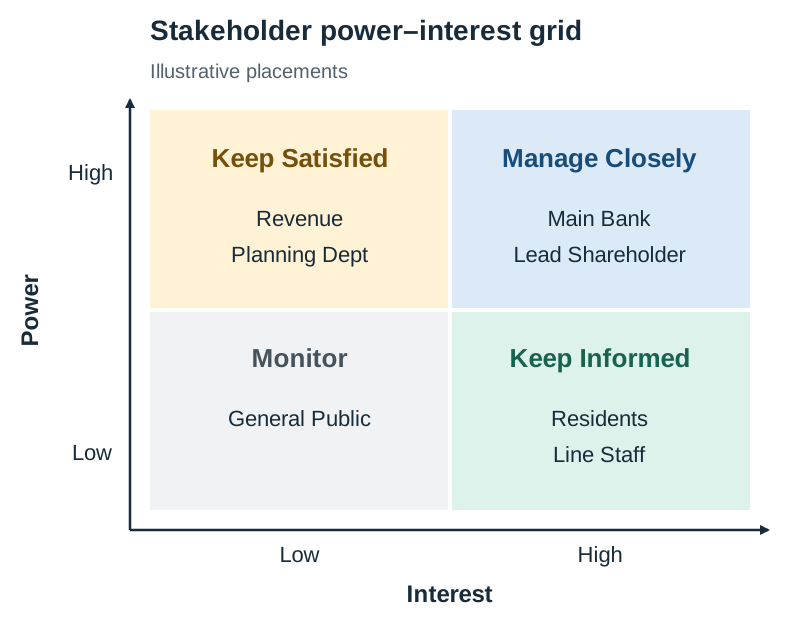
The power-interest grid is a form of stakeholder mapping which considers the motivations of stakeholders and their ability to exert influence (either positive or negative) thereby mapping them according to their relative power and interest.
The Four Management Quadrants
- Manage Closely (High Power, High Interest): Crucial decision-makers who can alter or halt a project. Engage with them continuously, consult them prior to key steps, and negotiate directly. Examples: Controlling shareholders, primary commercial lending banks, executive leadership.
- Keep Satisfied (High Power, Low Interest): Entities possessing the authority to halt commercial activity if dissatisfied, even if they show little interest in day-to-day operations. Ensure compliance with their regulations without overburdening them with detail. Examples: The Revenue Commissioners, the Environmental Protection Agency (EPA), local county planning authorities.
- Keep Informed (Low Power, High Interest): Groups significantly affected by decisions who lack direct executive control. Maintain transparent communication through newsletters, community briefings, and workplace intranet updates. Unconsulted groups here can quickly mobilise to gain power. Examples: Local residents' committees, factory-floor workers, local environmental associations.
- Monitor (Low Power, Low Interest): Parties with minimal leverage and limited interest in the project. Track them through standard communication channels to detect any change in attitude or interest. Examples: The wider public, casual website visitors.
Delivering a Complete Mapping Response
A comprehensive exam answer requires more than drawing four boxes. You must include:
- Interdependencies and inter-relationships: State how groups depend on each other and where alliances exist (for instance, local employees and community residents often overlap, linking pay and community goodwill).
- Motivations: Identify why the group cares (a bank cares about debt servicing; neighbours care about road safety and noise levels).
- Direction of influence: State whether the influence is positive (a State agency providing development grants) or negative (a local group submitting formal planning objections).
A map can be presented as a visual matrix diagram or as an analytical table covering stakeholder name, power level, interest level, motivation, and management strategy.
Digital Transformation and Media Engagement
Developments in technology and digital media have permanently altered the balance of stakeholder power, meaning a mapping completed years ago can quickly become obsolete.
How Digital Transformation Alters Stakeholder Power
- Consumers and local communities gain leverage: Online review platforms, viral social media posts, and crowdfunded planning appeals allow individuals with traditionally low power to organise rapidly. A poorly handled local grievance can quickly escalate into a national reputational issue.
- Employees and automation: The introduction of Artificial Intelligence (AI), automated logistics, and digital monitoring systems can trigger disputes over job security, worker surveillance, and deskilling. Proactive firms engage in collaborative retraining and consultation before deploying systems.
- Data integrity as a stakeholder issue: Holding employee and consumer data creates a legal and ethical duty under data protection legislation. Any breach destroys customer trust and invites heavy regulatory fines.
- Enhanced communication: Cloud-based supplier systems, shareholder portals, and internal collaboration apps reduce operational misunderstandings by making communication instant and verifiable.
Connecting Stakeholders to Current Media Stories
Learning outcome 6.1 requires you to apply your business understanding to current news items. Keep two or three real-world Irish business examples in mind where stakeholders have interacted:
- Planning and community: Objections lodged against industrial data centres or wind energy developments, where environmental groups and residents clash with tech multinationals and state grid operators.
- Industrial relations: Pay negotiations referred to the Workplace Relations Commission by public transport or healthcare unions seeking cost-of-living adjustments.
- Supply chains: Retail supermarket pricing disputes where agricultural bodies protest retail markups on beef or dairy goods.
Connection to the Business Alive Investigative Study
Stakeholder analysis is a fundamental skill in completing your Business Alive Investigative Study report. When formulating your research question, use a stakeholder map to identify which perspectives you must investigate (such as employers, front-line staff, consumers, or regulators). Pointing out in your final report which stakeholder viewpoints you were unable to gather demonstrates the critical awareness of study limitations that top-grade descriptors reward.
Key terms
- Stakeholder
- An individual, group, or organisation that has an interest in a business and is affected by its decisions, operations, and performance.
- Internal Stakeholder
- A party operating inside the business structure who directly takes part in its daily running or governance, such as owners, managers, and employees.
- External Stakeholder
- A party located outside the business who influences or is affected by its commercial activities, such as consumers, suppliers, lenders, government agencies, and the local community.
- Interdependence
- Arises when one group becomes dependent on another for the supply of necessary goods and services.
- Cooperative Relationship
- An interaction where stakeholders work collaboratively towards shared goals, creating a mutually beneficial win-win outcome.
- Competitive Relationship
- An interaction where stakeholders pursue conflicting objectives or contest scarce resources, resulting in a win-lose outcome.
- Dynamic Relationship
- A stakeholder relationship that changes over time, shifting between cooperation and competition as commercial conditions alter.
- Trade Union
- An organisation formed by workers to represent them collectively in negotiations with employers regarding pay, working conditions, and employment security.
- Shop Steward
- A workplace employee elected by fellow trade union members to act as their day-to-day union representative and initial point of contact with management.
- Corporate Social Responsibility
- The voluntary commitment of a business to operate in an ethical and sustainable manner, going beyond statutory obligations to protect employees, society, and the environment.
- Negotiation
- A direct, non-legislative dispute resolution method where disputing parties meet without third-party involvement to discuss terms and trade concessions until an agreement is reached.
- Mediation
- A non-legislative process where an independent third party facilitates constructive discussion between disputing sides to help them craft their own voluntary agreement, without recommending solutions.
- Conciliation
- A non-legislative process where an independent third party listens to both sides, explores common ground, and actively drafts a recommended settlement for the parties to consider.
- Arbitration
- A dispute resolution method where an independent third party investigates the case and issues a formal decision, which can be legally binding or advisory by prior agreement.
- Workplace Relations Commission
- The statutory body established under the Workplace Relations Act 2015 that provides conciliation, mediation, workplace advisory services, and formal adjudication for employment disputes in Ireland.
- Labour Court
- An independent statutory tribunal that hears appeals against WRC adjudication decisions (issuing binding determinations) and provides recommendations in trade disputes under industrial relations law.
- Stakeholder Mapping
- Considering the main stakeholders and their power and influence, while learning about the range of stakeholders and the need to consider a range of perspectives, including interdependencies and inter-relationships.
- Power-Interest Grid
- A form of stakeholder mapping which considers the motivations of stakeholders and their ability to exert influence (either positive or negative), mapping them according to their relative power and interest.
Check yourself
What is the primary difference between an internal and an external stakeholder?
Internal stakeholders operate directly within the firm's daily working and governance structures (owners, managers, employees), while external stakeholders sit outside the enterprise but influence or feel the impact of its choices (consumers, suppliers, banks, government).
Why is an equity shareholder classified as an internal stakeholder while a commercial lending bank is an external stakeholder?
An equity shareholder holds an ownership stake and voting rights within the company's governance structure, whereas a commercial bank provides loan capital from outside without taking ownership.
What does stakeholder interdependence mean in business?
Interdependence arises when one group becomes dependent on another for the supply of necessary goods and services, meaning neither can achieve its objectives in isolation.
What is the distinction between a stakeholder need and a stakeholder want?
A need is a fundamental condition required for the commercial relationship to survive (e.g. prompt wage payment for staff or on-time delivery for buyers), while a want is a secondary preference that a stakeholder desires if conditions permit (e.g. wage bonuses or flexible hours).
State the social responsibility a business owes its suppliers and give one practical example.
A business owes its suppliers fair contract terms and prompt settlement of accounts. In practice, this means paying 30-day invoices strictly within 30 days rather than extending credit to 90 days to protect cash flow.
Name two ways a business can avoid conflict with the local community before expanding its premises.
Engage in early public consultation before lodging the formal planning application, and agree to restricted delivery hours so heavy goods vehicles do not operate at night.
What is the key practical difference between mediation and conciliation?
In mediation, the neutral third party helps the disputing sides communicate so they can devise their own solution without the mediator suggesting terms. In conciliation, the third party actively drafts and suggests recommended terms of settlement.
Under what circumstance is a Labour Court ruling legally binding?
A Labour Court ruling is legally binding when it issues a determination on an appeal against an adjudication decision under employment legislation. In trade disputes under industrial relations law, it issues a non-binding recommendation.
On the power-interest grid, what management strategy should be used for a stakeholder with high power and low interest?
Keep Satisfied. The business must ensure their legal, financial, and regulatory standards are met without overwhelming them with day-to-day operational details.