

Within any population, individuals differ. Some of those differences are inherited. If a difference helps an individual survive and breed in its surroundings, more of the next generation will inherit it. Repeat that for thousands of generations and the whole population changes: that is evolution. Driven by natural selection acting on inherited variation, the theory of evolution explains both why all living things share the same basic chemistry inside their cells and how millions of distinct species came to exist.
Sources of Variation: Sexual Reproduction and Mutations
Variation refers to the differences that exist between individuals of the same species. Biologists separate these differences into two distinct categories:
- Acquired variations: Characteristics developed during an organism's lifetime through lifestyle, learning, or environmental exposure (such as a scar, language fluency, or muscle developed through weight training). Because these changes only affect somatic (body) cells and do not alter the DNA of gametes, they cannot be inherited by offspring and cannot drive evolutionary change.
- Inherited variations: Differences controlled by genes and passed from parents to offspring through gametes (such as human blood groups or natural eye colour). Natural selection acts exclusively on inherited variations.
Inherited variation comes from two primary sources:
1. Sexual Reproduction
Sexual reproduction does not create new genes. Instead, it shuffles existing alleles into new combinations in three ways:
- Meiosis (independent assortment): Homologous chromosomes line up and separate randomly during gamete formation, creating genetically distinct haploid sex cells. (Note: While you may see crossing over mentioned in textbooks as another meiotic source of variation, detailed knowledge of crossing over is not required for this specification).
- Random fertilisation: Any one sperm can fertilise any one egg, creating millions of possible parental allele combinations in the diploid zygote.
- Random mating: Which two individuals in a population breed together determines which sets of alleles combine in the offspring.
2. Mutations
A mutation is a spontaneous, permanent change in the amount or structure of DNA. It is the only way entirely new alleles arise. Mutations occur at random with respect to an organism's needs and can be classified by scale:
- Gene mutation: A localised change in the base sequence of a single gene. Example: sickle-cell anaemia, caused by a single base substitution in the beta-globin gene.
- Chromosome mutation: A large change in the structure of a chromosome or a change in the total chromosome number. Example: Down syndrome, caused by having an extra copy of chromosome 21 (trisomy 21).
Agents that increase the rate of mutation are called mutagens. Common mutagens include ionising radiation (X-rays, gamma rays), ultraviolet (UV) light, and specific chemicals like those in tobacco smoke. Most mutations are neutral or harmful; rare beneficial mutations give an organism an advantage, raising its biological fitness in a particular environment.
The Theory of Evolution by Natural Selection
Evolution is the change in the characteristics (genetic make-up) of a population or species over many generations. The mechanism of natural selection was proposed independently by Charles Darwin and Alfred Russel Wallace in 1858, followed by Darwin's On the Origin of Species in 1859.
Where the Idea Came From (The Rationale)
Darwin and Wallace did not guess the mechanism out of thin air. They built it on several clear observations:
- During the voyage of HMS Beagle, Darwin noticed that closely related species on different Galápagos islands differed slightly (such as the beaks of finches or shapes of tortoise shells). This made far more sense as descent from a common ancestor than as separate origins.
- Fossil evidence revealed extinct organisms that looked similar to living species, but not identical.
- Animal and plant breeders routinely changed populations by choosing which individuals were allowed to reproduce (artificial selection).
- Thomas Malthus showed that human populations produce more offspring than their food supply can support, which inevitably leads to competition.
How the Theory Has Been Modified Over Time
Darwin could not explain how variations arose or how traits were transmitted because DNA, genes, and chromosomes were unknown in his lifetime. When Gregor Mendel's laws of inheritance were rediscovered in 1900, followed by the discovery of DNA structure and genetic mutations, the missing mechanism was supplied. The modern theory incorporates Mendelian genetics, molecular biology, and DNA sequencing. Theories in science are continually refined as new evidence emerges, and over a century of molecular genetics has consistently supported Darwin and Wallace's model.
The Six Steps of Natural Selection
Darwin and Wallace's reasoning follows six linked steps:
- Overproduction: Species produce more offspring than the environment can support.
- Competition (Struggle for existence): Limiting resources such as food, water, light, and space force individuals to compete.
- Inherited variation: Individuals within the population possess different inherited traits through meiosis, random fertilisation, and mutation.
- Differential survival: Organisms with inherited variations best suited to their environment survive longer when facing an environmental selection pressure.
- Reproduction and inheritance: The surviving, better-adapted individuals breed and pass their favourable alleles to the next generation.
- Shift in the population: Over many generations, the frequency of favourable alleles increases, changing the population's overall characteristics.
Memory chain for the exam: MORE → COMPETE → DIFFER → SURVIVE → BREED → SHIFT.
Worked Example: The Peppered Moth (Biston betularia)
- Overproduction and competition: Moths lay hundreds of eggs, but birds hunt them, so only a portion reach adulthood.
- Inherited variation: A rare mutation created a dark (melanic) allele alongside the common pale, speckled form.
- Selection pressure: Industrial pollution covered tree trunks in dark soot and killed pale tree lichens.
- Differential survival: On soot-stained trees, pale moths stood out and were eaten by predatory birds. Dark moths were camouflaged and survived.
- Reproduction and inheritance: Surviving dark moths reproduced, transmitting the dark allele to their offspring.
- Shift in population: Within a few decades, dark moths made up over 90% of populations in industrial cities. (Crucially: no individual moth changed its colour; the soot did not cause the mutation, but merely changed which moths lived to reproduce).
Natural Selection vs Artificial Selection
| Feature | Natural Selection | Artificial Selection (Selective Breeding) |
|---|---|---|
| Selecting agent | Environmental conditions (predators, disease, climate, competitors) | Humans |
| Basis of selection | Reproductive success and fitness in the wild | Traits considered desirable or profitable by humans |
| Examples | Antibiotic resistance in bacteria; peppered moth camouflage | High-yield dairy cattle; modern wheat cultivars; domestic dog breeds |
| Consequences | Increases adaptation to local wild habitats | Decreases genetic diversity; can fix traits that would be fatal in the wild |
Evidence for Evolution by Natural Selection
Several independent lines of evidence support the theory of evolution, all converging on the same reality of common descent:
- The Fossil Record: Sedimentary rock strata provide a timeline of past life. Deeper, older strata contain only relatively simple organisms, while more complex body plans appear for the first time in progressively younger rock. Simple single-celled organisms persist right through to modern layers. The chronological sequence matches what common ancestry predicts, and transitional fossils show intermediate stages linking major groups.
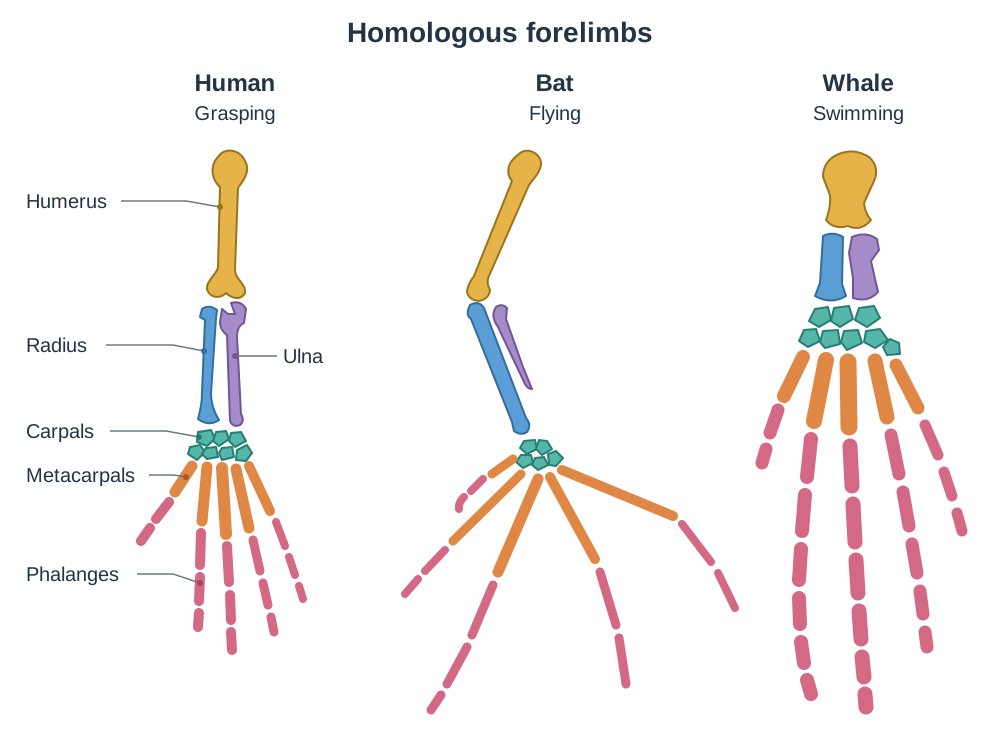
- Comparative Anatomy: Shared body designs point to shared ancestry. The classic example is the homologous structure of the pentadactyl limb found in vertebrates (such as humans, bats, whales, and horses). Across these species, the limbs perform entirely different functions—grasping, flying, swimming, or running. Yet all share the same basic arrangement: one upper bone (humerus), two lower bones (radius and ulna), wrist bones (carpals), hand bones (metacarpals), and digit bones (phalanges). In species like the horse, this basic pattern is modified down to one weight-bearing digit. The shared skeletal architecture demonstrates descent from a common ancestor.
- Comparative Embryology: Early vertebrate embryos (fish, amphibians, reptiles, birds, mammals) share structural characteristics, including a post-anal tail and pharyngeal pouches. In fish, these pouches develop into functioning gills; in mammals, they are remodelled during development into throat and middle ear structures, such as the Eustachian tube. Sharing these early developmental pathways shows a common evolutionary origin.
- Phylogeny and Molecular Biology: Phylogeny is the evolutionary history of a species or group. Comparing DNA sequences or amino acid sequences of shared proteins (such as cytochrome c or haemoglobin) provides direct evidence of relatedness. Species that diverged recently share a recent common ancestor and have accumulated very few sequence differences. Exam link (Technology): High-throughput DNA sequencing and bioinformatics now allow precise tracking of ancestry and classification.
- Antibiotic Resistance in Bacteria: This provides direct, observable proof of natural selection in real time. Exam link (Health): Spontaneous mutations confer resistance to an antibiotic before it is encountered. When an antibiotic is used, it acts as a strong selection pressure, wiping out susceptible bacteria. The resistant mutants survive, multiply rapidly by binary fission, and pass the resistance allele down, rendering treatments ineffective.
- Speciation: Speciation is the process by which one ancestral species splits into two or more distinct species. Exam link (Sustainability): Evolution by natural selection acts only on pre-existing variation. Understanding how populations diverge and adapt informs modern conservation efforts.
Speciation and How to Read Phylogenetic Trees
How One Species Becomes Two (Speciation)
Speciation occurs through a reliable sequence of events:
- Isolation: A population is split, most often by a geographical barrier like an ocean, river, or mountain range. Gene flow between the two groups stops.
- Different selection pressures: The two separated environments have different food sources, predators, and climates.
- Independent mutation and selection: Spontaneous mutations occur independently in each group, and natural selection favours different alleles in each environment.
- Genetic divergence: Over many generations, the two groups change noticeably in anatomy, physiology, and behaviour.
- Reproductive isolation: If the barrier disappears and the groups meet again, they can no longer interbreed to produce fertile offspring. They are now separate biological species.
Named example: Darwin's finches in the Galápagos Islands. Birds blown from the South American mainland colonised different islands. On islands with tough seeds, birds with deep, stout beaks survived best; on islands with nectar-producing flowers or insects in bark, birds with slender, sharp beaks were selected. The populations diverged until they became separate species.
Reading a Phylogenetic Tree
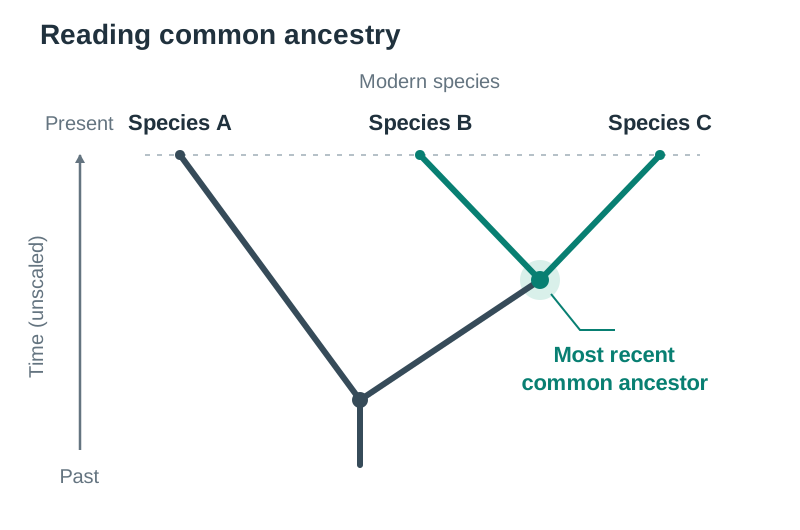
A phylogenetic tree is a branching diagram representing evolutionary relationships. Each branch point (node) marks the most recent common ancestor of the descendants that follow.
- Species that join at the most recent branch point are the most closely related.
- The tips of the branches represent modern species; distance across the page does not mean one organism is 'more advanced' than another.
- When comparing protein differences (such as cytochrome c differences compared to humans: chimpanzee = 0, horse = 12, tuna = 21, yeast = 44), the organism with the fewest differences shares the most recent common ancestor.
The Centrality of Evolution in Biology
Hypothesis vs Theory
In everyday language, 'theory' is often used casually to mean an unproven guess. In science, the terms have exact meanings:
- A hypothesis is a single testable statement proposed as an explanation for an observation, which an investigation can support or refute.
- A theory is a comprehensive, well-tested explanation supported by a vast body of confirmed hypotheses, verified observations, and experimental data.
A scientific theory is not a hunch waiting to be proven; it is the highest level of scientific explanation.
Why Evolution is the Unifying Concept of Biology
Evolution accounts for both the biochemical unity of life and its remarkable diversity. Because all living things share common ancestors, they use the same universal genetic code, depend on ATP as their energy carrier, and run the same core metabolic cycles (such as glycolysis). Because populations adapt to distinct environments over time, we see millions of different species.
Biologists apply evolutionary theory daily across several fields:
- Taxonomy and classification: Organisms are grouped according to evolutionary ancestry rather than superficial appearance. When DNA sequencing reveals that two species are more closely related than once thought, classification schemes are updated.
- Medicine and public health: Evolutionary principles explain why doctors avoid overprescribing antibiotics and insist patients finish their full course. Influenza and SARS-CoV-2 vaccines must be updated periodically because virus populations continue to evolve new surface antigens.
- Medical research: Scientists study yeast, fruit flies, and mice to understand human diseases because our shared ancestry means we share many similar (homologous) genes and the same core metabolic pathways.
- Agriculture: Weeds evolve resistance to herbicides and insect pests evolve resistance to pesticides via natural selection. Evolutionary thinking informs crop rotation schedules and refuges to slow resistance.
- Conservation: Natural selection can act only on existing variation. Conservation biologists work to preserve genetic variation within populations rather than just counting heads, ensuring species retain the capacity to adapt to environmental changes.
Balancing point for discussion questions: The theory of evolution explains how living things change, diversify, and adapt once life is established; it does not attempt to explain how the very first living cell originated from non-living chemicals.
Generalist Species vs Highly Specialised Organisms
Evolutionary theory helps us predict how organisms will handle environmental changes:
Generalist Species
Species with broad diets, flexible habitat requirements, and large amounts of genetic variation (such as rats, crows, or foxes) can adapt quickly when selection pressures change. They have high ecological resilience.
Highly Specialised Organisms
Species adapted to a very narrow niche (such as the giant panda feeding almost entirely on bamboo, or cheetahs with low genetic diversity from historical population bottlenecks) face elevated extinction risks. If their environment changes rapidly through habitat loss or climate change, there may be no individuals with the alleles needed to survive the new selection pressure.
Key terms
- Evolution
- The change in the characteristics (genetic make-up) of a population or species over many generations.
- Natural Selection
- The process whereby organisms with inherited variations best suited to their environment survive, reproduce, and pass their advantageous traits to their offspring.
- Adaptation
- An inherited characteristic that increases an organism's chance of surviving and reproducing in its environment.
- Selection Pressure
- Any environmental factor that affects which individuals in a population survive and reproduce.
- Fitness
- The ability of an organism to survive and reproduce in its environment, measured by the number of fertile offspring it leaves behind.
- Variation
- The differences in characteristics that exist between individuals of the same species.
- Inherited Variation
- Differences in traits controlled by genes that can be passed from parents to offspring.
- Acquired Variation
- Differences in characteristics that develop during an organism's lifetime due to environmental influences or learning, which cannot be inherited.
- Mutation
- A spontaneous, permanent change in the amount or structure of DNA.
- Gene Mutation
- A localised change in the nucleotide base sequence of a single gene.
- Chromosome Mutation
- A large change in the structure of a chromosome or a change in the total chromosome number.
- Mutagen
- An environmental agent that increases the rate of mutation.
- Artificial Selection
- The intentional breeding of organisms by humans across generations to select for specific desirable traits.
- Homologous Structures
- Anatomical structures in different species that share a common evolutionary origin and basic structural plan, even if they carry out different functions.
- Phylogeny
- The evolutionary history of a species or group, showing its genealogical relationships to other species.
- Speciation
- The evolutionary process by which separated populations diverge until they can no longer interbreed to produce fertile offspring.
- Scientific Theory
- A comprehensive, well-tested explanation of natural phenomena supported by a vast body of confirmed hypotheses and experimental evidence.
- Hypothesis
- A testable statement proposed as a tentative explanation for an observation, which an investigation can support or refute.
Check yourself
Name the two 19th-century naturalists who jointly presented the theory of evolution by natural selection.
Charles Darwin and Alfred Russel Wallace.
What is the difference between a gene mutation and a chromosome mutation?
A gene mutation is a localised change in the base sequence of a single gene, whereas a chromosome mutation is a large structural change in a chromosome or a change in the total chromosome number.
Name, from the shoulder outwards, the bones and groups of bones of the vertebrate pentadactyl limb.
Humerus; radius and ulna; carpals (wrist bones); metacarpals; phalanges (bones of the digits).
Why can natural selection act only on inherited variations rather than acquired variations?
Only inherited variations are coded in DNA and passed to offspring through gametes; acquired variations alter somatic body cells and cannot be inherited.
How does evolutionary theory explain why highly specialised species face high extinction risks?
Specialised species have narrow niches and low genetic variation, meaning they lack the varied alleles required to adapt when selection pressures shift rapidly.
What defines speciation in sexually reproducing organisms?
The divergence of separated populations until they are reproductively isolated and can no longer interbreed to produce fertile offspring.
Distinguish between a hypothesis and a scientific theory.
A hypothesis is a single testable proposed explanation; a theory is a broad, well-tested explanation supported by a large body of confirmed hypotheses and experimental evidence.
Give two examples of how biologists use the theory of evolution in practical applications.
Any two of: classifying organisms by evolutionary ancestry; managing antibiotic use to slow resistance; updating flu vaccines annually; choosing model organisms (like mice or yeast) for medical research; managing genetic diversity in endangered species.