Metabolism, Energy Carriers, and Metabolic Pathways
Metabolism is simply the sum of all chemical reactions taking place inside a living organism. In a cell, these reactions never run in total isolation. Instead, cells organise them into ordered sequences called metabolic pathways. In these pathways, the product of one enzyme-controlled step becomes the starting substrate for the very next step. If a genetic mutation prevents a cell from producing an enzyme along that sequence, the whole pathway grinds to a halt right before the missing step.
Every reaction in a cell falls into one of two distinct categories:
- Anabolism: reactions that assemble small, simple molecules into larger, complex ones. Anabolic reactions take in energy. Photosynthesis is our classic example: green plant cells absorb light energy to build glucose () from carbon dioxide and water.
- Catabolism: reactions that break down complex molecules into simpler pieces, releasing energy as bonds rearrange. Cellular respiration is our standard example: cells break down glucose to yield energy that fuels everyday cellular work.
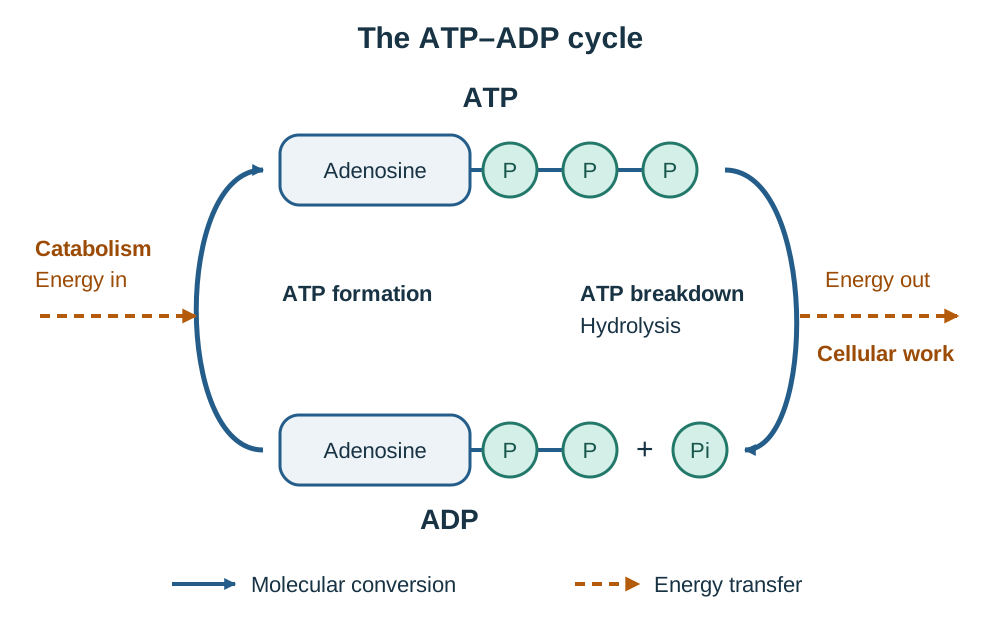
Cells cannot afford to let catabolic energy escape as a sudden burst of heat, which would destroy cell components. To manage this energy safely, cells rely on dedicated carrier molecules:
- ATP (adenosine triphosphate): the immediate energy currency of every living cell. When catabolic pathways break down fuel, the released energy attaches a third phosphate group onto adenosine diphosphate (ADP). Later, when the cell needs to pump ions, contract a muscle fibre, or assemble a protein, it breaks that terminal bond to release a controlled packet of energy.
- NAD+ and NADP+: electron and proton taxis. Catabolic reactions like glycolysis and the Krebs cycle transfer high-energy electrons and hydrogen ions to , forming . In contrast, works in anabolic reactions, particularly photosynthesis, where supplies the reducing power needed to fix carbon dioxide into sugar.